
Matematyka

Arystoteles na nowo odczytany. Ryszarda Kilvingtona
Elżbieta Jung
Książka jest efektem wieloletnich badań dotyczących historii nauki średniowiecznej, mianowicie początków fizyki matematycznej. Można w niej wyodrębnić dwie części: monografię, w której autorka odpowiada na pytanie, czy XIV-wieczna fizyka matematyczna, inspirowana nominalistyczną filozofią Wilhelma Ockhama, doprowadziła do zerwania z jakościową fizyką Arystotelesa już w wieku XIV, oraz – tłumaczenie Kwestii o ruchu Ryszarda Kilvingtona, jednego z twórców szkoły Oksfordzkich Kalkulatorów. Z pozycji nominalistycznej, z jednej strony odrzuca on dużą część podejmowanej przez Arystotelesa problematyki, z drugiej zaś, wypełniając obowiązki nauczycielskie na średniowiecznym uniwersytecie, poddaje teorie Stagiryty interpretacji pozwalającej odnaleźć w jego myśli elementy bliskie – jak się Kilvingtonowi wydaje – jego poglądom. W swoich kwestiach Kilvington podejmuje analizę zagadnienia zmian, rozumianych, zgodnie z definicją Arystotelesa, jako ruch przestrzenny, zmiany jakościowe oraz ilościowe w ujęciu nominalistycznym, czyniąc matematykę właściwym językiem opisu przyrody. Są one też rezultatem jego nauczania, czasami zapisu ćwiczeń odbywanych w klasie ze studentami, zatem tekst ten ma również walor historyczny, ponieważ pokazuje nam, jak wielkie wymagania stawiano studentom średniowiecznym i jak dobrze się z nich wywiązywali. Jakiego rodzaju były to „obliczenia” i jakie dzięki nim można osiągnąć rezultaty, Czytelnik dowie się z lektury książki.
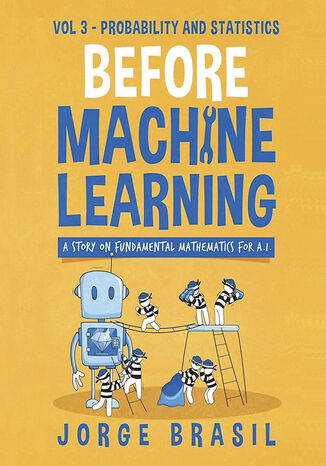
Jorge Brasil
Delve into the importance of probability and statistics in AI, beginning with fundamental measures like mean, median, and variance. This book takes you on a journey through the basics of probability theory, introducing key concepts such as central tendency, variance, and probability distributions. It emphasizes the role of statistical measures in understanding and analyzing data.Building on these foundations, the book explores hypothesis testing, Bayesian inference, and statistical distributions in-depth. Readers will gain practical insights into essential techniques for model evaluation, maximum likelihood estimation, and the interpretation of data in the context of AI applications. Each concept is illustrated with practical examples and case studies to ensure clarity and application.Finally, advanced topics like Markov processes, hierarchical Bayesian models, and multivariate distributions are introduced. The book addresses critical areas like variance, correlation, and hypothesis testing, equipping readers with the skills to tackle real-world challenges in AI and machine learning. Whether you're a student, professional, or AI enthusiast, this book offers the essential statistical tools and knowledge to excel in the field.
Yousri El Fattah, Reza Bagheri
This practical guide explores Bayesian networks, graphical models, and causal inference for probabilistic reasoning and treatment effect estimation using real-world data. You’ll learn Bayesian networks, conditional independence, structural causal models (SCM), and intervention-based reasoning for causal analysis. The book explains how graphical models support probabilistic inference, decision-making, and knowledge representation across healthcare, economics, epidemiology, finance, and social sciences.You’ll work with probabilistic inference methods such as variable elimination, tree clustering, and Bayesian network reasoning. For causal inference, the book covers Pearl’s do-calculus, backdoor and front-door criteria, causal effect identification, and treatment effect estimation using observational data. You’ll also explore the potential outcomes framework and machine learning approaches for causal inference, including meta-learners for estimating conditional average treatment effects and heterogeneous treatment effects.Practical examples and exercises in R and Python help reinforce concepts and build implementation skills for causal modeling workflows. By the end of the book, you’ll be able to design Bayesian network models, perform probabilistic and causal inference, and develop practical causal analysis applications for evidence-based decision-making.
Combinatorial point configurations and polytopes
Sergiy Yakovlev, Oksana Pichugina, Liudmyla Koliechkina
The monograph is dedicated to exploring combinatorial point configurations derived from mapping a set of combinatorial configurations into Euclidean space. Various methods for this mapping, along with the typology and properties of the resultant configurations, are presented. In addition, the study revolves around combinatorial polytopes defined as convex hulls of combinatorial point configurations. The primary focus lies in examining multipermutation and partial multipermutation point configurations alongside their associated combinatorial polytopes known as multipermutohedra and partial multipermutohedra. Our theoretical contributions are substantiated through the proof of theorems and supporting auxiliary statements. Examples and illustrations are included to enhance the comprehension of the material.

Lauren Mullennex, Nate Bachmeier, Jay Rao
Computer vision (CV) is a field of artificial intelligence that helps transform visual data into actionable insights to solve a wide range of business challenges. This book provides prescriptive guidance to anyone looking to learn how to approach CV problems for quickly building and deploying production-ready models.You’ll begin by exploring the applications of CV and the features of Amazon Rekognition and Amazon Lookout for Vision. The book will then walk you through real-world use cases such as identity verification, real-time video analysis, content moderation, and detecting manufacturing defects that’ll enable you to understand how to implement AWS AI/ML services. As you make progress, you'll also use Amazon SageMaker for data annotation, training, and deploying CV models. In the concluding chapters, you'll work with practical code examples, and discover best practices and design principles for scaling, reducing cost, improving the security posture, and mitigating bias of CV workloads.By the end of this AWS book, you'll be able to accelerate your business outcomes by building and implementing CV into your production environments with the help of AWS AI/ML services.

Continuity. Eleven sketches from the past of Mathematics
Jerzy Mioduszewski, tłum. Abe Shenitzer
The book was written in the eighties of the last century. Being encouraged by the editorial board of monthly Delta in the person of Professor Marek Kordos, the author’s first aim was a collection of essays about Peano maps, lakes of Wada, and several singularities of real functions. But it was the time when university duties stopped and the author could freely meditate whether this curious mathematics had its roots in the forgotten past. He remembered old authors who began their books with the words “already the ancient Greeks… .” The celebrated nineteenth century, the century of concepts, was preceded by the century of calculations. Going further back we can see Newton, but what and who was there before? Were the centuries between the Ancients and Newton a vacuum in mathematical sciences? Accidentally, the treatise De continuo by Thomas Bradwardine, the Archbishop of Canterbury, led the author into an unknown and strange world of medieval scholastic thought, showing to him the lost thread joining our times with Zeno, Aristotle and Democritus. However, to find this forgotten link a step should be taken beyond pure mathematical thinking. In this extended surrounding we can observe the unity of mathematical concepts being non-existent in the realm of pure mathematics.
Czy fizyka i matematyka to nauki humanistyczne?
Michał Heller, Stanisław Krajewski
Czy jest prawdziwe powiedzenie, że wszystkie nauki dzielą się na fizykę i zbieranie znaczków? W takim razie co z matematyką? Czy nauki ścisłe i humanistyka to organiczne części tej samej, ogólnoludzkiej kultury? Zarówno wśród „zwykłych” ludzi, jak i wśród osób zajmujących się pracą naukową dominuje przeciwstawianie nauk ścisłych, czyli przede wszystkim matematyki i fizyki, naukom humanistycznym. Czasem czyni się to wywyższając ścisłość nauk ścisłych, czasem wskazując na ich ograniczenia, niemożność uchwycenia prawdziwej, żywej złożoności, której nie mogą uchwycić struktury formalne. Tymczasem to przeciwstawienie nie jest absolutne: u źródeł podstawowych pojęć matematyki i fizyki są doświadczenia potoczne, odniesienia do człowieczej perspektywy postrzegania świata, próby jego spontanicznego modelowania, sądy wartościujące – jednym słowem takie zachowania, które można znaleźć również u podstaw nauk humanistycznych. Świat fizyczny jest niemiłosiernie logiczny i dlatego fizyka dopiero wtedy zaczęła odnosić sukcesy, gdy nauczyła się badać świat przy pomocy narzędzi matematycznych. Nie jest jednak pewne, czy obecnie rozwijane teorie matematyczne są najlepszymi możliwymi narzędziami potrzebnymi fizyce lub innym naukom, które chcą formułować prawa, a nie tylko „zbierać znaczki”. Stawiając w tym książkowym dwugłosie pytanie, czy fizyka i matematyka to nauki humanistyczne, nie zamierzamy tego pytania rozstrzygać do końca – odpowiedź na nie zależy od zbyt wielu osobistych i kulturowych preferencji – ale chcemy dać wyraz przekonaniu, że obydwie te dziedziny – nauki ścisłe i humanistyka – są organicznymi częściami tej samej, ogólnoludzkiej kultury. Bez którejkolwiek z nich nasza kultura byłaby płaska i zubożona. Żeby widzieć trójwymiarowo trzeba mieć dwoje oczu.

Czy można mnożyć pieniądze? Zdrowy rozsądek w nauczaniu matematyki
Danuta Zaremba
Przekonaj uczniów, że matma wcale nie musi być nudna i niezrozumiała! Poznaj sposoby skutecznego przekazywania wiedzy Naucz się wzbudzać zainteresowanie matematyką Dowiedz się, czego unikać na swoich lekcjach Matematyka jest najlepszym przykładem przedmiotu, który zupełnie niesłusznie ma opinię trudnego, nudnego i nieprzydatnego w codziennym życiu. Tę złą sławę zawdzięcza głównie przestarzałym metodom edukacyjnym, niepodzielnie panującym w większości polskich szkół, oraz nieinteresującym, z punktu widzenia uczniów, przykładom i zadaniom, które są zmuszeni rozwiązywać. Tymczasem matematyka to pasjonująca dziedzina, która znajduje zastosowanie dosłownie wszędzie i której zawdzięczamy rozwój wielu innych nauk i tysiące wynalazków technicznych. Wyjdź poza schemat i zerwij z tradycją złego nauczania matematyki! Dowiedz się, jak prowadzić interesujące lekcje i zachęcać uczniów do aktywności, poznaj sposoby, dzięki którym dostrzegą zastosowanie zdobytej wiedzy poza murami szkoły, i spraw, aby nauka stałą się dla nich prawdziwą przygodą. Zebrane w tej książce felietony pomogą Ci przygotowywać ciekawe zajęcia, zrozumieć młodych ludzi i wzbudzić w nich pasję do matematyki. Autorka dzieli się swoim bogatym doświadczeniem i nieszablonowym podejściem do tematu, a także pokazuje, jak w pracy nauczyciela stosować dobre praktyki i korzystać z przykładów, które uczą logicznego myślenia, zamiast powielać schematy. Pasja i pomysłowość Nauka przez zabawę Myślenie ponad schematy Nieszablonowe metody Obalanie starych mitów Radość ze zdobywania wiedzy Eksperymenty, które uczą Samodzielne wyciąganie wniosków Błędy jako okazja do nauki Zastosowanie wiedzy w praktyce Przykłady z życia wzięte Spraw, aby lekcje matematyki były niezapomnianą przygodą!