
Algorytmy
W publikacjach zawartych w kategorii Algorytmy znajdziecie cały szereg użytecznych informacji dotyczących algorytmów i związanych z nimi struktur danych.
Poznacie takie pojęcia jak rekurencja, analiza złożoności czy algorytmy sortowania i przeszukiwania oraz metody numeryczne. Nauczycie się stosować w praktyce techniki programowania typu dziel i rządź, algorytmy żarłoczne oraz metody przeszukiwania tekstów takie jak brute-force, Rabina i Karpa czy K-M-P. Dzięki książkom o strukturach i algorytmach szybko opanujecie metody optymalizacji, sposoby kodowania i kompresji danych. Dane te pozwolą Wam szybko i bezboleśnie opanować najlepsze techniki programowania.
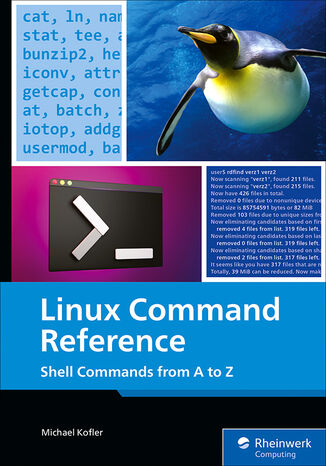
Linux Command Reference. Shell Commands from A to Z
Rheinwerk Publishing, Inc, Michael Kofler
This guide takes readers through the essentials of Linux commands, starting with basic commands and progressing to advanced techniques. The first few sections focus on foundational commands and their practical applications. As the book progresses, it introduces more complex concepts, including bash scripting, advanced command usage, and system management techniques. This ensures readers build a strong command-line proficiency step by step.The book’s structure is organized alphabetically from A to Z, making it easy to find and reference commands. It also covers important special bash characters and configuration files, essential for system administrators. Readers will also learn about efficient keyboard shortcuts that can enhance productivity when working in the terminal.By the end of the book, readers will be equipped with the tools to effectively manage Linux systems, automate tasks with scripts, and troubleshoot common issues. With this knowledge, users will gain confidence in navigating and optimizing their Linux environments.
Giuseppe Bonaccorso
In this book, you will learn all the important machine learning algorithms that are commonly used in the field of data science. These algorithms can be used for supervised as well as unsupervised learning, reinforcement learning, and semi-supervised learning. The algorithms that are covered in this book are linear regression, logistic regression, SVM, naïve Bayes, k-means, random forest, TensorFlow and feature engineering.In this book, you will how to use these algorithms to resolve your problems, and how they work. This book will also introduce you to natural language processing and recommendation systems, which help you to run multiple algorithms simultaneously.On completion of the book, you will know how to pick the right machine learning algorithm for clustering, classification, or regression for your problem
Hyatt Saleh
As machine learning algorithms become popular, new tools that optimize these algorithms are also developed. Machine Learning Fundamentals explains you how to use the syntax of scikit-learn. You'll study the difference between supervised and unsupervised models, as well as the importance of choosing the appropriate algorithm for each dataset. You'll apply unsupervised clustering algorithms over real-world datasets, to discover patterns and profiles, and explore the process to solve an unsupervised machine learning problem.The focus of the book then shifts to supervised learning algorithms. You'll learn to implement different supervised algorithms and develop neural network structures using the scikit-learn package. You'll also learn how to perform coherent result analysis to improve the performance of the algorithm by tuning hyperparameters.By the end of this book, you will have gain all the skills required to start programming machine learning algorithms.
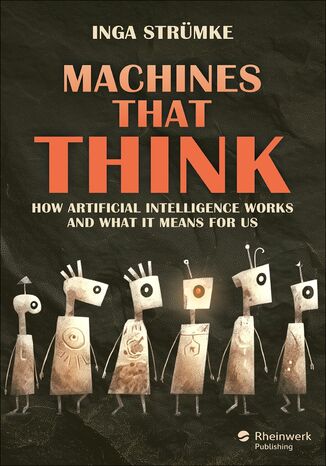
Machines That Think. How Artificial Intelligence Works and What It Means for Us
Rheinwerk Publishing, Inc, Inga Strümke
Machines That Think explores the evolution of artificial intelligence (AI), from its roots in early theoretical frameworks to modern machine learning technologies. It begins by diving into the history of AI, featuring the foundational contributions of pioneers like Alan Turing and John von Neumann. The book then examines the attempts to make machines intelligent, covering symbolic AI, expert systems, and the rise of neural networks. With a focus on the technological advancements that shaped AI, this book provides readers with a deep understanding of how AI systems have evolved over time.The book continues by addressing the growing importance of data in AI systems. It explores how data shapes machine learning models and the inherent challenges faced by data scientists when gathering and processing data for AI applications. The impact of data on model accuracy and the ethical dilemmas surrounding its collection and usage are also discussed. In the final chapters, the book delves into the ethical and societal implications of AI, exploring issues such as privacy, accountability, and the future of AI in everyday life. It speculates on the future of artificial general intelligence (AGI) and superintelligence, contemplating the potential consequences of these technologies.
Siddharth Shekar, Wajahat Karim
Game engines such as Unity are the power-tools behind the games we know and love. Unity is one of the most widely-used and best loved packages for game development and is used by everyone, from hobbyists to large studios, to create games and interactive experiences for the Web, desktop, mobile, and console. With Unity's intuitive, easy-to-learn toolset and this book, it's never been easier to become a game developer.You will begin with the basic concepts of Android game development, a brief history of Android games, the building blocks of Android games in Unity 5, and the basic flow of games. You will configure an empty project for the Jetpack Joyride Clone Game, add an environment and characters, and control them. Next you will walk through topics such as particle systems, camera management, prefabs, animations, triggers, colliders, and basic GUI systems. You will then cover the basic setup for 3D action fighting games, importing models, textures and controlling them with a virtual on-screen joystick. Later you will set up Scene for 3D Configuration, create basic gameplays, and manage input controls. Next you will learn to create the interface for the main menu, gameplay, game over, achievements, and high score screens. Finally you will polish your game with stats, sounds, and Social Networking, followed by testing the game on Android devices and then publishing it on Google Play, Amazon, and OUYA Stores.
Anatolii Kmetiuk
Functional programming is a paradigm specifically designed to deal with the complexity of software development in large projects. It helps developers to keep track of the interdependencies in the code base and changes in its state in runtime. Mastering Functional Programming provides detailed coverage of how to apply the right abstractions to reduce code complexity, so that it is easy to read and understand.Complete with explanations of essential concepts, practical examples, and self-assessment questions, the book begins by covering the basics such as what lambdas are and how to write declarative code with the help of functions. It then moves on to concepts such as pure functions and type classes, the problems they aim to solve, and how to use them in real-world scenarios. You’ll also explore some of the more advanced patterns in the world of functional programming such as monad transformers and Tagless Final. In the concluding chapters, you’ll be introduced to the actor model, which you can implement in modern functional languages, and delve into parallel programming.By the end of the book, you will be able to apply the concepts of functional programming and object-oriented programming (OOP)in order to build robust applications.
Cory Lesmeister
Given the growing popularity of the R-zerocost statistical programming environment, there has never been a better time to start applying ML to your data. This book will teach you advanced techniques in ML ,using? the latest code in R 3.5. You will delve into various complex features of supervised learning, unsupervised learning, and reinforcement learning algorithms to design efficient and powerful ML models. This newly updated edition is packed with fresh examples covering a range of tasks from different domains. Mastering Machine Learning with R starts by showing you how to quickly manipulate data and prepare it for analysis. You will explore simple and complex models and understand how to compare them. You’ll also learn to use the latest library support, such as TensorFlow and Keras-R, for performing advanced computations. Additionally, you’ll explore complex topics, such as natural language processing (NLP), time series analysis, and clustering, which will further refine your skills in developing applications. Each chapter will help you implement advanced ML algorithms using real-world examples. You’ll even be introduced to reinforcement learning, along with its various use cases and models. In the concluding chapters, you’ll get a glimpse into how some of these blackbox models can be diagnosed and understood. By the end of this book, you’ll be equipped with the skills to deploy ML techniques in your own projects or at work.
Alvaro Fuentes
Python is a programming language that provides a wide range of features that can be used in the field of data science. Mastering Predictive Analytics with scikit-learn and TensorFlow covers various implementations of ensemble methods, how they are used with real-world datasets, and how they improve prediction accuracy in classification and regression problems.This book starts with ensemble methods and their features. You will see that scikit-learn provides tools for choosing hyperparameters for models. As you make your way through the book, you will cover the nitty-gritty of predictive analytics and explore its features and characteristics. You will also be introduced to artificial neural networks and TensorFlow, and how it is used to create neural networks. In the final chapter, you will explore factors such as computational power, along with improvement methods and software enhancements for efficient predictive analytics.By the end of this book, you will be well-versed in using deep neural networks to solve common problems in big data analysis.