
E-prasa
Text Matters: A Journal of Literature, Theory and Culture, No. 5 (2015)
Jadwiga Maszewska
The aim of the main sections of issue 5 (2015), edited by Jadwiga Maszewska, is to draw attention to the growing significance of collecting, archiving, and publishing. As Jeremy Braddock argues in Collecting as Modernist Practice, the material collection and the anthology should both be considered as an "authored work," and, following Bourdieu, a "system of positions." The history of collecting and publishing in the 20th century-"from Peggy Guggenheim to the Harry Ransom Center in Austin, TX"-illustrates a widespread development and framing of how literary and cultural materials are received. Publishers, editors, librarians, and curators have all played a fundamental role in authoring and shaping the reception, preservation, and influence of textual and cultural objects. Thus, the fifth issue of Text Matters is organized, for the most part, around the themes of collecting, anthologizing, and publishing in the context of North American literature and cultural practice, with special emphasis on the visual arts. Among the topics addressed are actual sites and institutions, such as the Yiddish Book Center in Amherst, Massachusetts, or the Toronto-based Coach House Press; archival practices, e.g. the problem of preserving works created in the ephemeral digital media; the anthologizing impulse, for instance in the wake of tragedies such as 9/11; and literary representations or figures of the archive, e.g. in post-apocalyptic fiction. The special section entitled "Exhibitions" concerns artistic practices variously connected to the city of Łódź, the journal's home, and includes discussions of works by Mieke Bal and Michelle Williams Gamaker. The final section involves conversations with influential translation theorist Sherry Simon and foremost Polish Americanist Agnieszka Salska.
Text Matters: A Journal of Literature, Theory and Culture, No. 6 (2016)
Agnieszka Soltysik Monnet
Issue 6 of Text Matters, entitled Gothic Matters and edited by Professor Agnieszka Soltysik Monnet (University of Lausanne), is a collection of essays that explore the relevance of the Gothic genre (and Gothic studies as such) in the first decades of the 21st century. Apart from the informative editorial, the main section contains thirteen scholarly texts that address topics as diverse as the reading of The Monk by M. G. Lewis and Mary Shelley's Frankenstein through the lens of the French Revolution, the EcoGothic analysis of Margaret Fuller's Summer on the Lakes, the notion of Imperial Gothic, the filmic representations of (dismembered) hands, the Gothic in postcolonial writing in the Philippines and the American pastoral tradition, the close ties between the Gothic, globalization and economic crisis (as aptly illustrated by Cormac McCarthy's The Road, as well as two films: Take Shelter and Winter's Bone), gender and genre hybridity in the Supernatural series, vampires (in American Indian myths and in Jim Jarmusch's Only Lovers Left Alive), and, finally, the juxtaposition of zombies with the Big Pharma. The volume also includes three texts gathered in the section appropriately named Intersections. They discuss the images of Trebizond and the Pontos in contemporary literature in English, allusions to Henryk Sienkiewicz's short story "The Lighthouse Keeper of Aspinwall" in "Through the Panama" by Malcolm Lowry, and liminality in Tony Harrison's poetry. The concluding section consists of three reviews (of Ann Radcliffe, Romanticism and the Gothic, edited by Dale Townshend and Angela Wright; Charles I. Armstrong's Reframing Yeats: Genre, Allusion and History; and Anna Pochmara's The Making of the New Negro: Black Authorship, Masculinity, and Sexuality in the Harlem Renaissance) and two interviews (with Bill Gaston and Uilleam Blacker).
Text Matters: A Journal of Literature, Theory and Culture, No. 7 (2017)
Andrzej Wicher, Rachel E. Burke
Issue 7 (2017) of Text Matters opens with an exclusive conversation between Mieke Bal, a cultural theorist, critic, and video artist, and Dorota Filipczak, the journal's editor-in-chief. It is followed by a special section entitled "Emma and Edvard" (edited by Rachel E. Burke) that includes seven scholarly texts revolving thematically around Emma and Edvard: Love in the Time of Loneliness, an exhibition curated by Mieke Bal that opened in Munchmuseet, Oslo, on 27 January 2017. The articles explore the intersections between the works of Gustave Flaubert, Edvard Munch, Henrik Ibsen, and Charlotte Salomon, among others. The volume continues with an extensive section named "Drama, Performance, Media" (edited by Andrzej Wicher). Its main points of focus are reflected by the titles of its three subsections: "Shakespeare in New Configurations," "The Importance of Performative Aspects of Drama," and "Experimental Mimesis in Modern British and Irish Drama." The first of them presents selected aspects of Shakespearean studies: the distribution of gender roles in The Tempest, the (mis)representation of fairies in Shakespeare's oeuvre, the political implications of a Shakespearean theatre festival organized in a post-war Poland, as well as affinities between the Bard of Avon and Stanisław Wyspiański. The second one discusses Dickensian musicals on stage and screen, the importance of translation in contemporary opera productions, recreational drama classes for the elderly in the UK, and the concept of contagion in the theatrical context. The third one deals with Edward Bond's theories of drama, Caryl Churchill's plays, the employment of diegetic and narrative forms in modern Anglophone drama, and, finally, the works of Sam Shepard and Harold Pinter. The volume concludes with a short section, "Traditional Epic Patterns Seen in the Perspective of Modernity," which contains two texts (on the portrayal of Eowyn in Tolkien's The Lord of the Rings and on Lloyd Jones's novel, Mister Pip).
Text Matters: A Journal of Literature, Theory and Culture, No. 8 (2018)
Wit Pietrzak
Issue 8 (2018) of Text Matters is a collection of texts on diverse topics within literary and cultural studies, focusing on Ireland and including the literary explorations of American and Canadian identities. The main section, "Engaging Ireland: History, Politics and Aesthetics," edited by Wit Pietrzak, features essays critically examining Irish history and culture through literary analysis. Among the articles in this section, we can find the analysis of Kevin McCarthy's Peeler as a post revisionist novel, a re-evaluation of George Moore's role in the Gaelic Revival, as well as articles on Colm Tóibin's Brooklyn, Jamie O'Neill's At Swim, Two Boys, Michael Longley's poetry, the connection between gender issues, Irish poetry, and the Troubles, Frank Ormsby's poems on war and soldiers in A Northern Spring, Samuel Beckett's oeuvre, the Charabanc collective's Somewhere over the Balcony, and the coverage of the Irish Famine in the American press. The "Continuities" section concentrates on the portrayal of Jews in Chester Mystery Cycle plays, Alan Spence's play No Nothing, and the construction of otherness in modern sci-fi cinema. Articles in "Engaging American Identities" concern the artistic connection between Hart Crane and David Siqueiros, the General Council of the Chippewa's governance structure blending traditional and American systems, the representation of oppressive whiteness in Walter Mosley's Devil in a Blue Dress, the political potential of parataxis and Ron Silliman's New Sentence in disrupting conventional narratives, the perpetuation of white male supremacy through economic exploitation of black domestics as seen in V. F. Durr's memoirs, Laila Lalami's novel The Moor's Account, the literary experience of childhood and nostalgia, Josefina Niggli's Mexican Village exploring Mexican culture and border narratives through folklore, the concept of simulacrum in American art and photography, and the notion of hyperreality and the antihero in Joseph Heller's Catch-22. Finally, the "Canadiana" part discusses the works of Timothy Findley and Audrey Thomas. The issue concludes with three reviews (of John Berryman's Public Vision by Philip Coleman; Barry Shiels's W. B. Yeats and World Literature: The Subject of Poetry; and Stewart Parker's Hopdance), as well as Jadwiga Uchman's interview with Jan Jędrzejewski.
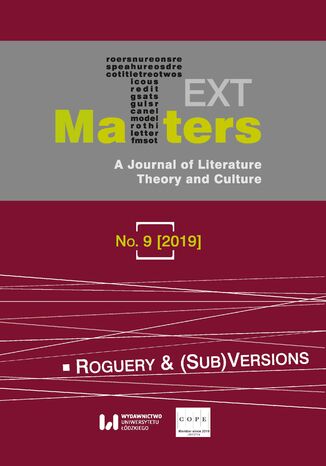
Text Matters: A Journal of Literature, Theory and Culture, No. 9 (2019)
Aritha van Herk, Vanja Polić
Issue 9 (2019) of Text Matters, titled Roguery and (Sub)Versions, edited by Aritha van Herk (University of Calgary) and Vanja Polić (University of Zagreb), focuses on the figure of the new rogue as a personification of subversion in literature and film. Roguery is understood here both as a feature of characters who break up societal conformity through their creativity, and of texts which embrace liminality and defy discursive boundaries. These visions of roguery are addressed by the volume's first section, "New Versions of Roguery," which contains papers dealing with Bruce Chatwin's rogue appropriation of the concept of songlines, the representation of women manipulating others through wealth, the rogue protagonist of the film Monster, mobility in the road movies Scorpio Rising and Duel as well as fiction by Guy Vanderhaeghe, the self-fashioning rogue in a short story by Aleksandar Hemon and in Ned Buntline's fiction, rogue textuality in comics, a subversion of roguery in Patrick deWitt's novel, and roguery understood as disappearance. The second section, "(Sub)Versions and (Re)Visions," builds on the rogue's subversive potential, and includes papers on the figure of Mary Magdalene in Michele Roberts's book, the figure of the heretic in the secular age, life writing by Joe Brainard, the Irish noir by Lisa McInerney, and the hardboiled fiction of Ross Macdonald. The following section called "Negotiating Traumas" contains essays that discuss the ability of performance art to heal trauma, the figure of the trickster in Leslie Marmon Silko's novel, as well as trauma in hag horror. Finally, "Liminal Spaces" includes papers focusing on the environmental disaster in the poetry of Robert Minhinnick, spatial representations in J. G. Ballard's novel, a Virilian reading of Don DeLillo, and the development of American improvisational theatre. The volume ends with reviews of works by Sam Solnick and Bret Easton Ellis.
TOP 10 Kadry i ubezpieczenia - kwiecień 2022
Katarzyna Dorociak, Andrzej Lazarowicz, Katarzyna Tokarczyk, Zespół...
Seria TOP 10 to przegląd najpopularniejszych tematów, które zaciekawiły czytelników w kwietniu 2022 roku. Publikacja zawiera pozycje o tematyce kadrowej oraz ubezpieczeniowej. Podczas lektury znajdą Państwo między innymi odpowiedzi na pytania: Kiedy i w jakiej formie złożyć wypowiedzenie o pracę? Kto i kiedy ma prawo do trzymiesięcznej odprawy? Czy praca w gospodarstwie rolnym zalicza się do stażu pracy? Jakie są konsekwencje naruszenia doby pracowniczej? Artykuły zostały przygotowane przez ekspertów z zakresu prawa pracy, kadr oraz ubezpieczeń. Są doskonałym wsparciem merytorycznym nie tylko dla osób prowadzących działalność gospodarczą, ale również dla specjalistów z obszaru kadr.

TOP 10 Księgowość i podatki - kwiecień 2022
Angelika Borowska, Andrzej Lazarowicz, Ewa Szpytko-Waszczyszyn, Zespół...
Seria TOP 10 to przegląd najpopularniejszych tematów, które zaciekawiły czytelników w kwietniu 2022 roku. Publikacja zawiera pozycje o tematyce księgowej oraz podatkowej. Podczas lektury znajdą Państwo między innymi odpowiedzi na pytania: Czy brak podpisu na fakturze jest błędem? Co zrobić, gdy nie zostanie wydrukowany raport dobowy? Czy usługi hotelowe mogą stanowić koszt firmowy? Jakie są konsekwencje podatkowe wystawiania pustych faktur? Artykuły zostały przygotowane przez ekspertów z zakresu prawa podatkowego oraz księgowości. Są doskonałym wsparciem merytorycznym nie tylko dla osób prowadzących działalność gospodarczą, ale również dla specjalistów z obszaru księgowości.
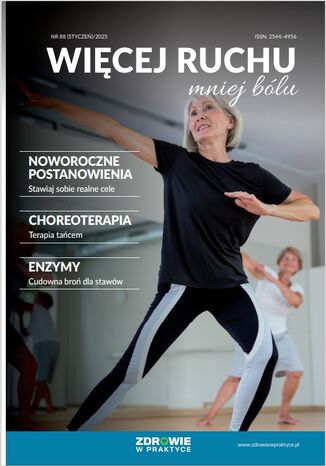
Więcej ruchu mniej bólu 88 (styczeń)/2025
2544-4956
Kto z nas nie robił noworocznych postanowień? Schudnę po świętach, będę się zdrowiej odżywiać, codziennie 15 minut gimnastyki itp. A kto wytrwał dłużej niż tydzień? Niewielu...Często po takim fi nale realizacji naszych zamierzeń zostajemy z poczuciem braku motywacji, zwątpieniem i rozczarowaniem, że jednak i w tym roku się nie udało. Dlaczego tak się dzieje? Co zrobić, by styczeń 2025 był początkiem zdrowych zmian w naszym życiu?