
Bazy danych
Miguel Angel Garcia, Barry Harmsen
Business Intelligence technologies are a must-have in every business to make informed decisions and keep up-to speed with the ever-evolving markets. QlikView's disruptive technology makes it a key player and leader in the industry; with its flexibility and powerful analytics environment, building QlikView apps can be mastered by both, business users as well as developers.This book will help you learn QlikView Development from a basic to a practitioner level using a step-by-step approach in a practical environment, and apply proven best practices on each topic.Throughout the book, we will build a QlikView app based on real data about Airline Operations that will help HighCloud Airlines make informed business decisions and analysis-guided strategies. HighCloud Airlines executives are evaluating if entering the US market is a good strategy and, if so, which line of business should they focus their investments on; they need QlikView to make the best decision.The application will be evolving chapter by chapter, along with your skills, going from a simple proof of concept to creating a Data Model, adding a custom style, building a Dashboard and handling and manipulating the source data via script. We will meet the HighCloud Airlines requirement by using many different data visualization objects and time-saving techniques.The whole application uses real data taken from the Bureau of Transportations statistics of the US and encompasses the operations of Airlines both domestic and international. With three years worth of data, you will help HighCloud Airlines discover where people travel the most, which are the Carriers with the most market share, what is the average load factor per airline, which aircraft is the most used to perform flights, which are the busiest airports, and a whole universe of new insights.
Chandraish Sinha
This guide demonstrates just how easy it is to get started with QlikView and create your own BI application. Featuring an introduction to its core features before exploring how to load data and model it, you’ll soon become more confident that you can take full advantage of QlikView’s capabilities.. You will also learn how to use QVD files with QlikView – and how they offer a simpler way of handling data.After digging deeper into data handling, as you learn how to use mapping tables and create a master calendar, you’ll then find out how to get the most from QlikView’s visualization features – vital if you are to use your data insights effectively. From accessible and user friendly dashboards to strategies and best practices for subjecting data to further analysis, you can be confident that you’ll be prepared to get the most out of your data with QlikView.With details on how to finally secure your application and deploy it for a successful integration in your organization, QlikView Essentials underlines exactly why QlikView is becoming more and more popular for businesses that understand the value of data.
Qlikview Unlocked. Unlock more than 50 amazing tips and tricks to enhance your QlikView skills
Roger Stone, Andrew Dove
QlikView Unlocked will provide you with new insights to get the very best from QlikView. This book will help you to develop skills to work with data efficiently. We will cover all the secrets of unleashing the full power of QlikView, which will enable you to make better use of the tool and create better results for future projects. In the course of this book, we will walk you through techniques and best practices that will enable you to be more productive. You will gain quick insights into the tool with the help of short steps called ”keys,” which will help you discover new features of QlikView. Moving on you will learn new techniques for data visualization, scripting, data modeling, and more. This book will then cover best practices to help you establish an efficient system with improved performance. We will also teach you some tricks that will help you speed up development processes, monitor data with dashboards, and so on.By the end of this book, you will have gained beneficial tips, tricks, and techniques to enhance the overall experience of working with QlikView.
R: Data Analysis and Visualization. Master the art of building analytical models using R
Tony Fischetti, Brett Lantz, Hrishi V. Mittal,...
The R learning path created for you has five connected modules, which are a mini-course in their own right. As you complete each one, you'll have gained key skills and be ready for the material in the next module!This course begins by looking at the Data Analysis with R module. This will help you navigate the R environment. You'll gain a thorough understanding of statistical reasoning and sampling. Finally, you'll be able to put best practices into effect to make your job easier and facilitate reproducibility.The second place to explore is R Graphs, which will help you leverage powerful default R graphics and utilize advanced graphics systems such as lattice and ggplot2, the grammar of graphics. You'll learn how to produce, customize, and publish advanced visualizations using this popular and powerful framework.With the third module, Learning Data Mining with R, you will learn how to manipulate data with R using code snippets and be introduced to mining frequent patterns, association, and correlations while working with R programs.The Mastering R for Quantitative Finance module pragmatically introduces both the quantitative finance concepts and their modeling in R, enabling you to build a tailor-made trading system on your own. By the end of the module, you will be well-versed with various financial techniques using R and will be able to place good bets while making financial decisions.Finally, we'll look at the Machine Learning with R module. With this module, you'll discover all the analytical tools you need to gain insights from complex data and learn how to choose the correct algorithm for your specific needs. You'll also learn to apply machine learning methods to deal with common tasks, including classification, prediction, forecasting, and so on.
Prabhanjan Narayanachar Tattar, Yu-Wei, Chiu (David Chiu)
This cookbook offers a range of data analysis samples in simple and straightforward R code, providing step-by-step resources and time-saving methods to help you solve data problems efficiently.The first section deals with how to create R functions to avoid the unnecessary duplication of code. You will learn how to prepare, process, and perform sophisticated ETL for heterogeneous data sources with R packages. An example of data manipulation is provided, illustrating how to use the “dplyr” and “data.table” packages to efficiently process larger data structures. We also focus on “ggplot2” and show you how to create advanced figures for data exploration.In addition, you will learn how to build an interactive report using the “ggvis” package. Later chapters offer insight into time series analysis on financial data, while there is detailed information on the hot topic of machine learning, including data classification, regression, clustering, association rule mining, and dimension reduction.By the end of this book, you will understand how to resolve issues and will be able to comfortably offer solutions to problems encountered while performing data analysis.
Raghav Bali
Data science and machine learning are some of the top buzzwords in the technical world today. From retail stores to Fortune 500 companies, everyone is working hard to making machine learning give them data-driven insights to grow their business. With powerful data manipulation features, machine learning packages, and an active developer community, R empowers users to build sophisticated machine learning systems to solve real-world data problems.This book takes you on a data-driven journey that starts with the very basics of R and machine learning and gradually builds upon the concepts to work on projects that tackle real-world problems.You’ll begin by getting an understanding of the core concepts and definitions required to appreciate machine learning algorithms and concepts. Building upon the basics, you will then work on three different projects to apply the concepts of machine learning, following current trends and cover major algorithms as well as popular R packages in detail. These projects have been neatly divided into six different chapters covering the worlds of e-commerce, finance, and social-media, which are at the very core of this data-driven revolution. Each of the projects will help you to understand, explore, visualize, and derive insights depending upon the domain and algorithms.Through this book, you will learn to apply the concepts of machine learning to deal with data-related problems and solve them using the powerful yet simple language, R.
R: Mining spatial, text, web, and social media data. Create and customize data mining algorithms
Richard Heimann, Nathan H. Danneman, Pradeepta Mishra,...
Data mining is the first step to understanding data and making sense of heaps of data. Properly mined data forms the basis of all data analysis and computing performed on it. This learning path will take you from the very basics of data mining to advanced data mining techniques, and will end up with a specialized branch of data mining—social media mining.You will learn how to manipulate data with R using code snippets and how to mine frequent patterns, association, and correlation while working with R programs. You will discover how to write code for various predication models, stream data, and time-series data. You will also be introduced to solutions written in R based on R Hadoop projects. Now that you are comfortable with data mining with R, you will move on to implementing your knowledge with the help of end-to-end data mining projects. You will learn how to apply different mining concepts to various statistical and data applications in a wide range of fields. At this stage, you will be able to complete complex data mining cases and handle any issues you might encounter during projects.After this, you will gain hands-on experience of generating insights from social media data. You will get detailed instructions on how to obtain, process, and analyze a variety of socially-generated data while providing a theoretical background to accurately interpret your findings. You will be shown R code and examples of data that can be used as a springboard as you get the chance to undertake your own analyses of business, social, or political data.This Learning Path combines some of the best that Packt has to offer in one complete, curated package. It includes content from the following Packt products:? Learning Data Mining with R by Bater Makhabel ? R Data Mining Blueprints by Pradeepta Mishra? Social Media Mining with R by Nathan Danneman and Richard Heimann
Raportowanie w System Center Configuration Manager Bez tajemnic
Garth Jones, Dan Toll, Kerrie Meyler
Baza danych SQL Server programu Microsoft System Center Configuration Manager (ConfigMgr) zawiera wiele cennych informacji na temat Twoich użytkowników, komputerów, sprzętu, systemów operacyjnych, aplikacji czy stanu zgodności. Aby umożliwić Ci efektywne wyodrębnianie tych danych, Microsoft dostarczył kilku doskonałych narzędzi, wliczając w to usługi raportowania SQL Server Reporting Services (SSRS) i dodatek SQL Server Data Tools Business Intelligence (SSDT-BI). Podręcznik Raportowanie w System Center Configuration Manager bez tajemnic pokaże Ci, w jaki sposób możesz wykorzystać maksymalny potencjał tych narzędzi. Światowej sławy guru raportowania, Garth Jones, wraz z będącymi ekspertami współautorami tego przewodnika poprowadzi Cię przez wszystkie aspekty niestandardowego raportowania w System Center. Poczynając od instalacji i konfiguracji usług SSRS, krok po kroku nauczysz się wykorzystywać widoki języka SQL do wyszukiwania potrzebnych Ci danych, budować zapytania SQL, tworzyć proste i zaawansowane raporty, a także wykorzystywać administrację opartą na rolach do bezpiecznego dostarczania tych raportów właściwym osobom. W książce tej Jones zebrał aktualne, niezawodne i wszechstronne techniki raportowania w System Center, których na próżno szukać w innych podręcznikach i witrynach internetowych. Korzystając z tego przewodnika będziesz w stanie konsekwentnie pozyskiwać właściwe informacje, które pozwolą Ci rozwiązywać palące problemy i szybko reagować na ewentualne obawy zarządu. Garth Jones, główny architekt w Enhansoft i Microsoft MVP, specjalizuje się w poszerzaniu wartości i znaczenia programu System Center Configuration Manager. Z rodziną produktów System Center pracuje od roku 1996, kiedy to występowała jeszcze pod nazwą SMS. Dan Toll jest administratorem programu Configuration Manager, z którym pracuje od wersji SMS 2003. Specjalizuje się we wdrożeniach systemów operacyjnych dla stacji roboczych i serwerów przy użyciu narzędzi Microsoft Deployment Toolkit (MDT) oraz w raportowaniu w programie ConfigMgr. Kerrie Meyler, Microsoft MVP, jest wiodącą autorką wielu książek z serii System Center Unleashed. Obecnie pracuje jako niezależny konsultant. W czasie trwającej ponad 17 lat kariery zawodowej ewangelizowała produkt SMS na stanowisku starszego specjalisty technologii w Microsoft i prezentowała technologie System Center na konferencjach TechEd i MMS. Szczegółowe informacje na temat Instalowania i konfigurowania usług SSRS pod kątem optymalnego raportowania w System Center i łatwiej-szego rozwiązywania problemów Danych przechowywanych w bazie lokacji programu ConfigMgr Wydajnego pozyskiwania danych programu ConfigMgr poprzez tworzenie zapytań SQL z poziomu SQL Server Management Studio Najlepszych praktyk w zakresie tworzenia i projektowania raportów w System Center Tworzenia szablonów raportów, dostosowywania treści z użyciem parametrów raportów oraz zagnieżdżania wykresów Dostosowywania logo, palet kolorów i pozostałych elementów raportów na potrzeby konkretnej organizacji Konstruowania zaawansowanych metod przeglądania szczegółowego w celu dostarczenia dodatkowych informacji Wzmacniania zabezpieczeń raportów poprzez integrowanie administracji programu ConfigMgr opartej na rolach w zapytaniach SQL Wykorzystywania raportowania do pomiaru kluczowych wskaźników wydajności i pogłębiania wiedzy na temat własnego środowiska Dostosowywania raportów do potrzeb użytkowników końcowych lub zarządu W SIECI: Wszystkie zaprezentowane w tej książce przykłady i skrypty dostępne są do pobrania na stronie informit.com/title/9780672337789
Piotr J Kula
This is an engaging, easy to follow guide for developing a wide range of server projects with Raspberry Pi. This book is targeted towards all Raspberry Pi enthusiasts who are interested in exploring the potential of Pi as a server. Even if you have no prior experience with the Raspberry Pi, you can pick up this book and develop a wide range of projects.
Bruce M. Van Horn II
As a software developer, you need to learn new languages and simultaneously get familiarized with the programming paradigms and methods of leveraging patterns, as both a communications tool and an advantage when designing well-written, easy-to-maintain code. Design patterns, being a collection of best practices, provide the necessary wisdom to help you overcome common sets of challenges in object-oriented design and programming.This practical guide to design patterns helps C# developers put their programming knowledge to work. The book takes a hands-on approach to introducing patterns and anti-patterns, elaborating on 14 patterns along with their real-world implementations. Throughout the book, you'll understand the implementation of each pattern, as well as find out how to successfully implement those patterns in C# code within the context of a real-world project.By the end of this design patterns book, you’ll be able to recognize situations that tempt you to reinvent the wheel, and quickly avoid the time and cost associated with solving common and well-understood problems with battle-tested design patterns.
Adnan Masood, Ed Price, Dr. Ehsan Adeli,...
Responsible AI in the Enterprise is a comprehensive guide to implementing ethical, transparent, and compliant AI systems in an organization. With a focus on understanding key concepts of machine learning models, this book equips you with techniques and algorithms to tackle complex issues such as bias, fairness, and model governance. Throughout the book, you’ll gain an understanding of FairLearn and InterpretML, along with Google What-If Tool, ML Fairness Gym, IBM AI 360 Fairness tool, and Aequitas. You’ll uncover various aspects of responsible AI, including model interpretability, monitoring and management of model drift, and compliance recommendations. You’ll gain practical insights into using AI governance tools to ensure fairness, bias mitigation, explainability, privacy compliance, and privacy in an enterprise setting. Additionally, you’ll explore interpretability toolkits and fairness measures offered by major cloud AI providers like IBM, Amazon, Google, and Microsoft, while discovering how to use FairLearn for fairness assessment and bias mitigation. You’ll also learn to build explainable models using global and local feature summary, local surrogate model, Shapley values, anchors, and counterfactual explanations.By the end of this book, you’ll be well-equipped with tools and techniques to create transparent and accountable machine learning models.
red. Antoni Barciak, Dorota Drzewiecka, Katarzyna Pepłowska
Książka omawia trudny proces jakim jest wdrażanie systemów EZD w działalności jednostek organizacyjnych w kontekście informatyzacji państwa. W literaturze naukowej coraz więcej miejsca poświęca się tematyce projektowania i wdrażania systemów do elektronicznego zarządzania dokumentacją. Niestety zbyt mało mówi się o udziale archiwistów, często można odnieść wrażanie, że są oni pomijani w tym ważnym procesie. Z drugiej strony, należy przypomnieć, że wiedza, którą dysponują archiwiści w wielu kwestiach związanych z zarządzaniem dokumentacją pozwoliłaby uniknąć licznych problemów występujących w praktyce. Niniejsza książka wypełnią tę lukę, bowiem koncentruje się na doświadczeniach archiwów i ich roli w procesie wdrażania EZD. Książka jest szerokim spojrzeniem na działalność archiwów. Jest adresowana archiwistom, pracownikom jednostek organizacyjnych, dysponentom oraz studentom. Zawiera w sobie praktyczne wyjaśnienie procesów wdrażania EZD dzięki czemu może stanowić cenne źródło wiedzy dla wszystkich, którzy obecnie zmagają z problemem EZD.
Siddhesh Kabe
The Salesforce Certified Platform App Builder exam is for individuals who want to demonstrate their skills and knowledge in designing, building, and implementing custom applications using the declarative customization capabilities of Force.com. This book will build a strong foundation in Force.com to prepare you for the platform app builder certification exam. It will guide you through designing the interface while introducing the Lightning Process Builder. Next, we will implement business logic using various point and click features of Force.com. We will learn to manage data and create reports and dashboards. We will then learn to administer the force.com application by configuring the object-level, field-level, and record-level security. By the end of this book, you will be completely equipped to take the Platform App Builder certification exam.
Ivan Shomnikov
Want to cost effectively deliver trusted information to all of your crucial business functions? SAP Data Services delivers one enterprise-class solution for data integration, data quality, data profiling, and text data processing. It boosts productivity with a single solution for data quality and data integration. SAP Data Services also enables you to move, improve, govern, and unlock big data. This book will lead you through the SAP Data Services environment to efficiently develop ETL processes. To begin with, you’ll learn to install, configure, and prepare the ETL development environment. You will get familiarized with the concepts of developing ETL processes with SAP Data Services. Starting from smallest unit of work- the data flow, the chapters will lead you to the highest organizational unit—the Data Services job, revealing the advanced techniques of ETL design. You will learn to import XML files by creating and implementing real-time jobs. It will then guide you through the ETL development patterns that enable the most effective performance when extracting, transforming, and loading data. You will also find out how to create validation functions and transforms.Finally, the book will show you the benefits of data quality management with the help of another SAP solution—Information Steward.
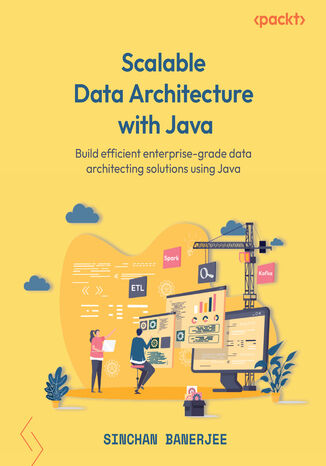
Sinchan Banerjee
Java architectural patterns and tools help architects to build reliable, scalable, and secure data engineering solutions that collect, manipulate, and publish data.This book will help you make the most of the architecting data solutions available with clear and actionable advice from an expert.You’ll start with an overview of data architecture, exploring responsibilities of a Java data architect, and learning about various data formats, data storage, databases, and data application platforms as well as how to choose them. Next, you’ll understand how to architect a batch and real-time data processing pipeline. You’ll also get to grips with the various Java data processing patterns, before progressing to data security and governance. The later chapters will show you how to publish Data as a Service and how you can architect it. Finally, you’ll focus on how to evaluate and recommend an architecture by developing performance benchmarks, estimations, and various decision metrics.By the end of this book, you’ll be able to successfully orchestrate data architecture solutions using Java and related technologies as well as to evaluate and present the most suitable solution to your clients.
Claus Führer, Claus Fuhrer, Jan Erik Solem,...
Python can be used for more than just general-purpose programming. It is a free, open source language and environment that has tremendous potential for use within the domain of scientific computing. This book presents Python in tight connection with mathematical applications and demonstrates how to use various concepts in Python for computing purposes, including examples with the latest version of Python 3. Python is an effective tool to use when coupling scientific computing and mathematics and this book will teach you how to use it for linear algebra, arrays, plotting, iterating, functions, polynomials, and much more.