
Bazy danych
Eric Tome, Rupam Bhattacharjee, David Radford
Most data engineers know that performance issues in a distributed computing environment can easily lead to issues impacting the overall efficiency and effectiveness of data engineering tasks. While Python remains a popular choice for data engineering due to its ease of use, Scala shines in scenarios where the performance of distributed data processing is paramount.This book will teach you how to leverage the Scala programming language on the Spark framework and use the latest cloud technologies to build continuous and triggered data pipelines. You’ll do this by setting up a data engineering environment for local development and scalable distributed cloud deployments using data engineering best practices, test-driven development, and CI/CD. You’ll also get to grips with DataFrame API, Dataset API, and Spark SQL API and its use. Data profiling and quality in Scala will also be covered, alongside techniques for orchestrating and performance tuning your end-to-end pipelines to deliver data to your end users. By the end of this book, you will be able to build streaming and batch data pipelines using Scala while following software engineering best practices.
Data Governance Handbook. A practical approach to building trust in data
Wendy S. Batchelder
2.5 quintillion bytes! This is the amount of data being generated every single day across the globe. As this number continues to grow, understanding and managing data becomes more complex. Data professionals know that it’s their responsibility to navigate this complexity and ensure effective governance, empowering businesses with the right data, at the right time, and with the right controls.If you are a data professional, this book will equip you with valuable guidance to conquer data governance complexities with ease. Written by a three-time chief data officer in global Fortune 500 companies, the Data Governance Handbook is an exhaustive guide to understanding data governance, its key components, and how to successfully position solutions in a way that translates into tangible business outcomes.By the end, you’ll be able to successfully pitch and gain support for your data governance program, demonstrating tangible outcomes that resonate with key stakeholders.*Email sign-up and proof of purchase required
Gláucia Esppenchutz
Data Ingestion with Python Cookbook offers a practical approach to designing and implementing data ingestion pipelines. It presents real-world examples with the most widely recognized open source tools on the market to answer commonly asked questions and overcome challenges.You’ll be introduced to designing and working with or without data schemas, as well as creating monitored pipelines with Airflow and data observability principles, all while following industry best practices. The book also addresses challenges associated with reading different data sources and data formats. As you progress through the book, you’ll gain a broader understanding of error logging best practices, troubleshooting techniques, data orchestration, monitoring, and storing logs for further consultation.By the end of the book, you’ll have a fully automated set that enables you to start ingesting and monitoring your data pipeline effortlessly, facilitating seamless integration with subsequent stages of the ETL process.
Aleksejs Plotnikovs
Microsoft pioneered data innovation and investment ahead of many in the industry, setting a remarkable standard for data maturity. Written by a data leader with over 15 years of experience following Microsoft’s data journey, this book delves into every crucial aspect of this journey, including change management, aligning with business needs, enhancing data value, and cultivating a data-driven culture.This book emphasizes that success in a data-driven enterprise goes beyond relying solely on modern technology and highlights the importance of prioritizing genuine business needs to propel necessary modernizations through change management practices. You’ll see how data-driven innovation does not solely reside within central IT engineering teams but also among the data's business owners who rely on data daily for their operational needs. This guide empower these professionals with clean, easily discoverable, and business-ready data, marking a significant breakthrough in how data is perceived and utilized throughout an enterprise. You’ll also discover advanced techniques to nurture the value of data as unique intellectual property, and differentiate your organization with the power of data.Its storytelling approach and summary of essential insights at the end of each chapter make this book invaluable for business and data leaders to advocate for crucial data investments.
Serge Gershkovich, Kent Graziano
The Snowflake Data Cloud is one of the fastest-growing platforms for data warehousing and application workloads. Snowflake's scalable, cloud-native architecture and expansive set of features and objects enables you to deliver data solutions quicker than ever before.Yet, we must ensure that these solutions are developed using recommended design patterns and accompanied by documentation that’s easily accessible to everyone in the organization.This book will help you get familiar with simple and practical data modeling frameworks that accelerate agile design and evolve with the project from concept to code. These universal principles have helped guide database design for decades, and this book pairs them with unique Snowflake-native objects and examples like never before – giving you a two-for-one crash course in theory as well as direct application.By the end of this Snowflake book, you’ll have learned how to leverage Snowflake’s innovative features, such as time travel, zero-copy cloning, and change-data-capture, to create cost-effective, efficient designs through time-tested modeling principles that are easily digestible when coupled with real-world examples.
Serge Gershkovich, Joe Reis
Struggling with rising Snowflake costs and constant tuning? Poorly aligned data models can lead to bloated expenses, inefficient queries, and time-consuming rework. Data Modeling with Snowflake helps you harness the Snowflake Data Cloud’s scalable, cloud-native architecture and expansive feature set to deliver data solutions faster than ever.This book introduces simple, practical data modeling frameworks that accelerate agile design and evolve alongside your projects from concept to code. Rooted in decades of proven database design principles, these frameworks are paired, for the first time, with Snowflake-native objects and real-world examples, offering a two-in-one crash course in theory and direct application.Through real-world examples designed to make learning easy, you’ll leverage Snowflake’s innovative features like Time Travel, Zero-Copy Cloning, and Change Data Capture (CDC) to create cost-efficient solutions. Whether you're just starting out or refining your architecture, this book will guide you in designing smarter, scaling faster, and cutting costs by aligning timeless modeling principles with the power of Snowflake.*Email sign-up and proof of purchase required
Kirk Munroe
Tableau is unlike most other BI platforms that have a single data modeling tool and enterprise data model (for example, LookML from Google’s Looker). That doesn’t mean Tableau doesn’t have enterprise data governance; it is both robust and highly flexible. This book will help you effectively use Tableau governance models to build a data-driven organization.Data Modeling with Tableau is an extensive guide, complete with step-by-step explanations of essential concepts, practical examples, and hands-on exercises. As you progress through the chapters, you’ll learn the role that Tableau Prep Builder and Tableau Desktop each play in data modeling. You’ll also explore the components of Tableau Server and Tableau Cloud that make data modeling more robust, secure, and performant. Moreover, by extending data models for Ask and Explain Data, you’ll gain the knowledge required to extend analytics to more people in their organizations, leading to better data-driven decisions. Finally, this book will guide you through the entire Tableau stack and the techniques required to build the right level of governance into Tableau data models for the correct use cases.By the end of this Tableau book, you’ll have a firm understanding of how to leverage data modeling in Tableau to benefit your organization.
Data Quality in the Age of AI. Building a foundation for AI strategy and data culture
Andrew Jones
As organizations worldwide seek to revamp their data strategies to leverage AI advancements and benefit from newfound capabilities, data quality emerges as the cornerstone for success. Without high-quality data, even the most advanced AI models falter. Enter Data Quality in the Age of AI, a detailed report that illuminates the crucial role of data quality in shaping effective data strategies.Packed with actionable insights, this report highlights the critical role of data quality in your overall data strategy. It equips teams and organizations with the knowledge and tools to thrive in the evolving AI landscape, serving as a roadmap for harnessing the power of data quality, enabling them to unlock their data's full potential, leading to improved performance, reduced costs, increased revenue, and informed strategic decisions.
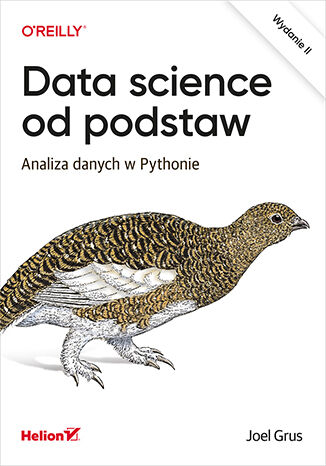
Data science od podstaw. Analiza danych w Pythonie. Wydanie II
Joel Grus
Analityka danych jest uważana za wyjątkowo obiecującą dziedzinę wiedzy. Rozwija się błyskawicznie i znajduje coraz to nowsze zastosowania. Profesjonaliści biegli w eksploracji danych i wydobywaniu z nich pożytecznych informacji mogą liczyć na interesującą pracę i bardzo atrakcyjne warunki zatrudnienia. Jednak aby zostać analitykiem danych, trzeba znać matematykę i statystykę, a także nauczyć się programowania. Umiejętności w zakresie uczenia maszynowego i uczenia głębokiego również są ważne. W przypadku tak specyficznej dziedziny, jaką jest nauka o danych, szczególnie istotne jest zdobycie gruntownych podstaw i dogłębne ich zrozumienie. W tym przewodniku opisano zagadnienia związane z podstawami nauki o danych. Wyjaśniono niezbędne elementy matematyki i statystyki. Przedstawiono także techniki budowy potrzebnych narzędzi i sposoby działania najistotniejszych algorytmów. Książka została skonstruowana tak, aby poszczególne implementacje były jak najbardziej przejrzyste i zrozumiałe. Zamieszczone tu przykłady napisano w Pythonie: jest to język dość łatwy do nauki, a pracę na danych ułatwia szereg przydatnych bibliotek Pythona. W drugim wydaniu znalazły się nowe tematy, takie jak uczenie głębokie, statystyka i przetwarzanie języka naturalnego, a także działania na ogromnych zbiorach danych. Zagadnienia te często pojawiają się w pracy współczesnego analityka danych. W książce między innymi: elementy algebry liniowej, statystyki i rachunku prawdopodobieństwa zbieranie, oczyszczanie i eksploracja danych algorytmy modeli analizy danych podstawy uczenia maszynowego systemy rekomendacji i przetwarzanie języka naturalnego analiza sieci społecznościowych i algorytm MapReduce Nauka o danych: bazuj na solidnych podstawach!
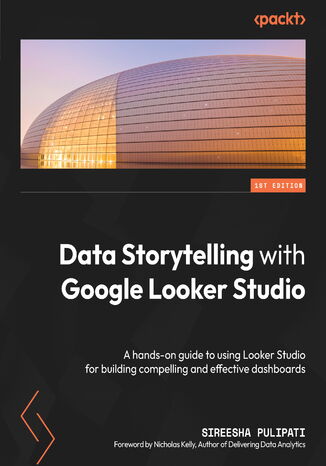
Sireesha Pulipati
Presenting data visually makes it easier for organizations and individuals to interpret and analyze information. Looker Studio is an easy-to-use, collaborative tool that enables you to transform your data into engaging visualizations. This allows you to build and share dashboards that help monitor key performance indicators, identify patterns, and generate insights to ultimately drive decisions and actions.Data Storytelling with Looker Studio begins by laying out the foundational design principles and guidelines that are essential to creating accurate, effective, and compelling data visualizations. Next, you’ll delve into features and capabilities of Looker Studio – from basic to advanced – and explore their application with examples. The subsequent chapters walk you through building dashboards with a structured three-stage process called the 3D approach using real-world examples that’ll help you understand the various design and implementation considerations. This approach involves determining the objectives and needs of the dashboard, designing its key components and layout, and developing each element of the dashboard.By the end of this book, you will have a solid understanding of the storytelling approach and be able to create data stories of your own using Looker Studio.
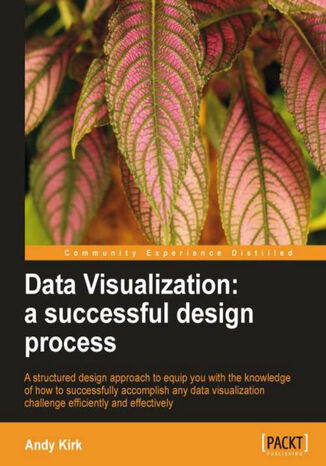
Data Visualization: a successful design process
Andy Kirk
Do you want to create more attractive charts? Or do you have huge data sets and need to unearth the key insights in a visual manner? Data visualization is the representation and presentation of data, using proven design techniques to bring alive the patterns, stories and key insights locked away.Data Visualization: a Successful Design Process explores the unique fusion of art and science that is data visualization; a discipline for which instinct alone is insufficient for you to succeed in enabling audiences to discover key trends, insights and discoveries from your data. This book will equip you with the key techniques required to overcome contemporary data visualization challenges. You'll discover a proven design methodology that helps you develop invaluable knowledge and practical capabilities.You'll never again settle for a default Excel chart or resort to fancy-looking graphs. You will be able to work from the starting point of acquiring, preparing and familiarizing with your data, right through to concept design. Choose your killer visual representation to engage and inform your audience.Data Visualization: a Successful Design Process will inspire you to relish any visualization project with greater confidence and bullish know-how; turning challenges into exciting design opportunities.
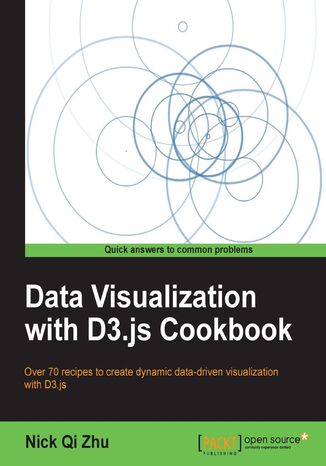
Nick Zhu
D3.js is a JavaScript library designed to display digital data in dynamic graphical form. It helps you bring data to life using HTML, SVG, and CSS. D3 allows great control over the final visual result, and it is the hottest and most powerful web-based data visualization technology on the market today.Data Visualization with D3.js Cookbook is packed with practical recipes to help you learn every aspect of data visualization with D3.Data Visualization with D3.js Cookbook is designed to provide you with all the guidance you need to get to grips with data visualization with D3. With this book, you will create breathtaking data visualization with professional efficiency and precision with the help of practical recipes, illustrations, and code samples.Data Visualization with D3.js Cookbook starts off by touching upon data visualization and D3 basics before gradually taking you through a number of practical recipes covering a wide range of topics you need to know about D3.You will learn the fundamental concepts of data visualization, functional JavaScript, and D3 fundamentals including element selection, data binding, animation, and SVG generation. You will also learn how to leverage more advanced techniques such as custom interpolators, custom tweening, timers, the layout manager, force manipulation, and so on. This book also provides a number of pre-built chart recipes with ready-to-go sample code to help you bootstrap quickly.
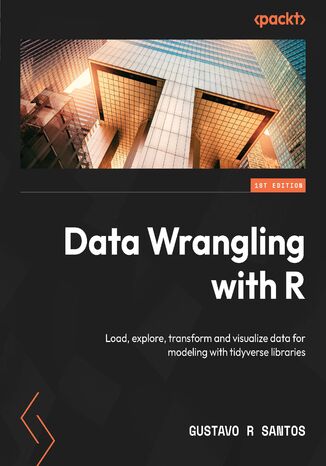
Gustavo Santos
In this information era, where large volumes of data are being generated every day, companies want to get a better grip on it to perform more efficiently than before. This is where skillful data analysts and data scientists come into play, wrangling and exploring data to generate valuable business insights. In order to do that, you’ll need plenty of tools that enable you to extract the most useful knowledge from data.Data Wrangling with R will help you to gain a deep understanding of ways to wrangle and prepare datasets for exploration, analysis, and modeling. This data book enables you to get your data ready for more optimized analyses, develop your first data model, and perform effective data visualization.The book begins by teaching you how to load and explore datasets. Then, you’ll get to grips with the modern concepts and tools of data wrangling. As data wrangling and visualization are intrinsically connected, you’ll go over best practices to plot data and extract insights from it. The chapters are designed in a way to help you learn all about modeling, as you will go through the construction of a data science project from end to end, and become familiar with the built-in RStudio, including an application built with Shiny dashboards.By the end of this book, you’ll have learned how to create your first data model and build an application with Shiny in R.
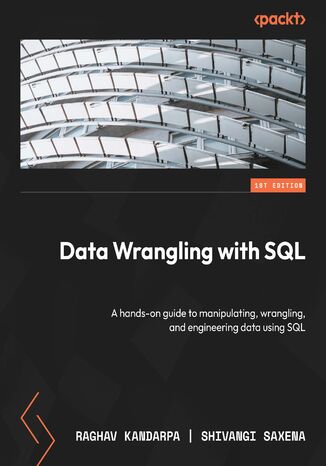
Data Wrangling with SQL. A hands-on guide to manipulating, wrangling, and engineering data using SQL
Raghav Kandarpa, Shivangi Saxena
The amount of data generated continues to grow rapidly, making it increasingly important for businesses to be able to wrangle this data and understand it quickly and efficiently. Although data wrangling can be challenging, with the right tools and techniques you can efficiently handle enormous amounts of unstructured data.The book starts by introducing you to the basics of SQL, focusing on the core principles and techniques of data wrangling. You’ll then explore advanced SQL concepts like aggregate functions, window functions, CTEs, and subqueries that are very popular in the business world. The next set of chapters will walk you through different functions within SQL query that cause delays in data transformation and help you figure out the difference between a good query and bad one. You’ll also learn how data wrangling and data science go hand in hand. The book is filled with datasets and practical examples to help you understand the concepts thoroughly, along with best practices to guide you at every stage of data wrangling.By the end of this book, you’ll be equipped with essential techniques and best practices for data wrangling, and will predominantly learn how to use clean and standardized data models to make informed decisions, helping businesses avoid costly mistakes.
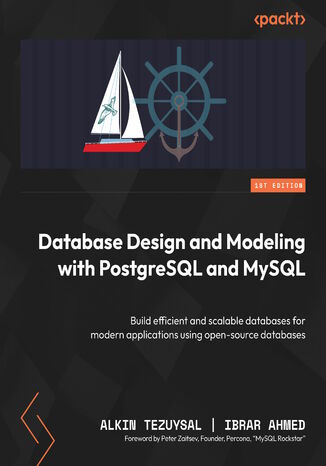
Alkin Tezuysal, Ibrar Ahmed, Peter Zaitsev
Database Design and Modeling with PostgreSQL and MySQL will equip you with the knowledge and skills you need to architect, build, and optimize efficient databases using two of the most popular open-source platforms.As you progress through the chapters, you'll gain a deep understanding of data modeling, normalization, and query optimization, supported by hands-on exercises and real-world case studies that will reinforce your learning. You'll explore topics like concurrency control, backup and recovery strategies, and seamless integration with web and mobile applications. These advanced topics will empower you to tackle complex database challenges confidently and effectively. Additionally, you’ll explore emerging trends, such as NoSQL databases and cloud-based solutions, ensuring you're well-versed in the latest developments shaping the database landscape. By embracing these cutting-edge technologies, you'll be prepared to adapt and innovate in today's ever-evolving digital world.By the end of this book, you’ll be able to understand the technologies that exist to design a modern and scalable database for developing web applications using MySQL and PostgreSQL open-source databases.
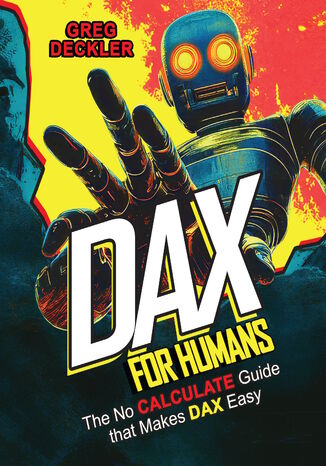
DAX for Humans. The No CALCULATE Guide that Makes DAX Easy
Greg Deckler
Although DAX has been around for over a decade, many struggle to master the language primarily because DAX is often taught through the CALCULATE function, which is the most complex and unintuitive function in all of DAX. But what if DAX could be taught without CALCULATE? The result would be an incredibly intuitive and easy way to learn DAX.DAX for Humans stands the traditional approach to learning DAX on its head, foregoing the traditional, legacy methods of learning DAX for a more modern approach that focuses on core DAX concepts and not any specific function. Even if you know nothing about DAX, from the very first chapter you will learn the essentials of the DAX language, as well as a single pattern to solve the majority of DAX problems. From that point forward, you’ll explore how to work with the basic building blocks of the DAX language and apply what you learn to real-world business scenarios across customers, human resources, projects, finance, operations, and more.By the end of this book, you’ll be able to apply your DAX skills to simple, complex, and advanced scenarios; understand how to optimize and debug your DAX code; and even know how to efficiently apply artificial intelligence to help you write and debug your DAX code.