
Bazy danych
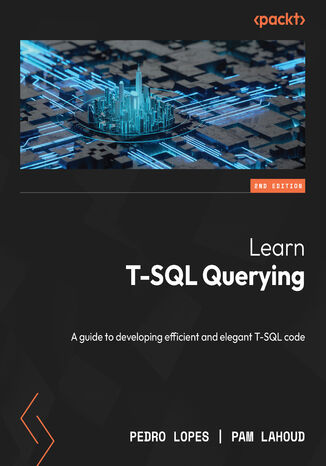
Learn T-SQL Querying. A guide to developing efficient and elegant T-SQL code - Second Edition
Pedro Lopes, Pam Lahoud
Data professionals seeking to excel in Transact-SQL for Microsoft SQL Server and Azure SQL Database often lack comprehensive resources. Learn T-SQL Querying second edition focuses on indexing queries and crafting elegant T-SQL code enabling data professionals gain mastery in modern SQL Server versions (2022) and Azure SQL Database. The book covers new topics like logical statement processing flow, data access using indexes, and best practices for tuning T-SQL queries.Starting with query processing fundamentals, the book lays a foundation for writing performant T-SQL queries. You’ll explore the mechanics of the Query Optimizer and Query Execution Plans, learning to analyze execution plans for insights into current performance and scalability. Using dynamic management views (DMVs) and dynamic management functions (DMFs), you’ll build diagnostic queries. The book covers indexing and delves into SQL Server’s built-in tools to expedite resolution of T-SQL query performance and scalability issues. Hands-on examples will guide you to avoid UDF pitfalls and understand features like predicate SARGability, Query Store, and Query Tuning Assistant. By the end of this book, you‘ll have developed the ability to identify query performance bottlenecks, recognize anti-patterns, and avoid pitfalls
Learning Couchbase. Design documents and implement real world e-commerce applications with Couchbase
Henry Potsangbam
This book achieves its goal by taking up an end-to-end development structure, right from understanding NOSQL document design to implementing full fledged eCommerce application design using Couchbase as a backend. Starting with the architecture of Couchbase to get you up and running, this book quickly takes you through designing a NoSQL document and implementing highly scalable applications using Java API. You will then be introduced to document design and get to know the various ways to administer Couchbase. Followed by this, learn to store documents using bucket. Moving on, you will then learn to store, retrieve and delete documents using smart client base on Java API. You will then retrieve documents using SQL like syntax call N1QL. Next, you will learn how to write map reduce base views. Finally, you will configure XDCR for disaster recovery and implement an eCommerce application using Couchbase.
Saurabh Chhajed
The ELK stack—Elasticsearch, Logstash, and Kibana, is a powerful combination of open source tools. Elasticsearch is for deep search and data analytics. Logstash is for centralized logging, log enrichment, and parsing. Kibana is for powerful and beautiful data visualizations. In short, the Elasticsearch ELK stack makes searching and analyzing data easier than ever before.This book will introduce you to the ELK (Elasticsearch, Logstash, and Kibana) stack, starting by showing you how to set up the stack by installing the tools, and basic configuration. You’ll move on to building a basic data pipeline using the ELK stack.Next, you’ll explore the key features of Logstash and its role in the ELK stack, including creating Logstash plugins, which will enable you to use your own customized plugins. The importance of Elasticsearch and Kibana in the ELK stack is also covered, along with various types of advanced data analysis, and a variety of charts, tables ,and maps.Finally, by the end of the book you will be able to develop full-fledged data pipeline using the ELK stack and have a solid understanding of the role of each of the components.
Learning Google BigQuery. A beginner's guide to mining massive datasets through interactive analysis
Thirukkumaran Haridass, Eric Brown
Google BigQuery is a popular cloud data warehouse for large-scale data analytics. This book will serve as a comprehensive guide to mastering BigQuery, and how you can utilize it to quickly and efficiently get useful insights from your Big Data.You will begin with getting a quick overview of the Google Cloud Platform and the various services it supports. Then, you will be introduced to the Google BigQuery API and how it fits within in the framework of GCP. The book covers useful techniques to migrate your existing data from your enterprise to Google BigQuery, as well as readying and optimizing it for analysis. You will perform basic as well as advanced data querying using BigQuery, and connect the results to various third party tools for reporting and visualization purposes such as R and Tableau. If you're looking to implement real-time reporting of your streaming data running in your enterprise, this book will also help you.This book also provides tips, best practices and mistakes to avoid while working with Google BigQuery and services that interact with it. By the time you're done with it, you will have set a solid foundation in working with BigQuery to solve even the trickiest of data problems.
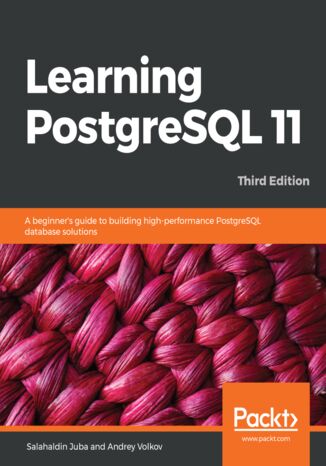
Christopher Travers, Andrey Volkov
PostgreSQL is one of the most popular open source database management systems in the world, and it supports advanced features included in SQL standards. This book will familiarize you with the latest features in PostgreSQL 11, and get you up and running with building efficient PostgreSQL database solutions from scratch.Learning PostgreSQL, 11 begins by covering the concepts of relational databases and their core principles. You’ll explore the Data Definition Language (DDL) and commonly used DDL commands supported by ANSI SQL. You’ll also learn how to create tables, define integrity constraints, build indexes, and set up views and other schema objects. As you advance, you’ll come to understand Data Manipulation Language (DML) and server-side programming capabilities using PL/pgSQL, giving you a robust background to develop, tune, test, and troubleshoot your database application. The book will guide you in exploring NoSQL capabilities and connecting to your database to manipulate data objects. You’ll get to grips with using data warehousing in analytical solutions and reports, and scaling the database for high availability and performance.By the end of this book, you’ll have gained a thorough understanding of PostgreSQL 11 and developed the necessary skills to build efficient database solutions.
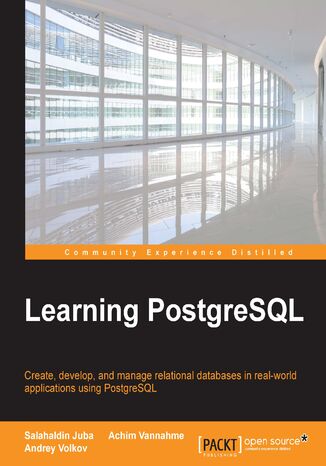
Salahaldin Juba, Achim Vannahme, Andrey Volkov
PostgreSQL is one of the most powerful and easy to use database management systems. It supports the most advanced features included in SQL standards. The book starts with the introduction of relational databases with PostegreSQL. It then moves on to covering data definition language (DDL) with emphasis on PostgreSQL and common DDL commands supported by ANSI SQL. You will then learn the data manipulation language (DML), and advanced topics like locking and multi version concurrency control (MVCC). This will give you a very robust background to tune and troubleshoot your application. The book then covers the implementation of data models in the database such as creating tables, setting up integrity constraints, building indexes, defining views and other schema objects. Next, it will give you an overview about the NoSQL capabilities of PostgreSQL along with Hstore, XML, Json and arrays. Finally by the end of the book, you'll learn to use the JDBC driver and manipulate data objects in the Hibernate framework.
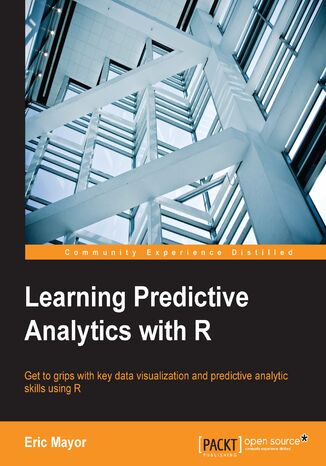
Eric Mayor
This book is packed with easy-to-follow guidelines that explain the workings of the many key data mining tools of R, which are used to discover knowledge from your data.You will learn how to perform key predictive analytics tasks using R, such as train and test predictive models for classification and regression tasks, score new data sets and so on. All chapters will guide you in acquiring the skills in a practical way. Most chapters also include a theoretical introduction that will sharpen your understanding of the subject matter and invite you to go further.The book familiarizes you with the most common data mining tools of R, such as k-means, hierarchical regression, linear regression, association rules, principal component analysis, multilevel modeling, k-NN, Naïve Bayes, decision trees, and text mining. It also provides a description of visualization techniques using the basic visualization tools of R as well as lattice for visualizing patterns in data organized in groups. This book is invaluable for anyone fascinated by the data mining opportunities offered by GNU R and its packages.
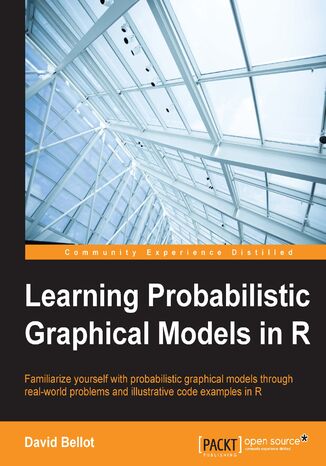
David Bellot
Probabilistic graphical models (PGM, also known as graphical models) are a marriage between probability theory and graph theory. Generally, PGMs use a graph-based representation. Two branches of graphical representations of distributions are commonly used, namely Bayesian networks and Markov networks. R has many packages to implement graphical models.We’ll start by showing you how to transform a classical statistical model into a modern PGM and then look at how to do exact inference in graphical models. Proceeding, we’ll introduce you to many modern R packages that will help you to perform inference on the models. We will then run a Bayesian linear regression and you’ll see the advantage of going probabilistic when you want to do prediction. Next, you’ll master using R packages and implementing its techniques. Finally, you’ll be presented with machine learning applications that have a direct impact in many fields. Here, we’ll cover clustering and the discovery of hidden information in big data, as well as two important methods, PCA and ICA, to reduce the size of big problems.