
Big data
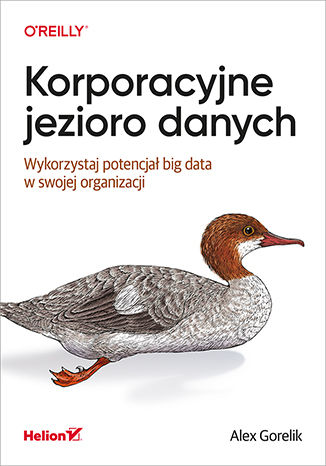
Korporacyjne jezioro danych. Wykorzystaj potencjał big data w swojej organizacji
Alex Gorelik
Koncepcja big data, nauka o danych i analityka danych wspomagają dziś procesy decyzyjne w przedsiębiorstwach w niespotykanym wcześniej zakresie. Zwiększają poziom efektywności pracy w wielu różnych branżach. Korporacje zaczęły więc eksperymenty z wykorzystaniem big data i technologii chmury, aby budować jeziora danych oraz tworzyć oparte na nich systemy podejmowania decyzji. Niejeden z tych projektów się nie powiódł, gdyż nie został dostosowany do kultury i potrzeb przedsiębiorstwa. Najwyraźniej zabrakło wiedzy, w jaki sposób skutecznie przeprowadzać tak radykalną transformację. Ta książka jest praktycznym przewodnikiem, który ułatwia wdrażanie architektury jeziora danych (ang. data lake) w przedsiębiorstwie. Omówiono tu różne podejścia do jej uruchamiania i rozwijania, w tym kałuże danych (analityczne piaskownice) i stawy danych (hurtownie danych), a także budowanie jezior danych od podstaw. Opisano konfigurowanie różnych stref, co pozwala na odpowiednie rozmieszczenie zarówno surowych, jak i starannie zarządzanych i przetworzonych danych. Wyjaśniono znaczenie zarządzania dostępem do stref. Zawarto tu również wskazówki umożliwiające zachowanie zgodności z regułami zarządzania danymi przedsiębiorstwa. W tej książce: wprowadzenie do hurtowni danych, big data i nauki o danych praktyczne techniki budowania jezior danych najlepsze praktyki dostarczania analitykom dostępu do danych projektowanie architektury jeziora danych oraz różne techniki implementacji zalety i wady różnych podejść do budowania magazynów danych i zarządzania nimi Jeziora danych i big data - ocean możliwości!
Luca Massaron, Alberto Boschetti, Bastiaan Sjardin
Large Python machine learning projects involve new problems associated with specialized machine learning architectures and designs that many data scientists have yet to tackle. But finding algorithms and designing and building platforms that deal with large sets of data is a growing need. Data scientists have to manage and maintain increasingly complex data projects, and with the rise of big data comes an increasing demand for computational and algorithmic efficiency. Large Scale Machine Learning with Python uncovers a new wave of machine learning algorithms that meet scalability demands together with a high predictive accuracy. Dive into scalable machine learning and the three forms of scalability. Speed up algorithms that can be used on a desktop computer with tips on parallelization and memory allocation. Get to grips with new algorithms that are specifically designed for large projects and can handle bigger files, and learn about machine learning in big data environments. We will also cover the most effective machine learning techniques on a map reduce framework in Hadoop and Spark in Python.
Stefan Kottwitz
LaTeX is high-quality open source typesetting software that produces professional prints and PDF files. It's a powerful and complex tool with a multitude of features, so getting started can be intimidating. However, once you become comfortable with LaTeX, its capabilities far outweigh any initial challenges, and this book will help you with just that!The LaTeX Beginner's Guide will make getting started with LaTeX easy. If you are writing mathematical, scientific, or business papers, or have a thesis to write, this is the perfect book for you. With the help of fully explained examples, this book offers a practical introduction to LaTeX with plenty of step-by-step examples that will help you achieve professional-level results in no time. You'll learn to typeset documents containing tables, figures, formulas, and common book elements such as bibliographies, glossaries, and indexes, and go on to manage complex documents and use modern PDF features. You'll also get to grips with using macros and styles to maintain a consistent document structure while saving typing work.By the end of this LaTeX book, you'll have learned how to fine-tune text and page layout, create professional-looking tables, include figures, present complex mathematical formulas, manage complex documents, and benefit from modern PDF features.
Sebastien Donadio, Sourav Ghosh
It’s now harder than ever to get a significant edge over competitors in terms of speed and efficiency when it comes to algorithmic trading. Relying on sophisticated trading signals, predictive models and strategies can make all the difference. This book will guide you through these aspects, giving you insights into how modern electronic trading markets and participants operate.You’ll start with an introduction to algorithmic trading, along with setting up the environment required to perform the tasks in the book. You’ll explore the key components of an algorithmic trading business and aspects you’ll need to take into account before starting an automated trading project. Next, you’ll focus on designing, building and operating the components required for developing a practical and profitable algorithmic trading business. Later, you’ll learn how quantitative trading signals and strategies are developed, and also implement and analyze sophisticated trading strategies such as volatility strategies, economic release strategies, and statistical arbitrage. Finally, you’ll create a trading bot from scratch using the algorithms built in the previous sections.By the end of this book, you’ll be well-versed with electronic trading markets and have learned to implement, evaluate and safely operate algorithmic trading strategies in live markets.
Julien Simon
Amazon SageMaker enables you to quickly build, train, and deploy machine learning models at scale without managing any infrastructure. It helps you focus on the machine learning problem at hand and deploy high-quality models by eliminating the heavy lifting typically involved in each step of the ML process. This second edition will help data scientists and ML developers to explore new features such as SageMaker Data Wrangler, Pipelines, Clarify, Feature Store, and much more.You'll start by learning how to use various capabilities of SageMaker as a single toolset to solve ML challenges and progress to cover features such as AutoML, built-in algorithms and frameworks, and writing your own code and algorithms to build ML models. The book will then show you how to integrate Amazon SageMaker with popular deep learning libraries, such as TensorFlow and PyTorch, to extend the capabilities of existing models. You'll also see how automating your workflows can help you get to production faster with minimum effort and at a lower cost. Finally, you'll explore SageMaker Debugger and SageMaker Model Monitor to detect quality issues in training and production.By the end of this Amazon book, you'll be able to use Amazon SageMaker on the full spectrum of ML workflows, from experimentation, training, and monitoring to scaling, deployment, and automation.
Pericles Rocha
Large volumes of data are generated daily from applications, websites, IoT devices, and other free-text, semi-structured data sources. Azure Synapse Data Explorer helps you collect, store, and analyze such data, and work with other analytical engines, such as Apache Spark, to develop advanced data science projects and maximize the value you extract from data.This book offers a comprehensive view of Azure Synapse Data Explorer, exploring not only the core scenarios of Data Explorer but also how it integrates within Azure Synapse. From data ingestion to data visualization and advanced analytics, you’ll learn to take an end-to-end approach to maximize the value of unstructured data and drive powerful insights using data science capabilities. With real-world usage scenarios, you’ll discover how to identify key projects where Azure Synapse Data Explorer can help you achieve your business goals. Throughout the chapters, you'll also find out how to manage big data as part of a software as a service (SaaS) platform, as well as tune, secure, and serve data to end users.By the end of this book, you’ll have mastered the big data life cycle and you'll be able to implement advanced analytical scenarios from raw telemetry and log data.
Kirankalyan Kulkarni
Blockchain is a distributed database that enables permanent, transparent, and secure storage of data. Blockchain technology uses cryptography to keep data secure. Learn Bitcoin and Blockchain is the perfect entry point to the world of decentralized databases.This book will take you on a journey through the blockchain database, followed by advanced implementations of the blockchain concept. You will learn about Bitcoin basics and their technical operations. As you make your way through the book, you will gain insight into this leading technology and its implementation in the real world. You will also cover the technical foundation of blockchain and understand the fundamentals of cryptography and how they keep data secure. In the concluding chapters, you’ll get to grips with the mechanisms behind cryptocurrencies.By the end of this book, you will have learned about decentralized digital money, advanced blockchain concepts, and Bitcoin and blockchain security.
Learn Chart.js. Create interactive visualizations for the Web with Chart.js 2
Helder Da Rocha
Chart.js is a free, open-source data visualization library, maintained by an active community of developers in GitHub, where it rates as the second most popular data visualization library. If you want to quickly create responsive Web-based data visualizations for the Web, Chart.js is a great choice.This book guides the reader through dozens of practical examples, complete with code you can run and modify as you wish. It is a practical hands-on introduction to Chart.js. If you have basic knowledge of HTML, CSS and JavaScript you can learn to create beautiful interactive Web Canvas-based visualizations for your data using Chart.js. This book will help you set up Chart.js in a Web page and show how to create each one of the eight Chart.js chart types. You will also learn how to configure most properties that override Chart’s default styles and behaviors. Practical applications of Chart.js are exemplified using real data files obtained from public data portals. You will learn how to load, parse, filter and select the data you wish to display from those files. You will also learn how to create visualizations that reveal patterns in the data. This book is based on Chart.js version 2.7.3 and ES2015 JavaScript.By the end of the book, you will be able to create beautiful, efficient and interactive data visualizations for the Web using Chart.js.
Helder Da Rocha
Learn D3.js, Second Edition is a fully updated guide to building interactive, standards-compliant web visualizations using D3.js v7 and modern JavaScript. Whether you're a developer, designer, data journalist, or analyst, this book helps you master the core techniques for transforming data into compelling, meaningful visuals.Beginning with fundamentals like selections, data binding, and SVG, the book progressively covers scales, axes, animations, hierarchical data, and geographical maps. Each chapter includes short examples and a full hands-on project with downloadable code you can run, modify, and use in your own work.This new edition introduces improved chapter structure, updated code samples using ES2015 standards, and better formatting for readability. A dedicated chapter focuses on integrating D3 with modern frameworks like React and Vue, along with performance, accessibility, and deployment strategies. An appendix helps users migrate from older versions of D3.With thoughtful pedagogy and a practical approach, this book remains one of the most thorough and respected resources for learning D3.js.
Eric Salituro
Get ready to unlock the full potential of the open-source Grafana observability platform, ideal for analyzing and monitoring time-series data with this updated second edition. This beginners guide will help you get up to speed with Grafana’s latest features for querying, visualizing, and exploring logs and metrics, no matter where they are stored.Starting with the basics, this book demonstrates how to quickly install and set up a Grafana server using Docker. You’ll then be introduced to the main components of the Grafana interface before learning how to analyze and visualize data from sources such as InfluxDB, Telegraf, Prometheus, Logstash, and Elasticsearch. The book extensively covers key panel visualizations in Grafana, including Time Series, Stat, Table, Bar Gauge, and Text, and guides you in using Python to pipeline data, transformations to facilitate analytics, and templating to build dynamic dashboards. Exploring real-time data streaming with Telegraf, Promtail, and Loki, you’ll work with observability features like alerting rules and integration with PagerDuty and Slack. As you progress, the book addresses the administrative aspects of Grafana, from configuring users and organizations to implementing user authentication with Okta and LDAP, as well as organizing dashboards into folders, and more.By the end of this book, you’ll have gained all the knowledge you need to start building interactive dashboards.
Arshad Ali, Bradley Schacht
Discover the capabilities of Microsoft Fabric, the premier unified solution designed for the AI era, seamlessly combining data integration, OneLake, transformation, visualization, universal security, and a unified business model. This book provides an overview of Microsoft Fabric, its components, and the wider analytics landscape.In this book, you'll explore workloads such as Data Factory, Synapse Data Engineering, data science, data warehouse, real-time analytics, and Power BI. You’ll learn how to build end-to-end lakehouse and data warehouse solutions using the medallion architecture, unlock the real-time analytics, and implement machine learning and AI models. As you progress, you’ll build expertise in monitoring workloads and administering Fabric across tenants, capacities, and workspaces. The book also guides you step by step through enhancing security and governance practices in Microsoft Fabric and implementing CI/CD workflows with Azure DevOps or GitHub. Finally, you’ll discover the power of Copilot, an AI-driven assistant that accelerates your analytics journey.By the end of this book, you’ll have unlocked the full potential of AI-driven data analytics, gaining a comprehensive understanding of the analytics landscape and mastery over the essential concepts and principles of Microsoft Fabric.
Greg Deckler
Everyone’s swimming in data. The ones who thrive? They know how to make sense of it with the right tools quickly and effectively. Learn Microsoft Power BI, Third Edition is your essential guide to mastering one of the most powerful platforms for data analysis and visualization. In this newly revised and expanded edition, Greg Deckler, a 7-time Microsoft MVP and Power BI expert, takes you on a journey of data exploration and discovery using Microsoft Power BI to ingest, cleanse, and organize data and uncover key business insights that can be shared effectively.Covering the latest features and interface changes, including Microsoft Fabric and Copilot, this book guides you through deploying, adopting, and governing Power BI within your organization. You’ll get to grips with the fundamentals of business intelligence projects and learn how to leverage your expertise in the broader Power BI ecosystem. From ingesting and cleansing your data to transforming it into stunning visualizations, reports, and dashboards that speak to business decision-makers, this book will fully prepare you to become the data analysis hero of your organization or kickstart a rewarding career in business intelligence.*Email sign-up and proof of purchase required
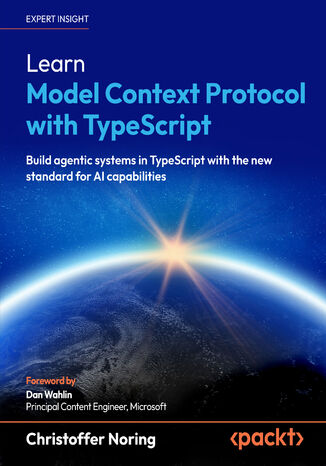
Christoffer Noring, Dan Wahlin
Learn Model Context Protocol with TypeScript introduces developers, architects, and AI practitioners to the transformative capabilities of Model Context Protocol (MCP), an emerging protocol designed to standardize, distribute, and scale AI-driven applications. Through the lens of a practical project, the book tackles the modern challenges of resource management, client-server interaction, and deployment at scale.Drawing from Christoffer's expertise as a published author and tutor at the University of Oxford, you’ll explore the components of MCP and how they streamline server and client development. After that, you’ll progress from building robust backends and integrating LLMs into intelligent clients to interacting with servers via tools such as Claude for desktop and Visual Studio Code agents. The chapters help you understand the capabilities of hosts, clients, and servers, facilitating better interoperability, easier integration, and clearer communication between different components.The book also covers security best practices and building for the cloud, ensuring that you're ready to deploy your MCP-based apps. Each chapter enables you to develop hands-on skills for building and operating MCP-based agentic apps.*Email sign-up and proof of purchase required
Greg Moss
Odoo is management software that contains a set of open source enterprise management applications that help you modernize your business.Completely revised and updated, this comprehensive Odoo guide is a fourth edition of Working with Odoo. This book begins with an introduction to Odoo and helps you set up Odoo Online in your system. You'll learn how to start a new company database in Odoo and the basics of Odoo sales management. You will explore customer relationship management in Odoo and its importance in a modern business environment. Moving on, you'll learn how to install the purchasing application, set up suppliers, and begin purchasing and receiving products in Odoo. Next, you'll learn how to use the MRP module to create, process, and schedule the manufacturing and production order. Once you get to grips with the basic applications, you'll uncover how to customize Odoo to meet the specific needs of your business. You'll learn some advanced techniques for searching and finding information, and you'll be taken through business intelligence in Odoo. Towards the end of the book, you'll go in-depth into Odoo's architecture and learn to use Odoo's API to integrate with other applications. By the end of the book, you'll be ready to use Odoo to build enterprise applications and set up the functional requirements for your business.
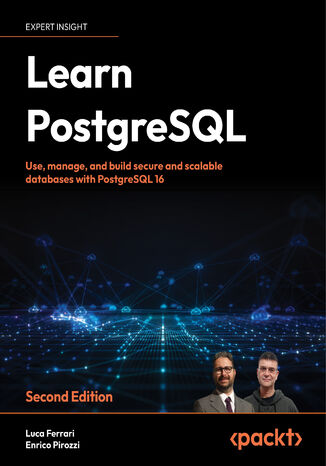
Luca Ferrari, Enrico Pirozzi
The latest edition of this PostgreSQL book will help you to start using PostgreSQL from absolute scratch, helping you to quickly understand the internal workings of the database. With a structured approach and practical examples, go on a journey that covers the basics, from SQL statements and how to run server-side programs, to configuring, managing, securing, and optimizing database performance.This new edition will not only help you get to grips with all the recent changes within the PostgreSQL ecosystem but will also dig deeper into concepts like partitioning and replication with a fresh set of examples. The book is also equipped with Docker images for each chapter which makes the learning experience faster and easier. Starting with the absolute basics of databases, the book sails through to advanced concepts like window functions, logging, auditing, extending the database, configuration, partitioning, and replication. It will also help you seamlessly migrate your existing database system to PostgreSQL and contains a dedicated chapter on disaster recovery. Each chapter ends with practice questions to test your learning at regular intervals.By the end of this book, you will be able to install, configure, manage, and develop applications against a PostgreSQL database.
Luca Ferrari, Enrico Pirozzi
The latest edition of this PostgreSQL- dedicated book guides you from the ground up in using this great and feature-rich relational database. Starting from absolute scratch, you will quickly learn the internal mechanics of PostgreSQL and how to use the SQL language to get the most out of your databases. The book presents ways to configure, manage, secure and exploit the rich set of features that PostgreSQL provides to you and your applications, including its rich and continuously growing ecosystem of tools and extensions. You will get PostgreSQL up and running at lightning speed.You’ll become familiar with SQL for basic and advanced statements, including window functions, triggers, functions and procedures, and more. Managing large tables and databases through advanced techniques like table partitioning will be covered in detail.In this edition you will see also how to use PostgreSQL as a backbone for Artificial Intelligence systems. All the examples are presented through a set of Docker images, pre-built and freely available, to help you get comfortable with trying out and verifying new concepts. Moreover, every chapter includes a Q&A section to validate your new knowledge and important concepts. Thanks to this new edition, you will also learn how to deal with disaster recovery and database optimization.