
Big data
arc42 by Example. Software architecture documentation in practice
Gernot Starke, Michael Simons, Stefan Zörner, Ralf...
When developers document the architecture of their systems, they often invent their own specific ways of articulating structures, designs, concepts, and decisions. What they need is a template that enables simple and efficient software architecture documentation. arc42 by Example shows how it's done through several real-world examples.Each example in the book, whether it is a chess engine, a huge CRM system, or a cool web system, starts with a brief description of the problem domain and the quality requirements. Then, you'll discover the system context with all the external interfaces. You'll dive into an overview of the solution strategy to implement the building blocks and runtime scenarios. The later chapters also explain various cross-cutting concerns and how they affect other aspects of a program.
Nagaraj Venkatesan
Business Intelligence (BI) tools like Power BI are used by a wide range of professionals, creating diverse and complex scenarios, and finding the right solution can be daunting, especially when multiple approaches exist for a single use case. The author distills his 17 years of experience on various data platform technologies in this book to walk you through various Power BI usage scenarios.The book is structured around Power BI usage scenarios, such as developing solutions for corporate BI reporting, self-service BI reporting, and Power BI for data scientists and independent software vendors (ISVs). Each part highlights common data issues encountered in the usage scenario, the correct approach to solve the problems, and supporting technical guidance. The chapters also introduce you to some of the latest enhancements in Power BI, such as Microsoft Fabric integration with Power BI, AI features like Copilot, Power BI Git integration, and Power BI Governance features.By the end of this book, you’ll have learned how to design optimal solutions using Power BI components and pick the right tool for the job, while adhering to security and performance best practices.*Email sign-up and proof of purchase required
Zsolt Nagy
Machine learning and neural networks are pillars on which you can build intelligent applications. Artificial Intelligence and Machine Learning Fundamentals begins by introducing you to Python and discussing AI search algorithms. You will cover in-depth mathematical topics, such as regression and classification, illustrated by Python examples.As you make your way through the book, you will progress to advanced AI techniques and concepts, and work on real-life datasets to form decision trees and clusters. You will be introduced to neural networks, a powerful tool based on Moore's law.By the end of this book, you will be confident when it comes to building your own AI applications with your newly acquired skills!
Denis Rothman, Nicolas GUET, Jérémie ROTHMAN
Artificial intelligence has the potential to replicate humans in every field. Artificial Intelligence By Example serves as a starting point for you to understand how AI is built, with the help of intriguing examples and case studies.Artificial Intelligence By Example will make you an adaptive thinker and help you apply concepts to real-life scenarios. Using some of the most interesting AI examples, right from a simple chess engine to a cognitive chatbot, you will learn how to tackle the machine you are competing with. You will study some of the most advanced machine learning models, understand how to apply AI to blockchain and IoT, and develop emotional quotient in chatbots using neural networks.You will move on to designing AI solutions in a simple manner rather than get confused by complex architectures and techniques. This comprehensive guide will be a starter kit for you to develop AI applications on your own.By the end of this book, you will have understood the fundamentals of AI and worked through a number of case studies that will help you develop your business vision.
Artificial Intelligence. Ethical, social, and security impacts for the present and the future
IT Governance Publishing, Dr. Julie E. Mehan
This book offers an in-depth exploration of Artificial Intelligence (AI), from its origins to the ethical and societal challenges it presents today. It provides a comprehensive understanding of AI’s impact on human interaction, collaboration, privacy, and security. Through analyzing both opportunities and risks, the book emphasizes the ethical concerns surrounding AI, such as bias, privacy violations, and security threats.Chapters explore AI’s transformative role in cybersecurity, misinformation, and human-machine collaboration, highlighting its implications for job markets and human relationships. Real-world examples illustrate how AI can drive progress or cause harm. The ethical dilemmas around AI, including its use in surveillance and decision-making, are thoroughly examined, presenting challenges central to modern technology.Looking ahead, the book offers a forward-thinking perspective on AI’s future, discussing emerging trends and the need for responsible policy-making. It concludes by addressing how society can prepare for AI’s continued growth, offering strategies for navigating the evolving landscape. With practical insights and deep analysis, this book helps readers grasp AI’s profound implications for our future.
Anand Deshpande, Manish Kumar, Albenzo Coletta, Giancarlo...
In this age of big data, companies have larger amount of consumer data than ever before, far more than what the current technologies can ever hope to keep up with. However, Artificial Intelligence closes the gap by moving past human limitations in order to analyze data.With the help of Artificial Intelligence for big data, you will learn to use Machine Learning algorithms such as k-means, SVM, RBF, and regression to perform advanced data analysis. You will understand the current status of Machine and Deep Learning techniques to work on Genetic and Neuro-Fuzzy algorithms. In addition, you will explore how to develop Artificial Intelligence algorithms to learn from data, why they are necessary, and how they can help solve real-world problems.By the end of this book, you'll have learned how to implement various Artificial Intelligence algorithms for your big data systems and integrate them into your product offerings such as reinforcement learning, natural language processing, image recognition, genetic algorithms, and fuzzy logic systems.
Francis X. Govers III
Artificial Intelligence for Robotics starts with an introduction to Robot Operating Systems (ROS), Python, robotic fundamentals, and the software and tools that are required to start out with robotics. You will learn robotics concepts that will be useful for making decisions, along with basic navigation skills.As you make your way through the chapters, you will learn about object recognition and genetic algorithms, which will teach your robot to identify and pick up an irregular object. With plenty of use cases throughout, you will explore natural language processing (NLP) and machine learning techniques to further enhance your robot. In the concluding chapters, you will learn about path planning and goal-oriented programming, which will help your robot prioritize tasks.By the end of this book, you will have learned to give your robot an artificial personality using simulated intelligence.
Mary-Jo Diepeveen
The artificial intelligence (AI) capabilities in Power BI enable organizations to quickly and easily gain more intelligent insights from unstructured and structured data.This book will teach you how to make use of the many AI features available today in Power BI to quickly and easily enrich your data and gain better insights into patterns that can be found in your data.You’ll begin by understanding the benefits of AI and how it can be used in Power BI. Next, you’ll focus on exploring and preparing your data for building AI projects and then progress to using prominent AI features already available in Power BI, such as forecasting, anomaly detection, and Q&A. Later chapters will show you how to apply text analytics and computer vision within Power BI reports. This will help you create your own Q&A functionality in Power BI, which allows you to ask FAQs from another knowledge base and then integrate it with PowerApps. Toward the concluding chapters, you’ll be able to create and deploy AutoML models trained in Azure ML and consume them in Power Query Editor. After your models have been trained, you’ll work through principles such as privacy, fairness, and transparency to use AI responsibly.By the end of this book, you’ll have learned when and how to enrich your data with AI using the out-of-the-box AI capabilities in Power BI.
Adnan Masood
Every machine learning engineer deals with systems that have hyperparameters, and the most basic task in automated machine learning (AutoML) is to automatically set these hyperparameters to optimize performance. The latest deep neural networks have a wide range of hyperparameters for their architecture, regularization, and optimization, which can be customized effectively to save time and effort.This book reviews the underlying techniques of automated feature engineering, model and hyperparameter tuning, gradient-based approaches, and much more. You'll discover different ways of implementing these techniques in open source tools and then learn to use enterprise tools for implementing AutoML in three major cloud service providers: Microsoft Azure, Amazon Web Services (AWS), and Google Cloud Platform. As you progress, you’ll explore the features of cloud AutoML platforms by building machine learning models using AutoML. The book will also show you how to develop accurate models by automating time-consuming and repetitive tasks in the machine learning development lifecycle.By the end of this machine learning book, you’ll be able to build and deploy AutoML models that are not only accurate, but also increase productivity, allow interoperability, and minimize feature engineering tasks.
Trenton Potgieter
AWS provides a wide range of solutions to help automate a machine learning workflow with just a few lines of code. With this practical book, you'll learn how to automate a machine learning pipeline using the various AWS services.Automated Machine Learning on AWS begins with a quick overview of what the machine learning pipeline/process looks like and highlights the typical challenges that you may face when building a pipeline. Throughout the book, you'll become well versed with various AWS solutions such as Amazon SageMaker Autopilot, AutoGluon, and AWS Step Functions to automate an end-to-end ML process with the help of hands-on examples. The book will show you how to build, monitor, and execute a CI/CD pipeline for the ML process and how the various CI/CD services within AWS can be applied to a use case with the Cloud Development Kit (CDK). You'll understand what a data-centric ML process is by working with the Amazon Managed Services for Apache Airflow and then build a managed Airflow environment. You'll also cover the key success criteria for an MLSDLC implementation and the process of creating a self-mutating CI/CD pipeline using AWS CDK from the perspective of the platform engineering team.By the end of this AWS book, you'll be able to effectively automate a complete machine learning pipeline and deploy it to production.
Luis Sobrecueva
AutoKeras is an AutoML open-source software library that provides easy access to deep learning models. If you are looking to build deep learning model architectures and perform parameter tuning automatically using AutoKeras, then this book is for you.This book teaches you how to develop and use state-of-the-art AI algorithms in your projects. It begins with a high-level introduction to automated machine learning, explaining all the concepts required to get started with this machine learning approach. You will then learn how to use AutoKeras for image and text classification and regression. As you make progress, you'll discover how to use AutoKeras to perform sentiment analysis on documents. This book will also show you how to implement a custom model for topic classification with AutoKeras. Toward the end, you will explore advanced concepts of AutoKeras such as working with multi-modal data and multi-task, customizing the model with AutoModel, and visualizing experiment results using AutoKeras Extensions.By the end of this machine learning book, you will be able to confidently use AutoKeras to design your own custom machine learning models in your company.
Dennis Sawyers
Automated Machine Learning with Microsoft Azure will teach you how to build high-performing, accurate machine learning models in record time. It will equip you with the knowledge and skills to easily harness the power of artificial intelligence and increase the productivity and profitability of your business. Guided user interfaces (GUIs) enable both novices and seasoned data scientists to easily train and deploy machine learning solutions to production. Using a careful, step-by-step approach, this book will teach you how to use Azure AutoML with a GUI as well as the AzureML Python software development kit (SDK).First, you'll learn how to prepare data, train models, and register them to your Azure Machine Learning workspace. You'll then discover how to take those models and use them to create both automated batch solutions using machine learning pipelines and real-time scoring solutions using Azure Kubernetes Service (AKS). Finally, you will be able to use AutoML on your own data to not only train regression, classification, and forecasting models but also use them to solve a wide variety of business problems.By the end of this Azure book, you'll be able to show your business partners exactly how your ML models are making predictions through automatically generated charts and graphs, earning their trust and respect.
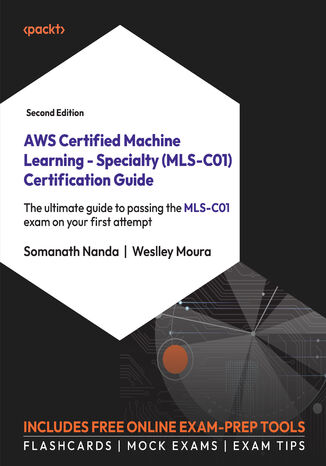
Somanath Nanda, Weslley Moura
The AWS Certified Machine Learning Specialty (MLS-C01) exam evaluates your ability to execute machine learning tasks on AWS infrastructure. This comprehensive book aligns with the latest exam syllabus, offering practical examples to support your real-world machine learning projects on AWS. Additionally, you'll get lifetime access to supplementary online resources, including mock exams with exam-like timers, detailed solutions, interactive flashcards, and invaluable exam tips, all accessible across various devices—PCs, tablets, and smartphones.Throughout the book, you’ll learn data preparation techniques for machine learning, covering diverse methods for data manipulation and transformation across different variable types. Addressing challenges such as missing data and outliers, the book guides you through an array of machine learning tasks including classification, regression, clustering, forecasting, anomaly detection, text mining, and image processing, accompanied by requisite machine learning algorithms essential for exam success. The book helps you master the deployment of models in production environments and their subsequent monitoring.Equipped with insights from this book and the accompanying mock exams, you'll be fully prepared to achieve the AWS MLS-C01 certification.
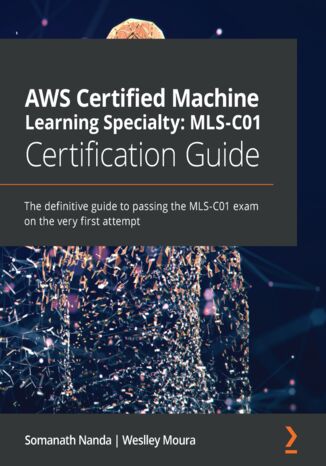
Somanath Nanda, Weslley Moura
The AWS Certified Machine Learning Specialty exam tests your competency to perform machine learning (ML) on AWS infrastructure. This book covers the entire exam syllabus using practical examples to help you with your real-world machine learning projects on AWS.Starting with an introduction to machine learning on AWS, you'll learn the fundamentals of machine learning and explore important AWS services for artificial intelligence (AI). You'll then see how to prepare data for machine learning and discover a wide variety of techniques for data manipulation and transformation for different types of variables. The book also shows you how to handle missing data and outliers and takes you through various machine learning tasks such as classification, regression, clustering, forecasting, anomaly detection, text mining, and image processing, along with the specific ML algorithms you need to know to pass the exam. Finally, you'll explore model evaluation, optimization, and deployment and get to grips with deploying models in a production environment and monitoring them.By the end of this book, you'll have gained knowledge of the key challenges in machine learning and the solutions that AWS has released for each of them, along with the tools, methods, and techniques commonly used in each domain of AWS ML.
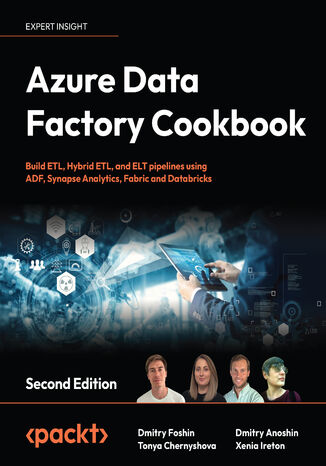
Dmitry Foshin, Tonya Chernyshova, Dmitry Anoshin, Xenia...
This new edition of the Azure Data Factory book, fully updated to reflect ADS V2, will help you get up and running by showing you how to create and execute your first job in ADF. There are updated and new recipes throughout the book based on developments happening in Azure Synapse, Deployment with Azure DevOps, and Azure Purview. The current edition also runs you through Fabric Data Factory, Data Explorer, and some industry-grade best practices with specific chapters on each.You’ll learn how to branch and chain activities, create custom activities, and schedule pipelines, as well as discover the benefits of cloud data warehousing, Azure Synapse Analytics, and Azure Data Lake Gen2 Storage. With practical recipes, you’ll learn how to actively engage with analytical tools from Azure Data Services and leverage your on-premises infrastructure with cloud-native tools to get relevant business insights. You'll familiarize yourself with the common errors that you may encounter while working with ADF and find out the solutions to them. You’ll also understand error messages and resolve problems in connectors and data flows with the debugging capabilities of ADF.By the end of this book, you’ll be able to use ADF with its latest advancements as the main ETL and orchestration tool for your data warehouse projects.
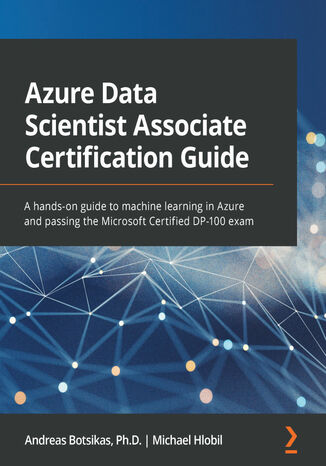
Andreas Botsikas , Michael Hlobil
The Azure Data Scientist Associate Certification Guide helps you acquire practical knowledge for machine learning experimentation on Azure. It covers everything you need to pass the DP-100 exam and become a certified Azure Data Scientist Associate.Starting with an introduction to data science, you'll learn the terminology that will be used throughout the book and then move on to the Azure Machine Learning (Azure ML) workspace. You'll discover the studio interface and manage various components, such as data stores and compute clusters.Next, the book focuses on no-code and low-code experimentation, and shows you how to use the Automated ML wizard to locate and deploy optimal models for your dataset. You'll also learn how to run end-to-end data science experiments using the designer provided in Azure ML Studio.You'll then explore the Azure ML Software Development Kit (SDK) for Python and advance to creating experiments and publishing models using code. The book also guides you in optimizing your model's hyperparameters using Hyperdrive before demonstrating how to use responsible AI tools to interpret and debug your models. Once you have a trained model, you'll learn to operationalize it for batch or real-time inferences and monitor it in production.By the end of this Azure certification study guide, you'll have gained the knowledge and the practical skills required to pass the DP-100 exam.