
Big data
Shilpi Saxena, Selva raj Ramasamy, Prateek Bhati,...
With the rise of Big Data, there is an increasing need to process large amounts of data continuously, with a shorter turnaround time. Real-time data processing involves continuous input, processing and output of data, with the condition that the time required for processing is as short as possible.This book covers the majority of the existing and evolving open source technology stack for real-time processing and analytics. You will get to know about all the real-time solution aspects, from the source to the presentation to persistence. Through this practical book, you’ll be equipped with a clear understanding of how to solve challenges on your own.We’ll cover topics such as how to set up components, basic executions, integrations, advanced use cases, alerts, and monitoring. You’ll be exposed to the popular tools used in real-time processing today such as Apache Spark, Apache Flink, and Storm. Finally, you will put your knowledge to practical use by implementing all of the techniques in the form of a practical, real-world use case.By the end of this book, you will have a solid understanding of all the aspects of real-time data processing and analytics, and will know how to deploy the solutions in production environments in the best possible manner.
Pethuru Raj Chelliah, Shreyash Naithani, Shailender Singh
Site reliability engineering (SRE) is being touted as the most competent paradigm in establishing and ensuring next-generation high-quality software solutions.This book starts by introducing you to the SRE paradigm and covers the need for highly reliable IT platforms and infrastructures. As you make your way through the next set of chapters, you will learn to develop microservices using Spring Boot and make use of RESTful frameworks. You will also learn about GitHub for deployment, containerization, and Docker containers. Practical Site Reliability Engineering teaches you to set up and sustain containerized cloud environments, and also covers architectural and design patterns and reliability implementation techniques such as reactive programming, and languages such as Ballerina and Rust. In the concluding chapters, you will get well-versed with service mesh solutions such as Istio and Linkerd, and understand service resilience test practices, API gateways, and edge/fog computing.By the end of this book, you will have gained experience on working with SRE concepts and be able to deliver highly reliable apps and services.
Valentina Costa-Gazcón
Threat hunting (TH) provides cybersecurity analysts and enterprises with the opportunity to proactively defend themselves by getting ahead of threats before they can cause major damage to their business.This book is not only an introduction for those who don’t know much about the cyber threat intelligence (CTI) and TH world, but also a guide for those with more advanced knowledge of other cybersecurity fields who are looking to implement a TH program from scratch.You will start by exploring what threat intelligence is and how it can be used to detect and prevent cyber threats. As you progress, you’ll learn how to collect data, along with understanding it by developing data models. The book will also show you how to set up an environment for TH using open source tools. Later, you will focus on how to plan a hunt with practical examples, before going on to explore the MITRE ATT&CK framework.By the end of this book, you’ll have the skills you need to be able to carry out effective hunts in your own environment.
PKS Prakash, Avishek Pal
Time Series Analysis allows us to analyze data which is generated over a period of time and has sequential interdependencies between the observations. This book describes special mathematical tricks and techniques which are geared towards exploring the internal structures of time series data and generating powerful descriptive and predictive insights. Also, the book is full of real-life examples of time series and their analyses using cutting-edge solutions developed in Python. The book starts with descriptive analysis to create insightful visualizations of internal structures such as trend, seasonality, and autocorrelation. Next, the statistical methods of dealing with autocorrelation and non-stationary time series are described. This is followed by exponential smoothing to produce meaningful insights from noisy time series data. At this point, we shift focus towards predictive analysis and introduce autoregressive models such as ARMA and ARIMA for time series forecasting. Later, powerful deep learning methods are presented, to develop accurate forecasting models for complex time series, and under the availability of little domain knowledge. All the topics are illustrated with real-life problem scenarios and their solutions by best-practice implementations in Python.The book concludes with the Appendix, with a brief discussion of programming and solving data science problems using Python.
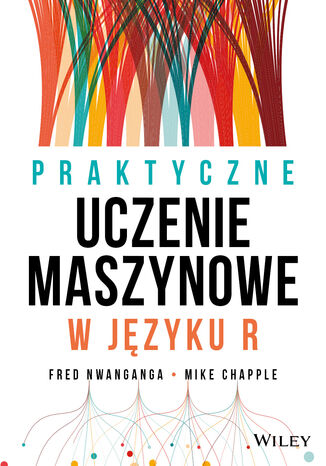
Praktyczne uczenie maszynowe w języku R
Fred Nwanganga, Mike Chapple
WPROWADZENIE DO UCZENIA MASZYNOWEGO Z WYKORZYSTANIEM INTUICYJNEGO JĘZYKA R Uczenie maszynowe i analiza danych pełnią coraz ważniejszą rolę w tworzeniu wartości dodanej. Uczenie maszynowe pozwala znajdować ukryte w danych zależności, wnosząc nowe pomysły i wiedzę, którą trudno byłoby osiągnąć bez tej zaawansowanej techniki. Książka Praktyczne uczenie maszynowe w języku R to wstępne przygotowanie do pracy z dużymi zbiorami danych w języku R, który jest łatwy w zrozumieniu i został opracowany specjalnie z myślą o analizie statystycznej. Nawet osoby bez doświadczenia w programowaniu mogą skorzystać z tej książki, dowiadując się, w jaki sposób praktyczne zastosowania uczenia maszynowego pozwalają analitykom danych pozyskiwać strategiczne informacje biznesowe, solidne prognozy i podejmować trafniejsze decyzje. W odróżnieniu od innych książek na ten temat, Praktyczne uczenie maszynowe w języku R oferuje zarówno teoretyczne, jak i techniczne wprowadzenie do uczenia maszynowego. W przykładach i ćwiczeniach wykorzystywany jest język programowania R oraz najnowsze narzędzia analizy danych, co pozwala zacząć pracę bez nadmiernego zagłębiania się w zaawansowaną matematykę. Dzięki tej książce techniki uczenia maszynowego – począwszy od regresji logistycznej po reguły asocjacyjne i analizę skupień – są w zasięgu ręki. Jedyna publikacja, która łączy intuicyjne wprowadzenie do uczenia maszynowego z opisami zastosowań technicznych krok po kroku. Praktyczne uczenie maszynowe w języku R pokaże jak: przyswoić koncepcje różnych typów uczenia maszynowego, odkrywać wzorce ukryte w dużych zbiorach danych, pisać i wykonywać skrypty R za pomocą RStudio, używać języka R w połączeniu z pakietami Tidyverse do zarządzania danymi i ich wizualizacji, stosować podstawowe techniki statystyczne, takie jak regresja logistyczna czy naiwny klasyfikator Bayesa, oceniać i ulepszać modele uczenia maszynowego. DR FRED NWANGANGA jest profesorem uczelni na wydziale Business Analytics w Mendoza College of Business na uniwersytecie Notre Dame, Indiana, USA. Ma ponad 15-letnie doświadczenie w pełnieniu roli lidera technicznego. DR MIKE CHAPPLE jest profesorem uczelni na wydziale Technology, Analytics, and Operations w Mendoza College of Business. Mike jest autorem ponad 25 poczytnych książek i pełni funkcję dyrektora naukowego programu studiów magisterskich z analizy biznesowej.
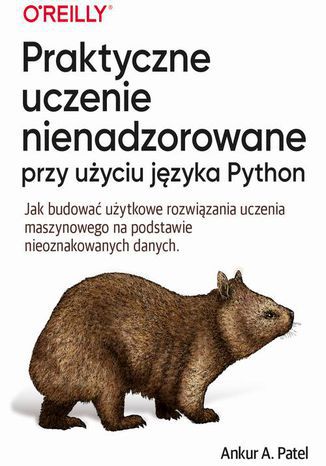
Praktyczne uczenie nienadzorowane przy użyciu języka Python
Ankur A. Patel
Wielu ekspertów branżowych uważa uczenie nienadzorowane za kolejną granicę w dziedzinie sztucznej inteligencji, która może stanowić klucz do pełnej sztucznej inteligencji. Ponieważ większość danych na świecie jest nieoznakowana, nie można do nich zastosować konwencjonalnego uczenia nadzorowanego. Z kolei uczenie nienadzorowane może być stosowane wobec nieoznakowanych zbiorów danych w celu odkrycia istotnych wzorców ukrytych głęboko w tych danych, które dla człowieka mogą być niemal niemożliwe do odkrycia. Autor Ankur Patel pokazuje, jak stosować uczenie nienadzorowane przy wykorzystaniu dwóch prostych platform dla języka Python: Scikit-learn oraz TensorFlow (wraz z Keras). Dzięki dołączonemu kodowi i praktycznym przykładom analitycy danych będą mogli identyfikować trudne do znalezienia wzorce w danych i odkrywać dogłębne zależności biznesowe, wykrywać anomalie, przeprowadzać automatyczną selekcję zmiennych i generować syntetyczne zbiory danych. Wystarczy znajomość programowania i nieco doświadczenia w uczeniu maszynowym, aby zająć się: Porównywaniem mocnych i słabych stron różnych podejść do uczenia maszynowego: uczenia nadzorowanego, nienadzorowanego i wzmacnianego. Przygotowywaniem i zarządzaniem projektami uczenia maszynowego. Budowaniem systemu wykrywania anomalii w celu wychwycenia oszustwa dotyczącego kard kredytowych. Rozdzielaniem użytkowników na wydzielone i jednorodne grupy. Przeprowadzaniem uczenia pół-nadzorowanego. Opracowywaniem systemów polecania filmów z użyciem ograniczonych automatów Boltzmanna. Generowaniem syntetycznych obrazów przy użyciu generujących sieci antagonistycznych. Badacze, inżynierowie i studenci docenią tę książkę pełną praktycznych technik uczenia nienadzorowanego, napisaną prostym językiem z nieskomplikowanymi przykładami w języku Python, które można szybko i skutecznie implementować. Sarah Nagy Główny analityk danych w firmie Edison Ankur A. Patel jest wiceprezesem ds. informatyki analitycznej w firmie 7Park Data, wspieranej przez firmę inwestycyjną Vista Equity Partners. W firmie 7Park Data, Ankur i jego zespół analizy danych wykorzystują dane alternatywne do opracowywania produktów związanych z danymi dla funduszy hedgingowych i korporacji oraz rozwijają usługi uczenia maszynowego dla klientów firmowych.
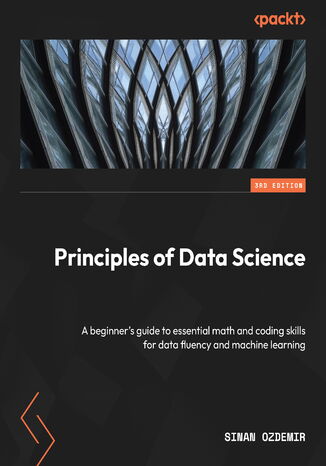
Sinan Ozdemir
Principles of Data Science bridges mathematics, programming, and business analysis, empowering you to confidently pose and address complex data questions and construct effective machine learning pipelines. This book will equip you with the tools to transform abstract concepts and raw statistics into actionable insights.Starting with cleaning and preparation, you’ll explore effective data mining strategies and techniques before moving on to building a holistic picture of how every piece of the data science puzzle fits together. Throughout the book, you’ll discover statistical models with which you can control and navigate even the densest or the sparsest of datasets and learn how to create powerful visualizations that communicate the stories hidden in your data.With a focus on application, this edition covers advanced transfer learning and pre-trained models for NLP and vision tasks. You’ll get to grips with advanced techniques for mitigating algorithmic bias in data as well as models and addressing model and data drift. Finally, you’ll explore medium-level data governance, including data provenance, privacy, and deletion request handling.By the end of this data science book, you'll have learned the fundamentals of computational mathematics and statistics, all while navigating the intricacies of modern ML and large pre-trained models like GPT and BERT.
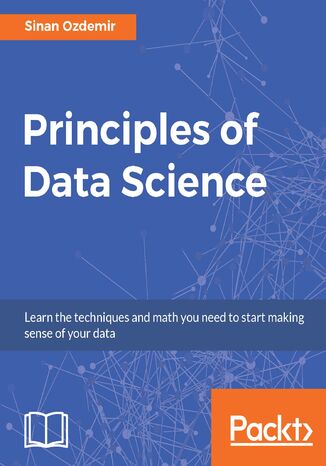
Principles of Data Science. Mathematical techniques and theory to succeed in data-driven industries
Sinan Ozdemir
Need to turn your skills at programming into effective data science skills? Principles of Data Science is created to help you join the dots between mathematics, programming, and business analysis. With this book, you’ll feel confident about asking—and answering—complex and sophisticated questions of your data to move from abstract and raw statistics to actionable ideas.With a unique approach that bridges the gap between mathematics and computer science, this books takes you through the entire data science pipeline. Beginning with cleaning and preparing data, and effective data mining strategies and techniques, you’ll move on to build a comprehensive picture of how every piece of the data science puzzle fits together. Learn the fundamentals of computational mathematics and statistics, as well as some pseudocode being used today by data scientists and analysts. You’ll get to grips with machine learning, discover the statistical models that help you take control and navigate even the densest datasets, and find out how to create powerful visualizations that communicate what your data means.
Sinan Ozdemir, Sunil Kakade, Marco Tibaldeschi
Need to turn programming skills into effective data science skills? This book helps you connect mathematics, programming, and business analysis. You’ll feel confident asking—and answering—complex, sophisticated questions of your data, making abstract and raw statistics into actionable ideas.Going through the data science pipeline, you'll clean and prepare data and learn effective data mining strategies and techniques to gain a comprehensive view of how the data science puzzle fits together. You’ll learn fundamentals of computational mathematics and statistics and pseudo-code used by data scientists and analysts. You’ll learn machine learning, discovering statistical models that help control and navigate even the densest datasets, and learn powerful visualizations that communicate what your data means.
Principles of Strategic Data Science. Creating value from data, big and small
Peter Prevos
Mathematics and computer science form an integral part of data science, and understanding them is crucial for efficiently managing data. This book is designed to take you through the entire data science pipeline and help you join the dots between mathematics, programming, and business analysis. You’ll start by learning what data science is and how organizations can use it to revolutionize the way they use their data. The book then covers the criteria for the soundness of data products and demonstrates how to effectively visualize information. As you progress, you’ll discover the strategic aspects of data science by exploring the five-phase framework that enables you to enhance the value you extract from data. Toward the concluding chapters, you’ll understand the role of a data science manager in helping an organization take the data-driven approach.By the end of this book, you’ll have a good understanding of data science and how it can enable you to extract value from your data.
Srinivasa Rao Aravilli, Sam Hamilton
– In an era of evolving privacy regulations, compliance is mandatory for every enterprise – Machine learning engineers face the dual challenge of analyzing vast amounts of data for insights while protecting sensitive information – This book addresses the complexities arising from large data volumes and the scarcity of in-depth privacy-preserving machine learning expertise, and covers a comprehensive range of topics from data privacy and machine learning privacy threats to real-world privacy-preserving cases – As you progress, you’ll be guided through developing anti-money laundering solutions using federated learning and differential privacy – Dedicated sections will explore data in-memory attacks and strategies for safeguarding data and ML models – You’ll also explore the imperative nature of confidential computation and privacy-preserving machine learning benchmarks, as well as frontier research in the field – Upon completion, you’ll possess a thorough understanding of privacy-preserving machine learning, equipping them to effectively shield data from real-world threats and attacks
MrExcel's Holy Macro! Books, Eduardo N Sanchez
This book dives deep into the world of PowerPoint VBA with this practical guide. Starting with basic operations, the book moves through advanced automation techniques, covering themes, layouts, and animations. Readers will learn to craft professional-grade presentations, create interactive quizzes, and integrate PowerPoint with other Office apps, while mastering VBA essentials.This book provides a comprehensive introduction to PowerPoint VBA, enabling readers to apply programming concepts to automate repetitive tasks, enhance presentations, and build creative visual effects. With real-world projects and practical code examples, the book helps readers gain confidence in customizing PowerPoint features.Whether you're creating professional reports, interactive presentations, or seamless Office integrations, this guide ensures you stay ahead with advanced VBA techniques, enabling you to transform your PowerPoint workflow.
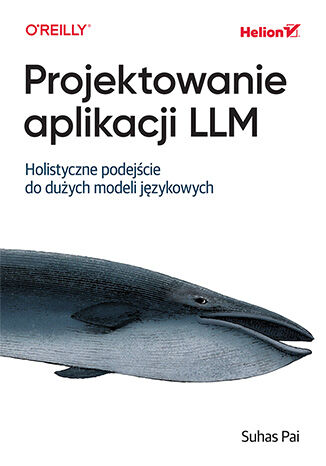
Projektowanie aplikacji LLM. Holistyczne podejście do dużych modeli językowych
Suhas Pai
Duże modele językowe przeniknęły do wielu dziedzin techniki uważa się je za skuteczne narzędzia do rozwiązywania szerokiej gamy problemów. Coraz więcej przedsiębiorstw korzysta z ich potencjału w celu własnego rozwoju. Jednak przekształcenie prototypów w funkcjonalne aplikacje bywa złożone i skomplikowane. To wyjątkowe opracowanie zawiera wszystkie ważne koncepcje w dziedzinie LLM! Madhav Singhal, CEO, AutoComputer W tej praktycznej książce opisano wszelkie niezbędne narzędzia, techniki i rozwiązania, których potrzebujesz do tworzenia użytecznych produktów wykorzystujących potęgę modeli językowych. Na początku zdobędziesz wiedzę o budowie modelu językowego. Następnie poznasz różne sposoby zastosowania modeli językowych, czy to poprzez bezpośrednie zapytania do modelu, czy też poprzez jego dostrajanie. Zrozumiesz ograniczenia LLM, takie jak halucynacje i problemy z rozumowaniem, a także dowiesz się, jak sobie z nimi poradzić. Znajdziesz tu również omówienie paradygmatów zastosowań, takich jak generowanie wspomagane wyszukiwaniem (RAG) czy agenty. Z tą książką: przygotujesz zbiory danych do treningu i dostrajania modeli zrozumiesz architekturę transformera zaadaptujesz wstępnie wytrenowane modele do własnych potrzeb poznasz skuteczne techniki optymalizacji i adaptacji dziedzinowej dowiesz się, jak integrować modele językowe z zewnętrznymi środowiskami i źródłami danych Gorąco polecam tę książkę! Megan Risdal, Kaggle (Google) To mistrzowski kurs budowania zaawansowanych systemów AI! Jay Alammar, autor książek
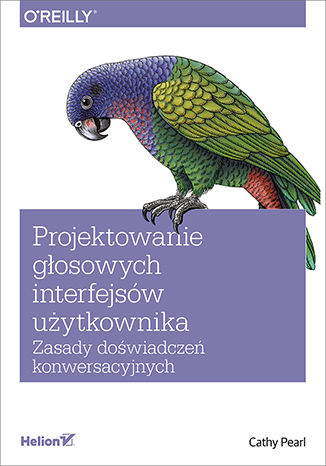
Projektowanie głosowych interfejsów użytkownika. Zasady doświadczeń konwersacyjnych
Cathy Pearl
Możliwość porozmawiania ze swoim komputerem od lat rozpalała wyobraźnię inżynierów, użytkowników i... artystów. Jak się okazało, sprawa nie jest - i nigdy nie była - oczywista: rozumienie naturalnej mowy to skomplikowany proces. Języki, którymi posługują się ludzie, są bowiem przepełnione subtelnościami i niejednoznacznością, a ich zrozumienie wymaga znajomości kontekstu. Intensywny rozwój technologii VUI doprowadził do tego, że komputer wykonujący polecenia głosowe nie jest niczym nadzwyczajnym. Wciąż jednak sporo można w tej dziedzinie poprawić. Szczególnie ważne wydaje się wzięcie pod uwagę wrażeń użytkownika: interfejs VUI, który jest uciążliwy dla odbiorcy, nie podaje potrzebnych informacji lub podaje zupełnie nieprzydatne, będzie użytkowany z niechęcią albo wcale. W tym przewodniku znajdziesz przegląd najważniejszych zasad projektowania interfejsów głosowych, a także opis narzędzi służących do tego celu. Poza najbardziej podstawowymi informacjami o mechanizmach rozpoznawania głosu omówiono złożone strategie rozumienia języka naturalnego, analizę nastroju, zbieranie danych oraz techniki przekształcania tekstu w mowę. W książce wyczerpująco opisano zagadnienia wydajności interfejsu VUI: dowiesz się, co na tę wydajność wpływa i w jaki sposób można ją podnieść. Przedstawiono również problematykę systemów sterowanych głosowo, takich jak asystenty domowe czy interfejsy projektowane dla samochodów. Z przewodnika skorzystają zarówno menedżerowie oraz projektanci biznesowi, jak i projektanci interfejsów VUI, niezależnie od tego, czy samodzielnie piszą swoje VUI, czy korzystają z istniejących platform. W książce: kluczowe koncepcje projektów interfejsów głosowych wizualne reprezentacje interfejsów głosowych technologie rozpoznawania mowy metody testowania aplikacji głosowych poprawa wydajności aplikacji głosowych rzeczywiste przykłady interfejsów głosowych
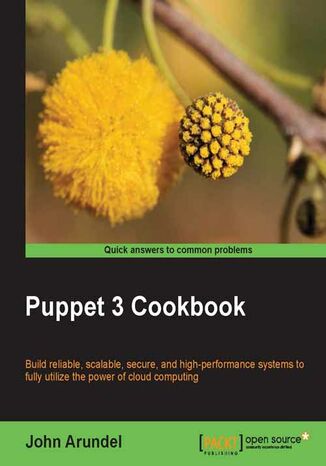
John Arundel
A revolution is happening in web operations. Configuration management tools can build servers in seconds, and automate your entire network. Tools like Puppet are essential to taking full advantage of the power of cloud computing, and building reliable, scalable, secure, high-performance systems. More and more systems administration and IT jobs require some knowledge of configuration management, and specifically Puppet.Puppet 3 Cookbook takes you beyond the basics to explore the full power of Puppet, showing you in detail how to tackle a variety of real-world problems and applications. At every step it shows you exactly what commands you need to type, and includes full code samples for every recipe.The book takes the reader from a basic knowledge of Puppet to a complete and expert understanding of Puppet's latest and most advanced features, community best practices, writing great manifests, scaling and performance, and extending Puppet by adding your own providers and resources. It starts with guidance on how to set up and expand your Puppet infrastructure, then progresses through detailed information on the language and features, external tools, reporting, monitoring, and troubleshooting, and concludes with many specific recipes for managing popular applications.The book includes real examples from production systems and techniques that are in use in some of the world's largest Puppet installations, including a distributed Puppet architecture based on the Git version control system. You'll be introduced to powerful tools that work with Puppet such as Hiera. The book also explains managing Ruby applications and MySQL databases, building web servers, load balancers, high-availability systems with Heartbeat, and many other state-of-the-art techniques
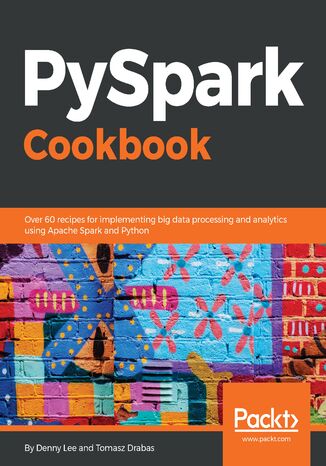
Denny Lee, Tomasz Drabas
Apache Spark is an open source framework for efficient cluster computing with a strong interface for data parallelism and fault tolerance. The PySpark Cookbook presents effective and time-saving recipes for leveraging the power of Python and putting it to use in the Spark ecosystem.You’ll start by learning the Apache Spark architecture and how to set up a Python environment for Spark. You’ll then get familiar with the modules available in PySpark and start using them effortlessly. In addition to this, you’ll discover how to abstract data with RDDs and DataFrames, and understand the streaming capabilities of PySpark. You’ll then move on to using ML and MLlib in order to solve any problems related to the machine learning capabilities of PySpark and use GraphFrames to solve graph-processing problems. Finally, you will explore how to deploy your applications to the cloud using the spark-submit command.By the end of this book, you will be able to use the Python API for Apache Spark to solve any problems associated with building data-intensive applications.