
Big data
The Tableau Workshop. A practical guide to the art of data visualization with Tableau
Sumit Gupta, Sylvester Pinto, Shweta Savale, JC...
Learning Tableau has never been easier, thanks to this practical introduction to storytelling with data. The Tableau Workshop breaks down the analytical process into five steps: data preparation, data exploration, data analysis, interactivity, and distribution of dashboards. Each stage is addressed with a clear walkthrough of the key tools and techniques you'll need, as well as engaging real-world examples, meaningful data, and practical exercises to give you valuable hands-on experience.As you work through the book, you'll learn Tableau step by step, studying how to clean, shape, and combine data, as well as how to choose the most suitable charts for any given scenario. You'll load data from various sources and formats, perform data engineering to create new data that delivers deeper insights, and create interactive dashboards that engage end-users.All concepts are introduced with clear, simple explanations and demonstrated through realistic example scenarios. You'll simulate real-world data science projects with use cases such as traffic violations, urban populations, coffee store sales, and air travel delays.By the end of this Tableau book, you'll have the skills and knowledge to confidently present analytical results and make data-driven decisions.
Matthew Moocarme, Abhranshu Bagchi, Anthony So ,...
Getting to grips with tensors, deep learning, and neural networks can be intimidating and confusing for anyone, no matter their experience level. The breadth of information out there, often written at a very high level and aimed at advanced practitioners, can make getting started even more challenging.If this sounds familiar to you, The TensorFlow Workshop is here to help. Combining clear explanations, realistic examples, and plenty of hands-on practice, it’ll quickly get you up and running.You’ll start off with the basics – learning how to load data into TensorFlow, perform tensor operations, and utilize common optimizers and activation functions. As you progress, you’ll experiment with different TensorFlow development tools, including TensorBoard, TensorFlow Hub, and Google Colab, before moving on to solve regression and classification problems with sequential models.Building on this solid foundation, you’ll learn how to tune models and work with different types of neural network, getting hands-on with real-world deep learning applications such as text encoding, temperature forecasting, image augmentation, and audio processing.By the end of this deep learning book, you’ll have the skills, knowledge, and confidence to tackle your own ambitious deep learning projects with TensorFlow.
Shankar Narayanan SGS, Vivekanandan SS, Jeff Hollan
Snowpark is a powerful framework that helps you unlock numerous possibilities within the Snowflake Data Cloud. However, without proper guidance, leveraging the full potential of Snowpark with Python can be challenging. Packed with practical examples and code snippets, this book will be your go-to guide to using Snowpark with Python successfully.The Ultimate Guide to Snowpark helps you develop an understanding of Snowflake Snowpark and how it enables you to implement workloads in data engineering, data science, and data applications within the Data Cloud. From configuration and coding styles to workloads such as data manipulation, collection, preparation, transformation, aggregation, and analysis, this guide will equip you with the right knowledge to make the most of this framework. You'll discover how to build, test, and deploy data pipelines and data science models. As you progress, you’ll deploy data applications natively in Snowflake and operate large language models (LLMs) using Snowpark container services.By the end of this book, you'll be able to leverage Snowpark's capabilities and propel your career as a Snowflake developer to new heights.
Aaron Jones , Christopher Kruger , Benjamin...
Do you find it difficult to understand how popular companies like WhatsApp and Amazon find valuable insights from large amounts of unorganized data? The Unsupervised Learning Workshop will give you the confidence to deal with cluttered and unlabeled datasets, using unsupervised algorithms in an easy and interactive manner.The book starts by introducing the most popular clustering algorithms of unsupervised learning. You'll find out how hierarchical clustering differs from k-means, along with understanding how to apply DBSCAN to highly complex and noisy data. Moving ahead, you'll use autoencoders for efficient data encoding.As you progress, you’ll use t-SNE models to extract high-dimensional information into a lower dimension for better visualization, in addition to working with topic modeling for implementing natural language processing (NLP). In later chapters, you’ll find key relationships between customers and businesses using Market Basket Analysis, before going on to use Hotspot Analysis for estimating the population density of an area.By the end of this book, you’ll be equipped with the skills you need to apply unsupervised algorithms on cluttered datasets to find useful patterns and insights.
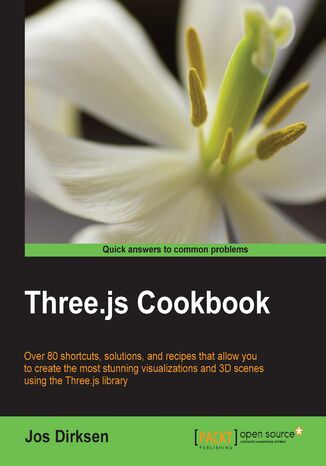
Jos Dirksen
This book is ideal for anyone who already knows JavaScript and would like to get a broad understanding of Three.js quickly, or for those of you who have a basic grasp of using Three.js but want to really make an impact with your 3D visualizations by learning its advanced features. To apply the recipes in this book you don’t need to know anything about WebGL; all you need is some general knowledge about JavaScript and HTML.
Michaël Hoarau
Being a business analyst and data scientist, you have to use many algorithms and approaches to prepare, process, and build ML-based applications by leveraging time series data, but you face common problems, such as not knowing which algorithm to choose or how to combine and interpret them. Amazon Web Services (AWS) provides numerous services to help you build applications fueled by artificial intelligence (AI) capabilities. This book helps you get to grips with three AWS AI/ML-managed services to enable you to deliver your desired business outcomes.The book begins with Amazon Forecast, where you’ll discover how to use time series forecasting, leveraging sophisticated statistical and machine learning algorithms to deliver business outcomes accurately. You’ll then learn to use Amazon Lookout for Equipment to build multivariate time series anomaly detection models geared toward industrial equipment and understand how it provides valuable insights to reinforce teams focused on predictive maintenance and predictive quality use cases. In the last chapters, you’ll explore Amazon Lookout for Metrics, and automatically detect and diagnose outliers in your business and operational data.By the end of this AWS book, you’ll have understood how to use the three AWS AI services effectively to perform time series analysis.
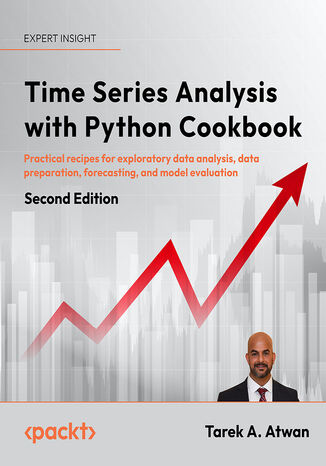
Tarek A. Atwan
To use time series data to your advantage, you need to master data preparation, analysis, and forecasting. This fully refreshed second edition helps you unlock insights from time series data with new chapters on probabilistic models, signal processing techniques, and new content on transformers. You’ll work with the latest releases of popular libraries like Pandas, Polars, Sktime, stats models, stats forecast, Darts, and Prophet through up-to-date examples.You'll hit the ground running by ingesting time series data from various sources and formats and learn strategies for handling missing data, dealing with time zones and custom business days, and detecting anomalies using intuitive statistical methods.Through detailed instructions, you'll explore forecasting using classical statistical models such as Holt-Winters, SARIMA, and VAR, and learn practical techniques for handling non-stationary data using power transforms, ACF and PACF plots, and decomposing time series data with seasonal patterns. The recipes then level up to cover more advanced topics such as building ML and DL models using TensorFlow and PyTorch and applying probabilistic modeling techniques. In this part, you’ll also be able to evaluate, compare, and optimize models, finishing with a strong command of wrangling data with Python.
Yoni Ramaswami, Dael Williamson, Jan Govaere
Written by Databricks Senior Solutions Architect Yoni Ramaswami, whose expertise in Data and AI has shaped innovative digital transformations across industries, this comprehensive guide bridges foundational concepts of time series analysis with the Spark framework and Databricks, preparing you to tackle real-world challenges with confidence.From preparing and processing large-scale time series datasets to building reliable models, this book offers practical techniques that scale effortlessly for big data environments. You’ll explore advanced topics such as scaling your analyses, deploying time series models into production, Generative AI, and leveraging Spark's latest features for cutting-edge applications across industries. Packed with hands-on examples and industry-relevant use cases, this guide is perfect for data engineers, ML engineers, data scientists, and analysts looking to enhance their expertise in handling large-scale time series data.By the end of this book, you’ll have mastered the skills to design and deploy robust, scalable time series models tailored to your unique project needs—qualifying you to excel in the rapidly evolving world of big data analytics.*Email sign-up and proof of purchase required
Time Series with PyTorch. Modern Deep Learning Toolkit for Real-World Forecasting Challenges
Graeme Davidson, Lei Ma
Neural networks are powerful tools for time-series forecasting, but applying them effectively requires both practical experience and a clear understanding of architectures, training strategies, and evaluation methods. This book brings these ideas together in a structured and practical way.Starting with PyTorch fundamentals, you will build neural networks from scratch and progress through recurrent networks, attention mechanisms, and transformers before exploring forecasting architectures such as N-BEATS, N-HiTS, and the Temporal Fusion Transformer. Along the way, you will learn robust hyperparameter tuning, conformal prediction for uncertainty estimation, and reliable evaluation practices.Unlike most forecasting books, this text also explores topics often overlooked or treated separately, including transfer learning across collections of series, synthetic data generation with diffusion models, and self-supervised representation learning. Beyond forecasting, later chapters cover classification, clustering, anomaly detection, and embeddings for large-scale time-series modeling.Throughout, the focus is pragmatic: theory is reinforced through experimentation and implementation so you can apply these methods confidently to real-world time-series problems.
Gian Marco Iodice
This book explores TinyML, a fast-growing field at the unique intersection of machine learning and embedded systems to make AI ubiquitous with extremely low-powered devices such as microcontrollers.The TinyML Cookbook starts with a practical introduction to this multidisciplinary field to get you up to speed with some of the fundamentals for deploying intelligent applications on Arduino Nano 33 BLE Sense and Raspberry Pi Pico. As you progress, you’ll tackle various problems that you may encounter while prototyping microcontrollers, such as controlling the LED state with GPIO and a push-button, supplying power to microcontrollers with batteries, and more. Next, you’ll cover recipes relating to temperature, humidity, and the three “V” sensors (Voice, Vision, and Vibration) to gain the necessary skills to implement end-to-end smart applications in different scenarios. Later, you’ll learn best practices for building tiny models for memory-constrained microcontrollers. Finally, you’ll explore two of the most recent technologies, microTVM and microNPU that will help you step up your TinyML game.By the end of this book, you’ll be well-versed with best practices and machine learning frameworks to develop ML apps easily on microcontrollers and have a clear understanding of the key aspects to consider during the development phase.
Gian Marco Iodice
Discover the incredible world of tiny Machine Learning (tinyML) and create smart projects using real-world data sensors with the Arduino Nano 33 BLE Sense, Raspberry Pi Pico, and SparkFun RedBoard Artemis Nano.TinyML Cookbook, Second Edition, will show you how to build unique end-to-end ML applications using temperature, humidity, vision, audio, and accelerometer sensors in different scenarios. These projects will equip you with the knowledge and skills to bring intelligence to microcontrollers. You'll train custom models from weather prediction to real-time speech recognition using TensorFlow and Edge Impulse.Expert tips will help you squeeze ML models into tight memory budgets and accelerate performance using CMSIS-DSP.This improved edition includes new recipes featuring an LSTM neural network to recognize music genres and the Faster-Objects-More-Objects (FOMO) algorithm for detecting objects in a scene. Furthermore, you’ll work on scikit-learn model deployment on microcontrollers, implement on-device training, and deploy a model using microTVM, including on a microNPU. This beginner-friendly and comprehensive book will help you stay up to date with the latest developments in the tinyML community and give you the knowledge to build unique projects with microcontrollers!
TinyML. Wykorzystanie TensorFlow Lite do uczenia maszynowego na Arduino i innych mikrokontrolerach
Pete Warden, Daniel Situnayake
Może się wydawać, że profesjonalne systemy uczenia maszynowego wymagają sporych zasobów mocy obliczeniowej i energii. Okazuje się, że niekoniecznie: można tworzyć zaawansowane, oparte na sieciach neuronowych aplikacje, które doskonale poradzą sobie bez potężnych procesorów. Owszem, praca na mikrokontrolerach podobnych do Arduino lub systemach wbudowanych wymaga pewnego przygotowania i odpowiedniego podejścia, jest to jednak fascynujący sposób na wykorzystanie niewielkich urządzeń o niskim zapotrzebowaniu na energię do tworzenia zdumiewających projektów. Ta książka jest przystępnym wprowadzeniem do skomplikowanego świata, w którym za pomocą techniki TinyML wdraża się głębokie uczenie maszynowe w systemach wbudowanych. Nie musisz mieć żadnego doświadczenia z zakresu uczenia maszynowego czy pracy z mikrokontrolerami. W książce wyjaśniono, jak można trenować modele na tyle małe, by mogły działać w każdym środowisku - również Arduino. Dokładnie opisano sposoby użycia techniki TinyML w tworzeniu systemów wbudowanych opartych na zastosowaniu ucze nia maszynowego. Zaprezentowano też kilka ciekawych projektów, na przykład dotyczący budowy urządzenia rozpoznającego mowę, magicznej różdżki reagującej na gesty, a także rozszerzenia możliwości kamery o wykrywanie ludzi. W książce między innymi: praca z Arduino i innymi mikrokontrolerami o niskim poborze mocy podstawy uczenia maszynowego, budowy i treningu modeli TensorFlow Lite i zestaw narzędzi Google dla TinyML bezpieczeństwo i ochrona prywatności w aplikacji optymalizacja modelu tworzenie modeli do interpretacji różnego rodzaju danych Ograniczone zasoby? Poznaj TinyML!
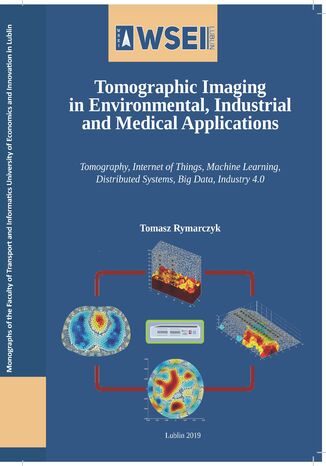
Tomographic imaging in environmental, industrial and medical applications
Tomasz Rymarczyk
Monografia przedstawia szeroki zakres dziedzin, w których znajduje zastosowanie tomografia. W nowatorski sposób prezentuje ważne zagadnienia z zakresu rozwiązywania problemów odwrotnych w tomografii przemysłowej oraz prototypów, pomiarów i modeli układów złożonych. Rozważania i dogłębna analiza numeryczna zastosowana na potrzeby rozwiązania problemu naprzód i odwrotnego czynią tę pracę wyjątkową w skali krajowej i międzynarodowej. Autor wniósł znaczący wkład w rozwój naukowej dyscypliny: Informatyka w aspekcie praktycznych zastosowań, zarówno przemysłowych, jak i medycznych. Używał tomografii procesowej do badania bardzo dużych obiektów. Obiekty te to wielohektarowe obszary położone w znacznej odległości od siebie. To innowacyjne zastosowanie tomografii procesowej
Train Your Own GPT. How to Train ChatGPT to Think Like You
MrExcel's Holy Macro! Books, Bill Jelen
This book offers a hands-on guide to building GPTs that learn, adapt, and respond in your unique style. It begins by breaking down how ChatGPT understands instructions, then guides readers through training personalized GPTs that automate tasks, create structured outputs, and integrate across business applications.Readers gain practical experience in linking GPTs with Excel, Power Automate, and APIs while exploring advanced memory, context, and action features. With clear guidance, examples, and exercises, the book bridges theory and application to make AI personalization achievable for any professional.By the end, readers can confidently design custom AI agents that extend beyond ChatGPT’s limits—capable of mirroring workflows, preferences, and communication style for real-world automation and creativity.
MrExcel's Holy Macro! Books, Mike Girvin
This book begins with the fundamentals, introducing key concepts like let expressions, keywords, and identifiers, before guiding you through more advanced techniques such as creating custom functions, handling diverse data types, and building reusable queries. Each chapter combines theoretical insights with practical examples, empowering you to handle complex data challenges with confidence.As you progress, you’ll learn how to master lookup formulas, manipulate data with unpivot, append, join, and group operations, and explore advanced table transformations. A dedicated section on data connectors provides in-depth knowledge of importing data from various sources and locales, ensuring flexibility and adaptability.The book concludes with practical data modeling projects that include handling inconsistent tables, appending multiple files, and building dynamic SharePoint connections. With a final focus on privacy levels and data security, this book equips you to use Power Query effectively and securely in real-world scenarios.
Denis Rothman
Transformers for Natural Language Processing and Computer Vision, Third Edition, explores Large Language Model (LLM) architectures, practical applications, and popular platforms (Hugging Face, OpenAI, and Google Vertex AI) used for Natural Language Processing (NLP) and Computer Vision (CV).The book guides you through a range of transformer architectures from foundation models and generative AI. You’ll pretrain and fine-tune LLMs and work through different use cases, from summarization to question-answering systems leveraging embedding-based search. You'll also implement Retrieval Augmented Generation (RAG) to enhance accuracy and gain greater control over your LLM outputs. Additionally, you’ll understand common LLM risks, such as hallucinations, memorization, and privacy issues, and implement mitigation strategies using moderation models alongside rule-based systems and knowledge integration.Dive into generative vision transformers and multimodal architectures, and build practical applications, such as image and video classification. Go further and combine different models and platforms to build AI solutions and explore AI agent capabilities.This book provides you with an understanding of transformer architectures, including strategies for pretraining, fine-tuning, and LLM best practices.