
Big data
Ayodele Oluleye
In today's data-centric world, the ability to extract meaningful insights from vast amounts of data has become a valuable skill across industries. Exploratory Data Analysis (EDA) lies at the heart of this process, enabling us to comprehend, visualize, and derive valuable insights from various forms of data.This book is a comprehensive guide to Exploratory Data Analysis using the Python programming language. It provides practical steps needed to effectively explore, analyze, and visualize structured and unstructured data. It offers hands-on guidance and code for concepts such as generating summary statistics, analyzing single and multiple variables, visualizing data, analyzing text data, handling outliers, handling missing values and automating the EDA process. It is suited for data scientists, data analysts, researchers or curious learners looking to gain essential knowledge and practical steps for analyzing vast amounts of data to uncover insights.Python is an open-source general purpose programming language which is used widely for data science and data analysis given its simplicity and versatility. It offers several libraries which can be used to clean, analyze, and visualize data. In this book, we will explore popular Python libraries such as Pandas, Matplotlib, and Seaborn and provide workable code for analyzing data in Python using these libraries.By the end of this book, you will have gained comprehensive knowledge about EDA and mastered the powerful set of EDA techniques and tools required for analyzing both structured and unstructured data to derive valuable insights.
Exploring GPT-3. An unofficial first look at the general-purpose language processing API from OpenAI
Steve Tingiris
Generative Pre-trained Transformer 3 (GPT-3) is a highly advanced language model from OpenAI that can generate written text that is virtually indistinguishable from text written by humans. Whether you have a technical or non-technical background, this book will help you understand and start working with GPT-3 and the OpenAI API.If you want to get hands-on with leveraging artificial intelligence for natural language processing (NLP) tasks, this easy-to-follow book will help you get started. Beginning with a high-level introduction to NLP and GPT-3, the book takes you through practical examples that show how to leverage the OpenAI API and GPT-3 for text generation, classification, and semantic search. You'll explore the capabilities of the OpenAI API and GPT-3 and find out which NLP use cases GPT-3 is best suited for. You’ll also learn how to use the API and optimize requests for the best possible results. With examples focusing on the OpenAI Playground and easy-to-follow JavaScript and Python code samples, the book illustrates the possible applications of GPT-3 in production.By the end of this book, you'll understand the best use cases for GPT-3 and how to integrate the OpenAI API in your applications for a wide array of NLP tasks.
Steven Sanderson, David Kun
– Extending Excel with Python and R is a game changer resource written by experts Steven Sanderson, the author of the healthyverse suite of R packages, and David Kun, co-founder of Functional Analytics. – This comprehensive guide transforms the way you work with spreadsheet-based data by integrating Python and R with Excel to automate tasks, execute statistical analysis, and create powerful visualizations. – Working through the chapters, you’ll find out how to perform exploratory data analysis, time series analysis, and even integrate APIs for maximum efficiency. – Both beginners and experts will get everything you need to unlock Excel's full potential and take your data analysis skills to the next level. – By the end of this book, you’ll be able to import data from Excel, manipulate it in R or Python, and perform the data analysis tasks in your preferred framework while pushing the results back to Excel for sharing with others as needed.
Luca Zavarella
Python and R allow you to extend Power BI capabilities to simplify ingestion and transformation activities, enhance dashboards, and highlight insights. With this book, you'll be able to make your artifacts far more interesting and rich in insights using analytical languages.You'll start by learning how to configure your Power BI environment to use your Python and R scripts. The book then explores data ingestion and data transformation extensions, and advances to focus on data augmentation and data visualization. You'll understand how to import data from external sources and transform them using complex algorithms. The book helps you implement personal data de-identification methods such as pseudonymization, anonymization, and masking in Power BI. You'll be able to call external APIs to enrich your data much more quickly using Python programming and R programming. Later, you'll learn advanced Python and R techniques to perform in-depth analysis and extract valuable information using statistics and machine learning. You'll also understand the main statistical features of datasets by plotting multiple visual graphs in the process of creating a machine learning model.By the end of this book, you’ll be able to enrich your Power BI data models and visualizations using complex algorithms in Python and R.
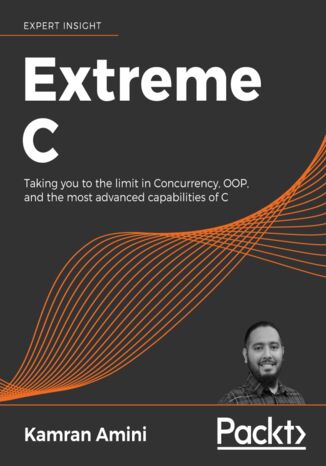
Extreme C. Taking you to the limit in Concurrency, OOP, and the most advanced capabilities of C
Kamran Amini
There’s a lot more to C than knowing the language syntax. The industry looks for developers with a rigorous, scientific understanding of the principles and practices. Extreme C will teach you to use C’s advanced low-level power to write effective, efficient systems. This intensive, practical guide will help you become an expert C programmer.Building on your existing C knowledge, you will master preprocessor directives, macros, conditional compilation, pointers, and much more. You will gain new insight into algorithm design, functions, and structures. You will discover how C helps you squeeze maximum performance out of critical, resource-constrained applications.C still plays a critical role in 21st-century programming, remaining the core language for precision engineering, aviations, space research, and more. This book shows how C works with Unix, how to implement OO principles in C, and fully covers multi-processing.In Extreme C, Amini encourages you to think, question, apply, and experiment for yourself. The book is essential for anybody who wants to take their C to the next level.
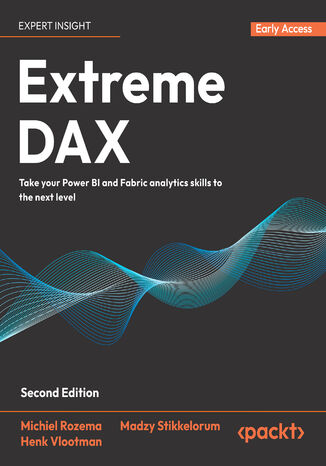
Extreme DAX. Take your Power BI and Fabric analytics skills to the next level - Second Edition
Michiel Rozema, Madzy Stikkelorum, Henk Vlootman, Jeroen...
This book helps experienced analysts unlock the full potential of DAX in Power BI and Microsoft Fabric to build scalable, production-ready analytics solutions.You’ll begin by strengthening your understanding of semantic models, data modeling, and evaluation context—the foundation of reliable analytics. Instead of isolated examples, the book uses real-world scenarios such as inventory analysis, benchmarking, and data security to show how advanced DAX calculations are applied in practice.As you progress, you’ll master advanced techniques including context transition, table functions, calculation groups, field parameters, and custom calendars. You’ll also explore analytical methods such as regression and goal-seeking to generate deeper insights from your data.With step-by-step guidance and practical PBIX examples, you’ll learn how to design efficient models, avoid common pitfalls, and implement reusable calculations. By the end, you’ll be able to create advanced DAX measures and high-performance Power BI solutions for complex analytical requirements.
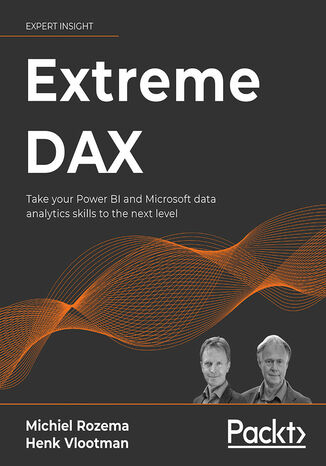
Extreme DAX. Take your Power BI and Microsoft data analytics skills to the next level
Michiel Rozema, Henk Vlootman
This book helps business analysts generate powerful and sophisticated analyses from their data using DAX and get the most out of Microsoft Business Intelligence tools.Extreme DAX will first teach you the principles of business intelligence, good model design, and how DAX fits into it all. Then, you’ll launch into detailed examples of DAX in real-world business scenarios such as inventory calculations, forecasting, intercompany business, and data security. At each step, senior DAX experts will walk you through the subtleties involved in working with Power BI models and common mistakes to look out for as you build advanced data aggregations. You’ll deepen your understanding of DAX functions, filters, and measures, and how and when they can be used to derive effective insights. You’ll also be provided with PBIX files for each chapter, so that you can follow along and explore in your own time.
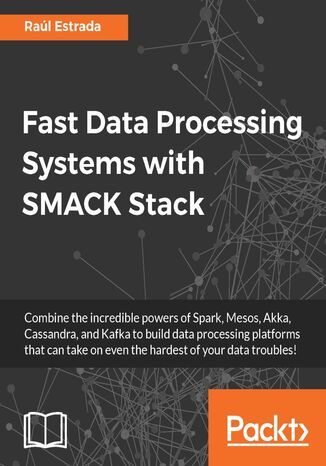
Raúl Estrada
SMACK is an open source full stack for big data architecture. It is a combination of Spark, Mesos, Akka, Cassandra, and Kafka. This stack is the newest technique developers have begun to use to tackle critical real-time analytics for big data. This highly practical guide will teach you how to integrate these technologies to create a highly efficient data analysis system for fast data processing.We’ll start off with an introduction to SMACK and show you when to use it. First you’ll get to grips with functional thinking and problem solving using Scala. Next you’ll come to understand the Akka architecture. Then you’ll get to know how to improve the data structure architecture and optimize resources using Apache Spark. Moving forward, you’ll learn how to perform linear scalability in databases with Apache Cassandra. You’ll grasp the high throughput distributed messaging systems using Apache Kafka. We’ll show you how to build a cheap but effective cluster infrastructure with Apache Mesos. Finally, you will deep dive into the different aspect of SMACK using a few case studies. By the end of the book, you will be able to integrate all the components of the SMACK stack and use them together to achieve highly effective and fast data processing.
Fast Data Processing with Spark 2. Accelerate your data for rapid insight - Third Edition
Krishna Sankar , Holden Karau
When people want a way to process big data at speed, Spark is invariably the solution. With its ease of development (in comparison to the relative complexity of Hadoop), it’s unsurprising that it’s becoming popular with data analysts and engineers everywhere. Beginning with the fundamentals, we’ll show you how to get set up with Spark with minimum fuss. You’ll then get to grips with some simple APIs before investigating machine learning and graph processing – throughout we’ll make sure you know exactly how to apply your knowledge. You will also learn how to use the Spark shell, how to load data before finding out how to build and run your own Spark applications. Discover how to manipulate your RDD and get stuck into a range of DataFrame APIs. As if that’s not enough, you’ll also learn some useful Machine Learning algorithms with the help of Spark MLlib and integrating Spark with R. We’ll also make sure you’re confident and prepared for graph processing, as you learn more about the GraphX API.
Joydeep Bhattacharjee
Facebook's fastText library handles text representation and classification, used for Natural Language Processing (NLP). Most organizations have to deal with enormous amounts of text data on a daily basis, and gaining efficient data insights requires powerful NLP tools such as fastText. This book is your ideal introduction to fastText. You will learn how to create fastText models from the command line, without the need for complicated code. You will explore the algorithms that fastText is built on and how to use them for word representation and text classification. Next, you will use fastText in conjunction with other popular libraries and frameworks such as Keras, TensorFlow, and PyTorch. Finally, you will deploy fastText models to mobile devices. By the end of this book, you will have all the required knowledge to use fastText in your own applications at work or in projects.
Sinan Ozdemir, Divya Susarla, Michael Smith
Feature engineering is the most important step in creating powerful machine learning systems. This book will take you through the entire feature-engineering journey to make your machine learning much more systematic and effective.You will start with understanding your data—often the success of your ML models depends on how you leverage different feature types, such as continuous, categorical, and more, You will learn when to include a feature, when to omit it, and why, all by understanding error analysis and the acceptability of your models. You will learn to convert a problem statement into useful new features. You will learn to deliver features driven by business needs as well as mathematical insights. You'll also learn how to use machine learning on your machines, automatically learning amazing features for your data.By the end of the book, you will become proficient in Feature Selection, Feature Learning, and Feature Optimization.
Feature Store for Machine Learning. Curate, discover, share and serve ML features at scale
Jayanth Kumar M J
Feature store is one of the storage layers in machine learning (ML) operations, where data scientists and ML engineers can store transformed and curated features for ML models. This makes them available for model training, inference (batch and online), and reuse in other ML pipelines. Knowing how to utilize feature stores to their fullest potential can save you a lot of time and effort, and this book will teach you everything you need to know to get started.Feature Store for Machine Learning is for data scientists who want to learn how to use feature stores to share and reuse each other's work and expertise. You’ll be able to implement practices that help in eliminating reprocessing of data, providing model-reproducible capabilities, and reducing duplication of work, thus improving the time to production of the ML model. While this ML book offers some theoretical groundwork for developers who are just getting to grips with feature stores, there's plenty of practical know-how for those ready to put their knowledge to work. With a hands-on approach to implementation and associated methodologies, you'll get up and running in no time.By the end of this book, you’ll have understood why feature stores are essential and how to use them in your ML projects, both on your local system and on the cloud.
MrExcel's Holy Macro! Books, Liam Bastick, Oscar...
This book is a practical guide for mastering financial modeling in project finance, providing a clear journey from foundational concepts to advanced techniques. It begins by introducing project finance, its significance, and how it differs from other finance structures. Readers will learn key Excel functions, data validation, and layout strategies essential for creating accurate and dynamic models.As the journey progresses, the book emphasizes best practices for building transparent, flexible, and robust models. It covers linked financial statements, cash flow waterfalls, debt structuring, and valuation techniques. A comprehensive case study walks readers through the construction of a full project finance model, separating construction and operational phases while integrating advanced concepts like scenario planning, sensitivity analysis, and ratio metrics.Designed with a logical flow, this book equips readers with practical skills to tackle real-world financial challenges. From Excel tips to project valuation and funding strategies, it provides actionable insights for analysts, finance professionals, and project managers seeking to excel in project finance modeling.
Financial Modelling in Power BI. Master Subtotals, Functions, and Advanced Excel Tricks in Minutes!
MrExcel's Holy Macro! Books, Jonathan Liau, Liam...
This book introduces readers to the fundamentals of financial modeling using Power BI, starting with an overview of the tool and best practices for creating robust, transparent, and flexible models. Early chapters lay the groundwork by explaining financial statement theory and control accounts, essential concepts for any financial analyst. Readers are guided step-by-step through creating parameters and calculating sales, ensuring a solid foundation in Power BI's core functionalities.As the book progresses, readers delve into more advanced topics such as inventory calculations, operating and capital expenditures, and tax computations. Practical examples and hands-on exercises make complex concepts like DAX functions, FIFO inventory modeling, and control account measures accessible to users of all experience levels. Detailed sections on cash flow statements, income statements, and balance sheets tie the lessons together, showing how these elements integrate into a comprehensive financial model.The final chapters explore advanced features like interest and debt modeling, recursion aversion, and equity calculations, culminating in the creation of fully dynamic and optimized models. Readers also learn to design compelling visualizations to present financial insights effectively. By the end of the journey, users will have the tools and confidence to apply their knowledge to real-world scenarios, mastering financial modeling with Power BI.
Financial Modelling using Dynamic Arrays. Let Lambdas Extend Your Range
MrExcel's Holy Macro! Books, Liam Bastick
Dive into the transformative power of Excel's dynamic arrays in financial modelling. Learn to optimize formulas with LET, create reusable LAMBDA functions, and craft sophisticated models. The book provides a comprehensive introduction to Excel’s dynamic arrays, comparing legacy methodologies with modern capabilities while integrating practical tips and best practices.Through real-world examples and step-by-step tutorials, you’ll uncover the full potential of functions like SORT, FILTER, SEQUENCE, and LAMBDA. Discover how dynamic arrays reduce errors, boost efficiency, and enable innovative approaches to financial modelling. The book also highlights advanced features like eta lambdas and helper functions, offering a deep dive into the cutting-edge tools now available in Excel 365.Whether you’re building complex financial models or just looking to refine your techniques, this guide equips you with the knowledge to transform your processes. Excel enthusiasts and professionals alike will appreciate the clarity and depth this book provides, helping you elevate your modelling game to a whole new level.
Frank Kane
Frank Kane’s Taming Big Data with Apache Spark and Python is your companion to learning Apache Spark in a hands-on manner. Frank will start you off by teaching you how to set up Spark on a single system or on a cluster, and you’ll soon move on to analyzing large data sets using Spark RDD, and developing and running effective Spark jobs quickly using Python.Apache Spark has emerged as the next big thing in the Big Data domain – quickly rising from an ascending technology to an established superstar in just a matter of years. Spark allows you to quickly extract actionable insights from large amounts of data, on a real-time basis, making it an essential tool in many modern businesses. Frank has packed this book with over 15 interactive, fun-filled examples relevant to the real world, and he will empower you to understand the Spark ecosystem and implement production-grade real-time Spark projects with ease.
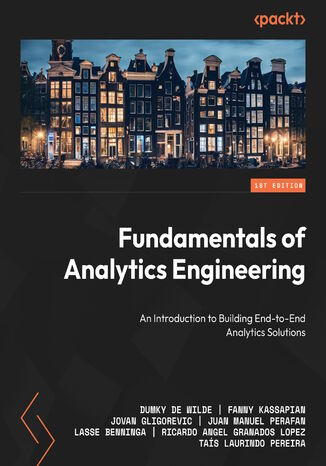
Fundamentals of Analytics Engineering. An introduction to building end-to-end analytics solutions
Dumky De Wilde, Fanny Kassapian, Jovan Gligorevic,...
Written by a team of 7 industry experts, Fundamentals of Analytics Engineering will introduce you to everything from foundational concepts to advanced skills to get started as an analytics engineer.After conquering data ingestion and techniques for data quality and scalability, you’ll learn about techniques such as data cleaning transformation, data modeling, SQL query optimization and reuse, and serving data across different platforms. Armed with this knowledge, you will implement a simple data platform from ingestion to visualization, using tools like Airbyte Cloud, Google BigQuery, dbt, and Tableau. You’ll also get to grips with strategies for data integrity with a focus on data quality and observability, along with collaborative coding practices like version control with Git. You’ll learn about advanced principles like CI/CD, automating workflows, gathering, scoping, and documenting business requirements, as well as data governance.By the end of this book, you’ll be armed with the essential techniques and best practices for developing scalable analytics solutions from end to end.
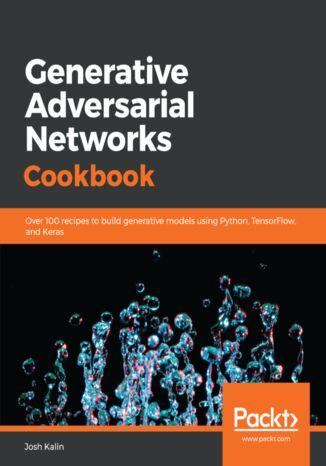
Josh Kalin
Developing Generative Adversarial Networks (GANs) is a complex task, and it is often hard to find code that is easy to understand.This book leads you through eight different examples of modern GAN implementations, including CycleGAN, simGAN, DCGAN, and 2D image to 3D model generation. Each chapter contains useful recipes to build on a common architecture in Python, TensorFlow and Keras to explore increasingly difficult GAN architectures in an easy-to-read format. The book starts by covering the different types of GAN architecture to help you understand how the model works. This book also contains intuitive recipes to help you work with use cases involving DCGAN, Pix2Pix, and so on. To understand these complex applications, you will take different real-world data sets and put them to use.By the end of this book, you will be equipped to deal with the challenges and issues that you may face while working with GAN models, thanks to easy-to-follow code solutions that you can implement right away.
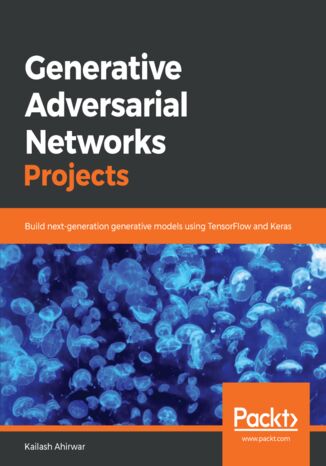
Kailash Ahirwar
Generative Adversarial Networks (GANs) have the potential to build next-generation models, as they can mimic any distribution of data. Major research and development work is being undertaken in this field since it is one of the rapidly growing areas of machine learning. This book will test unsupervised techniques for training neural networks as you build seven end-to-end projects in the GAN domain.Generative Adversarial Network Projects begins by covering the concepts, tools, and libraries that you will use to build efficient projects. You will also use a variety of datasets for the different projects covered in the book. The level of complexity of the operations required increases with every chapter, helping you get to grips with using GANs. You will cover popular approaches such as 3D-GAN, DCGAN, StackGAN, and CycleGAN, and you’ll gain an understanding of the architecture and functioning of generative models through their practical implementation.By the end of this book, you will be ready to build, train, and optimize your own end-to-end GAN models at work or in your own projects.
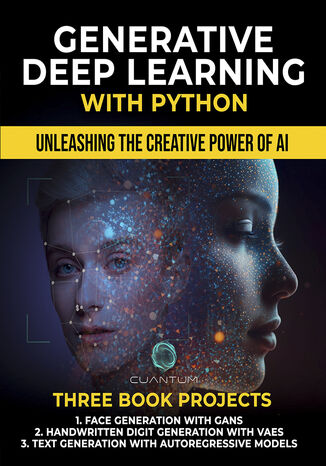
Generative Deep Learning with Python. Unleashing the Creative Power of AI by Mastering AI and Python
Cuantum Technologies LLC
Generative Deep Learning with Python opens the door to the fascinating world of AI where machines create. This course begins with an introduction to deep learning, establishing the essential concepts and techniques. You will then delve into generative models, exploring their theoretical foundations and practical applications. As you progress, you will gain a deep understanding of Generative Adversarial Networks (GANs), learning how they function and how to implement them for tasks like face generation.The course's hands-on projects, such as creating GANs for face generation and using Variational Autoencoders (VAEs) for handwritten digit generation, provide practical experience that reinforces your learning. You'll also explore autoregressive models for text generation, allowing you to see the versatility of generative models across different types of data. Advanced topics will prepare you for cutting-edge developments in the field.Throughout your journey, you will gain insights into the future landscape of generative deep learning, equipping you with the skills to innovate and lead in this rapidly evolving field. By the end of the course, you will have a solid foundation in generative deep learning and be ready to apply these techniques to real-world challenges, driving advancements in AI and machine learning.
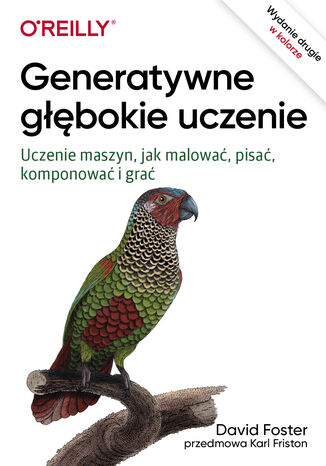
Generatywne głębokie uczenie, wyd. II. Uczenie maszyn, jak malować, pisać, komponować i grać
David Foster
Generatywna sztuczna inteligencja (AI) jest dziś gorącym tematem w dziedzinie techniki. Ta praktyczna książka pokazuje inżynierom uczenia się maszyn, jak wykorzystywać TensorFlow i Keras, aby od zera tworzyć robiące wrażenie generatywne modele głębokiego uczenia, w tym wariacyjne autokodowanie (VAE), generatywne sieci przeciwstawne (GAN), transformery, przepływy normalizacyjne, modele oparte na energii i dyfuzyjne modele odszumiające. Książka zaczyna się od podstaw głębokiego uczenia i prowadzi do nowatorskich architektur. Dzięki wskazówkom i sztuczkom zrozumiesz, jak sprawić, aby nasze modele uczyły się bardziej skutecznie i stawały się bardziej kreatywne. - Dowiedz się, jak VAE pozwala zmienić wyraz twarzy na zdjęciu. - Naucz GAN generowania obrazów na podstawie własnego zbioru danych. - Zbuduj modele dyfuzyjne do tworzenia nowych odmian kwiatów. - Wyszkol swój własny GPT, aby generował tekst. - Dowiedz się jak są szkolone duże modele językowe jak ChatGPT. - Przeanalizuj najnowocześniejsze architektury jak StyleGAN2 i ViT-VQGAN - Skomponuj muzykę polifoniczną wykorzystując transformery i MuseGAN - Zrozum jak generatywne modele świata mogą rozwiązać zadania uczenia przez wzmacnianie. - Zanurz się w multimodalnych modelach jak DALL.E 2, Imagen i Stable Diffusion Książka ta analizuje także przyszłą generacyjną sztuczną inteligencję i sposób, w jaki ludzie i firmy mogą proaktywnie zacząć wykorzystywać tę niezwykłą nową technikę, aby zyskiwać przewagę konkurencyjną. "Generatywne głębokie uczenie to dostępne wprowadzenie do narzędzi głębokiego uczenia dla celów modelowania generatywnego. Jeśli jesteście kreatywnymi praktykami, kochającymi bawić się kodem i chcecie zastosować głębokie uczenie w swojej pracy, ta książka jest dla was." -David Ha Szef strategii, Stability AT "Doskonała książka, która zagłębia się wprost w podstawowe technik stanowiące aktualną wiedzę o generacyjnym głębokim nauczaniu. Jest to ekscytująca analiza jednej z najbardziej fascynujących dziedzin w ramach sztucznej inteligencji!" -Francois Chollet Twórca Keras
Geospatial Data Analytics on AWS. Discover how to manage and analyze geospatial data in the cloud
Scott Bateman, Janahan Gnanachandran, Jeff DeMuth
Managing geospatial data and building location-based applications in the cloud can be a daunting task. This comprehensive guide helps you overcome this challenge by presenting the concept of working with geospatial data in the cloud in an easy-to-understand way, along with teaching you how to design and build data lake architecture in AWS for geospatial data.You’ll begin by exploring the use of AWS databases like Redshift and Aurora PostgreSQL for storing and analyzing geospatial data. Next, you’ll leverage services such as DynamoDB and Athena, which offer powerful built-in geospatial functions for indexing and querying geospatial data. The book is filled with practical examples to illustrate the benefits of managing geospatial data in the cloud. As you advance, you’ll discover how to analyze and visualize data using Python and R, and utilize QuickSight to share derived insights. The concluding chapters explore the integration of commonly used platforms like Open Data on AWS, OpenStreetMap, and ArcGIS with AWS to enable you to optimize efficiency and provide a supportive community for continuous learning.By the end of this book, you’ll have the necessary tools and expertise to build and manage your own geospatial data lake on AWS, along with the knowledge needed to tackle geospatial data management challenges and make the most of AWS services.
Abdishakur Hassan, Jayakrishnan Vijayaraghavan
Data scientists, who have access to vast data streams, are a bit myopic when it comes to intrinsic and extrinsic location-based data and are missing out on the intelligence it can provide to their models. This book demonstrates effective techniques for using the power of data science and geospatial intelligence to build effective, intelligent data models that make use of location-based data to give useful predictions and analyses.This book begins with a quick overview of the fundamentals of location-based data and how techniques such as Exploratory Data Analysis can be applied to it. We then delve into spatial operations such as computing distances, areas, extents, centroids, buffer polygons, intersecting geometries, geocoding, and more, which adds additional context to location data. Moving ahead, you will learn how to quickly build and deploy a geo-fencing system using Python. Lastly, you will learn how to leverage geospatial analysis techniques in popular recommendation systems such as collaborative filtering and location-based recommendations, and more.By the end of the book, you will be a rockstar when it comes to performing geospatial analysis with ease.
Tom Hombergs
We would all like to build software architecture that yields adaptable and flexible software with low development costs. But, unreasonable deadlines and shortcuts make it very hard to create such an architecture.Get Your Hands Dirty on Clean Architecture starts with a discussion about the conventional layered architecture style and its disadvantages. It also talks about the advantages of the domain-centric architecture styles of Robert C. Martin's Clean Architecture and Alistair Cockburn's Hexagonal Architecture. Then, the book dives into hands-on chapters that show you how to manifest a hexagonal architecture in actual code. You'll learn in detail about different mapping strategies between the layers of a hexagonal architecture and see how to assemble the architecture elements into an application. The later chapters demonstrate how to enforce architecture boundaries. You'll also learn what shortcuts produce what types of technical debt and how, sometimes, it is a good idea to willingly take on those debts.After reading this book, you'll have all the knowledge you need to create applications using the hexagonal architecture style of web development.