
Big data
Shilpi Saxena, Selva raj Ramasamy, Prateek Bhati,...
With the rise of Big Data, there is an increasing need to process large amounts of data continuously, with a shorter turnaround time. Real-time data processing involves continuous input, processing and output of data, with the condition that the time required for processing is as short as possible.This book covers the majority of the existing and evolving open source technology stack for real-time processing and analytics. You will get to know about all the real-time solution aspects, from the source to the presentation to persistence. Through this practical book, you’ll be equipped with a clear understanding of how to solve challenges on your own.We’ll cover topics such as how to set up components, basic executions, integrations, advanced use cases, alerts, and monitoring. You’ll be exposed to the popular tools used in real-time processing today such as Apache Spark, Apache Flink, and Storm. Finally, you will put your knowledge to practical use by implementing all of the techniques in the form of a practical, real-world use case.By the end of this book, you will have a solid understanding of all the aspects of real-time data processing and analytics, and will know how to deploy the solutions in production environments in the best possible manner.
Pethuru Raj Chelliah, Shreyash Naithani, Shailender Singh
Site reliability engineering (SRE) is being touted as the most competent paradigm in establishing and ensuring next-generation high-quality software solutions.This book starts by introducing you to the SRE paradigm and covers the need for highly reliable IT platforms and infrastructures. As you make your way through the next set of chapters, you will learn to develop microservices using Spring Boot and make use of RESTful frameworks. You will also learn about GitHub for deployment, containerization, and Docker containers. Practical Site Reliability Engineering teaches you to set up and sustain containerized cloud environments, and also covers architectural and design patterns and reliability implementation techniques such as reactive programming, and languages such as Ballerina and Rust. In the concluding chapters, you will get well-versed with service mesh solutions such as Istio and Linkerd, and understand service resilience test practices, API gateways, and edge/fog computing.By the end of this book, you will have gained experience on working with SRE concepts and be able to deliver highly reliable apps and services.
Valentina Costa-Gazcón
Threat hunting (TH) provides cybersecurity analysts and enterprises with the opportunity to proactively defend themselves by getting ahead of threats before they can cause major damage to their business.This book is not only an introduction for those who don’t know much about the cyber threat intelligence (CTI) and TH world, but also a guide for those with more advanced knowledge of other cybersecurity fields who are looking to implement a TH program from scratch.You will start by exploring what threat intelligence is and how it can be used to detect and prevent cyber threats. As you progress, you’ll learn how to collect data, along with understanding it by developing data models. The book will also show you how to set up an environment for TH using open source tools. Later, you will focus on how to plan a hunt with practical examples, before going on to explore the MITRE ATT&CK framework.By the end of this book, you’ll have the skills you need to be able to carry out effective hunts in your own environment.
PKS Prakash, Avishek Pal
Time Series Analysis allows us to analyze data which is generated over a period of time and has sequential interdependencies between the observations. This book describes special mathematical tricks and techniques which are geared towards exploring the internal structures of time series data and generating powerful descriptive and predictive insights. Also, the book is full of real-life examples of time series and their analyses using cutting-edge solutions developed in Python. The book starts with descriptive analysis to create insightful visualizations of internal structures such as trend, seasonality, and autocorrelation. Next, the statistical methods of dealing with autocorrelation and non-stationary time series are described. This is followed by exponential smoothing to produce meaningful insights from noisy time series data. At this point, we shift focus towards predictive analysis and introduce autoregressive models such as ARMA and ARIMA for time series forecasting. Later, powerful deep learning methods are presented, to develop accurate forecasting models for complex time series, and under the availability of little domain knowledge. All the topics are illustrated with real-life problem scenarios and their solutions by best-practice implementations in Python.The book concludes with the Appendix, with a brief discussion of programming and solving data science problems using Python.
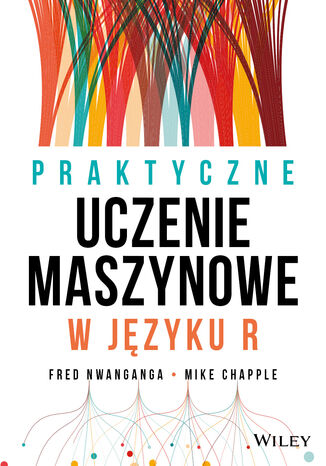
Praktyczne uczenie maszynowe w języku R
Fred Nwanganga, Mike Chapple
WPROWADZENIE DO UCZENIA MASZYNOWEGO Z WYKORZYSTANIEM INTUICYJNEGO JĘZYKA R Uczenie maszynowe i analiza danych pełnią coraz ważniejszą rolę w tworzeniu wartości dodanej. Uczenie maszynowe pozwala znajdować ukryte w danych zależności, wnosząc nowe pomysły i wiedzę, którą trudno byłoby osiągnąć bez tej zaawansowanej techniki. Książka Praktyczne uczenie maszynowe w języku R to wstępne przygotowanie do pracy z dużymi zbiorami danych w języku R, który jest łatwy w zrozumieniu i został opracowany specjalnie z myślą o analizie statystycznej. Nawet osoby bez doświadczenia w programowaniu mogą skorzystać z tej książki, dowiadując się, w jaki sposób praktyczne zastosowania uczenia maszynowego pozwalają analitykom danych pozyskiwać strategiczne informacje biznesowe, solidne prognozy i podejmować trafniejsze decyzje. W odróżnieniu od innych książek na ten temat, Praktyczne uczenie maszynowe w języku R oferuje zarówno teoretyczne, jak i techniczne wprowadzenie do uczenia maszynowego. W przykładach i ćwiczeniach wykorzystywany jest język programowania R oraz najnowsze narzędzia analizy danych, co pozwala zacząć pracę bez nadmiernego zagłębiania się w zaawansowaną matematykę. Dzięki tej książce techniki uczenia maszynowego – począwszy od regresji logistycznej po reguły asocjacyjne i analizę skupień – są w zasięgu ręki. Jedyna publikacja, która łączy intuicyjne wprowadzenie do uczenia maszynowego z opisami zastosowań technicznych krok po kroku. Praktyczne uczenie maszynowe w języku R pokaże jak: przyswoić koncepcje różnych typów uczenia maszynowego, odkrywać wzorce ukryte w dużych zbiorach danych, pisać i wykonywać skrypty R za pomocą RStudio, używać języka R w połączeniu z pakietami Tidyverse do zarządzania danymi i ich wizualizacji, stosować podstawowe techniki statystyczne, takie jak regresja logistyczna czy naiwny klasyfikator Bayesa, oceniać i ulepszać modele uczenia maszynowego. DR FRED NWANGANGA jest profesorem uczelni na wydziale Business Analytics w Mendoza College of Business na uniwersytecie Notre Dame, Indiana, USA. Ma ponad 15-letnie doświadczenie w pełnieniu roli lidera technicznego. DR MIKE CHAPPLE jest profesorem uczelni na wydziale Technology, Analytics, and Operations w Mendoza College of Business. Mike jest autorem ponad 25 poczytnych książek i pełni funkcję dyrektora naukowego programu studiów magisterskich z analizy biznesowej.
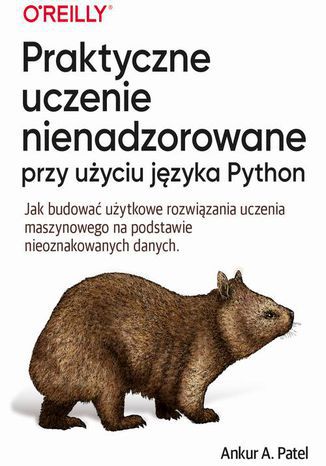
Praktyczne uczenie nienadzorowane przy użyciu języka Python
Ankur A. Patel
Wielu ekspertów branżowych uważa uczenie nienadzorowane za kolejną granicę w dziedzinie sztucznej inteligencji, która może stanowić klucz do pełnej sztucznej inteligencji. Ponieważ większość danych na świecie jest nieoznakowana, nie można do nich zastosować konwencjonalnego uczenia nadzorowanego. Z kolei uczenie nienadzorowane może być stosowane wobec nieoznakowanych zbiorów danych w celu odkrycia istotnych wzorców ukrytych głęboko w tych danych, które dla człowieka mogą być niemal niemożliwe do odkrycia. Autor Ankur Patel pokazuje, jak stosować uczenie nienadzorowane przy wykorzystaniu dwóch prostych platform dla języka Python: Scikit-learn oraz TensorFlow (wraz z Keras). Dzięki dołączonemu kodowi i praktycznym przykładom analitycy danych będą mogli identyfikować trudne do znalezienia wzorce w danych i odkrywać dogłębne zależności biznesowe, wykrywać anomalie, przeprowadzać automatyczną selekcję zmiennych i generować syntetyczne zbiory danych. Wystarczy znajomość programowania i nieco doświadczenia w uczeniu maszynowym, aby zająć się: Porównywaniem mocnych i słabych stron różnych podejść do uczenia maszynowego: uczenia nadzorowanego, nienadzorowanego i wzmacnianego. Przygotowywaniem i zarządzaniem projektami uczenia maszynowego. Budowaniem systemu wykrywania anomalii w celu wychwycenia oszustwa dotyczącego kard kredytowych. Rozdzielaniem użytkowników na wydzielone i jednorodne grupy. Przeprowadzaniem uczenia pół-nadzorowanego. Opracowywaniem systemów polecania filmów z użyciem ograniczonych automatów Boltzmanna. Generowaniem syntetycznych obrazów przy użyciu generujących sieci antagonistycznych. Badacze, inżynierowie i studenci docenią tę książkę pełną praktycznych technik uczenia nienadzorowanego, napisaną prostym językiem z nieskomplikowanymi przykładami w języku Python, które można szybko i skutecznie implementować. Sarah Nagy Główny analityk danych w firmie Edison Ankur A. Patel jest wiceprezesem ds. informatyki analitycznej w firmie 7Park Data, wspieranej przez firmę inwestycyjną Vista Equity Partners. W firmie 7Park Data, Ankur i jego zespół analizy danych wykorzystują dane alternatywne do opracowywania produktów związanych z danymi dla funduszy hedgingowych i korporacji oraz rozwijają usługi uczenia maszynowego dla klientów firmowych.
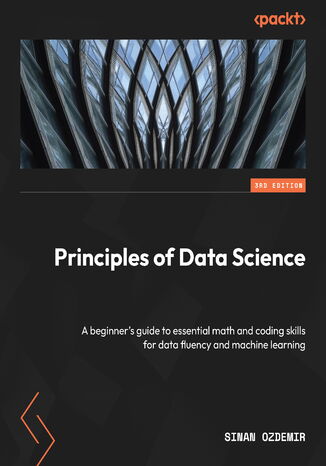
Sinan Ozdemir
Principles of Data Science bridges mathematics, programming, and business analysis, empowering you to confidently pose and address complex data questions and construct effective machine learning pipelines. This book will equip you with the tools to transform abstract concepts and raw statistics into actionable insights.Starting with cleaning and preparation, you’ll explore effective data mining strategies and techniques before moving on to building a holistic picture of how every piece of the data science puzzle fits together. Throughout the book, you’ll discover statistical models with which you can control and navigate even the densest or the sparsest of datasets and learn how to create powerful visualizations that communicate the stories hidden in your data.With a focus on application, this edition covers advanced transfer learning and pre-trained models for NLP and vision tasks. You’ll get to grips with advanced techniques for mitigating algorithmic bias in data as well as models and addressing model and data drift. Finally, you’ll explore medium-level data governance, including data provenance, privacy, and deletion request handling.By the end of this data science book, you'll have learned the fundamentals of computational mathematics and statistics, all while navigating the intricacies of modern ML and large pre-trained models like GPT and BERT.
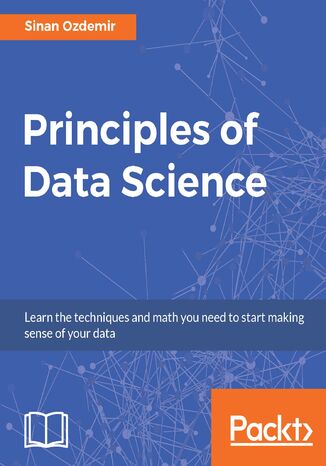
Principles of Data Science. Mathematical techniques and theory to succeed in data-driven industries
Sinan Ozdemir
Need to turn your skills at programming into effective data science skills? Principles of Data Science is created to help you join the dots between mathematics, programming, and business analysis. With this book, you’ll feel confident about asking—and answering—complex and sophisticated questions of your data to move from abstract and raw statistics to actionable ideas.With a unique approach that bridges the gap between mathematics and computer science, this books takes you through the entire data science pipeline. Beginning with cleaning and preparing data, and effective data mining strategies and techniques, you’ll move on to build a comprehensive picture of how every piece of the data science puzzle fits together. Learn the fundamentals of computational mathematics and statistics, as well as some pseudocode being used today by data scientists and analysts. You’ll get to grips with machine learning, discover the statistical models that help you take control and navigate even the densest datasets, and find out how to create powerful visualizations that communicate what your data means.