
Big data
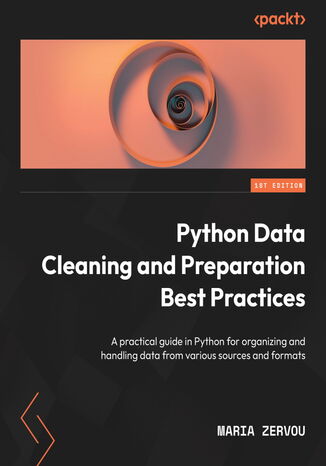
Maria Zervou
Professionals face several challenges in effectively leveraging data in today's data-driven world. One of the main challenges is the low quality of data products, often caused by inaccurate, incomplete, or inconsistent data. Another significant challenge is the lack of skills among data professionals to analyze unstructured data, leading to valuable insights being missed that are difficult or impossible to obtain from structured data alone.To help you tackle these challenges, this book will take you on a journey through the upstream data pipeline, which includes the ingestion of data from various sources, the validation and profiling of data for high-quality end tables, and writing data to different sinks. You’ll focus on structured data by performing essential tasks, such as cleaning and encoding datasets and handling missing values and outliers, before learning how to manipulate unstructured data with simple techniques. You’ll also be introduced to a variety of natural language processing techniques, from tokenization to vector models, as well as techniques to structure images, videos, and audio.By the end of this book, you’ll be proficient in data cleaning and preparation techniques for both structured and unstructured data.
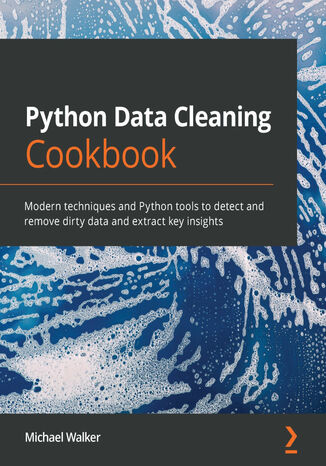
Michael Walker
Getting clean data to reveal insights is essential, as directly jumping into data analysis without proper data cleaning may lead to incorrect results. This book shows you tools and techniques that you can apply to clean and handle data with Python. You'll begin by getting familiar with the shape of data by using practices that can be deployed routinely with most data sources. Then, the book teaches you how to manipulate data to get it into a useful form. You'll also learn how to filter and summarize data to gain insights and better understand what makes sense and what does not, along with discovering how to operate on data to address the issues you've identified. Moving on, you'll perform key tasks, such as handling missing values, validating errors, removing duplicate data, monitoring high volumes of data, and handling outliers and invalid dates. Next, you'll cover recipes on using supervised learning and Naive Bayes analysis to identify unexpected values and classification errors, and generate visualizations for exploratory data analysis (EDA) to visualize unexpected values. Finally, you'll build functions and classes that you can reuse without modification when you have new data. By the end of this Python book, you'll be equipped with all the key skills that you need to clean data and diagnose problems within it.
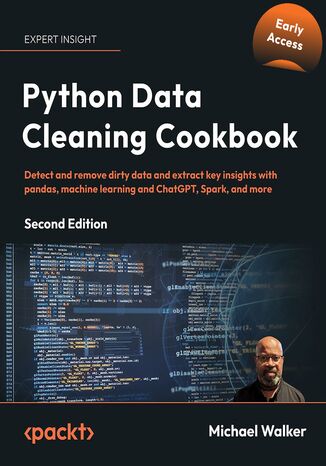
Michael Walker
Jumping into data analysis without proper data cleaning will certainly lead to incorrect results. The Python Data Cleaning Cookbook - Second Edition will show you tools and techniques for cleaning and handling data with Python for better outcomes.Fully updated to the latest version of Python and all relevant tools, this book will teach you how to manipulate and clean data to get it into a useful form. he current edition focuses on advanced techniques like machine learning and AI-specific approaches and tools for data cleaning along with the conventional ones. The book also delves into tips and techniques to process and clean data for ML, AI, and NLP models. You will learn how to filter and summarize data to gain insights and better understand what makes sense and what does not, along with discovering how to operate on data to address the issues you've identified. Next, you’ll cover recipes for using supervised learning and Naive Bayes analysis to identify unexpected values and classification errors and generate visualizations for exploratory data analysis (EDA) to identify unexpected values. Finally, you’ll build functions and classes that you can reuse without modification when you have new data.By the end of this Data Cleaning book, you'll know how to clean data and diagnose problems within it.
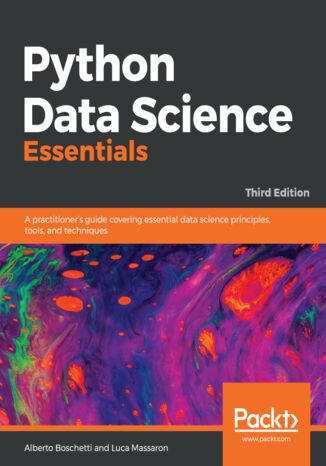
Alberto Boschetti, Luca Massaron
Fully expanded and upgraded, the latest edition of Python Data Science Essentials will help you succeed in data science operations using the most common Python libraries. This book offers up-to-date insight into the core of Python, including the latest versions of the Jupyter Notebook, NumPy, pandas, and scikit-learn.The book covers detailed examples and large hybrid datasets to help you grasp essential statistical techniques for data collection, data munging and analysis, visualization, and reporting activities. You will also gain an understanding of advanced data science topics such as machine learning algorithms, distributed computing, tuning predictive models, and natural language processing. Furthermore, You’ll also be introduced to deep learning and gradient boosting solutions such as XGBoost, LightGBM, and CatBoost.By the end of the book, you will have gained a complete overview of the principal machine learning algorithms, graph analysis techniques, and all the visualization and deployment instruments that make it easier to present your results to an audience of both data science experts and business users
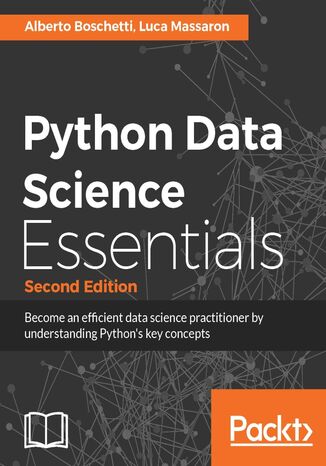
Python Data Science Essentials. Learn the fundamentals of Data Science with Python - Second Edition
Luca Massaron, Alberto Boschetti
Fully expanded and upgraded, the second edition of Python Data Science Essentials takes you through all you need to know to suceed in data science using Python. Get modern insight into the core of Python data, including the latest versions of Jupyter notebooks, NumPy, pandas and scikit-learn. Look beyond the fundamentals with beautiful data visualizations with Seaborn and ggplot, web development with Bottle, and even the new frontiers of deep learning with Theano and TensorFlow. Dive into building your essential Python 3.5 data science toolbox, using a single-source approach that will allow to to work with Python 2.7 as well. Get to grips fast with data munging and preprocessing, and all the techniques you need to load, analyse, and process your data. Finally, get a complete overview of principal machine learning algorithms, graph analysis techniques, and all the visualization and deployment instruments that make it easier to present your results to an audience of both data science experts and business users.
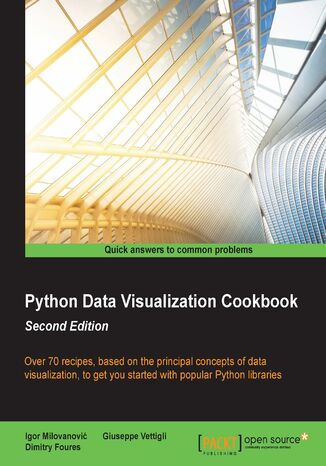
Igor Milovanovic, Dimitry Foures, Giuseppe Vettigli
Python Data Visualization Cookbook will progress the reader from the point of installing and setting up a Python environment for data manipulation and visualization all the way to 3D animations using Python libraries. Readers will benefit from over 60 precise and reproducible recipes that will guide the reader towards a better understanding of data concepts and the building blocks for subsequent and sometimes more advanced concepts.Python Data Visualization Cookbook starts by showing how to set up matplotlib and the related libraries that are required for most parts of the book, before moving on to discuss some of the lesser-used diagrams and charts such as Gantt Charts or Sankey diagrams. Initially it uses simple plots and charts to more advanced ones, to make it easy to understand for readers. As the readers will go through the book, they will get to know about the 3D diagrams and animations. Maps are irreplaceable for displaying geo-spatial data, so this book will also show how to build them. In the last chapter, it includes explanation on how to incorporate matplotlib into different environments, such as a writing system, LaTeX, or how to create Gantt charts using Python.
Indra den Bakker
Deep Learning is revolutionizing a wide range of industries. For many applications, deep learning has proven to outperform humans by making faster and more accurate predictions. This book provides a top-down and bottom-up approach to demonstrate deep learning solutions to real-world problems in different areas. These applications include Computer Vision, Natural Language Processing, Time Series, and Robotics. The Python Deep Learning Cookbook presents technical solutions to the issues presented, along with a detailed explanation of the solutions. Furthermore, a discussion on corresponding pros and cons of implementing the proposed solution using one of the popular frameworks like TensorFlow, PyTorch, Keras and CNTK is provided. The book includes recipes that are related to the basic concepts of neural networks. All techniques s, as well as classical networks topologies. The main purpose of this book is to provide Python programmers a detailed list of recipes to apply deep learning to common and not-so-common scenarios.
Ivan Vasilev, Daniel Slater, Gianmario Spacagna, Peter...
With the surge in artificial intelligence in applications catering to both business and consumer needs, deep learning is more important than ever for meeting current and future market demands. With this book, you’ll explore deep learning, and learn how to put machine learning to use in your projects.This second edition of Python Deep Learning will get you up to speed with deep learning, deep neural networks, and how to train them with high-performance algorithms and popular Python frameworks. You’ll uncover different neural network architectures, such as convolutional networks, recurrent neural networks, long short-term memory (LSTM) networks, and capsule networks. You’ll also learn how to solve problems in the fields of computer vision, natural language processing (NLP), and speech recognition. You'll study generative model approaches such as variational autoencoders and Generative Adversarial Networks (GANs) to generate images. As you delve into newly evolved areas of reinforcement learning, you’ll gain an understanding of state-of-the-art algorithms that are the main components behind popular games Go, Atari, and Dota.By the end of the book, you will be well-versed with the theory of deep learning along with its real-world applications.