
Big data
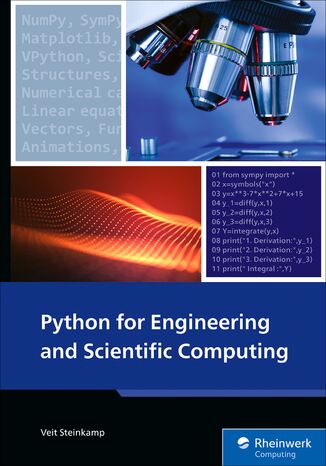
Rheinwerk Publishing, Inc, Veit Steinkamp
This book provides a thorough introduction to Python programming designed for engineers and scientists. It begins with foundational topics like development environments and program structures, then introduces key Python libraries such as NumPy, SymPy, SciPy, Matplotlib, and VPython. Clear explanations and practical exercises help readers write efficient, well-structured code while progressing through increasingly complex projects.The content covers core programming paradigms including functions, branching, and object-oriented design, followed by numerical analysis with NumPy and symbolic math with SymPy. Detailed chapters on data visualization with Matplotlib and 3D animations with VPython enhance comprehension. Additional focus on statistical computations, Boolean algebra, and interactive GUI programming with Tkinter prepares readers for real-world applications. Each chapter ends with project tasks reinforcing hands-on learning.Throughout the book, readers build a strong skill set combining programming expertise and scientific problem-solving. By the end, they will confidently use Python’s libraries to solve diverse engineering and scientific challenges. This practical, project-based approach ensures knowledge is both solid and immediately useful in research and professional work.
Yuxing Yan
This book uses Python as its computational tool. Since Python is free, any school ororganization can download and use it. This book is organized according to various finance subjects. In other words, the first edition focuses more on Python, while the second edition is truly trying to apply Python to finance.The book starts by explaining topics exclusively related to Python. Then we deal with critical parts of Python, explaining concepts such as time value of money stock and bond evaluations, capital asset pricing model, multi-factor models, time series analysis, portfolio theory,options and futures.This book will help us to learn or review the basics of quantitative finance and apply Python to solve various problems, such as estimating IBM’s market risk,running a Fama-French 3-factor, 5-factor, or Fama-French-Carhart 4 factor model, estimating the VaR of a 5-stock portfolio, estimating the optimal portfolio, and constructing the efficient frontier for a 20-stock portfolio with real-world stock, and with Monte Carlo Simulation. Later, we will also learn how to replicate the famous Black-Scholes-Merton option model and how to price exotic options such as the average price call option.
Python for TensorFlow Pocket Primer. A Quick Guide to Python Libraries for TensorFlow Developers
Mercury Learning and Information, Oswald Campesato
As part of the best-selling *Pocket Primer* series, this book prepares programmers for machine learning and deep learning with TensorFlow. It begins with a quick introduction to Python, followed by chapters on NumPy, Pandas, Matplotlib, and scikit-learn. The final chapters provide TensorFlow 1.x code samples, including detailed examples for TensorFlow Dataset, crucial for TensorFlow 2.The journey starts with Python basics and progresses through essential data manipulation and visualization libraries. You'll explore machine learning fundamentals with scikit-learn before diving into TensorFlow, learning to construct data pipelines with TensorFlow Dataset APIs like map(), filter(), and batch().Understanding these concepts is vital for modern AI applications. This book transitions readers from basic programming to advanced machine learning and deep learning techniques, blending theory with practical skills. Companion files with source code enhance learning, making this an essential resource for mastering Python, machine learning, and TensorFlow.
Ryan Marvin, Mark Nganga, Amos Omondi
After a brief history of Python and key differences between Python 2 and Python 3, you'll understand how Python has been used in applications such as YouTube and Google App Engine. As you work with the language, you'll learn about control statements, delve into controlling program flow and gradually work on more structured programs via functions.As you settle into the Python ecosystem, you'll learn about data structures and study ways to correctly store and represent information. By working through specific examples, you'll learn how Python implements object-oriented programming (OOP) concepts of abstraction, encapsulation of data, inheritance, and polymorphism. You'll be given an overview of how imports, modules, and packages work in Python, how you can handle errors to prevent apps from crashing, as well as file manipulation.By the end of this book, you'll have built up an impressive portfolio of projects and armed yourself with the skills you need to tackle Python projects in the real world.
Alexander Combs, Saurabh Chhajed, Michael Roman
Machine learning is transforming the way we understand and interact with the world around us. This book is the perfect guide for you to put your knowledge and skills into practice and use the Python ecosystem to cover key domains in machine learning. This second edition covers a range of libraries from the Python ecosystem, including TensorFlow and Keras, to help you implement real-world machine learning projects.The book begins by giving you an overview of machine learning with Python. With the help of complex datasets and optimized techniques, you’ll go on to understand how to apply advanced concepts and popular machine learning algorithms to real-world projects. Next, you’ll cover projects from domains such as predictive analytics to analyze the stock market and recommendation systems for GitHub repositories. In addition to this, you’ll also work on projects from the NLP domain to create a custom news feed using frameworks such as scikit-learn, TensorFlow, and Keras. Following this, you’ll learn how to build an advanced chatbot, and scale things up using PySpark. In the concluding chapters, you can look forward to exciting insights into deep learning and you'll even create an application using computer vision and neural networks.By the end of this book, you’ll be able to analyze data seamlessly and make a powerful impact through your projects.
Yuxi (Hayden) Liu
Python Machine Learning By Example, Third Edition serves as a comprehensive gateway into the world of machine learning (ML).With six new chapters, on topics including movie recommendation engine development with Naïve Bayes, recognizing faces with support vector machine, predicting stock prices with artificial neural networks, categorizing images of clothing with convolutional neural networks, predicting with sequences using recurring neural networks, and leveraging reinforcement learning for making decisions, the book has been considerably updated for the latest enterprise requirements.At the same time, this book provides actionable insights on the key fundamentals of ML with Python programming. Hayden applies his expertise to demonstrate implementations of algorithms in Python, both from scratch and with libraries.Each chapter walks through an industry-adopted application. With the help of realistic examples, you will gain an understanding of the mechanics of ML techniques in areas such as exploratory data analysis, feature engineering, classification, regression, clustering, and NLP.By the end of this ML Python book, you will have gained a broad picture of the ML ecosystem and will be well-versed in the best practices of applying ML techniques to solve problems.
Yuxi (Hayden) Liu
The surge in interest in machine learning (ML) is due to the fact that it revolutionizes automation by learning patterns in data and using them to make predictions and decisions. If you’re interested in ML, this book will serve as your entry point to ML.Python Machine Learning By Example begins with an introduction to important ML concepts and implementations using Python libraries. Each chapter of the book walks you through an industry adopted application. You’ll implement ML techniques in areas such as exploratory data analysis, feature engineering, and natural language processing (NLP) in a clear and easy-to-follow way.With the help of this extended and updated edition, you’ll understand how to tackle data-driven problems and implement your solutions with the powerful yet simple Python language and popular Python packages and tools such as TensorFlow, scikit-learn, gensim, and Keras. To aid your understanding of popular ML algorithms, the book covers interesting and easy-to-follow examples such as news topic modeling and classification, spam email detection, stock price forecasting, and more.By the end of the book, you’ll have put together a broad picture of the ML ecosystem and will be well-versed with the best practices of applying ML techniques to make the most out of new opportunities.
Python Machine Learning By Example. The easiest way to get into machine learning
Yuxi (Hayden) Liu, Ivan Idris
Data science and machine learning are some of the top buzzwords in the technical world today. A resurging interest in machine learning is due to the same factors that have made data mining and Bayesian analysis more popular than ever. This book is your entry point to machine learning. This book starts with an introduction to machine learning and the Python language and shows you how to complete the setup. Moving ahead, you will learn all the important concepts such as, exploratory data analysis, data preprocessing, feature extraction, data visualization and clustering, classification, regression and model performance evaluation. With the help of various projects included, you will find it intriguing to acquire the mechanics of several important machine learning algorithms – they are no more obscure as they thought. Also, you will be guided step by step to build your own models from scratch. Toward the end, you will gather a broad picture of the machine learning ecosystem and best practices of applying machine learning techniques. Through this book, you will learn to tackle data-driven problems and implement your solutions with the powerful yet simple language, Python. Interesting and easy-to-follow examples, to name some, news topic classification, spam email detection, online ad click-through prediction, stock prices forecast, will keep you glued till you reach your goal.