
Big data
Mohammed Rafi, Patrick R. Nicolas
The discovery of information through data clustering and classification is becoming a key differentiator for competitive organizations. Machine learning applications are everywhere, from self-driving cars, engineering design, logistics, manufacturing, and trading strategies, to detection of genetic anomalies. The book is your one stop guide that introduces you to the functional capabilities of the Scala programming language that are critical to the creation of machine learning algorithms such as dependency injection and implicits. You start by learning data preprocessing and filtering techniques. Following this, you'll move on to unsupervised learning techniques such as clustering and dimension reduction, followed by probabilistic graphical models such as Naïve Bayes, hidden Markov models and Monte Carlo inference. Further, it covers the discriminative algorithms such as linear, logistic regression with regularization, kernelization, support vector machines, neural networks, and deep learning. You’ll move on to evolutionary computing, multibandit algorithms, and reinforcement learning.Finally, the book includes a comprehensive overview of parallel computing in Scala and Akka followed by a description of Apache Spark and its ML library. With updated codes based on the latest version of Scala and comprehensive examples, this book will ensure that you have more than just a solid fundamental knowledge in machine learning with Scala.
Patrick R. Nicolas
Are you curious about AI? All you need is a good understanding of the Scala programming language, a basic knowledge of statistics, a keen interest in Big Data processing, and this book!
Scala: Guide for Data Science Professionals. Build robust data pipelines with Scala
Arun Manivannan, Pascal Bugnion, Patrick R. Nicolas
Scala is especially good for analyzing large sets of data as the scale of the task doesn’t have any significant impact on performance. Scala’s powerful functional libraries can interact with databases and build scalable frameworks — resulting in the creation of robust data pipelines. The first module introduces you to Scala libraries to ingest, store, manipulate, process, and visualize data. Using real world examples, you will learn how to design scalable architecture to process and model data — starting from simple concurrency constructs and progressing to actor systems and Apache Spark. After this, you will also learn how to build interactive visualizations with web frameworks.Once you have become familiar with all the tasks involved in data science, you will explore data analytics with Scala in the second module. You’ll see how Scala can be used to make sense of data through easy to follow recipes. You will learn about Bokeh bindings for exploratory data analysis and quintessential machine learning with algorithms with Spark ML library. You’ll get a sufficient understanding of Spark streaming, machine learning for streaming data, and Spark graphX. Armed with a firm understanding of data analysis, you will be ready to explore the most cutting-edge aspect of data science — machine learning. The final module teaches you the A to Z of machine learning with Scala. You’ll explore Scala for dependency injections and implicits, which are used to write machine learning algorithms. You’ll also explore machine learning topics such as clustering, dimentionality reduction, Naïve Bayes, Regression models, SVMs, neural networks, and more. This learning path combines some of the best that Packt has to offer into one complete, curated package. It includes content from the following Packt products:• Scala for Data Science, Pascal Bugnion• Scala Data Analysis Cookbook, Arun Manivannan • Scala for Machine Learning, Patrick R. Nicolas
Md. Rezaul Karim
Machine learning has had a huge impact on academia and industry by turning data into actionable information. Scala has seen a steady rise in adoption over the past few years, especially in the fields of data science and analytics. This book is for data scientists, data engineers, and deep learning enthusiasts who have a background in complex numerical computing and want to know more hands-on machine learning application development.If you're well versed in machine learning concepts and want to expand your knowledge by delving into the practical implementation of these concepts using the power of Scala, then this book is what you need! Through 11 end-to-end projects, you will be acquainted with popular machine learning libraries such as Spark ML, H2O, DeepLearning4j, and MXNet.At the end, you will be able to use numerical computing and functional programming to carry out complex numerical tasks to develop, build, and deploy research or commercial projects in a production-ready environment.
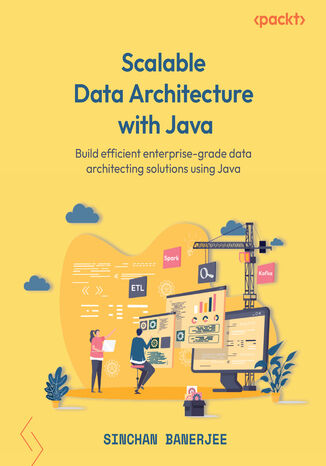
Sinchan Banerjee
Java architectural patterns and tools help architects to build reliable, scalable, and secure data engineering solutions that collect, manipulate, and publish data.This book will help you make the most of the architecting data solutions available with clear and actionable advice from an expert.You’ll start with an overview of data architecture, exploring responsibilities of a Java data architect, and learning about various data formats, data storage, databases, and data application platforms as well as how to choose them. Next, you’ll understand how to architect a batch and real-time data processing pipeline. You’ll also get to grips with the various Java data processing patterns, before progressing to data security and governance. The later chapters will show you how to publish Data as a Service and how you can architect it. Finally, you’ll focus on how to evaluate and recommend an architecture by developing performance benchmarks, estimations, and various decision metrics.By the end of this book, you’ll be able to successfully orchestrate data architecture solutions using Java and related technologies as well as to evaluate and present the most suitable solution to your clients.
Tarik Makota, Brian Maguire, Danny Gagne, Rajeev...
Amazon Kinesis is a collection of secure, serverless, durable, and highly available purpose-built data streaming services. This data streaming service provides APIs and client SDKs that enable you to produce and consume data at scale.Scalable Data Streaming with Amazon Kinesis begins with a quick overview of the core concepts of data streams, along with the essentials of the AWS Kinesis landscape. You'll then explore the requirements of the use case shown through the book to help you get started and cover the key pain points encountered in the data stream life cycle. As you advance, you'll get to grips with the architectural components of Kinesis, understand how they are configured to build data pipelines, and delve into the applications that connect to them for consumption and processing. You'll also build a Kinesis data pipeline from scratch and learn how to implement and apply practical solutions. Moving on, you'll learn how to configure Kinesis on a cloud platform. Finally, you’ll learn how other AWS services can be integrated into Kinesis. These services include Redshift, Dynamo Database, AWS S3, Elastic Search, and third-party applications such as Splunk.By the end of this AWS book, you’ll be able to build and deploy your own Kinesis data pipelines with Kinesis Data Streams (KDS), Kinesis Data Firehose (KFH), Kinesis Video Streams (KVS), and Kinesis Data Analytics (KDA).
Claus Führer, Claus Fuhrer, Jan Erik Solem,...
Python can be used for more than just general-purpose programming. It is a free, open source language and environment that has tremendous potential for use within the domain of scientific computing. This book presents Python in tight connection with mathematical applications and demonstrates how to use various concepts in Python for computing purposes, including examples with the latest version of Python 3. Python is an effective tool to use when coupling scientific computing and mathematics and this book will teach you how to use it for linear algebra, arrays, plotting, iterating, functions, polynomials, and much more.
Julian Avila, Trent Hauck
Python is quickly becoming the go-to language for analysts and data scientists due to its simplicity and flexibility, and within the Python data space, scikit-learn is the unequivocal choice for machine learning. This book includes walk throughs and solutions to the common as well as the not-so-common problems in machine learning, and how scikit-learn can be leveraged to perform various machine learning tasks effectively.The second edition begins with taking you through recipes on evaluating the statistical properties of data and generates synthetic data for machine learning modelling. As you progress through the chapters, you will comes across recipes that will teach you to implement techniques like data pre-processing, linear regression, logistic regression, K-NN, Naïve Bayes, classification, decision trees, Ensembles and much more. Furthermore, you’ll learn to optimize your models with multi-class classification, cross validation, model evaluation and dive deeper in to implementing deep learning with scikit-learn. Along with covering the enhanced features on model section, API and new features like classifiers, regressors and estimators the book also contains recipes on evaluating and fine-tuning the performance of your model. By the end of this book, you will have explored plethora of features offered by scikit-learn for Python to solve any machine learning problem you come across.