
Big data
Michael Hsieh
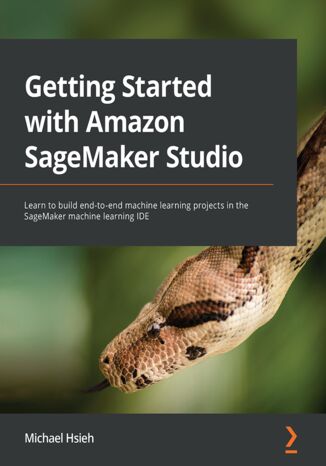
Amazon SageMaker Studio is the first integrated development environment (IDE) for machine learning (ML) and is designed to integrate ML workflows: data preparation, feature engineering, statistical bias detection, automated machine learning (AutoML), training, hosting, ML explainability, monitoring, and MLOps in one environment.In this book, you'll start by exploring the features available in Amazon SageMaker Studio to analyze data, develop ML models, and productionize models to meet your goals. As you progress, you will learn how these features work together to address common challenges when building ML models in production. After that, you'll understand how to effectively scale and operationalize the ML life cycle using SageMaker Studio.By the end of this book, you'll have learned ML best practices regarding Amazon SageMaker Studio, as well as being able to improve productivity in the ML development life cycle and build and deploy models easily for your ML use cases.
Simon Aubury, Ned Letcher, Kris Jenkins
DuckDB is a fast in-process analytical database. Getting Started with DuckDB offers a practical overview of its usage. You'll learn to load, transform, and query various data formats, including CSV, JSON, and Parquet. The book covers DuckDB's optimizations, SQL enhancements, and extensions for specialized applications. Working with examples in SQL, Python, and R, you'll explore analyzing public datasets and discover tools enhancing DuckDB workflows. This guide suits both experienced and new data practitioners, quickly equipping you to apply DuckDB's capabilities in analytical projects. You'll gain proficiency in using DuckDB for diverse tasks, enabling effective integration into your data workflows.
Asjad Athick
The Elastic Stack helps you work with massive volumes of data to power use cases in the search, observability, and security solution areas.This three-part book starts with an introduction to the Elastic Stack with high-level commentary on the solutions the stack can be leveraged for. The second section focuses on each core component, giving you a detailed understanding of the component and the role it plays. You’ll start by working with Elasticsearch to ingest, search, analyze, and store data for your use cases. Next, you’ll look at Logstash, Beats, and Elastic Agent as components that can collect, transform, and load data. Later chapters help you use Kibana as an interface to consume Elastic solutions and interact with data on Elasticsearch. The last section explores the three main use cases offered on top of the Elastic Stack. You’ll start with a full-text search and look at real-world outcomes powered by search capabilities. Furthermore, you’ll learn how the stack can be used to monitor and observe large and complex IT environments. Finally, you’ll understand how to detect, prevent, and respond to security threats across your environment. The book ends by highlighting architecture best practices for successful Elastic Stack deployments.By the end of this book, you’ll be able to implement the Elastic Stack and derive value from it.
Bhanu Birani
Analytics help you to understand the way your users are interacting with your mobile application. Flurry provides you with a strong analytics tool to keep track of your application and to analyze your application data without much hassle. It provides an SDK for almost all platforms to gather data from all platforms of mobile and web applications. The enormous amount of data Flurry handles directly translates into unique, powerful insights into your applications.Getting Started with Flurry Analytics is a practical, hands-on guide to instantly getting started with Flurry analytics using step-by-step exercises. You will take advantage of the real power of Flurry analytics and provides you with an example-based learning approach to help you master it quickly and efficiently.This book starts by discussing how to set up and integrate Flurry analytics and ends by making you aware of how to track your application using Parse. You will also learn about tracking your application data using Flurry analytics to strengthen your strategies and to improve the application monetization process. You will also learn about configuration and implementation of Flurry analytics and how to make the application track all the necessary details to empower management decisions.
James Church
Every business and organization that collects data is capable of tapping into its own data to gain insights how to improve. Haskell is a purely functional and lazy programming language, well-suited to handling large data analysis problems. This book will take you through the more difficult problems of data analysis in a hands-on manner.This book will help you get up-to-speed with the basics of data analysis and approaches in the Haskell language. You'll learn about statistical computing, file formats (CSV and SQLite3), descriptive statistics, charts, and progress to more advanced concepts such as understanding the importance of normal distribution. While mathematics is a big part of data analysis, we've tried to keep this course simple and approachable so that you can apply what you learn to the real world.By the end of this book, you will have a thorough understanding of data analysis, and the different ways of analyzing data. You will have a mastery of all the tools and techniques in Haskell for effective data analysis.
Alexandre Alves, Lloyd Williams, Robin J. Smith
Events are everywhere, events which can have positive or negative impacts on our lives and important business decisions. These events can impact a company's success, failure, and profitability. Technology now allows people from all walks of life to create Event Driven applications that will immediately and completely respond to the events that affect you and your business. So you are much more responsive to your customers, and competitive threats, and can take advantage of transient time sensitive situations. Getting Started with Oracle Event Processing will let you benefit from the skills and years of experience from the original pioneers who were the driving force behind this immensely flexible, complete, and award winning Event Stream Processing technology. It provides all of the information needed to rapidly deliver and understand Event Driven Architecture (EDA) Applications. These can then be executed on the comprehensive and powerful integral Java Event Server platform which utilizes the hardware and operating system.After an introduction into the benefits and uses of Event Stream Processing, this book uses tutorials and practical examples to teach you how to create valuable and rewarding Event Driven foundational applications. First you will learn how to solve Event Stream Processing problems, followed by the fundamentals of building an Oracle Event processing application in a step by step fashion. Exciting and unique topics are then covered: application construction, the powerful capabilities of the Oracle Event Processing language, CQL, monitoring and managing these applications, and the fascinating domain of real-time Geospatial Movement Analysis. Getting Started with Oracle Event Processing will provide a unique perspective on product creation, evolution and a solid understanding on how to effectively use the product.
Phuong Vo.T.H, Martin Czygan
Data analysis is the process of applying logical and analytical reasoning to study each component of data. Python is a multi-domain, high-level, programming language. It’s often used as a scripting language because of its forgiving syntax and operability with a wide variety of different eco-systems. Python has powerful standard libraries or toolkits such as Pylearn2 and Hebel, which offers a fast, reliable, cross-platform environment for data analysis.With this book, we will get you started with Python data analysis and show you what its advantages are.The book starts by introducing the principles of data analysis and supported libraries, along with NumPy basics for statistic and data processing. Next it provides an overview of the Pandas package and uses its powerful features to solve data processing problems.Moving on, the book takes you through a brief overview of the Matplotlib API and some common plotting functions for DataFrame such as plot. Next, it will teach you to manipulate the time and data structure, and load and store data in a file or database using Python packages. The book will also teach you how to apply powerful packages in Python to process raw data into pure and helpful data using examples.Finally, the book gives you a brief overview of machine learning algorithms, that is, applying data analysis results to make decisions or build helpful products, such as recommendations and predictions using scikit-learn.
Luca Zamboni
Simulink is an engineer's Swiss army knife: instead of spending the day typing out complex formulas, Simulink enables you to both draw and execute them. Block after block, you can develop your ideas without struggling with obscure programming languages and you don't have to wait to debug your algorithm - just launch a simulation!Getting Started with Simulink will give you comprehensive knowledge of Simulink's capabilities. From the humble constant block to the S-function block, you will have a clear understanding of what modelling really means, without feeling that something has been left out. By the time you close the book, you'll be able to further extend your modelling skills without any help.We''ll start with a brief introduction, and immediately start placing the first blocks. Little by little, you'll build a car cruise controller model, followed by the mathematical model of a sports car in order to calibrate it. Then you'll learn how to interface your Simulink model with the external world. This book will give you an easy understanding of the tools Simulink offers you, guiding you through a complex exercise split into the three main phases of Simulink development: modelling, testing, and interfacing.