
Big data
Greg Deckler
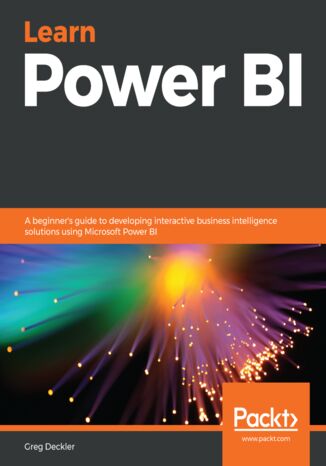
To succeed in today's transforming business world, organizations need business intelligence capabilities to make smarter decisions faster than ever before. This Power BI book is an entry-level guide that will get you up and running with data modeling, visualization, and analytical techniques from scratch.You'll find this book handy if you want to get well-versed with the extensive Power BI ecosystem. You'll start by covering the basics of business intelligence and installing Power BI. You'll then learn the wide range of Power BI features to unlock business insights. As you progress, the book will take you through how to use Power Query to ingest, cleanse, and shape your data, and use Power BI DAX to create simple to complex calculations. You'll also be able to add a variety of interactive visualizations to your reports to bring your data to life. Finally, you'll gain hands-on experience in creating visually stunning reports that speak to business decision makers, and see how you can securely share these reports and collaborate with others.By the end of this book, you'll be ready to create simple, yet effective, BI reports and dashboards using the latest features of Power BI.
Greg Deckler
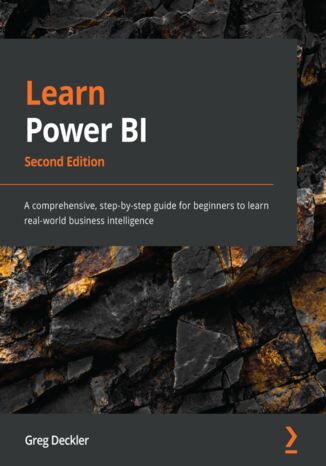
To succeed in today's transforming business world, organizations need business intelligence capabilities to make smarter decisions faster than ever before. This updated second edition of Learn Power BI takes you on a journey of data exploration and discovery, using Microsoft Power BI to ingest, cleanse, and organize data in order to unlock key business insights that can then be shared with others.This newly revised and expanded edition of Learn Power BI covers all of the latest features and interface changes and takes you through the fundamentals of business intelligence projects, how to deploy, adopt, and govern Power BI within your organization, and how to leverage your knowledge in the marketplace and broader ecosystem that is Power BI. As you progress, you will learn how to ingest, cleanse, and transform your data into stunning visualizations, reports, and dashboards that speak to business decision-makers.By the end of this Power BI book, you will be fully prepared to be the data analysis hero of your organization – or even start a new career as a business intelligence professional.
KC Tung
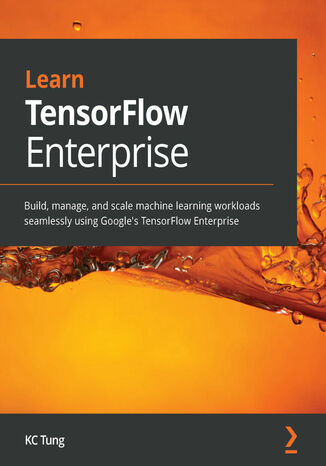
TensorFlow as a machine learning (ML) library has matured into a production-ready ecosystem. This beginner’s book uses practical examples to enable you to build and deploy TensorFlow models using optimal settings that ensure long-term support without having to worry about library deprecation or being left behind when it comes to bug fixes or workarounds.The book begins by showing you how to refine your TensorFlow project and set it up for enterprise-level deployment. You’ll then learn how to choose a future-proof version of TensorFlow. As you advance, you’ll find out how to build and deploy models in a robust and stable environment by following recommended practices made available in TensorFlow Enterprise. This book also teaches you how to manage your services better and enhance the performance and reliability of your artificial intelligence (AI) applications. You’ll discover how to use various enterprise-ready services to accelerate your ML and AI workflows on Google Cloud Platform (GCP). Finally, you’ll scale your ML models and handle heavy workloads across CPUs, GPUs, and Cloud TPUs.By the end of this TensorFlow book, you’ll have learned the patterns needed for TensorFlow Enterprise model development, data pipelines, training, and deployment.
Renato Baruti
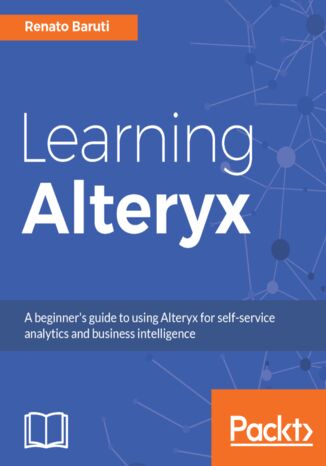
Alteryx, as a leading data blending and advanced data analytics platform, has taken self-service data analytics to the next level. Companies worldwide often find themselves struggling to prepare and blend massive datasets that are time-consuming for analysts. Alteryx solves these problems with a repeatable workflow designed to quickly clean, prepare, blend, and join your data in a seamless manner. This book will set you on a self-service data analytics journey that will help you create efficient workflows using Alteryx, without any coding involved. It will empower you and your organization to take well-informed decisions with the help of deeper business insights from the data.Starting with the fundamentals of using Alteryx such as data preparation and blending, you will delve into the more advanced concepts such as performing predictive analytics. You will also learn how to use Alteryx’s features to share the insights gained with the relevant decision makers. To ensure consistency, we will be using data from the Healthcare domain throughout this book. The knowledge you gain from this book will guide you to solve real-life problems related to Business Intelligence confidently. Whether you are a novice with Alteryx or an experienced data analyst keen to explore Alteryx’s self-service analytics features, this book will be the perfect companion for you.
Learning Apache Apex. Real-time streaming applications with Apex
Ananth Gundabattula, Thomas Weise, Munagala V. Ramanath,...
Apache Apex is a next-generation stream processing framework designed to operate on data at large scale, with minimum latency, maximum reliability, and strict correctness guarantees.Half of the book consists of Apex applications, showing you key aspects of data processing pipelines such as connectors for sources and sinks, and common data transformations. The other half of the book is evenly split into explaining the Apex framework, and tuning, testing, and scaling Apex applications.Much of our economic world depends on growing streams of data, such as social media feeds, financial records, data from mobile devices, sensors and machines (the Internet of Things - IoT). The projects in the book show how to process such streams to gain valuable, timely, and actionable insights. Traditional use cases, such as ETL, that currently consume a significant chunk of data engineering resources are also covered.The final chapter shows you future possibilities emerging in the streaming space, and how Apache Apex can contribute to it.
Sandeep Yarabarla, Graham Doman
Cassandra is a distributed database that stands out thanks to its robust feature set and intuitive interface, while providing high availability and scalability of a distributed data store. This book will introduce you to the rich feature set offered by Cassandra, and empower you to create and manage a highly scalable, performant and fault-tolerant database layer.The book starts by explaining the new features implemented in Cassandra 3.x and get you set up with Cassandra. Then you’ll walk through data modeling in Cassandra and the rich feature set available to design a flexible schema. Next you’ll learn to create tables with composite partition keys, collections and user-defined types and get to know different methods to avoid denormalization of data. You will then proceed to create user-defined functions and aggregates in Cassandra. Then, you will set up a multi node cluster and see how the dynamics of Cassandra change with it. Finally, you will implement some application-level optimizations using a Java client.By the end of this book, you'll be fully equipped to build powerful, scalable Cassandra database layers for your applications.
Chandramani Tiwary
If you are a Java developer and want to use Mahout and machine learning to solve Big Data Analytics use cases then this book is for you. Familiarity with shell scripts is assumed but no prior experience is required.
Muhammad Asif Abbasi
Apache Spark has seen an unprecedented growth in terms of its adoption over the last few years, mainly because of its speed, diversity and real-time data processing capabilities. It has quickly become the preferred choice of tool for many Big Data professionals looking to find quick insights from large chunks of data. This book introduces you to the Apache Spark framework, and familiarizes you with all the latest features and capabilities introduced in Spark 2.Starting with a detailed introduction to Spark’s architecture and the installation procedure, this book covers everything you need to know about the Spark framework in the most practical manner. You will learn how to perform the basic ETL activities using Spark, and work with different components of Spark such as Spark SQL, as well as the Dataset and DataFrame APIs for manipulating your data. Then, you will perform machine learning using Spark MLlib, as well as perform streaming analytics and graph processing using the Spark Streaming and GraphX modules respectively. The book also gives special emphasis on deploying your Spark models, and how they can be operated in a clustered mode.During the course of the book, you will come across implementations of different real-world use-cases and examples, giving you the hands-on knowledge you need to use Apache Spark in the best possible manner.