
Big data
Learning ArcGIS Runtime SDK for .NET. Build a GIS app Using ArcGIS Runtime SDK
Ron Vincent
ArcGIS is a geographic information system (GIS) that enables you to work with maps and geographic information. It can be used to create and utilize maps, compile geographic data, analyze mapped information, share and discover geographic information and manage geographic information in a database.This book starts by showing you where ArcGIS Runtime fits within Esri’s overall platform strategy. You'll create an initial map using the SDK, then use it to get an understanding of the MVVM model. You'll find out about the different kinds of layers and start adding layers, and you'll learn to transform maps into a 3D scene. The next chapters will help you comprehend and extract information contained in the maps using co-ordinates and layer objects. Towards the end, you will learn to set the symbology, decide whether to use 2D or 3D, see how to implement 2D or 3D, and learn to search and find objects. You'll also get to grips with many other standard features of the Application Programming Interface (API), including create applications and finally testing, licensing, and deploying them. Once completed, you will be able to meet most of the common requirements of any mapping application for desktop or mobile platforms.
Shiwang Kalkhanda
AWK is one of the most primitive and powerful utilities which exists in all Unix and Unix-like distributions. It is used as a command-line utility when performing a basic text-processing operation, and as programming language when dealing with complex text-processing and mining tasks. With this book, you will have the required expertise to practice advanced AWK programming in real-life examples. The book starts off with an introduction to AWK essentials. You will then be introduced to regular expressions, AWK variables and constants, arrays and AWK functions and more. The book then delves deeper into more complex tasks, such as printing formatted output in AWK, control flow statements, GNU's implementation of AWK covering the advanced features of GNU AWK, such as network communication, debugging, and inter-process communication in the GAWK programming language which is not easily possible with AWK. By the end of this book, the reader will have worked on the practical implementation of text processing and pattern matching using AWK to perform routine tasks.
Hari Manassery Koduvely
Bayesian Inference provides a unified framework to deal with all sorts of uncertainties when learning patterns form data using machine learning models and use it for predicting future observations. However, learning and implementing Bayesian models is not easy for data science practitioners due to the level of mathematical treatment involved. Also, applying Bayesian methods to real-world problems requires high computational resources. With the recent advances in computation and several open sources packages available in R, Bayesian modeling has become more feasible to use for practical applications today. Therefore, it would be advantageous for all data scientists and engineers to understand Bayesian methods and apply them in their projects to achieve better results.Learning Bayesian Models with R starts by giving you a comprehensive coverage of the Bayesian Machine Learning models and the R packages that implement them. It begins with an introduction to the fundamentals of probability theory and R programming for those who are new to the subject. Then the book covers some of the important machine learning methods, both supervised and unsupervised learning, implemented using Bayesian Inference and R.Every chapter begins with a theoretical description of the method explained in a very simple manner. Then, relevant R packages are discussed and some illustrations using data sets from the UCI Machine Learning repository are given. Each chapter ends with some simple exercises for you to get hands-on experience of the concepts and R packages discussed in the chapter.The last chapters are devoted to the latest development in the field, specifically Deep Learning, which uses a class of Neural Network models that are currently at the frontier of Artificial Intelligence. The book concludes with the application of Bayesian methods on Big Data using the Hadoop and Spark frameworks.
Learning Couchbase. Design documents and implement real world e-commerce applications with Couchbase
Henry Potsangbam
This book achieves its goal by taking up an end-to-end development structure, right from understanding NOSQL document design to implementing full fledged eCommerce application design using Couchbase as a backend. Starting with the architecture of Couchbase to get you up and running, this book quickly takes you through designing a NoSQL document and implementing highly scalable applications using Java API. You will then be introduced to document design and get to know the various ways to administer Couchbase. Followed by this, learn to store documents using bucket. Moving on, you will then learn to store, retrieve and delete documents using smart client base on Java API. You will then retrieve documents using SQL like syntax call N1QL. Next, you will learn how to write map reduce base views. Finally, you will configure XDCR for disaster recovery and implement an eCommerce application using Couchbase.
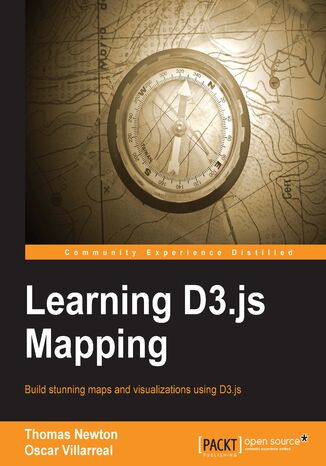
Learning D3.js Mapping. Build stunning maps and visualizations using D3.js
Thomas Newton, Oscar Villarreal
If you are interested in creating maps for the web GIS data, this book is for you. Familiarity with D3.js will be helpful but is not necessary.
Robert Layton
This book teaches you to design and develop data mining applications using a variety of datasets, starting with basic classification and affinity analysis. This book covers a large number of libraries available in Python, including the Jupyter Notebook, pandas, scikit-learn, and NLTK. You will gain hands on experience with complex data types including text, images, and graphs. You will also discover object detection using Deep Neural Networks, which is one of the big, difficult areas of machine learning right now.With restructured examples and code samples updated for the latest edition of Python, each chapter of this book introduces you to new algorithms and techniques. By the end of the book, you will have great insights into using Python for data mining and understanding of the algorithms as well as implementations.
Pranav Shukla, Sharath Kumar
The Elastic Stack is a powerful combination of tools for distributed search, analytics, logging, and visualization of data from medium to massive data sets. The newly released Elastic Stack 6.0 brings new features and capabilities that empower users to find unique, actionable insights through these techniques. This book will give you a fundamental understanding of what the stack is all about, and how to use it efficiently to build powerful real-time data processing applications.After a quick overview of the newly introduced features in Elastic Stack 6.0, you’ll learn how to set up the stack by installing the tools, and see their basic configurations. Then it shows you how to use Elasticsearch for distributed searching and analytics, along with Logstash for logging, and Kibana for data visualization. It also demonstrates the creation of custom plugins using Kibana and Beats. You’ll find out about Elastic X-Pack, a useful extension for effective security and monitoring. We also provide useful tips on how to use the Elastic Cloud and deploy the Elastic Stack in production environments.On completing this book, you’ll have a solid foundational knowledge of the basic Elastic Stack functionalities. You’ll also have a good understanding of the role of each component in the stack to solve different data processing problems.
Abhishek Andhavarapu
Elasticsearch is a modern, fast, distributed, scalable, fault tolerant, and open source search and analytics engine. You can use Elasticsearch for small or large applications with billions of documents. It is built to scale horizontally and can handle both structured and unstructured data. Packed with easy-to- follow examples, this book will ensure you will have a firm understanding of the basics of Elasticsearch and know how to utilize its capabilities efficiently.You will install and set up Elasticsearch and Kibana, and handle documents using the Distributed Document Store. You will see how to query, search, and index your data, and perform aggregation-based analytics with ease. You will see how to use Kibana to explore and visualize your data. Further on, you will learn to handle document relationships, work with geospatial data, and much more, with this easy-to-follow guide. Finally, you will see how you can set up and scale your Elasticsearch clusters in production environments.