
Big data
Mastering .NET Machine Learning. Use machine learning in your .NET applications
Jamie Dixon
.Net is one of the widely used platforms for developing applications. With the meteoric rise of Machine learning, developers are now keen on finding out how can they make their .Net applications smarter. Also, .NET developers are interested into moving into the world of devices and how to apply machine learning techniques to, well, machines.This book is packed with real-world examples to easily use machine learning techniques in your business applications. You will begin with introduction to F# and prepare yourselves for machine learning using .NET framework. You will be writing a simple linear regression model using an example which predicts sales of a product. Forming a base with the regression model, you will start using machine learning libraries available in .NET framework such as Math.NET, Numl.NET and Accord.NET with the help of a sample application. You will then move on to writing multiple linear regressions and logistic regressions.You will learn what is open data and the awesomeness of type providers. Next, you are going to address some of the issues that we have been glossing over so far and take a deep dive into obtaining, cleaning, and organizing our data. You will compare the utility of building a KNN and Naive Bayes model to achieve best possible results.Implementation of Kmeans and PCA using Accord.NET and Numl.NET libraries is covered with the help of an example application. We will then look at many of issues confronting creating real-world machine learning models like overfitting and how to combat them using confusion matrixes, scaling, normalization, and feature selection. You will now enter into the world of Neural Networks and move your line of business application to a hybrid scientific application. After you have covered all the above machine learning models, you will see how to deal with very large datasets using MBrace and how to deploy machine learning models to Internet of Thing (IoT) devices so that the machine can learn and adapt on the fly.
Lior Gazit, Meysam Ghaffari, Asha Saxena
Do you want to master Natural Language Processing (NLP) but don’t know where to begin? This book will give you the right head start. Written by leaders in machine learning and NLP, Mastering NLP from Foundations to LLMs provides an in-depth introduction to techniques. Starting with the mathematical foundations of machine learning (ML), you’ll gradually progress to advanced NLP applications such as large language models (LLMs) and AI applications. You’ll get to grips with linear algebra, optimization, probability, and statistics, which are essential for understanding and implementing machine learning and NLP algorithms. You’ll also explore general machine learning techniques and find out how they relate to NLP. Next, you’ll learn how to preprocess text data, explore methods for cleaning and preparing text for analysis, and understand how to do text classification. You’ll get all of this and more along with complete Python code samples.By the end of the book, the advanced topics of LLMs’ theory, design, and applications will be discussed along with the future trends in NLP, which will feature expert opinions. You’ll also get to strengthen your practical skills by working on sample real-world NLP business problems and solutions.
Umit Mert Cakmak, Tiago Antao, Mert Cuhadaroglu
NumPy is one of the most important scientific computing libraries available for Python. Mastering Numerical Computing with NumPy teaches you how to achieve expert level competency to perform complex operations, with in-depth coverage of advanced concepts.Beginning with NumPy's arrays and functions, you will familiarize yourself with linear algebra concepts to perform vector and matrix math operations. You will thoroughly understand and practice data processing, exploratory data analysis (EDA), and predictive modeling. You will then move on to working on practical examples which will teach you how to use NumPy statistics in order to explore US housing data and develop a predictive model using simple and multiple linear regression techniques. Once you have got to grips with the basics, you will explore unsupervised learning and clustering algorithms, followed by understanding how to write better NumPy code while keeping advanced considerations in mind. The book also demonstrates the use of different high-performance numerical computing libraries and their relationship with NumPy. You will study how to benchmark the performance of different configurations and choose the best for your system.By the end of this book, you will have become an expert in handling and performing complex data manipulations.
Mastering OpenCV 3. Get hands-on with practical Computer Vision using OpenCV 3 - Second Edition
Jason Saragih
As we become more capable of handling data in every kind, we are becoming more reliant on visual input and what we can do with those self-driving cars, face recognition, and even augmented reality applications and games. This is all powered by Computer Vision.This book will put you straight to work in creating powerful and unique computer vision applications. Each chapter is structured around a central project and deep dives into an important aspect of OpenCV such as facial recognition, image target tracking, making augmented reality applications, the 3D visualization framework, and machine learning. You’ll learn how to make AI that can remember and use neural networks to help your applications learn.By the end of the book, you will have created various working prototypes with the projects in the book and will be well versed with the new features of OpenCV3.
Alberto Fernández Villán
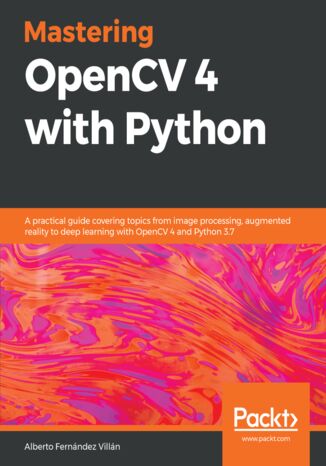
OpenCV is considered to be one of the best open source computer vision and machine learning software libraries. It helps developers build complete projects in relation to image processing, motion detection, or image segmentation, among many others. OpenCV for Python enables you to run computer vision algorithms smoothly in real time, combining the best of the OpenCV C++ API and the Python language.In this book, you'll get started by setting up OpenCV and delving into the key concepts of computer vision. You'll then proceed to study more advanced concepts and discover the full potential of OpenCV. The book will also introduce you to the creation of advanced applications using Python and OpenCV, enabling you to develop applications that include facial recognition, target tracking, or augmented reality. Next, you'll learn machine learning techniques and concepts, understand how to apply them in real-world examples, and also explore their benefits, including real-time data production and faster data processing. You'll also discover how to translate the functionality provided by OpenCV into optimized application code projects using Python bindings. Toward the concluding chapters, you'll explore the application of artificial intelligence and deep learning techniques using the popular Python libraries TensorFlow, and Keras.By the end of this book, you'll be able to develop advanced computer vision applications to meet your customers' demands.
Ashish Kumar
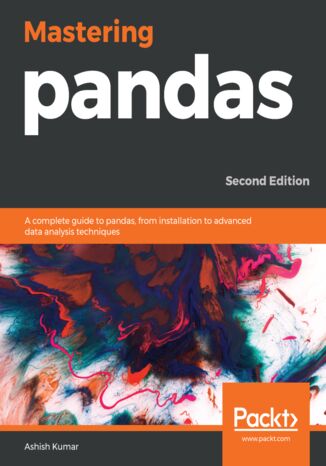
pandas is a popular Python library used by data scientists and analysts worldwide to manipulate and analyze their data. This book presents useful data manipulation techniques in pandas to perform complex data analysis in various domains.An update to our highly successful previous edition with new features, examples, updated code, and more, this book is an in-depth guide to get the most out of pandas for data analysis. Designed for both intermediate users as well as seasoned practitioners, you will learn advanced data manipulation techniques, such as multi-indexing, modifying data structures, and sampling your data, which allow for powerful analysis and help you gain accurate insights from it. With the help of this book, you will apply pandas to different domains, such as Bayesian statistics, predictive analytics, and time series analysis using an example-based approach. And not just that; you will also learn how to prepare powerful, interactive business reports in pandas using the Jupyter notebook.By the end of this book, you will learn how to perform efficient data analysis using pandas on complex data, and become an expert data analyst or data scientist in the process.
Michael Heydt
If you are interested in quantitative finance, financial modeling, and trading, or simply want to learn how Python and pandas can be applied to finance, then this book is ideal for you. Some knowledge of Python and pandas is assumed. Interest in financial concepts is helpful, but no prior knowledge is expected.
Simon R. Chapple, Terence Sloan, Thorsten Forster,...
R is one of the most popular programming languages used in data science. Applying R to big data and complex analytic tasks requires the harnessing of scalable compute resources.Mastering Parallel Programming with R presents a comprehensive and practical treatise on how to build highly scalable and efficient algorithms in R. It will teach you a variety of parallelization techniques, from simple use of R’s built-in parallel package versions of lapply(), to high-level AWS cloud-based Hadoop and Apache Spark frameworks. It will also teach you low level scalable parallel programming using RMPI and pbdMPI for message passing, applicable to clusters and supercomputers, and how to exploit thousand-fold simple processor GPUs through ROpenCL. By the end of the book, you will understand the factors that influence parallel efficiency, including assessing code performance and implementing load balancing; pitfalls to avoid, including deadlock and numerical instability issues; how to structure your code and data for the most appropriate type of parallelism for your problem domain; and how to extract the maximum performance from your R code running on a variety of computer systems.