
Big data

Mercury Learning and Information, Roger W. Pryor
This updated edition of the book explores COMSOL 5 and MATLAB, essential modeling tools for engineers and scientists. It includes five new models and covers systems from 0D to 3D, introducing numerical analysis techniques in COMSOL 5.6 and MATLAB. Using examples from electromagnetic, electronic, optical, thermal physics, and biomedical models, the book provides fundamental concepts and step-by-step instructions for building each model. Companion files include all models and related animations.The course starts with modeling methodology and material properties, progressing through 0D electrical circuit interface, 1D, 2D, 2D axisymmetric, 2D simple and complex mixed mode, and 3D modeling. Advanced topics like Perfectly Matched Layer models and Bioheat models are also covered. Each chapter builds on the previous one, ensuring a comprehensive understanding of modeling techniques.Understanding these concepts is crucial for developing and analyzing engineering, science, and biomedical systems. This book transitions readers from basic to advanced modeling, combining theoretical knowledge with practical skills. Companion files enhance the learning experience, making this an essential resource for mastering COMSOL 5 and MATLAB.
MySQL 8 Administrator???s Guide. Effective guide to administering high-performance MySQL 8 solutions
Chintan Mehta, Hetal Oza, Subhash Shah, Ravi...
MySQL is one of the most popular and widely used relational databases in the world today. The recently released version 8.0 brings along some major advancements in the way your MySQL solution can be administered. This handbook will be your companion to understand the newly introduced features in MySQL and show you how you can leverage them to design a high-performance MySQL solution for your organization.This book starts with a brief introduction to the new features in MySQL 8, and then quickly jumping onto the crucial administration topics that you will find useful in your day-to-day work. Topics such as migrating to MySQL 8, MySQL benchmarking, achieving high performance by implementing the indexing techniques, and optimizing your queries are covered in this book. You will also learn how to perform replication, scale your MySQL solution and implement effective security techniques. There is also a special section on the common and not so common troubleshooting techniques for effective MySQL administration is also covered in this book. By the end of this highly practical book, you will have all the knowledge you need to tackle any problem you might encounter while administering your MySQL solution.
MySQL 8 Cookbook. Over 150 recipes for high-performance database querying and administration
Karthik Appigatla
MySQL is one of the most popular and widely used relational databases in the World today. The recently released MySQL 8 version promises to be better and more efficient than ever before.This book contains everything you need to know to be the go-to person in your organization when it comes to MySQL. Starting with a quick installation and configuration of your MySQL instance, the book quickly jumps into the querying aspects of MySQL. It shows you the newest improvements in MySQL 8 and gives you hands-on experience in managing high-transaction and real-time datasets. If you've already worked with MySQL before and are looking to migrate your application to MySQL 8, this book will also show you how to do that. The book also contains recipes on efficient MySQL administration, with tips on effective user management, data recovery, security, database monitoring, performance tuning, troubleshooting, and more.With quick solutions to common and not-so-common problems you might encounter while working with MySQL 8, the book contains practical tips and tricks to give you the edge over others in designing, developing, and administering your database effectively.
Gökhan Ozar
Any database designer who wants to accomplish both everyday tasks and more advanced actions with a few clicks or drag-and-drops can now do so using Navicat's advanced tools and this book.Starting with the basics before progressing with advanced features, this book can be read from cover to cover, or simply used as a reference guide for any problems you encounter.The book features 'work along' tutorials, some of which will surprise you by revealing features of Navicat which you may never have known existed ñ features such as designing functions and stored procedures, event triggers, creating batch jobs and scheduling.MySQL Management and Administration with Navicat is an ideal resource to master Navicat and unlock its true potential.
Myślenie statystyczne. Jak analizować dane i wydobywać z nich wiedzę. Wydanie III
Allen B. Downey
Dla większości z nas statystyka jest poddziedziną matematyki związaną z opracowywaniem teoretycznych podstaw prawdopodobieństwa i wnioskowania statystycznego. Analitycy danych podchodzą do tego inaczej: dla nich statystyka jest niezbędnym zestawem narzędzi i praktyk, które służą do pracy z danymi, odpowiadania na pytania i ułatwiają podejmowanie najlepszych decyzji. To trzecie wydanie przewodnika cenionego przez analityków danych, inżynierów oprogramowania i pasjonatów danologii. Dzięki niemu szybko nauczysz się korzystać z bibliotek NumPy, SciPy i Pandas. Poznasz różne metody eksploracji i wizualizacji danych, odkrywania zależności i trendów, a także prezentowania wyników. Struktura książki odpowiada rzeczywistemu procesowi pracy ze zbiorem danych: od importowania i oczyszczenia, przez analizę wieloczynnikową, aż po wizualizację uzyskanych wyników. Wszystkie rozdziały są dostępne w formie notatników Jupytera, dzięki czemu możesz jednocześnie czytać tekst, uruchamiać kod i pracować nad ćwiczeniami. W książce znajdziesz również takie zagadnienia jak: analiza rozkładów danych i wizualizacja wzorców za pomocą bibliotek Pythona korzystanie z modeli regresji analiza szeregów czasowych i analiza przeżycia tworzenie zrozumiałych wizualizacji danych rozwiązywanie typowych problemów związanych z analizą danych Jeśli chcesz się szybko nauczyć statystyki i stosowania jej w praktyce, to ta książka jest dla Ciebie! Zachary del Rosario, adiunkt w Olin College of Engineering
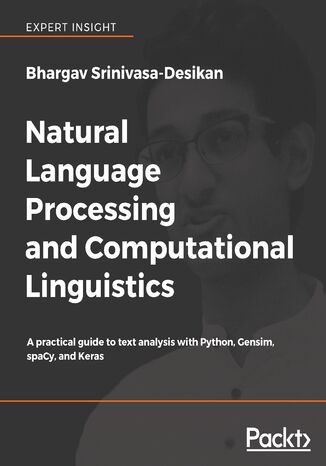
Brian Sacash, Bhargav Srinivasa-Desikan, Reddy Anil Kumar
Modern text analysis is now very accessible using Python and open source tools, so discover how you can now perform modern text analysis in this era of textual data.This book shows you how to use natural language processing, and computational linguistics algorithms, to make inferences and gain insights about data you have. These algorithms are based on statistical machine learning and artificial intelligence techniques. The tools to work with these algorithms are available to you right now - with Python, and tools like Gensim and spaCy.You'll start by learning about data cleaning, and then how to perform computational linguistics from first concepts. You're then ready to explore the more sophisticated areas of statistical NLP and deep learning using Python, with realistic language and text samples. You'll learn to tag, parse, and model text using the best tools. You'll gain hands-on knowledge of the best frameworks to use, and you'll know when to choose a tool like Gensim for topic models, and when to work with Keras for deep learning.This book balances theory and practical hands-on examples, so you can learn about and conduct your own natural language processing projects and computational linguistics. You'll discover the rich ecosystem of Python tools you have available to conduct NLP - and enter the interesting world of modern text analysis.
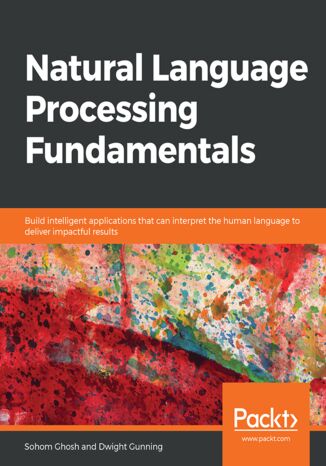
Sohom Ghosh , Dwight Gunning
If NLP hasn't been your forte, Natural Language Processing Fundamentals will make sure you set off to a steady start. This comprehensive guide will show you how to effectively use Python libraries and NLP concepts to solve various problems.You'll be introduced to natural language processing and its applications through examples and exercises. This will be followed by an introduction to the initial stages of solving a problem, which includes problem definition, getting text data, and preparing it for modeling. With exposure to concepts like advanced natural language processing algorithms and visualization techniques, you'll learn how to create applications that can extract information from unstructured data and present it as impactful visuals. Although you will continue to learn NLP-based techniques, the focus will gradually shift to developing useful applications. In these sections, you'll understand how to apply NLP techniques to answer questions as can be used in chatbots. By the end of this book, you'll be able to accomplish a varied range of assignments ranging from identifying the most suitable type of NLP task for solving a problem to using a tool like spacy or gensim for performing sentiment analysis. The book will easily equip you with the knowledge you need to build applications that interpret human language.
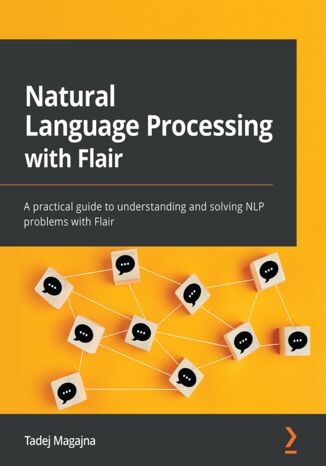
Tadej Magajna
Flair is an easy-to-understand natural language processing (NLP) framework designed to facilitate training and distribution of state-of-the-art NLP models for named entity recognition, part-of-speech tagging, and text classification. Flair is also a text embedding library for combining different types of embeddings, such as document embeddings, Transformer embeddings, and the proposed Flair embeddings.Natural Language Processing with Flair takes a hands-on approach to explaining and solving real-world NLP problems. You'll begin by installing Flair and learning about the basic NLP concepts and terminology. You will explore Flair's extensive features, such as sequence tagging, text classification, and word embeddings, through practical exercises. As you advance, you will train your own sequence labeling and text classification models and learn how to use hyperparameter tuning in order to choose the right training parameters. You will learn about the idea behind one-shot and few-shot learning through a novel text classification technique TARS. Finally, you will solve several real-world NLP problems through hands-on exercises, as well as learn how to deploy Flair models to production.By the end of this Flair book, you'll have developed a thorough understanding of typical NLP problems and you’ll be able to solve them with Flair.