
Big data
Manpreet Singh Ghotra, Rajdeep Dua
If you're aware of the buzz surrounding the terms such as machine learning, artificial intelligence, or deep learning, you might know what neural networks are. Ever wondered how they help in solving complex computational problem efficiently, or how to train efficient neural networks? This book will teach you just that.You will start by getting a quick overview of the popular TensorFlow library and how it is used to train different neural networks. You will get a thorough understanding of the fundamentals and basic math for neural networks and why TensorFlow is a popular choice Then, you will proceed to implement a simple feed forward neural network. Next you will master optimization techniques and algorithms for neural networks using TensorFlow. Further, you will learn to implement some more complex types of neural networks such as convolutional neural networks, recurrent neural networks, and Deep Belief Networks. In the course of the book, you will be working on real-world datasets to get a hands-on understanding of neural network programming. You will also get to train generative models and will learn the applications of autoencoders.By the end of this book, you will have a fair understanding of how you can leverage the power of TensorFlow to train neural networks of varying complexities, without any hassle. While you are learning about various neural network implementations you will learn the underlying mathematics and linear algebra and how they map to the appropriate TensorFlow constructs.
James Loy
Neural networks are at the core of recent AI advances, providing some of the best resolutions to many real-world problems, including image recognition, medical diagnosis, text analysis, and more. This book goes through some basic neural network and deep learning concepts, as well as some popular libraries in Python for implementing them.It contains practical demonstrations of neural networks in domains such as fare prediction, image classification, sentiment analysis, and more. In each case, the book provides a problem statement, the specific neural network architecture required to tackle that problem, the reasoning behind the algorithm used, and the associated Python code to implement the solution from scratch. In the process, you will gain hands-on experience with using popular Python libraries such as Keras to build and train your own neural networks from scratch.By the end of this book, you will have mastered the different neural network architectures and created cutting-edge AI projects in Python that will immediately strengthen your machine learning portfolio.
V Kishore Ayyadevara
This book will take you from the basics of neural networks to advanced implementations of architectures using a recipe-based approach.We will learn about how neural networks work and the impact of various hyper parameters on a network's accuracy along with leveraging neural networks for structured and unstructured data.Later, we will learn how to classify and detect objects in images. We will also learn to use transfer learning for multiple applications, including a self-driving car using Convolutional Neural Networks.We will generate images while leveraging GANs and also by performing image encoding. Additionally, we will perform text analysis using word vector based techniques. Later, we will use Recurrent Neural Networks and LSTM to implement chatbot and Machine Translation systems.Finally, you will learn about transcribing images, audio, and generating captions and also use Deep Q-learning to build an agent that plays Space Invaders game.By the end of this book, you will have developed the skills to choose and customize multiple neural network architectures for various deep learning problems you might encounter.
Neural Networks with R. Build smart systems by implementing popular deep learning models in R
Balaji Venkateswaran, Giuseppe Ciaburro
Neural networks are one of the most fascinating machine learning models for solving complex computational problems efficiently. Neural networks are used to solve wide range of problems in different areas of AI and machine learning.This book explains the niche aspects of neural networking and provides you with foundation to get started with advanced topics. The book begins with neural network design using the neural net package, then you’ll build a solid foundation knowledge of how a neural network learns from data, and the principles behind it. This book covers various types of neural network including recurrent neural networks and convoluted neural networks. You will not only learn how to train neural networks, but will also explore generalization of these networks. Later we will delve into combining different neural network models and work with the real-world use cases.By the end of this book, you will learn to implement neural network models in your applications with the help of practical examples in the book.
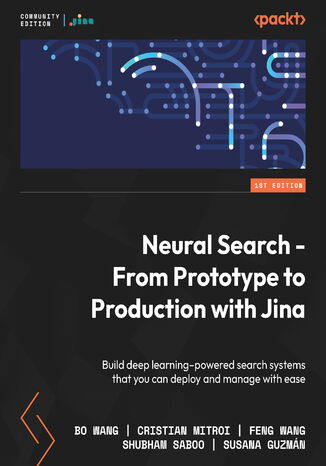
Bo Wang, Jina AI, Cristian Mitroi, Feng...
Search is a big and ever-growing part of the tech ecosystem. Traditional search, however, has limitations that are hard to overcome because of the way it is designed. Neural search is a novel approach that uses the power of machine learning to retrieve information using vector embeddings as first-class citizens, opening up new possibilities of improving the results obtained through traditional search.Although neural search is a powerful tool, it is new and finetuning it can be tedious as it requires you to understand the several components on which it relies. Jina fills this gap by providing an infrastructure that reduces the time and complexity involved in creating deep learning–powered search engines. This book will enable you to learn the fundamentals of neural networks for neural search, its strengths and weaknesses, as well as how to use Jina to build a search engine. With the help of step-by-step explanations, practical examples, and self-assessment questions, you'll become well-versed with the basics of neural search and core Jina concepts, and learn to apply this knowledge to build your own search engine.By the end of this deep learning book, you'll be able to make the most of Jina's neural search design patterns to build an end-to-end search solution for any modality.
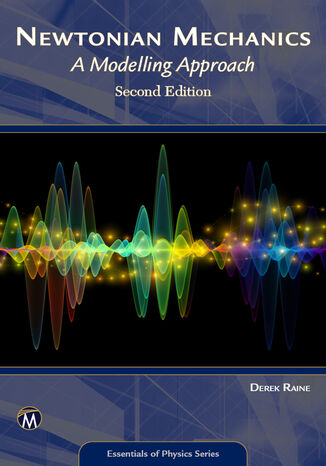
Mercury Learning and Information, Derek Raine
Newtonian mechanics is fundamental in physics education due to its intellectual significance, diverse applications, and its role in teaching modeling and problem-solving. This text covers both introductory and advanced topics, making it suitable for extended study. Emphasizing problem-solving, it guides readers through the process of constructing models and finding solutions, thus enhancing their analytical skills.Starting with mechanical models and forces, the course progresses through kinematics, energy, and motion, providing a solid foundation. Further chapters delve into momentum, orbital motion, and oscillations, offering insights into dynamic systems. Advanced topics like rigid bodies, stability of motion, and Lagrangian and Hamiltonian mechanics ensure a comprehensive understanding.The journey through this course equips learners with the skills to approach complex problems, construct effective models, and develop robust solutions, making it invaluable for students aiming to excel in physics and related fields.
NoSQL, NewSQL i BigData. Bazy danych następnej generacji
Guy Harrison
Model relacyjnej bazy danych zdecydowanie dominował wśród technologii bazodanowych przez ostatnie 20 lat. Poszczególne rozwiązania były do siebie na tyle podobne, że decyzja o zastosowaniu relacyjnej bazy danych stała się oczywista. Architektura rozwiązań tego typu była zbliżona, a różnice polegały głównie na koszcie wdrożenia, wydajności, niezawodności i łatwości użycia aplikacji. Obecnie sytuacja diametralnie się zmieniła: powstało wiele radykalnie różniących się od siebie technologii bazodanowych, a wybór właściwej bazy danych stał się złożonym zadaniem, wymagającym sporej wiedzy i obarczonym poważnymi konsekwencjami natury ekonomicznej i technologicznej. Ta książka szczególnie przyda się architektom technologii informatycznych, administratorom baz danych i projektantom, którzy do wykonywania swoich obowiązków potrzebują wiedzy o najświeższych rozwiązaniach z dziedziny technologii baz danych. Omówiono tu najnowsze, wykorzystywane obecnie technologie baz danych. Wyjaśniono, w jakim celu zaprojektowano każdą z nich. Zaprezentowano możliwości poszczególnych baz danych oraz ich potencjał w rozwiązywaniu realnych problemów biznesowych i problemów z aplikacjami. Co najważniejsze, ukazano różnice w architekturze między technologiami, które mają kluczowe znaczenie przy wyborze platformy baz danych dla nowych i planowanych projektów. W tej książce między innymi: Co zrewolucjonizowało bazy danych Google, Hadoop i koncepcja BigData Pamięciowe i rozproszone bazy danych NoSQL, CQL i nowe odsłony SQL Hybrydowe bazy danych Oracle NoSQL i BigData: potężne bazy danych przyszłości!
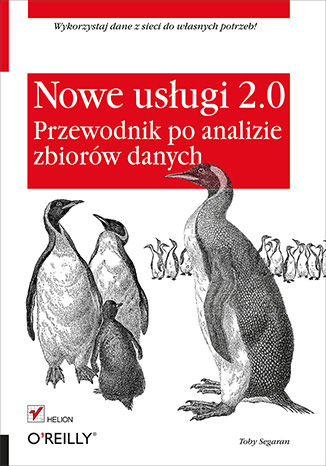
Nowe usługi 2.0. Przewodnik po analizie zbiorów danych
Toby Segaran
Wykorzystaj dane z sieci do własnych potrzeb! Internet to nic innego jak gigantyczny zbiór danych. Każdy, kto znajdzie sposób na ich umiejętne wykorzystanie, ma szansę zbudować aplikację, która odniesie światowy sukces. Serwisy randkowe, portale społecznościowe, porównywarki cen — to tylko drobna część serwisów, które możesz wykorzystać przy tworzeniu nowej usługi. Jak analizować dane i wyciągnąć wnioski? Na wiele podobnych pytań odpowiada ta jedyna w swoim rodzaju książka. W trakcie lektury poznasz najlepsze sposoby filtrowania danych, tworzenia rekomendacji, wykrywania grup oraz wyszukiwania i klasyfikowania. Na kolejnych stronach znajdziesz bogaty zbiór informacji poświęconych algorytmom analizującym dane. Ponadto będziesz mieć możliwość zapoznania się z różnymi sposobami optymalizacji, modelowania przy użyciu drzew decyzyjnych oraz tworzenia modeli cenowych. Książka ta w rękach wprawnego programisty może stanowić niesamowite narzędzie. Otwiera wrota do świata pełnego danych i zależności pomiędzy nimi! Dzięki tej książce: poznasz najlepsze i najskuteczniejsze algorytmy do analizy danych zbudujesz model cen nauczysz się korzystać z drzew decyzyjnych zastosujesz dane z sieci do budowy nowych usług Wyciągnij właściwe wnioski z posiadanych danych! „Brawo! Nic lepszego nie przychodzi mi na myśl w przypadku programisty, który zaczyna dopiero przygodę z opisanymi w książce algorytmami i metodami. Sam (jako stary »wyjadacz« od sztucznej inteligencji) sięgnąłbym po nią w pierwszej kolejności, żeby odświeżyć swoją znajomość szczegółów.” Dan Russell, główny specjalista ds. technologii, firma Google „W książce Toby’ego w znakomity sposób dokonano rozbicia złożonego zagadnienia dotyczącego algorytmów uczenia maszynowego na praktyczne i łatwe do zrozumienia przykłady, które mogą być bezpośrednio używane do analizowania interakcji społecznościowej w obecnym internecie. Jeśli ta książka trafiła w moje ręce dwa lata wcześniej, zaoszczędziłbym mój cenny czas, gdy podążałem bezowocnymi ścieżkami.” Tim Wolters, szef ds. technologii, firma Collective Intellect