Systemy operacyjne
Tablice informatyczne. Windows Vista PL
Radosław Sokół
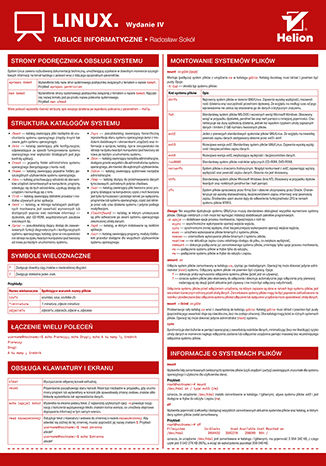
Windows Vista "od podszewki" Jak zdefiniować zasady bezpieczeństwa haseł? Jak konfigurować sieć z poziomu konsoli testowej? Jak usuwać "martwe" wpisy z listy zainstalowanych aplikacji? Windows Vista to niezwykle łatwy w obsłudze i elastyczny system operacyjny, zapewniający jednocześnie wysoki poziom bezpieczeństwa. Dlatego też doceniany jest zarówno przez początkujących, jak i zaawansowanych użytkowników. Mimo że posługiwanie się jego narzędziami jest naprawdę proste, aby poznać "od podszewki" i profesjonalnie wykorzystać wszystkie możliwości systemu, potrzebujesz książki "Tablice informatyczne. Windows Vista PL", która w zwięzły, przejrzysty i zrozumiały sposób prezentuje całą wiedzę na ten temat. "Tablice informatyczne. Windows Vista PL" dają Ci łatwy i natychmiastowy dostęp do potrzebnych informacji. Dzięki tej książce możesz w każdej chwili sprawdzić m.in. systemowe i standardowe kombinacje klawiszy oraz ich znaczenie, symbole wieloznaczne, polecenia wraz z objaśnieniami i przykładami, a także konstrukcję potoków i nazwy filtrów. Nauczysz się diagnozować działanie połączeń sieciowych oraz konfigurować sieć z poziomu konsoli tekstowej. Znajdziesz tu wszelkie informacje niezbędne do profesjonalnej obsługi systemu. Instalacja i wstępna konfiguracja systemu Obsługa systemu za pomocą klawiatury Konsola tekstowa Uzupełnianie nazw za pomocą klawisza tabulatora Symbole wieloznaczne Specjalne nazwy plików Najczęściej używane polecenia oraz ich łączenie Potoki i filtry w konsoli Windows Vista Najczęściej stosowane filtry Diagnostyka działania połączeń sieciowych z poziomu konsoli tekstowej Modyfikacja rejestru systemowego Blokowanie usług sieciowych Menedżer zadań systemu Windows "Tablice informatyczne. Windows Vista PL" - szybka informacja zawsze pod ręką.
Paul Thurrott, Rafael Rivera
Sprawdź możliwości systemu Windows 8! Windows 8 na dobre zadomowił się już na naszych komputerach i urządzeniach mobilnych. Jego nowy interfejs budzi jednak wiele skrajnych emocji. Mechanizmy, które dla początkujących są niezwykle przyjazne i intuicyjne, doświadczonych użytkowników systemu Windows potrafią wprawić w zakłopotanie. Pewne jednak jest to, że najnowsza wersja systemu dyktuje trendy w projektowaniu intefejsu użytkownika na kolejne lata. Dzięki tej książce jesteś w stanie błyskawicznie opanować nowości systemu Windows 8 – poznasz jego interfejs oraz umiejscowienie przydatnych narzędzi. Na samym początku dowiesz się, jak wybrać wersję systemu dopasowaną do Twoich potrzeb oraz jaki sprzęt musisz posiadać żeby w pełni wykorzystać potencjał tego systemu operacyjnego. W kolejnych rozdziałach poznasz aplikacje dostarczane wraz z systemem, które uprzyjemnią i ułatwią Twoje codzienne zadania. W tej książce znajdziesz również obszerne informacje na temat bezpieczeństwa systemu: kopie bezpieczeństwa, zarządzanie kontami i uprawnieniami i wiele innych. Książka ta jest kompletnym i unikalnym przewodnikiem po nowościach systemu Windows 8. Obowiązkowa lektura dla każdego użytkownika i dla wszystkich zastanawiających się nad zmianą systemu. Sięgnij po tą książkę i: poznaj zalety systemu Windows 8 przekonaj się, jak wygodny jest nowy interfejs Metro sprawdź, jak dostosować system do swoich potrzeb wykorzystaj potencjał systemu Windows 8 Poznaj moc ukrytą pod maską Windows 8!
Damodar Lohani
Using a shared codebase in addition to an extensive range of tools in the Flutter ecosystem optimized for browsers, the Flutter framework has expanded to enable you to bring your mobile apps to the web. You’ll find out how web developers can leverage the Flutter framework for web apps with this hands-on guide.Taking Flutter to the Web will help you learn all about the Flutter ecosystem by covering the tools and project structure that allows you to easily integrate Flutter into your web stack. You’ll understand the concepts of cross-platform UI development and how they can be applied to web platforms. As you explore Flutter on the web, you'll become well-versed with using Flutter as an alternative UI platform for building adaptive and responsive designs for web apps.By the end of this Flutter book, you'll have built and deployed a complete Flutter app for the web and have a roadmap ready to target the web for your existing Flutter mobile apps.
The Complete Kubernetes Guide. Become an expert in container management with the power of Kubernetes
Jonathan Baier, Gigi Sayfan, Jesse White
If you are running a number of containers and want to be able to automate the way they’re managed, it can be helpful to have Kubernetes at your disposal. This Learning Path guides you through core Kubernetes constructs, such as pods, services, replica sets, replication controllers, and labels. You'll get started by learning how to integrate your build pipeline and deployments in a Kubernetes cluster. As you cover more chapters in the Learning Path, you'll get up to speed with orchestrating updates behind the scenes, avoiding downtime on your cluster, and dealing with underlying cloud provider instability in your cluster. With the help of real-world use cases, you'll also explore options for network configuration, and understand how to set up, operate, and troubleshoot various Kubernetes networking plugins. In addition to this, you'll gain insights into custom resource development and utilization in automation and maintenance workflows.By the end of this Learning Path, you'll have the expertise you need to progress from an intermediate to an advanced level of understanding Kubernetes.This Learning Path includes content from the following Packt products:• Getting Started with Kubernetes - Third Edition by Jonathan Baier and Jesse White• Mastering Kubernetes - Second Edition by Gigi Sayfan
The Complete VMware vSphere Guide. Design a virtualized data center with VMware vSphere 6.7
Mike Brown, Hersey Cartwright, Martin Gavanda, Andrea...
vSphere 6.7 is the latest release of VMware's industry-leading virtual cloud platform. By understanding how to manage, secure, and scale apps with vSphere 6.7, you can easily run even the most demanding of workloads. This Learning Path begins with an overview of the features of the vSphere 6.7 suite. You'll learn how to plan and design a virtual infrastructure. You'll also gain insights into best practices to efficiently configure, manage, and secure apps. Next, you'll pick up on how to enhance your infrastructure with high-performance storage access, such as remote direct memory access (RDMA) and Persistent memory. The book will even guide you in securing your network with security features, such as encrypted vMotion and VM-level encryption. Finally, by learning how to apply Proactive High Availability and Predictive Distributed Resource Scheduler (DRS), you'll be able to achieve enhanced computing, storage, network, and management capabilities for your virtual data center.By the end of this Learning Path, you'll be able to build your own VMware vSphere lab that can run high workloads.This Learning Path includes content from the following Packt products:VMware vSphere 6.7 Data Center Design Cookbook - Third Edition by Mike Brown and Hersey CartwrightMastering VMware vSphere 6.7 - Second Edition by Martin Gavanda, Andrea Mauro, Karel Novak, and Paolo Valsecchi
Jeremy Wittkop
Security is everyone's responsibility and for any organization, the focus should be to educate their employees about the different types of security attacks and how to ensure that security is not compromised.This cybersecurity book starts by defining the modern security and regulatory landscape, helping you understand the challenges related to human behavior and how attacks take place. You'll then see how to build effective cybersecurity awareness and modern information security programs. Once you've learned about the challenges in securing a modern enterprise, the book will take you through solutions or alternative approaches to overcome those issues and explain the importance of technologies such as cloud access security brokers, identity and access management solutions, and endpoint security platforms. As you advance, you'll discover how automation plays an important role in solving some key challenges and controlling long-term costs while building a maturing program. Toward the end, you'll also find tips and tricks to keep yourself and your loved ones safe from an increasingly dangerous digital world.By the end of this book, you'll have gained a holistic understanding of cybersecurity and how it evolves to meet the challenges of today and tomorrow.
Viktor Farcic
Viktor Farcic's latest book, The DevOps 2.1 Toolkit: Docker Swarm, takes you deeper into one of the major subjects of his international best seller, The DevOps 2.0 Toolkit, and shows you how to successfully integrate Docker Swarm into your DevOps toolset.Viktor shares with you his expert knowledge in all aspects of building, testing, deploying, and monitoring services inside Docker Swarm clusters. You'll go through all the tools required for running a cluster. You'll travel through the whole process with clusters running locally on a laptop. Once you're confident with that outcome, Viktor shows you how to translate your experience to different hosting providers like AWS, Azure, and DigitalOcean. Viktor has updated his DevOps 2.0 framework in this book to use the latest and greatest features and techniques introduced in Docker. We'll go through many practices and even more tools. While there will be a lot of theory, this is a hands-on book. You won't be able to complete it by reading it on the metro on your way to work. You'll have to read this book while in front of the computer and get your hands dirty.
Viktor Farcic
Building on The DevOps 2.3 Toolkit: Kubernetes, Viktor Farcic brings his latest exploration of the Docker technology as he records his journey to continuously deploying applications with Jenkins into a Kubernetes cluster.The DevOps 2.4 Toolkit: Continuously Deploying Applications with Jenkins to a Kubernetes Cluster is the latest book in Viktor Farcic’s series that helps you build a full DevOps Toolkit. This book guides readers through the process of building, testing, and deploying applications through fully automated pipelines.Within this book, Viktor will cover a wide-range of emerging topics, including an exploration of continuous delivery and deployment in Kubernetes using Jenkins. It also shows readers how to perform continuous integration inside these clusters, and discusses the distribution of Kubernetes applications, as well as installing and setting up Jenkins.Work with Viktor and dive into the creation of self-adaptive and self-healing systems within Docker.