
Webmasterstwo
Peter Ward
“Microsoft SharePoint for Business Executives: Q&A Handbook” is a quick, non-technical reference for business executives who need to get up to speed with SharePoint and understand how to make the right decision about implementations. With an easy to absorb Q&A approach and short bite size chapters focused on defined SharePoint subjects, the book follows specific SharePoint situations drawn from real world experience, enabling you to learn from anecdotes and case studies along the way. “Microsoft SharePoint for Business Executives: Q&A Handbook” is the perfect companion for business executives or non-technical team leaders who don’t want to trawl through a detailed, hands-on functionality guide to get up to speed with SharePoint. If you simply need to understand important implementation decisions or have the confidence to challenge your technical team on an approach, this book will prepare you to ask the right questions and make the right decisions. No prior knowledge of SharePoint is required.
Mistrzowski JavaScript. Programowanie zorientowane obiektowo
Andrea Chiarelli
JavaScript jest popularnym, rozwiniętym i dojrzałym językiem programowania, a jego zastosowanie znacząco wykracza dziś poza WWW, HTML i CSS: skrypty można uruchamiać na serwerze, komputerach PC, w urządzeniach przenośnych i układach wbudowanych. Dzięki tym możliwościom JavaScript stał się potężnym i wszechstronnym narzędziem. Co więcej, ten język świetnie nadaje się do programowania zorientowanego obiektowo i pozwala na pisanie solidnego kodu, a w efekcie na tworzenie nawet bardzo złożonych, skalowalnych i łatwych w utrzymaniu aplikacji. Niniejsza książka jest przeznaczona dla osób, które mniej więcej znają JavaScript, ale chcą się nauczyć programować obiektowo w tym języku. Można tu znaleźć informacje o definiowaniu obiektów za pomocą klas ES6, metodach hermetyzacji oraz różnych sposobach dziedziczenia. Są tu niektóre zaawansowane wzorce projektowe i opis wykorzystania mechanizmu obietnic do pracy z procesami asynchronicznymi. Nie zabrakło również wyjaśnień zasad SOLID, dzięki którym tworzony kod staje się efektywny i niezawodny. Niektóre zagadnienia omówione w książce: podstawy programowania obiektowego w JavaScripcie techniki imitacji klasycznych interfejsów obiektowych modele prezentacyjne: MVC i MVVM programowanie asynchroniczne porządkowanie kodu źródłowego — moduły ECMAScript 6 rodzaje architektury aplikacji w JavaScript, wzorce fasada i mediator JavaScript — pisz skrypty do zadań specjalnych! Andrea Chiarelli — jest ekspertem programowania w różnych technologiach (C#, JavaScript, ASP.NET czy AngularJS, REST i PhoneGap/Cordova), a także autorem i współautorem licznych książek o programowaniu. Poza tym regularnie pisuje do takich magazynów, jak „Computer Programming” czy „ASP Today”. Pracuje na stanowisku starszego inżyniera oprogramowania we włoskim oddziale Apparound Inc., firmy, która urodziła się w samym sercu Doliny Krzemowej.
Mobile DevOps. Deliver continuous integration and deployment within your mobile applications
Rohin Tak, Jhalak Modi
Today's world is all about perfection, and there are hundreds of applications that are released each day out of which only a few succeed. Making sure that the app looks, performs, and behaves as expected is one of the biggest challenge developers face today.The main goal of this book is to teach developers to implement DevOps to build, test, and deliver. This book will teach you to implement Mobile DevOps at every stage of your application's lifecycle with Visual Studio and Xamarin Mobile Lifecycle solutions. Later, it will also show you how to leverage Mobile Center's continuous integration and automated testing to develop a high-quality applications. Next, you’ll see how to mobilize your on-premises data to the cloud and increase your productivity with code reuse. Finally, you’ll discover how to find and fix bugs beforehand, improving the efficiency of your application while it is being developed.By the end of this book, you will be well-versed with Mobile DevOps techniques, delivering high quality and high performance mobile apps.
Mobile Web Development. Smashing Magazine
G. Avola, Jon Raasch
„Smashing Magazine” to jeden z najpopularniejszych serwisów poświęconych zagadnieniom z dziedziny programowania, między innymi tworzenia profesjonalnych stron WWW. Jest to obowiązkowa pozycja wśród ulubionych serwisów każdego projektanta i dewelopera. Na łamach tego portalu najwybitniejsi eksperci dzielą się wiedzą z zakresu projektowania interfejsów użytkownika, aplikacji mobilnych i stron WWW. Kolejna książka z tej serii poświęcona jest w całości aplikacjom mobilnym. W trakcie lektury poznasz podstawy HTML5, CSS3 i JavaScriptu oraz zaznajomisz się z możliwościami, jakie dają one deweloperom. Z kolejnych rozdziałów dowiesz się, jak skonfigurować platformę rozwojową i produkcyjną, jak stworzyć prototyp oraz jaką bazę danych warto wykorzystać. Ponadto nauczysz się w praktyce stosować mechanizmy geolokalizacji czy integracji z serwisami społecznościowymi oraz kontrolować wydajność Twojej aplikacji. Na sam koniec przekonasz się, że przygotowanie aplikacji do premiery wcale nie jest takie trudne. Nie martw się, z tą książką odniesiesz sukces! Sprawdź: jakie nowości kryją HTML5 i CSS3 jak przygotować platformę rozwojową i produkcyjną jak przechowywać dane w aplikacji mobilnej dlaczego warto tworzyć aplikacje na urządzenia przenośne jak odnieść sukces Fenomenalne źródło informacji o aplikacjach mobilnych!
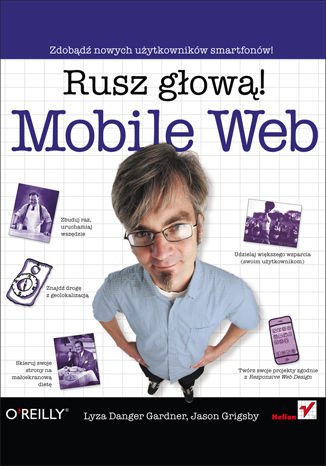
Lyza Danger Gardner, Jason Grigsby
Zdobądź nowych użytkowników smartfonów! Liczba użytkowników internetu przeglądających strony internetowe za pomocą smartfonów rośnie lawinowo. Powszechnie sądzi się, że wkrótce będzie ich więcej niż tych, którzy korzystają z tradycyjnych komputerów. Dlatego już dziś należy przygotować się na rewolucję i zmienić podejście do tworzenia stron internetowych. Skorzystaj z nowości HTML5 oraz CSS3 i przekonaj się, że to wcale nie musi być trudne. Jeżeli dołożysz do tego kolejną książkę z serii "Rusz głową!", całe zagadnienie może okazać się wręcz banalne. Dzięki nowatorskim technikom nauczania będziesz chłonął wiedzę niczym gąbka. W trakcie lektury nauczysz się korzystać z Responsive Web Design oraz sprawdzisz, jak rozpoznać, że użytkownik korzysta ze smartfona. Ponadto poznasz biblioteki, które pomogą Ci w trakcie realizacji postawionych (na przykład jQuery Mobile — jej możliwości są oszałamiające!). Twoją ciekawość powinien wzbudzić też projekt PhoneGap. Dzięki niemu będziesz mógł skonwertować swoją aplikację napisaną przy użyciu HTML5 do natywnego formatu, a to da Ci parę nowych możliwości. Książka ta jest obowiązkową pozycją dla wszystkich projektantów stron internetowych, którzy chcą być na czasie! Zaliczasz się do nich? Poznaj: przyszłość sieci internet i stron WWW podejście Responsive Web Design możliwości biblioteki jQuery i projektu PhoneGap rozwiązania typowych problemów Wykorzystaj potencjał HTML5 i CSS3!
MobX Quick Start Guide. Supercharge the client state in your React apps with MobX
Pavan Podila, Michel Weststrate
MobX is a simple and highly scalable state management library in JavaScript. Its abstractions can help you manage state in small to extremely large applications. However, if you are just starting out, it is essential to have a guide that can help you take the first steps. This book aims to be that guide that will equip you with the skills needed to use MobX and effectively handle the state management aspects of your application.You will first learn about observables, actions, and reactions: the core concepts of MobX. To see how MobX really shines and simplifies state management, you'll work through some real-world use cases. Building on these core concepts and use cases, you will learn about advanced MobX, its APIs, and libraries that extend MobX.By the end of this book, you will not only have a solid conceptual understanding of MobX, but also practical experience. You will gain the confidence to tackle many of the common state management problems in your own projects.
Richard Grimes, Marius Bancila
C++ is one of the most widely used programming languages. It is fast, flexible, and used to solve many programming problems.This Learning Path gives you an in-depth and hands-on experience of working with C++, using the latest recipes and understanding most recent developments. You will explore C++ programming constructs by learning about language structures, functions, and classes, which will help you identify the execution flow through code. You will also understand the importance of the C++ standard library as well as memory allocation for writing better and faster programs.Modern C++: Efficient and Scalable Application Development deals with the challenges faced with advanced C++ programming. You will work through advanced topics such as multithreading, networking, concurrency, lambda expressions, and many more recipes.By the end of this Learning Path, you will have all the skills to become a master C++ programmer.This Learning Path includes content from the following Packt products:• Beginning C++ Programming by Richard Grimes• Modern C++ Programming Cookbook by Marius Bancila• The Modern C++ Challenge by Marius Bancila
Daniel Bugl, Matthias Zronek
Recent trends show deeper integration between the two, opening numerous possibilities for building real-world web applications, through server-side technologies like Node.js, Express, and MongoDB.Written by the author of Learning Redux and Learn React Hooks, and CEO of TouchLay, Modern Full-Stack React Projects will guide you through the entire process of advancing from a frontend developer to a full-stack developer. Starting with how to set up robust projects that can be maintained for a long time, you’ll then progress toward developing a backend system and integrating it with the frontend. Throughout the book, you’ll learn how to build, test, and deploy a blog application and a chat application. You’ll also explore MongoDB, Express, React, Node.js (MERN) stack, best practices for frontend and backend development, different full-stack architectures, unit and end-to-end testing, and deployment of full-stack web applications. Once you get to grips with the essential concepts, you’ll progress to learn how to use Next.js, an enterprise-grade full-stack web framework for React.By the end, you’ll be well-versed in the MERN stack and all set to create performant and scalable full-stack web applications.*Email sign-up and proof of purchase required