
Biznes IT
Python dla DevOps. Naucz się bezlitośnie skutecznej automatyzacji
Noah Gift, Kennedy Behrman, Alfredo Deza, Grig...
Ostatnia dekada zmieniła oblicze IT. Kluczowego znaczenia nabrały big data, a chmura i automatyzacja rozpowszechniły się wszędzie tam, gdzie mowa o efektywności. Inżynierowie muszą wykorzystywać zalety systemów linuksowych w codziennej praktyce, aby zapewnić należyty poziom automatyzacji swoich zadań. Do tych celów świetnie nadaje się Python. Język ten zdobywa coraz większe uznanie z uwagi na jego wszechstronność, jak również wydajność, przenaszalność i bezpieczeństwo kodu. Warto więc wykorzystywać Pythona do administrowania systemami Linux wraz z takimi narzędziami DevOps jak Docker, Kubernetes i Terraform. Dzięki tej książce dowiesz się, jak sobie z tym poradzić. Znalazło się w niej krótkie wprowadzenie do Pythona oraz do automatyzacji przetwarzania tekstu i obsługi systemu plików, a także do pisania własnych narzędzi wiersza poleceń. Zaprezentowano również przydatne narzędzia linuksowe, systemy zarządzania pakietami oraz systemy budowania, monitorowania i automatycznego testowania kodu. Zagadnienia te szczególnie zainteresują specjalistów DevOps. Ponadto zawarto tu podstawowe informacje o chmurze obliczeniowej, usługach IaC i systemach Kubernetes. Omówiono zasady uczenia maszynowego i inżynierii danych z perspektywy DevOps. Przedstawiono także kompletny przewodnik po procesach budowania, wdrażania oraz operacyjnego wykorzystywania modelu uczenia maszynowego z użyciem systemów Flask, sklearn, Docker i Kubernetes. W tej książce: wprowadzenie do Pythona automatyczne przetwarzanie tekstu oraz automatyzacja operacji na plikach automatyzacja za pomocą sprawdzonych narzędzi linuksowych chmura, infrastruktura jako kod, Kubernetes i tryb bezserwerowy uczenie maszynowe i inżynieria danych z perspektywy DevOps tworzenie i operacjonalizacja projektu uczenia maszynowego Python: tutaj ważna jest prawdziwa nowoczesność oprogramowania!
Soledad Galli, Christoph Molnar
Streamline data preprocessing and feature engineering in your machine learning project with this third edition of the Python Feature Engineering Cookbook to make your data preparation more efficient.This guide addresses common challenges, such as imputing missing values and encoding categorical variables using practical solutions and open source Python libraries. You’ll learn advanced techniques for transforming numerical variables, discretizing variables, and dealing with outliers. Each chapter offers step-by-step instructions and real-world examples, helping you understand when and how to apply various transformations for well-prepared data.The book explores feature extraction from complex data types such as dates, times, and text. You’ll see how to create new features through mathematical operations and decision trees and use advanced tools like Featuretools and tsfresh to extract features from relational data and time series.By the end, you’ll be ready to build reproducible feature engineering pipelines that can be easily deployed into production, optimizing data preprocessing workflows and enhancing machine learning model performance.
Soledad Galli
Feature engineering is invaluable for developing and enriching your machine learning models. In this cookbook, you will work with the best tools to streamline your feature engineering pipelines and techniques and simplify and improve the quality of your code.Using Python libraries such as pandas, scikit-learn, Featuretools, and Feature-engine, you’ll learn how to work with both continuous and discrete datasets and be able to transform features from unstructured datasets. You will develop the skills necessary to select the best features as well as the most suitable extraction techniques. This book will cover Python recipes that will help you automate feature engineering to simplify complex processes. You’ll also get to grips with different feature engineering strategies, such as the box-cox transform, power transform, and log transform across machine learning, reinforcement learning, and natural language processing (NLP) domains.By the end of this book, you’ll have discovered tips and practical solutions to all of your feature engineering problems.
Rheinwerk Publishing, Inc, Veit Steinkamp
This book provides a thorough introduction to Python programming designed for engineers and scientists. It begins with foundational topics like development environments and program structures, then introduces key Python libraries such as NumPy, SymPy, SciPy, Matplotlib, and VPython. Clear explanations and practical exercises help readers write efficient, well-structured code while progressing through increasingly complex projects.The content covers core programming paradigms including functions, branching, and object-oriented design, followed by numerical analysis with NumPy and symbolic math with SymPy. Detailed chapters on data visualization with Matplotlib and 3D animations with VPython enhance comprehension. Additional focus on statistical computations, Boolean algebra, and interactive GUI programming with Tkinter prepares readers for real-world applications. Each chapter ends with project tasks reinforcing hands-on learning.Throughout the book, readers build a strong skill set combining programming expertise and scientific problem-solving. By the end, they will confidently use Python’s libraries to solve diverse engineering and scientific challenges. This practical, project-based approach ensures knowledge is both solid and immediately useful in research and professional work.
Yuxing Yan
This book uses Python as its computational tool. Since Python is free, any school ororganization can download and use it. This book is organized according to various finance subjects. In other words, the first edition focuses more on Python, while the second edition is truly trying to apply Python to finance.The book starts by explaining topics exclusively related to Python. Then we deal with critical parts of Python, explaining concepts such as time value of money stock and bond evaluations, capital asset pricing model, multi-factor models, time series analysis, portfolio theory,options and futures.This book will help us to learn or review the basics of quantitative finance and apply Python to solve various problems, such as estimating IBM’s market risk,running a Fama-French 3-factor, 5-factor, or Fama-French-Carhart 4 factor model, estimating the VaR of a 5-stock portfolio, estimating the optimal portfolio, and constructing the efficient frontier for a 20-stock portfolio with real-world stock, and with Monte Carlo Simulation. Later, we will also learn how to replicate the famous Black-Scholes-Merton option model and how to price exotic options such as the average price call option.
Python for TensorFlow Pocket Primer. A Quick Guide to Python Libraries for TensorFlow Developers
Mercury Learning and Information, Oswald Campesato
As part of the best-selling *Pocket Primer* series, this book prepares programmers for machine learning and deep learning with TensorFlow. It begins with a quick introduction to Python, followed by chapters on NumPy, Pandas, Matplotlib, and scikit-learn. The final chapters provide TensorFlow 1.x code samples, including detailed examples for TensorFlow Dataset, crucial for TensorFlow 2.The journey starts with Python basics and progresses through essential data manipulation and visualization libraries. You'll explore machine learning fundamentals with scikit-learn before diving into TensorFlow, learning to construct data pipelines with TensorFlow Dataset APIs like map(), filter(), and batch().Understanding these concepts is vital for modern AI applications. This book transitions readers from basic programming to advanced machine learning and deep learning techniques, blending theory with practical skills. Companion files with source code enhance learning, making this an essential resource for mastering Python, machine learning, and TensorFlow.
Sebastian Kondracki
Sztuczna inteligencja według Pythona. Sięgnij po potężne wsparcie dla swojego e-sklepu E-commerce wspierany przez potężną moc sztucznej inteligencji ― to dla wielu właścicieli rodzimych firm internetowych wciąż brzmi jak odległa przyszłość. Może gdzieś tam, w Kalifornii, może u technologicznych gigantów, może Apple, Amazon, a bliżej nas, powiedzmy, Allegro korzysta lub będzie korzystać z chatbotów czy data-driven marketingu. Ale nasza firma do tej pory świetnie sobie radziła, to i dalej będzie sobie radzić z prostym mechanizmem sklepu online i kilkoma osobami obsługi. Marzenie ściętej głowy. Do 2025 roku w Polsce brakować będzie 200 tysięcy specjalistów w dziedzinie AI. I to nie w wielkich korporacjach. Głód programistów potrafiących kodować algorytmy sztucznej inteligencji odczują przede wszystkim firmy mniejsze i średnie. Jeśli jesteś właścicielem biznesu bazującego na sprzedaży w sieci, jeśli jesteś początkującym programistą albo działasz już jako programista e-commerce, ale chcesz się w tym kierunku rozwijać ― ta "książka kucharska" jest dla Ciebie. Dlaczego "książka kucharska"? Ponieważ podręcznik zawiera gotowe przepisy na algorytmy optymalizacyjne, systemy rekomendacyjne, przetwarzanie ogromnych ilości danych z ruchu odnotowanego w sklepie i zamianę ich w wiedzę o kliencie. Wszystko to już dziś wdrożysz w dowolnym e-sklepie stosunkowo małym kosztem. Zarówno przy użyciu gotowych programów napisanych w Pythonie przez ogromną społeczność miłośników AI i Pythona, jak i sprytnych produktów w modelu SaaS (ang. software as a service), sprzedawanych przez rzeszę polskich i zagranicznych startupów.
Alexander Combs, Saurabh Chhajed, Michael Roman
Machine learning is transforming the way we understand and interact with the world around us. This book is the perfect guide for you to put your knowledge and skills into practice and use the Python ecosystem to cover key domains in machine learning. This second edition covers a range of libraries from the Python ecosystem, including TensorFlow and Keras, to help you implement real-world machine learning projects.The book begins by giving you an overview of machine learning with Python. With the help of complex datasets and optimized techniques, you’ll go on to understand how to apply advanced concepts and popular machine learning algorithms to real-world projects. Next, you’ll cover projects from domains such as predictive analytics to analyze the stock market and recommendation systems for GitHub repositories. In addition to this, you’ll also work on projects from the NLP domain to create a custom news feed using frameworks such as scikit-learn, TensorFlow, and Keras. Following this, you’ll learn how to build an advanced chatbot, and scale things up using PySpark. In the concluding chapters, you can look forward to exciting insights into deep learning and you'll even create an application using computer vision and neural networks.By the end of this book, you’ll be able to analyze data seamlessly and make a powerful impact through your projects.
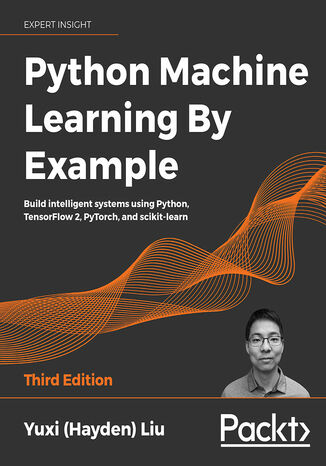
Yuxi (Hayden) Liu
Python Machine Learning By Example, Third Edition serves as a comprehensive gateway into the world of machine learning (ML).With six new chapters, on topics including movie recommendation engine development with Naïve Bayes, recognizing faces with support vector machine, predicting stock prices with artificial neural networks, categorizing images of clothing with convolutional neural networks, predicting with sequences using recurring neural networks, and leveraging reinforcement learning for making decisions, the book has been considerably updated for the latest enterprise requirements.At the same time, this book provides actionable insights on the key fundamentals of ML with Python programming. Hayden applies his expertise to demonstrate implementations of algorithms in Python, both from scratch and with libraries.Each chapter walks through an industry-adopted application. With the help of realistic examples, you will gain an understanding of the mechanics of ML techniques in areas such as exploratory data analysis, feature engineering, classification, regression, clustering, and NLP.By the end of this ML Python book, you will have gained a broad picture of the ML ecosystem and will be well-versed in the best practices of applying ML techniques to solve problems.
Yuxi (Hayden) Liu
The surge in interest in machine learning (ML) is due to the fact that it revolutionizes automation by learning patterns in data and using them to make predictions and decisions. If you’re interested in ML, this book will serve as your entry point to ML.Python Machine Learning By Example begins with an introduction to important ML concepts and implementations using Python libraries. Each chapter of the book walks you through an industry adopted application. You’ll implement ML techniques in areas such as exploratory data analysis, feature engineering, and natural language processing (NLP) in a clear and easy-to-follow way.With the help of this extended and updated edition, you’ll understand how to tackle data-driven problems and implement your solutions with the powerful yet simple Python language and popular Python packages and tools such as TensorFlow, scikit-learn, gensim, and Keras. To aid your understanding of popular ML algorithms, the book covers interesting and easy-to-follow examples such as news topic modeling and classification, spam email detection, stock price forecasting, and more.By the end of the book, you’ll have put together a broad picture of the ML ecosystem and will be well-versed with the best practices of applying ML techniques to make the most out of new opportunities.
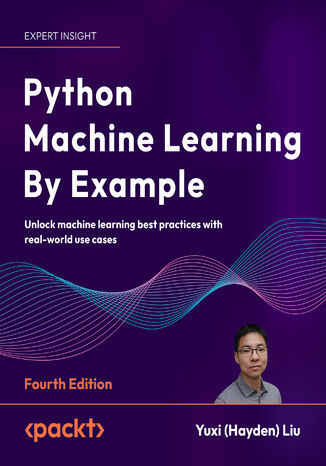
Yuxi (Hayden) Liu
The fourth edition of Python Machine Learning By Example is a comprehensive guide for beginners and experienced machine learning practitioners who want to learn more advanced techniques, such as multimodal modeling. Written by experienced machine learning author and ex-Google machine learning engineer Yuxi (Hayden) Liu, this edition emphasizes best practices, providing invaluable insights for machine learning engineers, data scientists, and analysts.Explore advanced techniques, including two new chapters on natural language processing transformers with BERT and GPT, and multimodal computer vision models with PyTorch and Hugging Face. You’ll learn key modeling techniques using practical examples, such as predicting stock prices and creating an image search engine.This hands-on machine learning book navigates through complex challenges, bridging the gap between theoretical understanding and practical application. Elevate your machine learning and deep learning expertise, tackle intricate problems, and unlock the potential of advanced techniques in machine learning with this authoritative guide.*Email sign-up and proof of purchase required
Giuseppe Ciaburro, Prateek Joshi
This eagerly anticipated second edition of the popular Python Machine Learning Cookbook will enable you to adopt a fresh approach to dealing with real-world machine learning and deep learning tasks.With the help of over 100 recipes, you will learn to build powerful machine learning applications using modern libraries from the Python ecosystem. The book will also guide you on how to implement various machine learning algorithms for classification, clustering, and recommendation engines, using a recipe-based approach. With emphasis on practical solutions, dedicated sections in the book will help you to apply supervised and unsupervised learning techniques to real-world problems. Toward the concluding chapters, you will get to grips with recipes that teach you advanced techniques including reinforcement learning, deep neural networks, and automated machine learning.By the end of this book, you will be equipped with the skills you need to apply machine learning techniques and leverage the full capabilities of the Python ecosystem through real-world examples.
Python. Machine learning i deep learning. Biblioteki scikit-learn i TensorFlow 2. Wydanie III
Sebastian Raschka, Vahid Mirjalili
Uczenie maszynowe jest jedną z najbardziej fascynujących technologii naszych czasów - rozwojem jego najróżniejszych zastosowań zajmują się tacy giganci jak Google, Facebook, Apple, Amazon czy IBM. Uczenie maszynowe otwiera zupełnie nowe możliwości i powoli staje się nieodzowne: wystarczy wymienić asystenty głosowe w smartfonach, chatboty ułatwiające klientom wybór produktu, a także sieci ułatwiające podejmowanie decyzji o inwestycjach giełdowych, filtrujące niechciane wiadomości e-mail czy wspomagające diagnostykę medyczną. Oto obszerny przewodnik po uczeniu maszynowym i uczeniu głębokim w Pythonie. Zawiera dokładne omówienie najważniejszych technik uczenia maszynowego oraz staranne wyjaśnienie zasad rządzących tą technologią. Poszczególne zagadnienia zilustrowano mnóstwem wyjaśnień, wizualizacji i przykładów, co znakomicie ułatwia zrozumienie materiału i sprawne rozpoczęcie samodzielnego budowania aplikacji i modeli, takich jak te służące do klasyfikacji obrazów, odkrywania ukrytych wzorców czy wydobywania dodatkowych informacji z danych. Wydanie trzecie zostało zaktualizowane - znalazł się w nim opis biblioteki TensorFlow 2 i najnowszych dodatków do biblioteki scikit-learn. Dodano również wprowadzenie do dwóch nowatorskich technik: uczenia przez wzmacnianie i budowy generatywnych sieci przeciwstawnych (GAN). W książce między innymi: platformy, modele i techniki uczenia maszynowego wykorzystywanie biblioteki scikit-learn i TensorFlow sieci neuronowe, sieci GAN i inne przygotowywanie danych dla modeli uczenia maszynowego ocena i strojenie modeli analizy: regresyjna, skupień i sentymentów Uczenie głębokie z Pythonem: zrozum i zastosuj!
Sebastian Raschka, Vahid Mirjalili
Python Machine Learning, Third Edition is a comprehensive guide to machine learning and deep learning with Python. It acts as both a step-by-step tutorial, and a reference you'll keep coming back to as you build your machine learning systems.Packed with clear explanations, visualizations, and working examples, the book covers all the essential machine learning techniques in depth. While some books teach you only to follow instructions, with this machine learning book, Raschka and Mirjalili teach the principles behind machine learning, allowing you to build models and applications for yourself.Updated for TensorFlow 2.0, this new third edition introduces readers to its new Keras API features, as well as the latest additions to scikit-learn. It's also expanded to cover cutting-edge reinforcement learning techniques based on deep learning, as well as an introduction to GANs. Finally, this book also explores a subfield of natural language processing (NLP) called sentiment analysis, helping you learn how to use machine learning algorithms to classify documents.This book is your companion to machine learning with Python, whether you're a Python developer new to machine learning or want to deepen your knowledge of the latest developments.
Sebastian Raschka, Jared Huffman, Vahid Mirjalili, Ryan...
Publisher's Note: This edition from 2017 is outdated and is not compatible with TensorFlow 2 or any of the most recent updates to Python libraries. A new third edition, updated for 2020 and featuring TensorFlow 2 and the latest in scikit-learn, reinforcement learning, and GANs, has now been published.Machine learning is eating the software world, and now deep learning is extending machine learning. Understand and work at the cutting edge of machine learning, neural networks, and deep learning with this second edition of Sebastian Raschka’s bestselling book, Python Machine Learning. Using Python's open source libraries, this book offers the practical knowledge and techniques you need to create and contribute to machine learning, deep learning, and modern data analysis.Fully extended and modernized, Python Machine Learning Second Edition now includes the popular TensorFlow 1.x deep learning library. The scikit-learn code has also been fully updated to v0.18.1 to include improvements and additions to this versatile machine learning library. Sebastian Raschka and Vahid Mirjalili’s unique insight and expertise introduce you to machine learning and deep learning algorithms from scratch, and show you how to apply them to practical industry challenges using realistic and interesting examples. By the end of the book, you’ll be ready to meet the new data analysis opportunities.If you’ve read the first edition of this book, you’ll be delighted to find a balance of classical ideas and modern insights into machine learning. Every chapter has been critically updated, and there are new chapters on key technologies. You’ll be able to learn and work with TensorFlow 1.x more deeply than ever before, and get essential coverage of the Keras neural network library, along with updates to scikit-learn 0.18.1.
Jalaj Thanaki
This book starts off by laying the foundation for Natural Language Processing and why Python is one of the best options to build an NLP-based expert system with advantages such as Community support, availability of frameworks and so on. Later it gives you a better understanding of available free forms of corpus and different types of dataset. After this, you will know how to choose a dataset for natural language processing applications and find the right NLP techniques to process sentences in datasets and understand their structure. You will also learn how to tokenize different parts of sentences and ways to analyze them. During the course of the book, you will explore the semantic as well as syntactic analysis of text. You will understand how to solve various ambiguities in processing human language and will come across various scenarios while performing text analysis. You will learn the very basics of getting the environment ready for natural language processing, move on to the initial setup, and then quickly understand sentences and language parts. You will learn the power of Machine Learning and Deep Learning to extract information from text data.By the end of the book, you will have a clear understanding of natural language processing and will have worked on multiple examples that implement NLP in the real world.