
Biznes IT
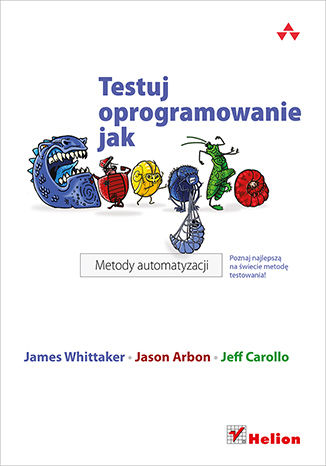
Testuj oprogramowanie jak Google. Metody automatyzacji
James A. Whittaker, Jason Arbon, Jeff Carollo
Poznaj najlepszą na świecie metodę testowania! Oprogramowanie firmy Google to miliony linii kodu źródłowego, dziesiątki wersji językowych, różne systemy operacyjne, przeglądarki i preferencje użytkownika. Jak przy takich wymogach dostarczyć klientom produkt najwyższej jakości? Tu mogą pomóc tylko testy automatyczne. Dzięki nim codziennie bez trudu można uruchomić miliony testów! Google opanowało tę sztukę do mistrzostwa. Warto uczyć się od najlepszych! Dzięki tej książce dowiesz się, jak zorganizować proces testowania tak, żeby był elastyczny, skuteczny i spełniał Twoje oczekiwania. Poznasz rolę inżyniera do spraw testowania oprogramowania, kierownika zespołów inżynierskich oraz inżyniera testującego. Zobaczysz, na jakie problemy natykają się oni każdego dnia oraz jak sobie z nimi radzą. Ponadto nauczysz się oceniać ryzyko, dokumentować proces testowania czy raportować błędy. Książka ta jest obowiązkową lekturą dla wszystkich osób, które doskonalą swoje umiejętności programistyczne i chcą polepszyć jakość dostarczanego oprogramowania. Dzięki tej książce: poznasz najlepsze metody zapewniania jakości oprogramowania nauczysz się planować i przeprowadzać testy poprawnie ocenisz ryzyko udoskonalisz proces wytwarzania oprogramowania! Sprawdź, jak testują najlepsi!
Testy A/B. Od kliknięcia do klienta
Dan Siroker, Pete Koomen
Odkryj możliwości testów A/B! Kampanie reklamowe to nie lada obciążenie dla firmowego budżetu. W dodatku badania pokazują, że zaledwie 2% osób klikających reklamę i odwiedzających Twoją witrynę staje się Twoimi klientami. Łatwo z tego wyciągnąć smutny wniosek - aż 98% z nich nie skorzysta z Twoich usług! Zmień to! Poznaj sposoby na zwiększenie współczynnika konwersji! Istnieją narzędzia, które pozwolą Ci polepszyć ten wskaźnik. Ta książka omawia jedną z najskuteczniejszych technik - testy A/B. Polegają one na prezentowaniu użytkownikom różnych wersji strony i mierzeniu, jak reagują ci użytkownicy. W trakcie lektury tego wyjątkowego poradnika dogłębnie poznasz tę metodykę i odkryjesz najlepsze sposoby jej wdrażania. A potem dowiesz się, jakie pułapki i problemy czekają na Ciebie oraz jak sobie z nimi poradzić. Książka ta jest poświęcona niełatwym zagadnieniom, jednak ta wiedza przekazywana jest w niezwykle przyjazny i prosty sposób. Popraw wyniki swoich kampanii! Dzięki tej książce: poznasz testy A/B wdrożysz testy A/B krok po kroku unikniesz najczęstszych błędów zwiększysz współczynnik konwersji Zwiększ skuteczność Twoich działań marketingowych!
Christopher Lee
The Art of Crafting User Stories is a must-read for product managers, UX professionals, and product developers dedicated to creating meaningful digital experiences. This book provides a comprehensive, step-by-step approach to empower you to master the techniques for creating user stories that drive effective product development.This book takes you on a journey from identifying and capturing user needs, goals, and perspectives through user stories, to crafting impactful stories for design choices and organizing tasks efficiently. You’ll learn how to define the problem area, recognize user personas, and develop user scenarios with the aid of real-world examples, practical tips, and exercises designed to help you develop your skills in crafting user-centered experiences. Moreover, you’ll gain a thorough understanding of user stories, their role in Agile development, and how to use them to plan and manage products effectively.By the end of this book, you’ll be able to improve the quality and efficiency of your own products by applying the hands-on practical skills to create compelling digital experiences that resonate with users and stay relevant in the market.
The Art of CRM. Proven strategies for modern customer relationship management
Max Fatouretchi
CRM systems have delivered huge value to organizations. This book shares proven and cutting-edge techniques to increase the power of CRM even further.In The Art of CRM, Max Fatouretchi shares his decades of experience building successful CRM systems that make a real difference to business performance.Through clear processes, actionable advice, and informative case studies, The Art of CRM teaches you to design successful CRM systems for your clients.Fatouretchi, founder of Academy4CRM institute, draws on his experience over 20 years and 200 CRM implementations worldwide.Bringing CRM bang up to date, The Art of CRM shows how to add AI and machine learning, ensure compliance with GDPR, and choose between on-premise, cloud, and hybrid hosting solutions.If you’re looking for an expert guide to real-world CRM implementations, this book is for you.
Jamie Champagne, Vincent Mirabelli
Designed by an industry expert, this book offers a structured and practical roadmap to help professionals confidently navigate their careers at every stage, whether they are aspiring analysts or seasoned leaders. You’ll begin with core business analysis principles and progress through advanced techniques, real-world applications, and the latest trends shaping the profession. Each chapter delivers expert insights, hands-on tools, and best practices to help you build essential skills to even advanced applications, select the right specialization, and stay ahead with evolving technologies. You'll explore career planning, certifications, stakeholder relationships and engagement, leadership, and continuous learning, culminating in a personalized career growth strategy. By the end, you'll have the knowledge and confidence to define your path and set meaningful goals for a successful business analysis career.
The Complete Metasploit Guide. Explore effective penetration testing techniques with Metasploit
Sagar Rahalkar, Nipun Jaswal
Most businesses today are driven by their IT infrastructure, and the tiniest crack in this IT network can bring down the entire business. Metasploit is a pentesting network that can validate your system by performing elaborate penetration tests using the Metasploit Framework to secure your infrastructure.This Learning Path introduces you to the basic functionalities and applications of Metasploit. Throughout this book, you’ll learn different techniques for programming Metasploit modules to validate services such as databases, fingerprinting, and scanning. You’ll get to grips with post exploitation and write quick scripts to gather information from exploited systems. As you progress, you’ll delve into real-world scenarios where performing penetration tests are a challenge. With the help of these case studies, you’ll explore client-side attacks using Metasploit and a variety of scripts built on the Metasploit Framework.By the end of this Learning Path, you’ll have the skills required to identify system vulnerabilities by using thorough testing.This Learning Path includes content from the following Packt products:Metasploit for Beginners by Sagar RahalkarMastering Metasploit - Third Edition by Nipun Jaswal
Matthew Moocarme, Mahla Abdolahnejad , Ritesh Bhagwat
New experiences can be intimidating, but not this one! This beginner’s guide to deep learning is here to help you explore deep learning from scratch with Keras, and be on your way to training your first ever neural networks.What sets Keras apart from other deep learning frameworks is its simplicity. With over two hundred thousand users, Keras has a stronger adoption in industry and the research community than any other deep learning framework.The Deep Learning with Keras Workshop starts by introducing you to the fundamental concepts of machine learning using the scikit-learn package. After learning how to perform the linear transformations that are necessary for building neural networks, you'll build your first neural network with the Keras library. As you advance, you'll learn how to build multi-layer neural networks and recognize when your model is underfitting or overfitting to the training data. With the help of practical exercises, you’ll learn to use cross-validation techniques to evaluate your models and then choose the optimal hyperparameters to fine-tune their performance. Finally, you’ll explore recurrent neural networks and learn how to train them to predict values in sequential data.By the end of this book, you'll have developed the skills you need to confidently train your own neural network models.
Hyatt Saleh , Tim Hoolihan, Learnkart Technology...
Want to get to grips with one of the most popular machine learning libraries for deep learning? The Deep Learning with PyTorch Workshop will help you do just that, jumpstarting your knowledge of using PyTorch for deep learning even if you’re starting from scratch.It’s no surprise that deep learning’s popularity has risen steeply in the past few years, thanks to intelligent applications such as self-driving vehicles, chatbots, and voice-activated assistants that are making our lives easier. This book will take you inside the world of deep learning, where you’ll use PyTorch to understand the complexity of neural network architectures.The Deep Learning with PyTorch Workshop starts with an introduction to deep learning and its applications. You’ll explore the syntax of PyTorch and learn how to define a network architecture and train a model. Next, you’ll learn about three main neural network architectures - convolutional, artificial, and recurrent - and even solve real-world data problems using these networks. Later chapters will show you how to create a style transfer model to develop a new image from two images, before finally taking you through how RNNs store memory to solve key data issues.By the end of this book, you’ll have mastered the essential concepts, tools, and libraries of PyTorch to develop your own deep neural networks and intelligent apps.
Mirza Rahim Baig , Thomas Joseph, Nipun...
Are you fascinated by how deep learning powers intelligent applications such as self-driving cars, virtual assistants, facial recognition devices, and chatbots to process data and solve complex problems? Whether you are familiar with machine learning or are new to this domain, The Deep Learning Workshop will make it easy for you to understand deep learning with the help of interesting examples and exercises throughout.The book starts by highlighting the relationship between deep learning, machine learning, and artificial intelligence and helps you get comfortable with the TensorFlow 2.0 programming structure using hands-on exercises. You’ll understand neural networks, the structure of a perceptron, and how to use TensorFlow to create and train models. The book will then let you explore the fundamentals of computer vision by performing image recognition exercises with convolutional neural networks (CNNs) using Keras. As you advance, you’ll be able to make your model more powerful by implementing text embedding and sequencing the data using popular deep learning solutions. Finally, you’ll get to grips with bidirectional recurrent neural networks (RNNs) and build generative adversarial networks (GANs) for image synthesis.By the end of this deep learning book, you’ll have learned the skills essential for building deep learning models with TensorFlow and Keras.
Jasmeet Bhatia, Kartik Chaudhary
While AI has become an integral part of every organization today, the development of large-scale ML solutions and management of complex ML workflows in production continue to pose challenges for many. Google’s unified data and AI platform, Vertex AI, directly addresses these challenges with its array of MLOPs tools designed for overall workflow management.This book is a comprehensive guide that lets you explore Google Vertex AI’s easy-to-advanced level features for end-to-end ML solution development. Throughout this book, you’ll discover how Vertex AI empowers you by providing essential tools for critical tasks, including data management, model building, large-scale experimentations, metadata logging, model deployments, and monitoring. You’ll learn how to harness the full potential of Vertex AI for developing and deploying no-code, low-code, or fully customized ML solutions. This book takes a hands-on approach to developing u deploying some real-world ML solutions on Google Cloud, leveraging key technologies such as Vision, NLP, generative AI, and recommendation systems. Additionally, this book covers pre-built and turnkey solution offerings as well as guidance on seamlessly integrating them into your ML workflows.By the end of this book, you’ll have the confidence to develop and deploy large-scale production-grade ML solutions using the MLOps tooling and best practices from Google.
The DevOps 2.2 Toolkit. Self-Sufficient Docker Clusters
Viktor Farcic
Building on The DevOps 2.0 Toolkit and The DevOps 2.1 Toolkit: Docker Swarm, Viktor Farcic brings his latest exploration of the Docker technology as he records his journey to explore two new programs, self-adaptive and self-healing systems within Docker. The DevOps 2.2 Toolkit: Self-Sufficient Docker Clusters is the latest book in Viktor Farcic’s series that helps you build a full DevOps Toolkit. This book in the series looks at Docker, the tool designed to make it easier in the creation and running of applications using containers. In this latest entry, Viktor combines theory with a hands-on approach to guide you through the process of creating self-adaptive and self-healing systems. Within this book, Viktor will cover a wide-range of emerging topics, including what exactly self-adaptive and self-healing systems are, how to choose a solution for metrics storage and query, the creation of cluster-wide alerts and what a successful self-sufficient system blueprint looks like. Work with Viktor and dive into the creation of self-adaptive and self-healing systems within Docker.
Irena Cronin, Robert Scoble, Steve Wozniak
What is Spatial Computing and why is everyone from Tesla, Apple, and Facebook investing heavily in it?In The Infinite Retina, authors Irena Cronin and Robert Scoble attempt to answer that question by helping you understand where Spatial Computing?an augmented reality where humans and machines can interact in a physical space?came from, where it's going, and why it's so fundamentally different from the computers or mobile phones that came before.They present seven visions of the future and the industry verticals in which Spatial Computing has the most influence?Transportation; Technology, Media, and Telecommunications; Manufacturing; Retail; Healthcare; Finance; and Education.The book also shares insights about the past, present, and future from leading experts an other industry veterans and innovators, including Sebastian Thrun, Ken Bretschneider, and Hugo Swart. They dive into what they think will happen in Spatial Computing in the near and medium term, and also explore what it could mean for humanity in the long term.The Infinite Retina then leaves it up to you to decide whether Spatial Computing is truly where the future of technology is heading or whether it's just an exciting, but passing, phase.
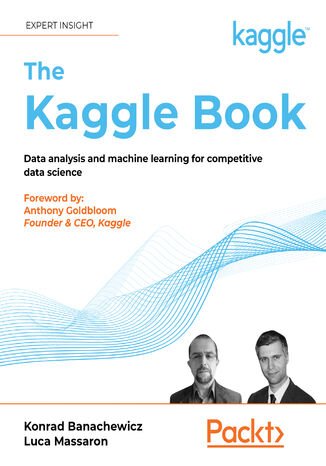
The Kaggle Book. Data analysis and machine learning for competitive data science
Konrad Banachewicz, Anthony Goldbloom, Luca Massaron
Millions of data enthusiasts from around the world compete on Kaggle, the most famous data science competition platform of them all. Participating in Kaggle competitions is a surefire way to improve your data analysis skills, network with an amazing community of data scientists, and gain valuable experience to help grow your career.The first book of its kind, The Kaggle Book assembles in one place the techniques and skills you’ll need for success in competitions, data science projects, and beyond. Two Kaggle Grandmasters walk you through modeling strategies you won’t easily find elsewhere, and the knowledge they’ve accumulated along the way. As well as Kaggle-specific tips, you’ll learn more general techniques for approaching tasks based on image, tabular, textual data, and reinforcement learning. You’ll design better validation schemes and work more comfortably with different evaluation metrics.Whether you want to climb the ranks of Kaggle, build some more data science skills, or improve the accuracy of your existing models, this book is for you.Plus, join our Discord Community to learn along with more than 1,000 members and meet like-minded people!
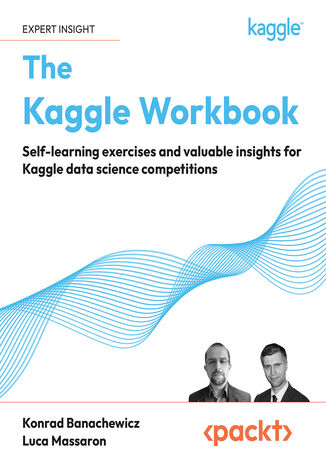
Konrad Banachewicz, Luca Massaron
More than 80,000 Kaggle novices currently participate in Kaggle competitions. To help them navigate the often-overwhelming world of Kaggle, two Grandmasters put their heads together to write The Kaggle Book, which made plenty of waves in the community. Now, they’ve come back with an even more practical approach based on hands-on exercises that can help you start thinking like an experienced data scientist.In this book, you’ll get up close and personal with four extensive case studies based on past Kaggle competitions. You’ll learn how bright minds predicted which drivers would likely avoid filing insurance claims in Brazil and see how expert Kagglers used gradient-boosting methods to model Walmart unit sales time-series data. Get into computer vision by discovering different solutions for identifying the type of disease present on cassava leaves. And see how the Kaggle community created predictive algorithms to solve the natural language processing problem of subjective question-answering.You can use this workbook as a supplement alongside The Kaggle Book or on its own alongside resources available on the Kaggle website and other online communities. Whatever path you choose, this workbook will help make you a formidable Kaggle competitor.
The Lean-Agile Way. Unleash business results in the digital era with value stream management
Cecil 'Gary' Rupp, Richard Knaster, Steve Pereira,...
In today’s fast-paced business landscape, efficiency is essential. Authored by industry experts Cecil ‘Gary’ Rupp, a Lean-Agile consultant with over three decades of executive experience; Richard Knaster, a SAFe® Fellow and transformation leader; Steve Pereira, a value stream consultant and board advisor; and Al Shalloway, creator of FLEX and PMI’s Disciplined Agile Value Stream Consultant workshop, the book offers proven strategies to streamline processes, enhance products, and improve service delivery. You’ll start with an introduction to foundational Lean and Agile practices, recognizing the significance of digital enhancements in modernizing business processes. As you progress, you'll learn VSM techniques to identify and prioritize work and investments to provide maximum value to customers. Moreover, you'll grasp Lean-Agile practices aimed at promoting collaboration among teams and ensuring the continuous flow of product-oriented deliveries tailored to address customer needs. Finally, you'll gain executive-level insights on how organizations must access timely information for decision-making and foster a culture of continuous business transformation. Armed with this knowledge and a robust toolkit, you'll be empowered to drive meaningful change, optimize resources, and stay ahead in the rapidly evolving marketplace.
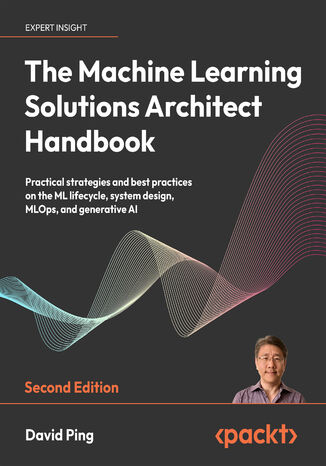
David Ping
David Ping, Head of GenAI and ML Solution Architecture for global industries at AWS, provides expert insights and practical examples to help you become a proficient ML solutions architect, linking technical architecture to business-related skills.You'll learn about ML algorithms, cloud infrastructure, system design, MLOps , and how to apply ML to solve real-world business problems. David explains the generative AI project lifecycle and examines Retrieval Augmented Generation (RAG), an effective architecture pattern for generative AI applications. You’ll also learn about open-source technologies, such as Kubernetes/Kubeflow, for building a data science environment and ML pipelines before building an enterprise ML architecture using AWS. As well as ML risk management and the different stages of AI/ML adoption, the biggest new addition to the handbook is the deep exploration of generative AI.By the end of this book , you’ll have gained a comprehensive understanding of AI/ML across all key aspects, including business use cases, data science, real-world solution architecture, risk management, and governance. You’ll possess the skills to design and construct ML solutions that effectively cater to common use cases and follow established ML architecture patterns, enabling you to excel as a true professional in the field.