
Biznes IT
Jesus Salcedo
Machine learning (ML) combined with data mining can give you amazing results in your data mining work by empowering you with several ways to look at data. This book will help you improve your data mining techniques by using smart modeling techniques.This book will teach you how to implement ML algorithms and techniques in your data mining work. It will enable you to pair the best algorithms with the right tools and processes. You will learn how to identify patterns and make predictions with minimal human intervention. You will build different types of ML models, such as the neural network, the Support Vector Machines (SVMs), and the Decision tree. You will see how all of these models works and what kind of data in the dataset they are suited for. You will learn how to combine the results of different models in order to improve accuracy. Topics such as removing noise and handling errors will give you an added edge in model building and optimization.By the end of this book, you will be able to build predictive models and extract information of interest from the dataset
Allan Ramsay, Tariq Ahmad
Artificial intelligence and machine learning are the technologies of the future, and this is the perfect time to tap into their potential and add value to your business. Machine Learning for Emotion Analysis in Python helps you employ these cutting-edge technologies in your customer feedback system and in turn grow your business exponentially. With this book, you’ll take your foundational data science skills and grow them in the exciting realm of emotion analysis. By following a practical approach, you’ll turn customer feedback into meaningful insights assisting you in making smart and data-driven business decisions.The book will help you understand how to preprocess data, build a serviceable dataset, and ensure top-notch data quality. Once you’re set up for success, you’ll explore complex ML techniques, uncovering the concepts of deep neural networks, support vector machines, conditional probabilities, and more. Finally, you’ll acquire practical knowledge using in-depth use cases showing how the experimental results can be transformed into real-life examples and how emotion mining can help track short- and long-term changes in public opinion. By the end of this book, you’ll be well-equipped to use emotion mining and analysis to drive business decisions.
Machine Learning for Finance. Principles and practice for financial insiders
James Le , Jannes Klaas
Machine Learning for Finance explores new advances in machine learning and shows how they can be applied across the financial sector, including insurance, transactions, and lending. This book explains the concepts and algorithms behind the main machine learning techniques and provides example Python code for implementing the models yourself.The book is based on Jannes Klaas’ experience of running machine learning training courses for financial professionals. Rather than providing ready-made financial algorithms, the book focuses on advanced machine learning concepts and ideas that can be applied in a wide variety of ways.The book systematically explains how machine learning works on structured data, text, images, and time series. You'll cover generative adversarial learning, reinforcement learning, debugging, and launching machine learning products. Later chapters will discuss how to fight bias in machine learning. The book ends with an exploration of Bayesian inference and probabilistic programming.
Eduonix Learning Solutions
Machine Learning (ML) has changed the way organizations and individuals use data to improve the efficiency of a system. ML algorithms allow strategists to deal with a variety of structured, unstructured, and semi-structured data. Machine Learning for Healthcare Analytics Projects is packed with new approaches and methodologies for creating powerful solutions for healthcare analytics.This book will teach you how to implement key machine learning algorithms and walk you through their use cases by employing a range of libraries from the Python ecosystem. You will build five end-to-end projects to evaluate the efficiency of Artificial Intelligence (AI) applications for carrying out simple-to-complex healthcare analytics tasks. With each project, you will gain new insights, which will then help you handle healthcare data efficiently. As you make your way through the book, you will use ML to detect cancer in a set of patients using support vector machines (SVMs) and k-Nearest neighbors (KNN) models. In the final chapters, you will create a deep neural network in Keras to predict the onset of diabetes in a huge dataset of patients. You will also learn how to predict heart diseases using neural networks.By the end of this book, you will have learned how to address long-standing challenges, provide specialized solutions for how to deal with them, and carry out a range of cognitive tasks in the healthcare domain.
Kumar Abhishek, Dr. Mounir Abdelaziz
As machine learning practitioners, we often encounter imbalanced datasets in which one class has considerably fewer instances than the other. Many machine learning algorithms assume an equilibrium between majority and minority classes, leading to suboptimal performance on imbalanced data. This comprehensive guide helps you address this class imbalance to significantly improve model performance.Machine Learning for Imbalanced Data begins by introducing you to the challenges posed by imbalanced datasets and the importance of addressing these issues. It then guides you through techniques that enhance the performance of classical machine learning models when using imbalanced data, including various sampling and cost-sensitive learning methods.As you progress, you’ll delve into similar and more advanced techniques for deep learning models, employing PyTorch as the primary framework. Throughout the book, hands-on examples will provide working and reproducible code that’ll demonstrate the practical implementation of each technique.By the end of this book, you’ll be adept at identifying and addressing class imbalances and confidently applying various techniques, including sampling, cost-sensitive techniques, and threshold adjustment, while using traditional machine learning or deep learning models.
Revathi Gopalakrishnan, Avinash Venkateswarlu
Machine learning presents an entirely unique opportunity in software development. It allows smartphones to produce an enormous amount of useful data that can be mined, analyzed, and used to make predictions. This book will help you master machine learning for mobile devices with easy-to-follow, practical examples.You will begin with an introduction to machine learning on mobiles and grasp the fundamentals so you become well-acquainted with the subject. You will master supervised and unsupervised learning algorithms, and then learn how to build a machine learning model using mobile-based libraries such as Core ML, TensorFlow Lite, ML Kit, and Fritz on Android and iOS platforms. In doing so, you will also tackle some common and not-so-common machine learning problems with regard to Computer Vision and other real-world domains.By the end of this book, you will have explored machine learning in depth and implemented on-device machine learning with ease, thereby gaining a thorough understanding of how to run, create, and build real-time machine-learning applications on your mobile devices.
Aditya Sharma, Michael Beyeler (USD), Vishwesh Ravi...
OpenCV is an opensource library for building computer vision apps. The latest release, OpenCV 4, offers a plethora of features and platform improvements that are covered comprehensively in this up-to-date second edition.You'll start by understanding the new features and setting up OpenCV 4 to build your computer vision applications. You will explore the fundamentals of machine learning and even learn to design different algorithms that can be used for image processing. Gradually, the book will take you through supervised and unsupervised machine learning. You will gain hands-on experience using scikit-learn in Python for a variety of machine learning applications. Later chapters will focus on different machine learning algorithms, such as a decision tree, support vector machines (SVM), and Bayesian learning, and how they can be used for object detection computer vision operations. You will then delve into deep learning and ensemble learning, and discover their real-world applications, such as handwritten digit classification and gesture recognition. Finally, you’ll get to grips with the latest Intel OpenVINO for building an image processing system.By the end of this book, you will have developed the skills you need to use machine learning for building intelligent computer vision applications with OpenCV 4.
Machine Learning for OpenCV. Intelligent image processing with Python
Michael Beyeler, Michael Beyeler (USD)
Machine learning is no longer just a buzzword, it is all around us: from protecting your email, to automatically tagging friends in pictures, to predicting what movies you like. Computer vision is one of today's most exciting application fields of machine learning, with Deep Learning driving innovative systems such as self-driving cars and Google’s DeepMind.OpenCV lies at the intersection of these topics, providing a comprehensive open-source library for classic as well as state-of-the-art computer vision and machine learning algorithms. In combination with Python Anaconda, you will have access to all the open-source computing libraries you could possibly ask for.Machine learning for OpenCV begins by introducing you to the essential concepts of statistical learning, such as classification and regression. Once all the basics are covered, you will start exploring various algorithms such as decision trees, support vector machines, and Bayesian networks, and learn how to combine them with other OpenCV functionality. As the book progresses, so will your machine learning skills, until you are ready to take on today's hottest topic in the field: Deep Learning.By the end of this book, you will be ready to take on your own machine learning problems, either by building on the existing source code or developing your own algorithm from scratch!
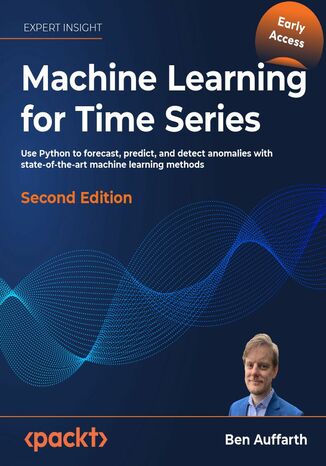
Ben Auffarth
The Python time-series ecosystem is a huge and challenging topic to tackle, especially for time series since there are so many new libraries and models. Machine Learning for Time Series, Second Edition, aims to deepen your understanding of time series by providing a comprehensive overview of popular Python time-series packages and helping you build better predictive systems.This fully updated second edition starts by re-introducing the basics of time series and then helps you get to grips with traditional autoregressive models as well as modern non-parametric models. By observing practical examples and the theory behind them, you will gain a deeper understanding of loading time-series datasets from any source and a variety of models, such as deep learning recurrent neural networks, causal convolutional network models, and gradient boosting with feature engineering. This book will also help you choose the right model for the right problem by explaining the theory behind several useful models. New updates include a chapter on forecasting and extracting signals on financial markets and case studies with relevant examples from operations management, digital marketing, and healthcare.By the end of this book, you should feel at home with effectively analyzing and applying machine learning methods to time series.
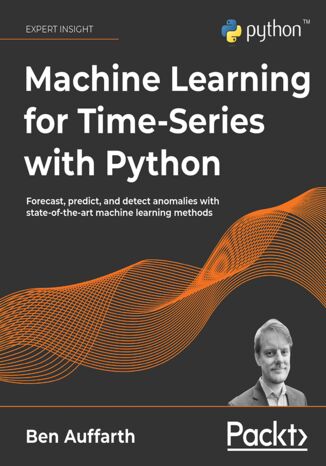
Ben Auffarth
The Python time-series ecosystem is huge and often quite hard to get a good grasp on, especially for time-series since there are so many new libraries and new models. This book aims to deepen your understanding of time series by providing a comprehensive overview of popular Python time-series packages and help you build better predictive systems.Machine Learning for Time-Series with Python starts by re-introducing the basics of time series and then builds your understanding of traditional autoregressive models as well as modern non-parametric models. By observing practical examples and the theory behind them, you will become confident with loading time-series datasets from any source, deep learning models like recurrent neural networks and causal convolutional network models, and gradient boosting with feature engineering.This book will also guide you in matching the right model to the right problem by explaining the theory behind several useful models. You’ll also have a look at real-world case studies covering weather, traffic, biking, and stock market data.By the end of this book, you should feel at home with effectively analyzing and applying machine learning methods to time-series.
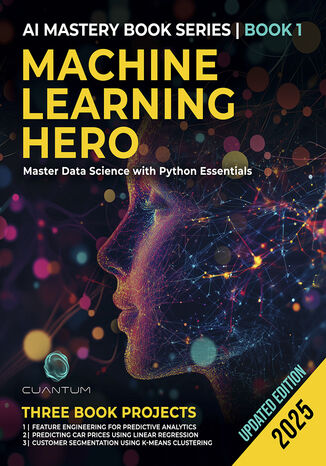
Machine Learning Hero. Master Data Science with Python Essentials
Cuantum Technologies LLC
This book takes you on a journey through the world of machine learning, beginning with foundational concepts such as supervised and unsupervised learning, and progressing to advanced topics like feature engineering, hyperparameter tuning, and dimensionality reduction. Each chapter blends theory with practical exercises to ensure a deep understanding of the material.The book emphasizes Python, introducing essential libraries like NumPy, Pandas, Matplotlib, and Scikit-learn, along with deep learning frameworks like TensorFlow and PyTorch. You’ll learn to preprocess data, visualize insights, and build models capable of tackling complex datasets. Hands-on coding examples and exercises reinforce concepts and help bridge the gap between knowledge and application.In the final chapters, you'll work on real-world projects like predictive analytics, clustering, and regression. These projects are designed to provide a practical context for the techniques learned and equip you with actionable skills for data science and AI roles. By the end, you'll be prepared to apply machine learning principles to solve real-world challenges with confidence.
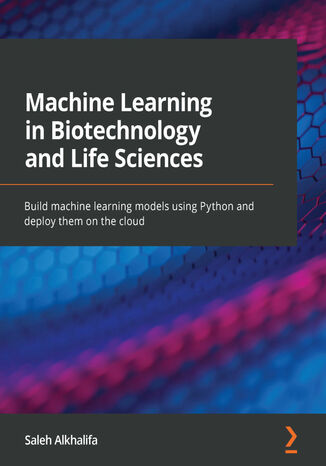
Saleh Alkhalifa
The booming fields of biotechnology and life sciences have seen drastic changes over the last few years. With competition growing in every corner, companies around the globe are looking to data-driven methods such as machine learning to optimize processes and reduce costs. This book helps lab scientists, engineers, and managers to develop a data scientist's mindset by taking a hands-on approach to learning about the applications of machine learning to increase productivity and efficiency in no time.You’ll start with a crash course in Python, SQL, and data science to develop and tune sophisticated models from scratch to automate processes and make predictions in the biotechnology and life sciences domain. As you advance, the book covers a number of advanced techniques in machine learning, deep learning, and natural language processing using real-world data.By the end of this machine learning book, you'll be able to build and deploy your own machine learning models to automate processes and make predictions using AWS and GCP.
AshishSingh Bhatia, Bostjan Kaluza
As the amount of data in the world continues to grow at an almost incomprehensible rate, being able to understand and process data is becoming a key differentiator for competitive organizations. Machine learning applications are everywhere, from self-driving cars, spam detection, document search, and trading strategies, to speech recognition. This makes machine learning well-suited to the present-day era of big data and Data Science. The main challenge is how to transform data into actionable knowledge.Machine Learning in Java will provide you with the techniques and tools you need. You will start by learning how to apply machine learning methods to a variety of common tasks including classification, prediction, forecasting, market basket analysis, and clustering. The code in this book works for JDK 8 and above, the code is tested on JDK 11.Moving on, you will discover how to detect anomalies and fraud, and ways to perform activity recognition, image recognition, and text analysis. By the end of the book, you will have explored related web resources and technologies that will help you take your learning to the next level.By applying the most effective machine learning methods to real-world problems, you will gain hands-on experience that will transform the way you think about data.
Miroslaw Staron
Although creating a machine learning pipeline or developing a working prototype of a software system from that pipeline is easy and straightforward nowadays, the journey toward a professional software system is still extensive. This book will help you get to grips with various best practices and recipes that will help software engineers transform prototype pipelines into complete software products.The book begins by introducing the main concepts of professional software systems that leverage machine learning at their core. As you progress, you’ll explore the differences between traditional, non-ML software, and machine learning software. The initial best practices will guide you in determining the type of software you need for your product. Subsequently, you will delve into algorithms, covering their selection, development, and testing before exploring the intricacies of the infrastructure for machine learning systems by defining best practices for identifying the right data source and ensuring its quality.Towards the end, you’ll address the most challenging aspect of large-scale machine learning systems – ethics. By exploring and defining best practices for assessing ethical risks and strategies for mitigation, you will conclude the book where it all began – large-scale machine learning software.
Oliver Theobald
With an introductory overview, the course prepares you for a deep dive into the practical application of Scikit-Learn and the datasets that bring theories to life. From the basics of machine learning to the intricate details of setting up a sandbox environment, this course covers the essential groundwork for any aspiring data scientist.The course focuses on developing your skills in working with data, implementing data reduction techniques, and understanding the intricacies of item-based and user-based collaborative filtering, along with content-based filtering. These core methodologies are crucial for creating accurate and efficient recommender systems that cater to the unique preferences of users. Practical examples and evaluations further solidify your learning, making complex concepts accessible and manageable.The course wraps up by addressing the critical topics of privacy, ethics in machine learning, and the exciting future of recommender systems. This holistic approach ensures that you not only gain technical proficiency but also consider the broader implications of your work in this field. With a final look at further resources, your journey into machine learning and recommender systems is just beginning, armed with the knowledge and tools to explore new horizons.
Faisal Masood, Ross Brigoli
MLOps is an emerging field that aims to bring repeatability, automation, and standardization of the software engineering domain to data science and machine learning engineering. By implementing MLOps with Kubernetes, data scientists, IT professionals, and data engineers can collaborate and build machine learning solutions that deliver business value for their organization.You'll begin by understanding the different components of a machine learning project. Then, you'll design and build a practical end-to-end machine learning project using open source software. As you progress, you'll understand the basics of MLOps and the value it can bring to machine learning projects. You will also gain experience in building, configuring, and using an open source, containerized machine learning platform. In later chapters, you will prepare data, build and deploy machine learning models, and automate workflow tasks using the same platform. Finally, the exercises in this book will help you get hands-on experience in Kubernetes and open source tools, such as JupyterHub, MLflow, and Airflow.By the end of this book, you'll have learned how to effectively build, train, and deploy a machine learning model using the machine learning platform you built.
Karthikeyan NG
Machine learning is a technique that focuses on developing computer programs that can be modified when exposed to new data. We can make use of it for our mobile applications and this book will show you how to do so.The book starts with the basics of machine learning concepts for mobile applications and how to get well equipped for further tasks. You will start by developing an app to classify age and gender using Core ML and Tensorflow Lite. You will explore neural style transfer and get familiar with how deep CNNs work. We will also take a closer look at Google’s ML Kit for the Firebase SDK for mobile applications. You will learn how to detect handwritten text on mobile. You will also learn how to create your own Snapchat filter by making use of facial attributes and OpenCV. You will learn how to train your own food classification model on your mobile; all of this will be done with the help of deep learning techniques. Lastly, you will build an image classifier on your mobile, compare its performance, and analyze the results on both mobile and cloud using TensorFlow Lite with an RCNN.By the end of this book, you will not only have mastered the concepts of machine learning but also learned how to resolve problems faced while building powerful apps on mobiles using TensorFlow Lite, Caffe2, and Core ML.
Machine learning, Python i data science. Wprowadzenie
Andreas Müller, Sarah Guido
Uczenie maszynowe kojarzy się z dużymi firmami i rozbudowanymi zespołami. Prawda jest taka, że obecnie można samodzielnie budować zaawansowane rozwiązania uczenia maszynowego i korzystać do woli z olbrzymich zasobów dostępnych danych. Trzeba tylko mieć pomysł i... trochę podstawowej wiedzy. Tymczasem większość opracowań na temat uczenia maszynowego i sztucznej inteligencji wymaga biegłości w zaawansowanej matematyce. Utrudnia to naukę tego zagadnienia, mimo że uczenie maszynowe jest coraz powszechniej stosowane w projektach badawczych i komercyjnych. Ta praktyczna książka ułatwi Ci rozpoczęcie wdrażania rozwiązań rzeczywistych problemów związanych z uczeniem maszynowym. Zawiera przystępne wprowadzenie do uczenia maszynowego i sztucznej inteligencji, a także sposoby wykorzystania Pythona i biblioteki scikit-learn, uwzględniające potrzeby badaczy i analityków danych oraz inżynierów pracujących nad aplikacjami komercyjnymi. Zagadnienia matematyczne ograniczono tu do niezbędnego minimum, zamiast tego skoncentrowano się na praktycznych aspektach algorytmów uczenia maszynowego. Dokładnie opisano, jak konkretnie można skorzystać z szerokiej gamy modeli zaimplementowanych w dostępnych bibliotekach. W książce między innymi: podstawowe informacje o uczeniu maszynowym najważniejsze algorytmy uczenia maszynowego przetwarzanie danych w uczeniu maszynowym ocena modelu i dostrajanie parametrów łańcuchy modeli i hermetyzacja przepływu pracy przetwarzanie danych tekstowych Python i uczenie maszynowe: programowanie do zadań specjalnych!
Rahul Kumar
Machine learning makes it possible to learn about the unknowns and gain hidden insights into your datasets by mastering many tools and techniques. This book guides you to do just that in a very compact manner.After giving a quick overview of what machine learning is all about, Machine Learning Quick Reference jumps right into its core algorithms and demonstrates how they can be applied to real-world scenarios. From model evaluation to optimizing their performance, this book will introduce you to the best practices in machine learning. Furthermore, you will also look at the more advanced aspects such as training neural networks and work with different kinds of data, such as text, time-series, and sequential data. Advanced methods and techniques such as causal inference, deep Gaussian processes, and more are also covered.By the end of this book, you will be able to train fast, accurate machine learning models at your fingertips, which you can easily use as a point of reference.
Georgia Kalyva, George Kavvalakis
With AI and machine learning (ML) models gaining popularity and integrating into more and more applications, it is more important than ever to ensure that models perform accurately and are not vulnerable to cyberattacks. However, attacks can target your data or environment as well. This book will help you identify security risks and apply the best practices to protect your assets on multiple levels, from data and models to applications and infrastructure.This book begins by introducing what some common ML attacks are, how to identify your risks, and the industry standards and responsible AI principles you need to follow to gain an understanding of what you need to protect. Next, you will learn about the best practices to secure your assets. Starting with data protection and governance and then moving on to protect your infrastructure, you will gain insights into managing and securing your Azure ML workspace. This book introduces DevOps practices to automate your tasks securely and explains how to recover from ML attacks. Finally, you will learn how to set a security benchmark for your scenario and best practices to maintain and monitor your security posture.By the end of this book, you’ll be able to implement best practices to assess and secure your ML assets throughout the Azure Machine Learning life cycle.
Jalaj Thanaki
Machine learning (ML) helps you find hidden insights from your data without the need for explicit programming. This book is your key to solving any kind of ML problem you might come across in your job.You’ll encounter a set of simple to complex problems while building ML models, and you'll not only resolve these problems, but you’ll also learn how to build projects based on each problem, with a practical approach and easy-to-follow examples. The book includes a wide range of applications: from analytics and NLP, to computer vision domains. Some of the applications you will be working on include stock price prediction, a recommendation engine, building a chat-bot, a facial expression recognition system, and many more. The problem examples we cover include identifying the right algorithm for your dataset and use cases, creating and labeling datasets, getting enough clean data to carry out processing, identifying outliers, overftting datasets, hyperparameter tuning, and more. Here, you'll also learn to make more timely and accurate predictions.In addition, you'll deal with more advanced use cases, such as building a gaming bot, building an extractive summarization tool for medical documents, and you'll also tackle the problems faced while building an ML model. By the end of this book, you'll be able to fine-tune your models as per your needs to deliver maximum productivity.
Alexia Audevart, Konrad Banachewicz, Luca Massaron
The independent recipes in Machine Learning Using TensorFlow Cookbook will teach you how to perform complex data computations and gain valuable insights into your data. Dive into recipes on training models, model evaluation, sentiment analysis, regression analysis, artificial neural networks, and deep learning - each using Google’s machine learning library, TensorFlow.This cookbook covers the fundamentals of the TensorFlow library, including variables, matrices, and various data sources. You’ll discover real-world implementations of Keras and TensorFlow and learn how to use estimators to train linear models and boosted trees, both for classification and regression.Explore the practical applications of a variety of deep learning architectures, such as recurrent neural networks and Transformers, and see how they can be used to solve computer vision and natural language processing (NLP) problems.With the help of this book, you will be proficient in using TensorFlow, understand deep learning from the basics, and be able to implement machine learning algorithms in real-world scenarios.
Joshua Arvin Lat
Amazon SageMaker is a fully managed machine learning (ML) service that helps data scientists and ML practitioners manage ML experiments. In this book, you'll use the different capabilities and features of Amazon SageMaker to solve relevant data science and ML problems.This step-by-step guide features 80 proven recipes designed to give you the hands-on machine learning experience needed to contribute to real-world experiments and projects. You'll cover the algorithms and techniques that are commonly used when training and deploying NLP, time series forecasting, and computer vision models to solve ML problems. You'll explore various solutions for working with deep learning libraries and frameworks such as TensorFlow, PyTorch, and Hugging Face Transformers in Amazon SageMaker. You'll also learn how to use SageMaker Clarify, SageMaker Model Monitor, SageMaker Debugger, and SageMaker Experiments to debug, manage, and monitor multiple ML experiments and deployments. Moreover, you'll have a better understanding of how SageMaker Feature Store, Autopilot, and Pipelines can meet the specific needs of data science teams.By the end of this book, you'll be able to combine the different solutions you've learned as building blocks to solve real-world ML problems.
Alessandro Marrandino
BigQuery ML enables you to easily build machine learning (ML) models with SQL without much coding. This book will help you to accelerate the development and deployment of ML models with BigQuery ML.The book starts with a quick overview of Google Cloud and BigQuery architecture. You'll then learn how to configure a Google Cloud project, understand the architectural components and capabilities of BigQuery, and find out how to build ML models with BigQuery ML. The book teaches you how to use ML using SQL on BigQuery. You'll analyze the key phases of a ML model's lifecycle and get to grips with the SQL statements used to train, evaluate, test, and use a model. As you advance, you'll build a series of use cases by applying different ML techniques such as linear regression, binary and multiclass logistic regression, k-means, ARIMA time series, deep neural networks, and XGBoost using practical use cases. Moving on, you'll cover matrix factorization and deep neural networks using BigQuery ML's capabilities. Finally, you'll explore the integration of BigQuery ML with other Google Cloud Platform components such as AI Platform Notebooks and TensorFlow along with discovering best practices and tips and tricks for hyperparameter tuning and performance enhancement.By the end of this BigQuery book, you'll be able to build and evaluate your own ML models with BigQuery ML.