
Biznes IT
Data Lake for Enterprises. Lambda Architecture for building enterprise data systems
Vivek Mishra, Tomcy John, Pankaj Misra
The term Data Lake has recently emerged as a prominent term in the big data industry. Data scientists can make use of it in deriving meaningful insights that can be used by businesses to redefine or transform the way they operate. Lambda architecture is also emerging as one of the very eminent patterns in the big data landscape, as it not only helps to derive useful information from historical data but also correlates real-time data to enable business to take critical decisions. This book tries to bring these two important aspects — data lake and lambda architecture—together.This book is divided into three main sections. The first introduces you to the concept of data lakes, the importance of data lakes in enterprises, and getting you up-to-speed with the Lambda architecture. The second section delves into the principal components of building a data lake using the Lambda architecture. It introduces you to popular big data technologies such as Apache Hadoop, Spark, Sqoop, Flume, and ElasticSearch. The third section is a highly practical demonstration of putting it all together, and shows you how an enterprise data lake can be implemented, along with several real-world use-cases. It also shows you how other peripheral components can be added to the lake to make it more efficient.By the end of this book, you will be able to choose the right big data technologies using the lambda architectural patterns to build your enterprise data lake.
Data Lakehouse in Action. Architecting a modern and scalable data analytics platform
Pradeep Menon
The Data Lakehouse architecture is a new paradigm that enables large-scale analytics. This book will guide you in developing data architecture in the right way to ensure your organization's success.The first part of the book discusses the different data architectural patterns used in the past and the need for a new architectural paradigm, as well as the drivers that have caused this change. It covers the principles that govern the target architecture, the components that form the Data Lakehouse architecture, and the rationale and need for those components. The second part deep dives into the different layers of Data Lakehouse. It covers various scenarios and components for data ingestion, storage, data processing, data serving, analytics, governance, and data security. The book's third part focuses on the practical implementation of the Data Lakehouse architecture in a cloud computing platform. It focuses on various ways to combine the Data Lakehouse pattern to realize macro-patterns, such as Data Mesh and Data Hub-Spoke, based on the organization's needs and maturity level. The frameworks introduced will be practical and organizations can readily benefit from their application.By the end of this book, you'll clearly understand how to implement the Data Lakehouse architecture pattern in a scalable, agile, and cost-effective manner.
Data Mining. Eksploracja danych w sieciach społecznościowych. Wydanie III
Matthew A. Russell, Mikhail Klassen
Internetu nie można rozważać wyłącznie jako tworu techniki. Powstanie tej sieci doprowadziło do rozwoju różnych zjawisk społecznych. Z tej perspektywy na szczególną uwagę zasługują media społecznościowe. Są źródłem informacji, które, właściwie spożytkowane, mogą przynieść niezły dochód. Mogą też dać odpowiedzi na wiele pytań zadawanych przez naukowców z różnych branż. Sama eksploracja tych danych przynosi sporo satysfakcji i radości. Zaskakujące przy tym jest to, że przygotowanie zestawu potrzebnych narzędzi i nauka posługiwania się nimi zabiera naprawdę niewiele czasu i nie wymaga specjalnych talentów! To trzecie, zaktualizowane wydanie popularnego podręcznika dla osób, które chcą zająć się wydobywaniem danych z sieci społecznościowych. Uwzględniono tu zmiany interfejsów API wprowadzone do poszczególnych platform i dodano rozdział o eksploracji Instagrama. Dowiesz się, jak dzięki danym z mediów społecznościowych określić sieć powiązań użytkowników, zorientować się, kto o czym mówi i gdzie się znajduje. Treść bogato zilustrowano przykładami kodu w Pythonie, a także plikami Jupyter Notebook lub kontenerów Dockera. Ciekawym elementem książki jest zbiór receptur dotyczących rozwiązywania konkretnych problemów z Twitterem. W tej książce między innymi: wprowadzenie do świata mediów społecznościowych przybliżenie bogactwa danych zawartych w mediach społecznościowych eksploracja danych za pomocą narzędzi Pythona 3 zaawansowane techniki eksploracji danych, w tym współczynniki TFIDF, podobieństwo kosinusów i rozpoznawanie obrazów tworzenie wizualizacji pozyskanych danych Jakie informacje dziś znajdziesz dzięki danym z Facebooka?
David Natingga
Machine learning applications are highly automated and self-modifying, and continue to improve over time with minimal human intervention, as they learn from the trained data. To address the complex nature of various real-world data problems, specialized machine learning algorithms have been developed. Through algorithmic and statistical analysis, these models can be leveraged to gain new knowledge from existing data as well.Data Science Algorithms in a Week addresses all problems related to accurate and efficient data classification and prediction. Over the course of seven days, you will be introduced to seven algorithms, along with exercises that will help you understand different aspects of machine learning. You will see how to pre-cluster your data to optimize and classify it for large datasets. This book also guides you in predicting data based on existing trends in your dataset. This book covers algorithms such as k-nearest neighbors, Naive Bayes, decision trees, random forest, k-means, regression, and time-series analysis.By the end of this book, you will understand how to choose machine learning algorithms for clustering, classification, and regression and know which is best suited for your problem
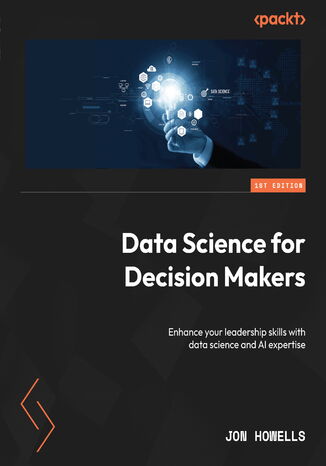
Data Science for Decision Makers. Enhance your leadership skills with data science and AI expertise
Jon Howells
As data science and artificial intelligence (AI) become prevalent across industries, executives without formal education in statistics and machine learning, as well as data scientists moving into leadership roles, must learn how to make informed decisions about complex models and manage data teams. This book will elevate your leadership skills by guiding you through the core concepts of data science and AI.This comprehensive guide is designed to bridge the gap between business needs and technical solutions, empowering you to make informed decisions and drive measurable value within your organization. Through practical examples and clear explanations, you'll learn how to collect and analyze structured and unstructured data, build a strong foundation in statistics and machine learning, and evaluate models confidently. By recognizing common pitfalls and valuable use cases, you'll plan data science projects effectively, from the ground up to completion. Beyond technical aspects, this book provides tools to recruit top talent, manage high-performing teams, and stay up to date with industry advancements.By the end of this book, you’ll be able to characterize the data within your organization and frame business problems as data science problems.
Mercury Learning and Information, P. G. Madhavan
This book introduces data science to professionals in engineering, physics, mathematics, and related fields. It serves as a workbook with MATLAB code, linking subject knowledge to data science, machine learning, and analytics, with applications in IoT. Part One integrates machine learning, systems theory, linear algebra, digital signal processing, and probability theory. Part Two develops a nonlinear, time-varying machine learning solution for modeling real-life business problems.Understanding data science is crucial for modern applications, particularly in IoT. This book presents a dynamic machine learning solution to handle these complexities. Topics include machine learning, systems theory, linear algebra, digital signal processing, probability theory, state-space formulation, Bayesian estimation, Kalman filter, causality, and digital twins.The journey begins with data science and machine learning, covering systems theory and linear algebra. Advanced concepts like the Kalman filter and Bayesian estimation lead to developing a dynamic machine learning model. The book ends with practical applications using digital twins.
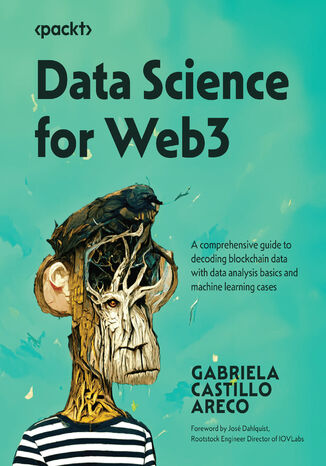
Gabriela Castillo Areco
Data is the new oil and Web3 is generating it at an unprecedented rate. Complete with practical examples, detailed explanations, and ideas for portfolio development, this comprehensive book serves as a step-by-step guide covering the industry best practices, tools, and resources needed to easily navigate the world of data in Web3.You’ll begin by acquiring a solid understanding of key blockchain concepts and the fundamental data science tools essential for Web3 projects. The subsequent chapters will help you explore the main data sources that can help address industry challenges, decode smart contracts, and build DeFi- and NFT-specific datasets. You’ll then tackle the complexities of feature engineering specific to blockchain data and familiarize yourself with diverse machine learning use cases that leverage Web3 data.The book includes interviews with industry leaders providing insights into their professional journeys to drive innovation in the Web 3 environment. Equipped with experience in handling crypto data, you’ll be able to demonstrate your skills in job interviews, academic pursuits, or when engaging potential clients.By the end of this book, you’ll have the essential tools to undertake end-to-end data science projects utilizing blockchain data, empowering you to help shape the next-generation internet.
Mercury Learning and Information, Christopher Greco
This book introduces popular data science tools and guides readers on how to use them effectively. It covers data analysis using Microsoft Excel, KNIME, R, and OpenOffice, applying statistical concepts such as confidence intervals, normal distribution, T-Tests, linear regression, histograms, and geographic analysis with real data from Federal Government sources.The course begins with the basics, including importing data and conducting various statistical tests. It progresses to specific methods for each tool, ensuring a comprehensive understanding of data analysis. Capstone exercises provide hands-on experience, reinforcing the concepts learned throughout the book.Understanding these tools and concepts is crucial for effective data analysis. This book takes readers from the basics to advanced statistical methods, combining theoretical insights with practical applications. Companion files with source code and data sets enhance the learning experience, making this book an essential resource for mastering data analysis with popular software applications.