
Biznes IT
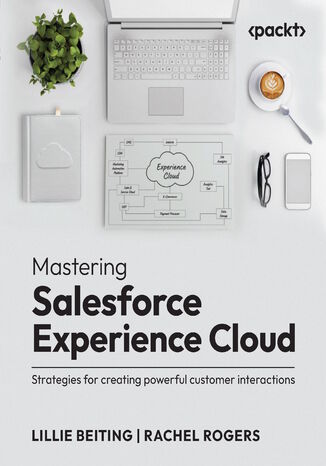
Mastering Salesforce Experience Cloud. Strategies for creating powerful customer interactions
Lillie Beiting, Rachel Rogers
Empowering your target audience to interact effortlessly with you and your product offerings is a critical aspect of business in the modern era. Users expect easy, professional digital experiences when engaging with organizations. However, creating engagement applications from scratch is challenging, and connecting user behavior with your organization’s data is even more complex. Enter Salesforce Experience Cloud sites, website portals built on the Salesforce data model that seamlessly connects your user data to your user experience. Mastering Salesforce Experience Cloud focuses on the human-centric nature of this product, beginning with a comprehensive guide on designing for your organization’s desired users and ensuring success for both internal teams and end users. After exploring the real-world applications of Experience Cloud and reviewing license models, this book provides a beginning-to-end guide to mastering the technical backend of this product, covering both out-of-the-box settings and customization techniques. By the end of this book, you’ll have gained a deep understanding of the Experience Cloud data model and customization options to create engaging, user-centric digital experiences that deliver value to your organization and stakeholders.
Paul Gerrard
If you want to learn how to quantitatively answer scientific questions for practical purposes using the powerful R language and the open source R tool ecosystem, this book is ideal for you. It is ideally suited for scientists who understand scientific concepts, know a little R, and want to be able to start applying R to be able to answer empirical scientific questions. Some R exposure is helpful, but not compulsory.
Mastering Spark for Data Science. Lightning fast and scalable data science solutions
Andrew Morgan, Antoine Amend, Matthew Hallett, David...
Data science seeks to transform the world using data, and this is typically achievedthrough disrupting and changing real processes in real industries. In order to operate at this level you need to build data science solutions of substance –solutions that solve real problems. Spark has emerged as the big data platform of choice for data scientists due to its speed, scalability, and easy-to-use APIs.This book deep dives into using Spark to deliver production-grade data sciencesolutions. This process is demonstrated by exploring the construction of a sophisticated global news analysis service that uses Spark to generate continuous geopolitical and current affairs insights.You will learn all about the core Spark APIs and take a comprehensive tour of advanced libraries, including Spark SQL, Spark Streaming, MLlib, and more.You will be introduced to advanced techniques and methods that will help you to construct commercial-grade data products. Focusing on a sequence of tutorials that deliver a working news intelligence service, you will learn about advanced Spark architectures, how to work with geographic data in Spark, and how to tune Spark algorithms so they scale linearly.
Marleen Meier, David Baldwin
Tableau is one of the leading business intelligence (BI) tools used to solve BI and analytics challenges. With this book, you will master Tableau's features and offerings in various paradigms of the BI domain. This book is also the second edition of the popular Mastering Tableau series, with new features, examples, and updated code. The book covers essential Tableau concepts and its advanced functionalities. Using Tableau Hyper and Tableau Prep, you’ll be able to handle and prepare data easily. You’ll gear up to perform complex joins, spatial joins, union, and data blending tasks using practical examples. Following this, you’ll learn how to perform data densification to make displaying granular data easier. Next, you’ll explore expert-level examples to help you with advanced calculations, mapping, and visual design using various Tableau extensions. With the help of examples, you’ll also learn about improving dashboard performance, connecting Tableau Server, and understanding data visualizations. In the final chapters, you’ll cover advanced use cases such as Self-Service Analytics, Time Series Analytics, and Geo-Spatial Analytics, and learn to connect Tableau to R, Python, and MATLAB. By the end of this book, you’ll have mastered the advanced offerings of Tableau and be able to tackle common and not-so-common challenges faced in the BI domain.
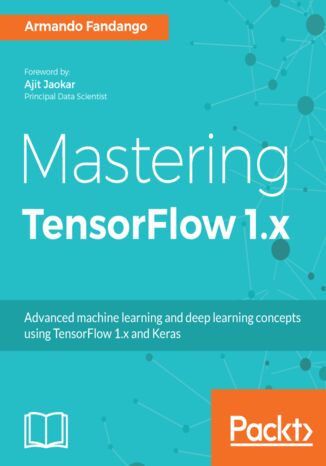
Armando Fandango, Ajit Jaokar
TensorFlow is the most popular numerical computation library built from the ground up for distributed, cloud, and mobile environments. TensorFlow represents the data as tensors and the computation as graphs.This book is a comprehensive guide that lets you explore the advanced features of TensorFlow 1.x. Gain insight into TensorFlow Core, Keras, TF Estimators, TFLearn, TF Slim, Pretty Tensor, and Sonnet. Leverage the power of TensorFlow and Keras to build deep learning models, using concepts such as transfer learning, generative adversarial networks, and deep reinforcement learning. Throughout the book, you will obtain hands-on experience with varied datasets, such as MNIST, CIFAR-10, PTB, text8, and COCO-Images.You will learn the advanced features of TensorFlow1.x, such as distributed TensorFlow with TF Clusters, deploy production models with TensorFlow Serving, and build and deploy TensorFlow models for mobile and embedded devices on Android and iOS platforms. You will see how to call TensorFlow and Keras API within the R statistical software, and learn the required techniques for debugging when the TensorFlow API-based code does not work as expected.The book helps you obtain in-depth knowledge of TensorFlow, making you the go-to person for solving artificial intelligence problems. By the end of this guide, you will have mastered the offerings of TensorFlow and Keras, and gained the skills you need to build smarter, faster, and efficient machine learning and deep learning systems.
Jeffrey Silver, Jason Mar-Tang, Michael Huckaby
Sales engineers often need to balance their technical expertise with the soft skills needed to close deals and build lasting client relationships. This book provides a framework for both senior engineers seeking professional growth and individuals just starting their sales engineering careers. This book draws from the authors’ extensive experience in this industry and as leaders in top high-tech companies, offering real-world insights and life lessons applicable to this specialized and in-demand industry. You’ll pick up the core disciplines a successful sales engineer should exemplify, along with mastering practical, day-to-day operational aspects. Within these chapters, you will learn the roles and responsibilities of a sales engineer, as well as adjacent roles within a sales team. You’ll also develop the skills needed to navigate complex sales cycles and exceed traditional expectations. This book covers various key aspects of sales engineering, including mastering communication techniques, navigating complex meetings, managing customer expectations, understanding legal matters, and handling administrative tasks. By the end of this book, you’ll have acquired advanced knowledge to excel as a world-class sales engineer and become a valuable member of your organization’s broader team.
Matematyka dyskretna dla praktyków. Algorytmy i uczenie maszynowe w Pythonie
Ryan T. White, Archana Tikayat Ray
Mimo że osiągnięcia matematyczne stały się podwalinami algorytmiki, wielu inżynierów nie w pełni rozumie reguły matematyki dyskretnej. Nawet jeśli nie stanowi to szczególnego problemu w codziennej pracy, w końcu okazuje się, że matematyka dyskretna jest niezbędna do osiągnięcia prawdziwej biegłości w operowaniu algorytmami i w pracy na danych. Co więcej, znajomość tej dziedziny bardzo ułatwia rozwiązywanie problemów z zakresu uczenia maszynowego. W ten sposób praktyczna biegłość w matematyce zauważalnie poprawia wyniki pracy inżynierów. Ta książka jest kompleksowym wprowadzeniem do matematyki dyskretnej, przydatnym dla każdego, kto chce pogłębić i ugruntować swoje umiejętności informatyczne. W zrozumiały sposób przedstawiono tu metody matematyki dyskretnej i ich zastosowanie w algorytmach i analizie danych, włączając w to techniki uczenia maszynowego. Zaprezentowano również zasady oceny złożoności obliczeniowej algorytmów i używania wyników tej oceny do zarządzania pracą procesora. Omówiono także sposoby przechowywania struktur grafowych, ich przeszukiwania i znajdywania ścieżek między wierzchołkami. Pokazano też, jak wykorzystać przedstawione informacje podczas posługiwania się bibliotekami Pythona, takimi jak scikit-learn i NumPy. W książce między innymi: terminologia i metody matematyki dyskretnej zastosowanie metod matematyki dyskretnej w algorytmach i analizie danych algebra Boole'a i kombinatoryka w podstawowych strukturach algorytmów rozwiązywanie problemów z dziedziny teorii grafów zadania związane z uczeniem maszynowym a matematyka dyskretna Matematyka dyskretna - poznaj, zrozum, zastosuj!
Hala Nelson
Sztuczna inteligencja i technologie oparte na danych są coraz częściej integrowane z istniejącymi systemami i operacjami. Ta tendencja dotyczy licznych branż. Dziś przy budowaniu systemów SI można korzystać z gotowych bibliotek, jeżeli jednak zależy Ci na w pełni świadomym tworzeniu doskonalszych aplikacji, musisz dobrze opanować matematykę leżącą u podstaw sztucznej inteligencji. Nawet jeśli nie darzysz królowej nauk płomiennym uczuciem, dzięki temu kompleksowemu opracowaniu z łatwością poradzisz sobie z jej lepszym poznaniem. Nie znajdziesz tu skomplikowanych teorii naukowych, tylko przystępnie podane koncepcje matematyczne niezbędne do rozwoju w dziedzinie sztucznej inteligencji, w szczególności do praktycznego stosowania najnowocześniejszych modeli. Poznasz takie zagadnienia jak regresja, sieci neuronowe, sieci konwolucyjne, optymalizacja, prawdopodobieństwo, procesy Markowa, równania różniczkowe i wiele innych w ekskluzywnym kontekście sztucznej inteligencji. Książkę docenią pasjonaci nowych technologii, twórcy aplikacji, inżynierowie i analitycy danych, a także matematycy i naukowcy. W książce: wyjaśnienie pojęć z zakresu uczenia maszynowego, inżynierii danych i matematyki ujednolicanie modeli w ramach jednej struktury matematycznej grafy i dane sieciowe eksploracja rzeczywistych danych, zmniejszanie liczby wymiarów i przetwarzanie obrazów korzystanie z modeli w różnych projektach opartych na danych implikacje i ograniczenia sztucznej inteligencji Ta książka w zachwycający sposób sprawia, że matematyka staje się zabawą dla licznych uczestników przyszłości opartej na sztucznej inteligencji! Adri Purkayastha, analityk oceny ryzyka, BNP Paribas O książce w mediach: Eksperyment Myślowy – recenzja książki