
Aplikacje biurowe
Access 2016 PL w biurze i nie tylko
Sergiusz Flanczewski
Bazy danych? Z Accessem to nic trudnego! Poznaj interfejs programu Access Naucz się projektować bazy danych i nimi zarządzać Dowiedz się, jak przetwarzać i wykorzystywać dane Informacja to władza. Informacja to pieniądz. Właściwie wykorzystana wpływa na sukces projektów i przedsiębiorstw, pozwala oszczędzić czas i środki, zmniejszać nakład pracy, odkrywać złożone zależności w przyrodzie, a nawet ratować ludzkie życie. Właśnie dlatego bazy danych są tak ważne w dzisiejszym dynamicznie rozwijającym się świecie, a zapotrzebowanie na specjalistów w tej dziedzinie stale rośnie. Jednym z najpopularniejszych narzędzi bazodanowych jest wchodzący w skład pakietu Microsoft Office program Access, który przez 18 lat swojej obecności na rynku zdołał zjednać sobie rzesze wiernych użytkowników. Jeśli Twoja praca wiąże się z gromadzeniem i przetwarzaniem informacji lub po prostu interesujesz się informatyką i chcesz poznać najbardziej rozpowszechniony system relacyjnych baz danych na świecie, sięgnij po tę książkę. Krok po kroku wprowadzi Cię ona w świat baz danych, przedstawi podstawowe pojęcia, niezbędne do zrozumienia modelu relacyjnego, zaprezentuje interfejs programu Access oraz pokaże, jak za jego pomocą zaprojektować i utworzyć bazę, zarządzać nią i wypełnić ją danymi. Nauczy Cię w praktyce korzystać z tych danych za pomocą kwerend, formularzy i raportów, tworzyć wykresy i posługiwać się makrami. Informacje o bazach danych i programie Access Podstawowe operacje na bazach Projektowanie, tworzenie i modyfikowanie tabel Tworzenie, edytowanie i usuwanie różnych typów relacji Korzystanie z różnych rodzajów kwerend Tworzenie i używanie formularzy, formantów i raportów Posługiwanie się makrami i językiem VBA Tworzenie i modyfikowanie wykresów Praktyczne przykłady zastosowania Accessa Uporządkuj swoją pracę z Accessem!
Ajit Kumar
Written in a cookbook style, this book offers solutions using a recipe-based approach. Each recipe contains step-by-step instructions followed by an analysis of what was done in each task and other useful information. The cookbook approach means you can dive into whatever recipes you want in no particular order. If you want to easily implement ADempiere in your organization, this book is for you. This book will also be beneficial to system users and administrators who wish to implement an ERP system. Only basic knowledge of ADempiere is required. This cookbook will build on that basic knowledge equipping you with the intermediate and advanced skills required to fully maximize ADempiere. A basic knowledge of accounting and the standard business workflow would be beneficial.
Andrey Baludin
This book features all the information you need to get started with administrating Microsoft Dynamics 365 Business Central Online. It contains detailed information about the admin portal and cloud migration process, all based on real usage experience.The book starts by covering the data migration process for developers, which will show you how to organize the data without code. You’ll also learn how the admin portal can be useful if you want to export a database copy, restore a backup, and set up telemetry to get detailed information about the call stack and operation statuses. As you progress, you’ll learn how to check your Business Central SaaS environment details, create new and different types of environments, and notifications, and keep your cloud data within limits. Later, you’ll explore how to set up cloud migration from an on-premise environment to SaaS, run the migration, upgrade data, and fix problems if something goes wrong.By the end of this book, you’ll be able to create new production and sandbox environments, restore them from backups, analyze environment telemetry, and confidently migrate your data to the cloud.
Jen Stirrup, Ruben Oliva Ramos, LOURDES BOLANOS...
Tableau and R offer accessible analytics by allowing a combination of easy-to-use data visualization along with industry-standard, robust statistical computation.Moving from data visualization into deeper, more advanced analytics? This book will intensify data skills for data viz-savvy users who want to move into analytics and data science in order to enhance their businesses by harnessing the analytical power of R and the stunning visualization capabilities of Tableau. Readers will come across a wide range of machine learning algorithms and learn how descriptive, prescriptive, predictive, and visually appealing analytical solutions can be designed with R and Tableau. In order to maximize learning, hands-on examples will ease the transition from being a data-savvy user to a data analyst using sound statistical tools to perform advanced analytics.By the end of this book, you will get to grips with advanced calculations in R and Tableau for analytics and prediction with the help of use cases and hands-on examples.
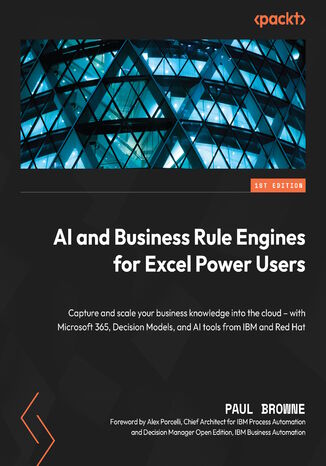
Paul Browne (GBP), ALEX PORCELLI
Microsoft Excel is widely adopted across diverse industries, but Excel Power Users often encounter limitations such as complex formulas, obscure business knowledge, and errors from using outdated sheets. They need a better enterprise-level solution, and this book introduces Business rules combined with the power of AI to tackle the limitations of Excel.This guide will give you a roadmap to link KIE (an industry-standard open-source application) to Microsoft’s business process automation tools, such as Power Automate, Power Query, Office Script, Forms, VBA, Script Lab, and GitHub. You’ll dive into the graphical Decision Modeling standard including decision tables, FEEL expressions, and advanced business rule editing and testing.By the end of the book, you’ll be able to share your business knowledge as graphical models, deploy and execute these models in the cloud (with Azure and OpenShift), link them back to Excel, and then execute them as an end-to-end solution removing human intervention. You’ll be equipped to solve your Excel queries and start using the next generation of Microsoft Office tools.
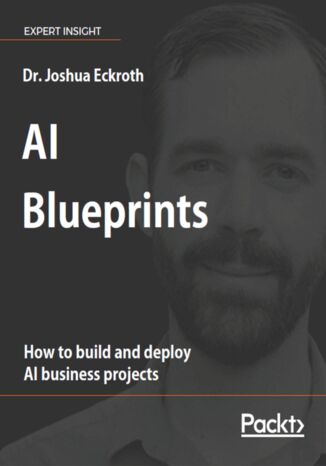
AI Blueprints. How to build and deploy AI business projects
Dr. Joshua Eckroth
AI Blueprints gives you a working framework and the techniques to build your own successful AI business applications. You’ll learn across six business scenarios how AI can solve critical challenges with state-of-the-art AI software libraries and a well thought out workflow. Along the way you’ll discover the practical techniques to build AI business applications from first design to full coding and deployment.The AI blueprints in this book solve key business scenarios. The first blueprint uses AI to find solutions for building plans for cloud computing that are on-time and under budget. The second blueprint involves an AI system that continuously monitors social media to gauge public feeling about a topic of interest - such as self-driving cars. You’ll learn how to approach AI business problems and apply blueprints that can ensure success.The next AI scenario shows you how to approach the problem of creating a recommendation engine and monitoring how those recommendations perform. The fourth blueprint shows you how to use deep learning to find your business logo in social media photos and assess how people interact with your products. Learn the practical techniques involved and how to apply these blueprints intelligently. The fifth blueprint is about how to best design a ‘trending now’ section on your website, much like the one we know from Twitter. The sixth blueprint shows how to create helpful chatbots so that an AI system can understand customers’ questions and answer them with relevant responses.This book continuously demonstrates a working framework and strategy for building AI business applications. Along the way, you’ll also learn how to prepare for future advances in AI. You’ll gain a workflow and a toolbox of patterns and techniques so that you can create your own smart code.
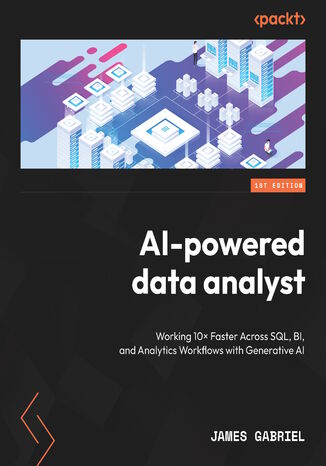
James Gabriel
The rapid rise of generative AI is transforming every industry, yet most data analysts still write SQL manually, debug queries line by line, and build reports through slow, repetitive processes. AI-Powered Data Analyst bridges the gap between AI hype and practical adoption, showing you how to integrate AI tools into every stage of the analytics workflow.This hands-on guide demonstrates how to use ChatGPT, Claude, GitHub Copilot, and AI APIs across SQL development, data cleaning, exploratory analysis, Power BI and DAX, and automated reporting. You’ll learn to translate business questions into optimized queries, automate EDA in Python, generate synthetic test data, and create executive-ready reports in minutes instead of hours. Using real-world examples, reusable prompt templates, and before-and-after productivity comparisons, the book shows how AI augments analysts rather than replaces them. It also covers validation workflows, data privacy, bias, and governance to ensure AI-assisted outputs are accurate and defensible.By the end, you’ll work 5–10× faster and deliver higher-value strategic insights with confidence.
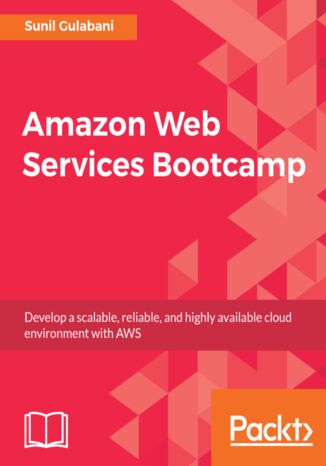
Sunil Gulabani
AWS is at the forefront of Cloud Computing today. Businesses are adopting AWS Cloud because of its reliability, versatility, and flexible design. The main focus of this book is teaching you how to build and manage highly reliable and scalable applications and services on AWS. It will provide you with all the necessary skills to design, deploy, and manage your applications and services on the AWS cloud platform. We’ll start by exploring Amazon S3, EC2, and so on to get you well-versed with core Amazon services. Moving on, we’ll teach you how to design and deploy highly scalable and optimized workloads. You’ll also discover easy-to-follow, hands-on steps, tips, and recommendations throughout the book and get to know essential security and troubleshooting concepts. By the end of the book, you’ll be able to create a highly secure, fault tolerant, and scalable environment for your applications to run on.
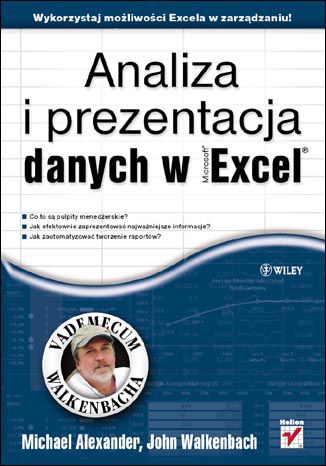
Analiza i prezentacja danych w Microsoft Excel. Vademecum Walkenbacha
Michael Alexander, John Walkenbach
Wykorzystaj możliwości Excela w zarządzaniu! Co to są pulpity menedżerskie? Jak efektownie zaprezentować najważniejsze informacje? Jak zautomatyzować tworzenie raportów? Excel to niezastąpione narzędzie, jeżeli musisz przetworzyć setki, tysiące, a nawet miliony danych. Od wielu lat obecny na rynku, program ten dzięki intuicyjnemu interfejsowi użytkownika, ogromnym możliwościom oraz rozsądnej cenie zdobył popularność w zasadzie w każdym środowisku - począwszy od akademickiego, a skończywszy na menedżerach i prezesach. Ta książka przeznaczona jest dla tej drugiej grupy. Ciągły napływ nowych informacji w świecie biznesu sprawia, że są one trudne do ogarnięcia. Z pomocą przychodzą pulpity menedżerskie! Dzięki tej książce dowiesz się, jak je stworzyć oraz wyłuskać najistotniejsze informacje z morza danych. W trakcie lektury nauczysz się analizować i przedstawiać w użytecznej formie dostępne dane, korzystać z metod szybkiej prezentacji oraz automatyzować procesy raportowania i tworzyć przyciągające wzrok prezentacje. Ponadto biegle opanujesz korzystanie z tabel i wykresów przestawnych oraz tworzenie zaawansowanych komponentów do prezentacji tendencji czy oceny efektywności realizacji celów. Jest to idealna książka dla każdego menedżera tonącego w gąszczu danych! Definicja pulpitów menedżerskich Określanie wymagań użytkowników Zasady projektowania pulpitów menedżerskich Projektowanie modelu danych Wykresy w programie Microsoft Excel Wykorzystanie tabel przestawnych Tworzenie wykresów przestawnych Wykresy przebiegu w czasie Inne techniki wizualizacji danych Tworzenie komponentów do prezentacji tendencji i grupowania danych Prezentacja efektywności realizacji celów Wykorzystanie makr w raportach Dodawanie interaktywnych kontrolek do pulpitu menedżerskiego Importowanie danych z Microsoft Access Metody bezpiecznego współdzielenia danych Uporządkuj i efektownie zaprezentuj najważniejsze informacje!
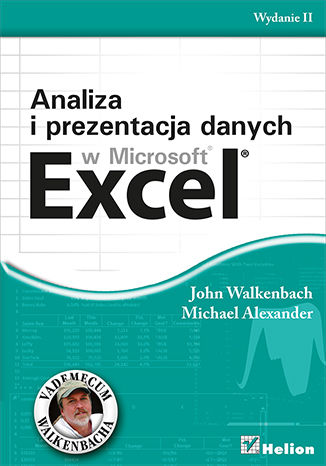
Analiza i prezentacja danych w Microsoft Excel. Vademecum Walkenbacha. Wydanie II
John Walkenbach, Michael Alexander
Wykorzystaj możliwości Excela w zarządzaniu! Jeżeli masz przed sobą setki, a może tysiące lub miliony danych, z których chcesz wyciągnąć celne wnioski, potrzebujesz narzędzia, które pomoże Ci to ogarnąć. Mowa oczywiście o Excelu. Nieważne, kim jesteś - studentem, księgowym, menedżerem czy prezesem - na 100% docenisz drzemiący w nim potencjał! Dzięki tej książce dowiesz się, jak wyłuskać najistotniejsze informacje z morza danych. W trakcie lektury nauczysz się błyskawicznie przygotowywać raporty oraz prezentacje. Przekonasz się, że tabele przestawne wcale nie muszą być takie straszne, oraz zobaczysz najlepsze techniki prezentacji tendencji czy oceny efektywności w realizacji celów. Kolejne wydanie książki zostało zaktualizowane, ulepszone i rozszerzone o mnóstwo nowych, przydatnych wiadomości. Dowiesz się, jak importować dane z bazy SQL Server oraz jak wykorzystać możliwości dodatku Power View. Książka ta jest idealną pozycją dla tonących w gąszczu danych! Dzięki tej książce: poznasz narzędzia Excela w zakresie analizy i prezentacji danych opanujesz najlepsze techniki projektowania tabel przygotujesz czytelne raporty wykorzystasz w pełni możliwości Excela Uratuj się z morza danych!
Analiza marketingowa. Praktyczne techniki z wykorzystaniem analizy danych i narzędzi Excela
Wayne L. Winston
Specjaliści w dziedzinie marketingu coraz częściej sięgają po wyrafinowane metody analizy. Obecnie firmy są zalewane ogromną ilością danych - skorzystanie z płynącej z nich wiedzy jest znakomitą szansą na poprawę kondycji przedsiębiorstwa. W tym celu trzeba dane zebrać, przetworzyć i poddać analizie. Potrzebne więc są narzędzia, najlepiej proste w użytkowaniu i powszechnie znane. Takim właśnie narzędziem jest arkusz kalkulacyjny MS Excel - potężna i wszechstronna aplikacja, dzięki której nawet bez specjalistycznej wiedzy można wykonać profesjonalną analizę marketingową i zdobyć mnóstwo przydatnych informacji. Ta książka powstała na bazie autorskiego kursu analizy marketingowej dla słuchaczy studiów MBA. Pokazuje, jak wykorzystywać Excela do modelowania danych i pozyskiwania wiedzy niezbędnej do kreowania skutecznego marketingu w firmie. Niemal wszystkie pojęcia wyjaśniono na przykładach, a sposób wykonania ćwiczeń pokazano krok po kroku. Do książki dołączono pliki z danymi i rozwiązaniami zadań. Dowiesz się, jak przetwarzać dane za pomocą wykresów, wyznaczać krzywe popytu, prowadzić analizę skupień w segmentach rynku oraz tworzyć indywidualne modele danych i prognozować wpływ akcji marketingowych na wzrost sprzedaży. Oznacza to, że aby zdobyć umiejętności analizy marketingowej, potrzebujesz tylko tego podręcznika i Excela! W tej książce między innymi: analiza danych marketingowych opracowywanie strategii najbardziej zyskownych wycen wykorzystywanie narzędzi prognostycznych analiza łączona i analiza wyborów dyskretnych pomiar skuteczności wydatków na reklamę analiza danych z mediów społecznościowych Wyrafinowane analizy biznesowe? Potrzebujesz tylko Excela!
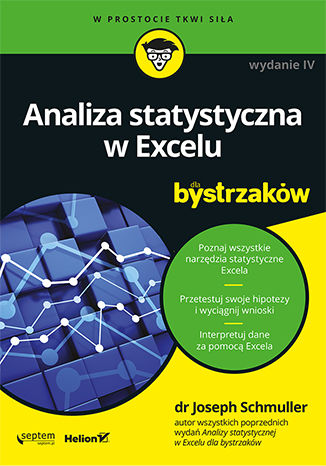
Analiza statystyczna w Excelu dla bystrzaków. Wydanie IV
Joseph Schmuller
Poznaj wszystkie narzędzia statystyczne Excela Przetestuj swoje hipotezy i wyciągnij wnioski Interpretuj dane za pomocą Excela Interpretuj statystyki w Excelu Analiza statystyczna w Excelu jest niezwykle przydatna, a dzięki tej książce przekonasz się, że może też być łatwa! Odkryjesz, jak używać perfekcyjnie zaprojektowanych narzędzi Excela do analizowania i interpretowania danych, przewidywania trendów, podejmowania decyzji oraz wykonywania wielu innych zadań. Zmierz się z technicznymi aspektami Excela i zacznij go wykorzystywać do interpretacji swoich danych! W książce: W yciąganie wniosków z arkuszy kalkulacyjnych Narzędzia analityczne Stosowanie narzędzi szybkiej analizy Tworzenie wykresów danych Praca na prawdopodobieństwie Wykorzystanie zmiennych losowych
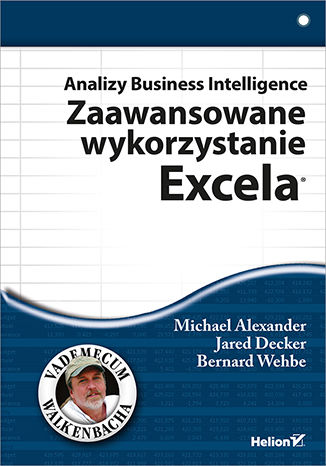
Analizy Business Intelligence. Zaawansowane wykorzystanie Excela
Michael Alexander
Poznaj potencjał Excela w zakresie BI! Program Excel można stosować na setki różnych sposobów, chociaż większość użytkowników uważa go za prosty arkusz kalkulacyjny. Co więcej, wachlarz jego zaawansowanych funkcjonalności jest stale poszerzany - program stał się częścią pakietu Microsoft Business Intelligence. Dzięki możliwości integracji danych z różnych źródeł Excel świetnie sprawdza się jako narzędzie do tworzenia interaktywnych kokpitów menedżerskich. Jeżeli interesujesz się tematyką BI i masz ambicję stworzyć własne "centrum dowodzenia", to trzymasz w rękach właściwą książkę! Ten wspaniały podręcznik stanowi kompendium wiedzy na temat prowadzenia analiz BI w środowisku Microsoft Excel. Sięgnij po niego i sprawdź, jak korzystać z tabel przestawnych oraz narzędzi Power Pivot, Power View czy Power Map. Dowiedz się, jak do tego wszystkiego dołożyć dane z baz SQL oraz użyć dodatku Data Mining. Zdobądź też wiedzę na temat publikowania Twoich rozwiązań na stronach SharePoint. Książka ta jest obowiązkową lekturą dla wszystkich menedżerów i analityków biznesowych chcących mieć wgląd w bieżące dane. Gdy poznasz i zastosujesz narzędzia Excela, podjęcie właściwej decyzji stanie się łatwiejsze! Dzięki tej książce: poznasz narzędzia: Power Pivot, Power View, Power Map oraz Power Query skorzystasz ze źródeł danych za pomocą języka SQL zastosujesz dodatek Data Mining udostępnisz swoje opracowania na stronach SharePointa Zbuduj doskonały kokpit menedżera!
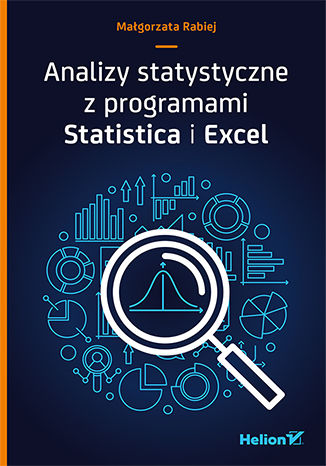
Analizy statystyczne z programami Statistica i Excel
Małgorzata Rabiej
Zostań mistrzem statystyki! Analizuj dane Wyciągaj wnioski Prezentuj wyniki W naszych czasach statystyka jest obecna dosłownie wszędzie. Opisuje procesy społeczne, wskazuje kierunki rozwoju, dyktuje strategie działania rządów i międzynarodowych korporacji. Pomaga ekonomistom, naukowcom i inżynierom, umożliwia tworzenie prognoz gospodarczych, pozwala opracowywać nowe technologie i rozwiązania techniczne, wspiera walkę z epidemiami i odkrywanie nowych terapii. Jest po prostu nieodzowna, aby radzić sobie z wyzwaniami współczesnego świata i skalą zjawisk, z którymi mamy do czynienia. Podstawą jest zgromadzenie oraz analiza danych w celu pozyskania z nich jak największej wiedzy o badanym zjawisku. Nie da się analizować ogromnych zbiorów danych bez pomocy komputerów i właściwego oprogramowania. Wśród najlepszych programów statystycznych jest Statistica firmy Statsoft, a do najpopularniejszych aplikacji biurowych należy Excel firmy Microsoft. Obydwa te rozwiązania oferują szereg specjalistycznych narzędzi wspomagających obróbkę danych statystycznych, przeprowadzanie analiz i prezentowanie wyników. Obydwa warto poznać, a najlepiej zrobić to w praktyczny sposób — za pomocą ćwiczeń. Właśnie takich, jakie zostały przedstawione w tej książce! Metody graficznej prezentacji danych Charakterystyki liczbowe i rozkłady zmiennych losowych Estymacja parametrów badanej zbiorowości Testy statystyczne Analiza wskaźników i zależności Liniowe i nieliniowe modele regresji Analiza szeregów czasowych i metody prognozowania Techniki eksploracji danych Zastosowanie sieci neuronowych Naucz się analizować i prezentować dane statystyczne!
Gineesh Madapparambath
Get ready to leverage the power of Ansible’s wide applicability to automate and manage IT infrastructure with Ansible for Real-Life Automation. This book will guide you in setting up and managing the free and open source automation tool and remote-managed nodes in the production and dev/staging environments.Starting with its installation and deployment, you’ll learn automation using simple use cases in your workplace. You’ll go beyond just Linux machines to use Ansible to automate Microsoft Windows machines, network devices, and private and public cloud platforms such as VMWare, AWS, and GCP. As you progress through the chapters, you’ll integrate Ansible into your DevOps workflow and deal with application container management and container platforms such as Kubernetes. This Ansible book also contains a detailed introduction to Red Hat Ansible Automation Platform to help you get up to speed with Red Hat AAP and integration with CI/CD and ITSM.What’s more, you’ll implement efficient automation solutions while learning best practices and methods to secure sensitive data using Ansible Vault and alternatives to automate non-supported platforms and operations using raw commands, command modules, and REST API calls.By the end of this book, you’ll be proficient in identifying and developing real-life automation use cases using Ansible.
Anshul Verma, Jitendra Zaa
Apex is an on-demand programming language providing a complete set of features for building business applications – including data models and objects to manage data. Apex being a proprietor programming language from Salesforce to be worked with multi tenant environment is a lot different than traditional OOPs languages like Java and C#. It acts as a workflow engine for managing collaboration of the data between users, a user interface model to handle forms and other interactions, and a SOAP API for programmatic access and integration.Apex Design Patterns gives you an insight to several problematic situations that can arise while developing on Force.com platform and the usage of Design patterns to solve them. Packed with real life examples, it gives you a walkthrough from learning design patterns that Apex can offer us, to implementing the appropriate ones in your own application. Furthermore, we learn about the creational patterns that deal with object creation mechanism and structural patterns that helps to identify the relationship between entities. Also, the behavioural and concurrency patterns are put forward explaining the communication between objects and multi-threaded programming paradigm respectively. We later on, deal with the issues regarding structuring of classes, instantiating or how to give a dynamic behaviour at a runtime, with the help of anti-patterns. We learn the basic OOPs principal in polymorphic and modular way to enhance its capability. Also, best practices of writing Apex code are explained to differentiate between the implementation of appropriate patterns. This book will also explain some unique patterns that could be applied to get around governor limits. By the end of this book, you will be a maestro in developing your applications on Force.com for Salesforce
API Analytics for Product Managers. Understand key API metrics that can help you grow your business
Deepa Goyal
APIs are crucial in the modern market as they allow faster innovation. But have you ever considered your APIs as products for revenue generation?API Analytics for Product Managers takes you through the benefits of efficient researching, strategizing, marketing, and continuously measuring the effectiveness of your APIs to help grow both B2B and B2C SaaS companies. Once you've been introduced to the concept of an API as a product, this fast-paced guide will show you how to establish metrics for activation, retention, engagement, and usage of your API products, as well as metrics to measure the reach and effectiveness of documentation—an often-overlooked aspect of development.Of course, it's not all about the product—as any good product manager knows; you need to understand your customers’ needs, expectations, and satisfaction too. Once you've gathered your data, you’ll need to be able to derive actionable insights from it. This is where the book covers the advanced concepts of leading and lagging metrics, removing bias from the metric-setting process, and bringing metrics together to establish long- and short-term goals.By the end of this book, you'll be perfectly placed to apply product management methodologies to the building and scaling of revenue-generating APIs.
Darren Paul Cope
Appcelerator Titanium is the leading method for creating native cross-platform apps. This book guides you from the initial stages with the language right through to the submission of your app to the marketplace/app store. Specially crafted examples cover the most common requirements of an app programmer. This book will be your companion as you progress with the language.Appcelerator Titanium Application Development by Example Beginner's Guide will guide you through the process of designing cross-platform apps using Titanium. It covers all areas of the language from installation through development to submission to the store. This book will take a hands-on approach in teaching you how to write cross-platform apps using Titanium, as well as exploring the new features of Titanium 3. Each chapter will show you how to overcome specific challenges using Titanium. You will learn how to design your apps using MVC principles and Alloy, use the cloud to your advantage, develop apps that work on tablets and phones, use the phone gadgets like the accelerometer, integrate social media, record usage using analytics, and monetise your app. All tasks from installation to deployment to the store are covered and backed by examples. The book will be your companion from your first steps with Titanium to successful live deployment.
Karthik Ramasubramanian, Jojo Moolayil
R provides excellent visualization features that are essential for exploring data before using it in automated learning.Applied Supervised Learning with R helps you cover the complete process of employing R to develop applications using supervised machine learning algorithms for your business needs. The book starts by helping you develop your analytical thinking to create a problem statement using business inputs and domain research. You will then learn different evaluation metrics that compare various algorithms, and later progress to using these metrics to select the best algorithm for your problem. After finalizing the algorithm you want to use, you will study the hyperparameter optimization technique to fine-tune your set of optimal parameters. The book demonstrates how you can add different regularization terms to avoid overfitting your model.By the end of this book, you will have gained the advanced skills you need for modeling a supervised machine learning algorithm that precisely fulfills your business needs.
Eric Pimpler
This book is an immersive guide to take your ArcGIS Desktop application development skills to the next levelIt starts off by providing detailed description and examples of how to create ArcGIS Desktop Python toolboxes that will serve as containers for many of the applications that you will build. We provide several practical projects that involve building a local area/community map and extracting wildfire data. You will then learn how to build tools that can access data from ArcGIS Server using the ArcGIS REST API. Furthermore, we deal with the integration of additional open source Python libraries into your applications, which will help you chart and graph advanced GUI development; read and write JSON, CSV, and XML format data sources; write outputs to Google Earth Pro, and more. Along the way, you will be introduced to advanced ArcPy Mapping and ArcPy Data Access module techniques and use data-driven Pages to automate the creation of map books.Finally, you will learn advanced techniques to work with video and social media feeds. By the end of the book, you will have your own desktop application without having spent too much time learning sophisticated theory.
Tripp Corbin, GISP
ArcGIS is Esri's catalog of GIS applications with powerful tools for visualizing, maintaining, and analyzing data. ArcGIS makes use of the modern ribbon interface and 64-bit processing to increase the speed and efficiency of using GIS. It allows users to create amazing maps in both 2D and 3D quickly and easily. If you want to gain a thorough understanding of the various data formats that can be used in ArcGIS Pro and shared via ArcGIS Online, then this book is for you. Beginning with a refresher on ArcGIS Pro and how to work with projects, this book will quickly take you through recipes about using various data formats supported by the tool. You will learn the limits of each format, such as Shapefiles, Geodatabase, and CAD files, and learn how to link tables from outside sources to existing GIS data to expand the amount of data that can be used in ArcGIS. You'll learn methods for editing 2D and 3D data using ArcGIS Pro and how topology can be used to ensure data integrity. Lastly the book will show you how data and maps can be shared via ArcGIS Online and used with web and mobile applications.
Sjoukje Zaal
Architecting Microsoft Azure Solutions: Exam Guide 70-535 will get Azure architects and developers up-to-date with the latest updates on Azure from an architecture and design perspective. The book includes all the topics that are still relevant from the previous 70-534 exam, and is updated with latest topics covered, including Artificial Intelligence, IoT, and architecture styles.This exam guide is divided into six parts, where the first part will give you a good understanding of how to design a compute infrastructure. It also dives into designing networking and data implementations. You will learn about designing solutions for Platform Service and operations. Next, you will be able to secure your resources and data, as well as design a mechanism for governance and policies. You will also understand the objective of designing solutions for Platform Services, by covering Artificial Intelligence, IoT, media services, and messaging solution concepts. Finally, you will cover the designing for operations objective. This objective covers application and platform monitoring, as well as designing alerting strategies and operations automation strategies. By the end of the book, you’ll have met all of the exam objectives, and will have all the information you need to ace the 70-535 exam. You will also have become an expert in designing solutions on Microsoft Azure.
Serdar Simsekler, Eric Du
SAP BTP is the foundation of SAP’s intelligent and sustainable enterprise vision for its customers. It’s efficient, agile, and an enabler of innovation. It’s technically robust, yet its superpower is its business centricity.If you’re involved in building IT and business strategies, it’s essential to familiarize yourself with SAP BTP to see the big picture for digitalization with SAP solutions. Similarly, if you have design responsibilities for enterprise solutions, learning SAP BTP is crucial to produce effective and complete architecture designs.This book teaches you about SAP BTP in five parts. First, you’ll see how SAP BTP is positioned in the intelligent enterprise. In the second part, you’ll learn the foundational elements of SAP BTP and find out how it operates. The next part covers integration architecture guidelines, integration strategy considerations, and integration styles with SAP’s integration technologies. Later, you’ll learn how to use application development capabilities to extend enterprise solutions for innovation and agility. This part also includes digital experience and process automation capabilities. The last part covers how SAP BTP can facilitate data-to-value use cases to produce actionable business insights.By the end of this SAP book, you’ll be able to architect solutions using SAP BTP to deliver high business value.
Robert Stackowiak, Carla Romano, Shyam Varan Nath
The Industrial Internet or the IIoT has gained a lot of traction. Many leading companies are driving this revolution by connecting smart edge devices to cloud-based analysis platforms and solving their business challenges in new ways. To ensure a smooth integration of such machines and devices, sound architecture strategies based on accepted principles, best practices, and lessons learned must be applied.This book begins by providing a bird's eye view of what the IIoT is and how the industrial revolution has evolved into embracing this technology. It then describes architectural approaches for success, gathering business requirements, and mapping requirements into functional solutions. In a later chapter, many other potential use cases are introduced including those in manufacturing and specific examples in predictive maintenance, asset tracking and handling, and environmental impact and abatement. The book concludes by exploring evolving technologies that will impact IIoT architecture in the future and discusses possible societal implications of the Industrial Internet and perceptions regarding these projects.By the end of this book, you will be better equipped to embrace the benefits of the burgeoning IIoT.