
Aplikacje biurowe
Egzamin 70-347 Udostępnianie usług Office 365
Orin Thomas
Książka ułatwia zdobycie umiejętności potrzebnych do zdania egzaminu 70-347 firmy Microsoft i opanowanie biegłości koniecznej do bezpiecznego i sprawnego udostępniania usług Microsoft Office 365 w dowolnym środowisku. Książka została opra-cowana z myślą o doświadczonych pracownikach IT, którzy chcą pogłębiać wiedzę i rozwijać karierę zawodową poprzez naukę logicznego myślenia i sprawnego podejmowania decyzji - elementów koniecznych do osiągnięcia poziomu MCSA. Opanuj umiejętności specjalistyczne omawiane w następujących zagadnieniach: - Zarządzanie klientami i urządzeniami użytkowników końcowych - Udostępnianie zbiorów witryn usługi Microsoft SharePoint Online - Konfigurowanie dla użytkowników aplikacji Microsoft Exchange Online i Skype for Business - Planowanie wdrożenia aplikacji Exchange Online i Skype for Business Cechy podręcznika Egzamin 70-347: - Zorganizowany według zagadnień egzaminacyjnych - Opisuje strategie postępowania w oparciu o warunkową analizę scenariusza - Przedstawia wskazówki przydatne podczas przygotowań do egzaminu opracowane szkoleniowców, konsultantów i administratorów systemów - W książce przyjęto założenie, że Czytelnik posiada doświadczenia z aplikacją Office 365 Admin Center oraz poznał działanie usług Exchange Online, Skype for Business, SharePoint Online, Office 365 ProPlus i Microsoft Azure Active Directory Informacje o egzaminie Egzamin 70-347 przede wszystkim sprawdza umiejętności i wiedzę potrzebną do bezpiecznego i sprawnego udostępniania usług Office 365 za pomocą aplikacji SharePoint Online, Exchange Online i Skype for Business. Informacje o certyfikacie firmy Microsoft Zdanie tego egzaminu ułatwia uzyskanie certyfikatu MCSA: Office 365 Solutions Associate, który zaświadcza o umiejętności przechodzenia do aplikacji biznesowych opartych na chmurze i zarządzania tymi aplikacjami za pomocą usług Office 365. Certyfikat ten można uzyskać, zdając egzamin 70-346: Managing Office 365 Identities and Requirements oraz egzamin Exam 70-347: Enabling Office 365 Services. Dodatkowe informacje: microsoft.com/learning O autorze Orin Thomas jest konsultantem, pisarzem, administratorem serwerów, wykładowcą oraz uzyskał tytuł Microsoft MVP, a w firmie Microsoft pełni funkcję Regional Director. Napisał ponad 30 książek wydanych przez Microsoft Press, a w tym Exam Ref 70-346 Managing Office 365 Identities and Requirements. Autor specjalizuje się w technologiach zagadnieniach związanych z bezpieczeństwem sieci, zarządzaniem wiedzą i współpracą.
Witold Wrotek
Poznaj podstawy elektroniki na konkretnych przykładach Naucz się wyznaczać charakterystyki układów za pomocą Excela Dowiedz się, jak przy użyciu arkusza rozwiązywać elektroniczne problemy projektowe Naucz się elektroniki z programem Excel! Excel na dobre zagościł w szkołach, firmach i instytucjach naukowych, w których wykorzystywany jest do rozwiązywania różnorodnych problemów obliczeniowych: od przeprowadzania symulacji, wyznaczania trendów i wskaźników, poprzez generowanie różnych zestawień, porównań i podsumowań danych, aż po tworzenie na ich podstawie charakterystyk i wykresów. Aplikacja ta znajduje też zastosowanie w wielu dziedzinach techniki, wspomagając zarówno proste rachunki czy działania związane z wyceną kosztów realizacji projektów, jak i zaawansowane obliczenia inżynierskie. Jeśli chcesz poznać podstawy elektroniki i dowiedzieć się, jak wykorzystać arkusz kalkulacyjny do rozwiązywania typowych problemów z tej dziedziny, sięgnij po książkę "Elektronika z Excelem". Dzięki niej łatwo zrozumiesz działanie najważniejszych elementów i układów elektronicznych analogowych oraz cyfrowych, a także nauczysz się wykorzystywać program Excel do wyznaczania parametrów układów elektronicznych, wykreślania charakterystyk czy prezentacji otrzymanych wyników. Książka okaże się nieocenioną pomocą, jeśli chcesz poznać metodykę eksperymentów elektronicznych bez angażowania laboratorium i nauczyć się wykonywać solidne sprawozdania z zajęć laboratoryjnych. Budowa i zasada działania podstawowych elementów elektronicznych Przegląd najczęściej wykorzystywanych układów analogowych Sposoby przetwarzania sygnałów analogowych na cyfrowe i na odwrót Podstawy techniki cyfrowej i mikroprocesorowej Zagadnienia związane z nadawaniem, propagacją i odbiorem sygnałów radiowych oraz telewizyjnych Przekonaj się, ile prac możesz wykonać z pomocą Excela, bez laboratorium elektronicznego!
Joel Kruger, Helen Beal
At the core of software development lies the imperative of swiftly and reliably releasing new features and updates, emphasizing the vital role of release management in the DevOps methodology. Discover how software development teams can elevate their processes by incorporating quality checks and shifting left, moving testing, automation, and QA procedures much earlier into the SDLC. However, release management is still tasked with application monitoring, overseeing infrastructure components, and managing change orders and schedules.This book offers insights into the essence of DevOps Release Management, illuminating its nuances and providing basic strategies for its implementation. You’ll explore how CI/CD pipelines enforce good DevOps release management and master techniques to optimize them. You’ll also learn how to foster a culture of cross-functional product development that minimizes waste and maximizes value to the customer.By the end of the book, you’ll have gained a comprehensive understanding of DevOps release management, its benefits, and practical implementation strategies. Equipped with this knowledge, you’ll be able to assess your own development processes and identify areas for improvement, ultimately leading to increased efficiency, collaboration, and value creation.
Arun Ramakani
In the last few years, countless organizations have taken advantage of the disruptive application deployment operating model provided by Kubernetes. With Crossplane, the same benefits are coming to the world of infrastructure provisioning and management. The limitations of Infrastructure as Code with respect to drift management, role-based access control, team collaboration, and weak contract make people move towards a control-plane-based infrastructure automation, but setting it up requires a lot of know-how and effort.This book will cover a detailed journey to building a control-plane-based infrastructure automation platform with Kubernetes and Crossplane. The cloud-native landscape has an overwhelming list of configuration management tools that can make it difficult to analyze and choose. This book will guide cloud-native practitioners to select the right tools for Kubernetes configuration management that best suit the use case. You'll learn about configuration management with hands-on modules built on popular configuration management tools such as Helm, Kustomize, Argo, and KubeVela. The hands-on examples will be patterns that one can directly use in their work.By the end of this book, you'll be well-versed with building a modern infrastructure automation platform to unify application and infrastructure automation.
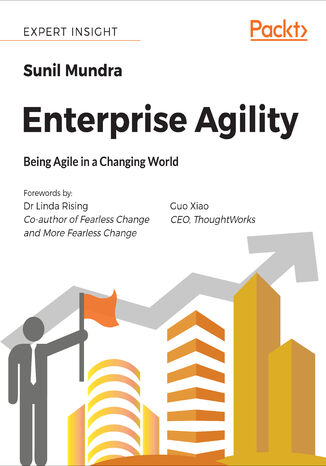
Enterprise Agility. Being Agile in a Changing World
Sunil Mundra
The biggest challenge enterprises face today is dealing with fast-paced change in all spheres of business. Enterprise Agility shows how an enterprise can address this challenge head on and thrive in the dynamic environment. Avoiding the mechanistic construction of existing enterprises that focus on predictability and certainty, Enterprise Agility delivers practical advice for responding and adapting to the scale and accelerating pace of disruptive change in the business environment.Agility is a fundamental shift in thinking about how enterprises work to effectively deal with disruptive changes in the business environment. The core belief underlying agility is that enterprises are open and living systems. These living systems, also known as complex adaptive systems (CAS), are ideally suited to deal with change very effectively.Agility is to enterprises what health is to humans. There are some foundational principles that can be broadly applied, but the definition of healthy is very specific to each individual. Enterprise Agility takes a similar approach with regard to agility: it suggests foundational practices to improve the overall health of the body—culture, mindset, and leadership—and the health of its various organs: people, process, governance, structure, technology, and customers. The book also suggests a practical framework to create a plan to enhance agility.
Ravindra Akella, Arun Kumar Tamirisa , Suneel...
Building production-ready enterprise applications can be a challenging task due to the overabundance of tools and their different versions that make app development complex. This book simplifies the process with an end-to-end road map for building enterprise applications from scratch using the latest features of .NET Core 6 and C# 10.Throughout the book, you'll work on creating an enterprise app, adding a key component to the app with each chapter, before ?nally getting it ready for testing and deployment. You'll learn concepts relating to advanced data structures, the Entity Framework Core, parallel programming, and dependency injection. As you progress, you'll cover various authentication and authorization schemes provided by .NET Core to make your apps and APIs secure. The book then shows you how the latest Microsoft Visual Studio and C# 10 help you simplify developer tasks and shares tips and tricks in Visual Studio to improve your productivity. You'll discover various testing techniques, such as unit testing and performance testing, as well as di?erent methods to deploy enterprise apps.By the end of this book, you’ll be able to create enterprise apps using the powerful features of .NET 6 and deploy them to the cloud while working with various cloud components using Azure.
Gerald Gierer
Spring and Ext JS are cutting edge frameworks that allow us to build high performance web applications for modern devices, that are now consuming data at a faster rate than ever before. It is the appropriate time for you to understand how to best leverage these technologies when architecting, designing, and developing large scale web development projects.This practical guide condenses an approach to web development that was gained from real world projects, and outlines a simple, practical approach to developing high performance, and enterprise grade web applications.Starting with configuring Java, NetBeans, and MySQL to prepare your development environment, you will then learn how to connect your NetBeans IDE to the MySQL database server. We will then explore the Task Time Tracker (3T) project database structure and populate these tables with test data.Following on from this, we will examine core JPA concepts after reverse engineering the domain layer with NetBeans. Leveraging the Data Access Object design pattern, you will learn how to build the Java DAO implementation layer assisted by generics in base classes, followed by a Data Transfer Object enabled service layer to encapsulate the business logic of your 3T application.The final chapters that focus on Java explore how to implement the request handling layer using Spring annotated controllers, and deploy the 3T application to the GlassFish server. We will then configure the Ext JS 4 development environment and introduce key Ext JS 4 concepts, including MVC and practical design conventions.Covering a variety of important Ext JS 4 strategies and concepts, you will be fully-equipped to implement a variety of different user interfaces using the Ext JS MVC design pattern. Your journey ends by exploring the production build and deployment process using Maven, Sencha Cmd and GlassFish.
Jorge R. López Benito, Enara Artetxe González
Augmented reality (AR) is expanding its scope from just being used in mobile and game applications to enterprise. Different industries are using AR to enhance assembly line visualization, guide operators performing difficult tasks, attract more customers, and even improve training techniques. In this book, you'll gain comprehensive insights into different aspects of developing AR-based apps for six different enterprise sectors, focusing on market needs and choosing the most suitable tool in each case.You'll delve into the basics of Unity and get familiar with Unity assets, materials, and resources, which will help you build a strong foundation for working on the different AR projects covered in the book. You'll build real-world projects for various industries such as marketing, retail, and automation in a step-by-step manner. This will give you hands-on experience in developing your own industrial AR apps. While building the projects, you'll explore various AR frameworks used in the enterprise environment such as Vuforia, EasyAR, ARCore, and ARKit, and understand how they can be used by themselves or integrated into the Unity 3D engine to create AR markers, 3D models, and components of an AR app.By the end of this book, you'll be well versed in using different commercial AR frameworks as well as Unity for building robust AR projects.