
Hardware
Troubleshooting OpenStack. Get unstuck and start stacking!
Tony Campbell
OpenStack is a collection of software projects that work together to provide a cloud fabric. OpenStack is one of the fastest growing open source projects in history that unlocks cloud computing for everyone. With OpenStack, you are able to create public or private clouds on your own hardware. The flexibility and control afforded by OpenStack puts the cloud within reach of anyone willing to learn this technology.Starting with an introduction to OpenStack troubleshooting tools, we’ll walk through each OpenStack service and how you can quickly diagnose, troubleshoot, and correct problems in your OpenStack. Understanding the various projects and how they interact is essential for anyone attempting to troubleshoot an OpenStack cloud. We will start by explaining each of the major components and the dependencies between them, and move on to show you how to identify and utilize an effective set of OpenStack troubleshooting tools and fix common Keystone problems. Next, we will expose you to common errors and problems you may encounter when using the OpenStack Block Storage service (Cinder). We will then examine Heat, the OpenStack Orchestration Service, where you will learn how to trace errors, determine their root cause, and effectively correct the issue.Finally, you will get to know the best practices to architect your OpenStack cloud in order to achieve optimal performance, availability, and reliability.
Mike Preston
Virtualization has created a new role within IT departments everywhere; the vSphere administrator. vSphere administrators have long been managing more than just the hypervisor, they have quickly had to adapt to become a ‘jack of all trades' in organizations. More and more tier 1 workloads are being virtualized, making the infrastructure underneath them all that more important. Due to this, along with the holistic nature of vSphere, administrators are forced to have the know-how on what to do when problems occur.This practical, easy-to-understand guide will give the vSphere administrator the knowledge and skill set they need in order to identify, troubleshoot, and solve issues that relate to storage visibility, storage performance, and storage capacity in a vSphere environment.This book will first give you the fundamental background knowledge of storage and virtualization. From there, you will explore the tools and techniques that you can use to troubleshoot common storage issues in today's data centers.You will learn the steps to take when storage seems slow, or there is limited availability of storage. The book will go over the most common storage transport such as Fibre Channel, iSCSI, and NFS, and explain what to do when you can't see your storage, where to look when your storage is experiencing performance issues, and how to react when you reach capacity. You will also learn about the tools that ESXi contains to help you with this, and how to identify key issues within the many vSphere logfiles.
Edgars Karlsons, Inese Liberte
The popularity of online shopping has increased drastically over the past few years. TYPO3 is fully equipped to meet all the challenges of modern electronic commerce. TYPO3 can be enlarged afrom a pure content-based online catalog to a fully-grown shop system with a variety of extensions. It may be easy to plan a website but when it comes to implementing the design and developing a successful e-commerce site, you might come across a lot of difficulties.This book teaches all the aspects of quickly setting up a feature-packed, easy-to-build e-commerce site—from basic installation and configuration of TYPO3 through adding features step-by-step to an example website. It demonstrates the setting up of an online TYPO3 e-commerce site from scratch and walks you through lucrative tips on attracting customers and maximizing profit.This book takes you through the creation of an appealing online shop in steps. It starts with the basics of TYPO3 and TYPO3 installation and shows how to use its standard features to begin construction of an online shop. It will help you improve the selling interface and handling of orders with new modules and other customizations. It discusses various template configurations and plugins. You will learn how to build attractive product catalogs, profiles for registered and unregistered users, and online shop SEO. You will also learn to provide effective search facilities for systematic navigation of your site. Further, various modules for payment and delivery will be discussed. Finally, you will learn how to manage and market your site.
Dan Osipov
TYPO3 is one of the world's leading open source content management systems, written in PHP, which can be used to create and customize your web site. Along with text content, you can display high quality images, audio, and video to your site's visitors by using TYPO3. It is essential to manage various types of multimedia files in content management systems for both editors and the users on the frontend of the site.The book gives you a step-by-step process for organizing an effective multimedia system. It also gives solutions to commonly encountered problems, and offers a variety of tools for dealing with multimedia content. The author's experience in large-scale systems enables him to share his effective solutions to these problems.If you choose to work through all the recipes from the beginning, you will start by setting up a basic web site set up, aimed at future expansion and scalability. Next, you will cover the basics of digital asset management—a major topic important in all enterprises. You can organize user groups because next you will be creating accounts for users and assigning permissions. Then you will jump into metadata—text information describing the multimedia objects—and learn how it can be manipulated in TYPO3. You will embed multimedia on your site when you have read the various methods for embedding mentioned in this book. Before you finish the book you will learn about some advanced topics, such as external API integrations and process automation.
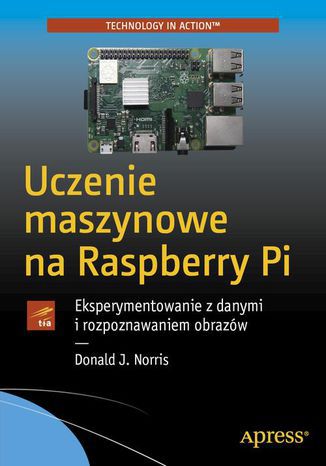
Uczenie maszynowe na Raspberry Pi
Donald Norris
Rozwijaj i replikuj interesujące eksperymenty uczenia maszynowego (ML) przy użyciu kamery Pi Camera i płytki Raspberry Pi. Niniejsza książka zapewnia solidny przegląd technik uczenia maszynowego i niezliczonych zagadnień leżących u jego podstaw, zachęcając do ich dalszego poznawania. Nietechniczne omówienia równoważą złożone objaśnienia techniczne, sprawiając, że najnowszy i najbardziej złożony temat w świecie hobbystów informatyki staje się zrozumiały i przystępny. Uczenie maszynowe, odwołujące się zwykle także do uczenia głębokiego (DL) jest obecnie zintegrowane z mnóstwem komercyjnych produktów, a także szeroko stosowane w przemyśle, medycynie i wojskowości. Trudno znaleźć jakąkolwiek nowoczesną działalność człowieka, która nie została "dotknięta" przez aplikacje sztucznej inteligencji (AI). Bazując na koncepcjach wprowadzonych w książce Beginning Artificial Intelligence with the Raspberry Pi, niniejsza książka prowadzi poza proste rozumienie koncepcji AI do rzeczywistych doświadczeń z wykorzystaniem uczenia maszynowego i praktycznych zastosowań koncepcji uczenia głębokiego w eksperymentach związanych z rozpoznawaniem obrazów przy użyciu płytki Pi. Koncepcje związane z uczeniem maszynowym na Raspberry Pi można przenieść na inne platformy, wchodząc jeszcze dalej w świat sztucznej inteligencji i uczenia maszynowego, aby realizować coraz lepsze projekty hobbystyczne lub komercyjne.
Patrick Grassle, Henriette Baumann, Philippe Baumann
Most books about UML describe it almost in its entirety. Inevitably you're left with only a superficial knowledge of the range of UML elements, without a deep and intuitive understanding of how to apply UML as a whole to real world design problems. This book doesn't set out to cover all of UML, but instead pulls together those parts of UML with immediate practical relevance and presents them as part of a coherent process for using UML in your actual development projects.This book is designed to be read while you work on a real project. After an initial review of the essentials of UML and the design process, it begins with the modeling of a business system and its business processes, in this case an airport. Then the IT system intended to serve that business process is described and analysed. Finally the integration of the system into the production environment is covered in detail. The book can be used in two ways: it can be read through as a thorough grounding in how UML really works in practice; in addition it can be used as stand alone guide to that particular aspect of your own project. Both result in an intuitive understanding of how to actually use UML.
Ryan Henson Creighton
Beginner game developers are wonderfully optimistic, passionate, and ambitious. But that ambition is often dangerous! Too often, budding indie developers and hobbyists bite off more than they can chew. Some of the most popular games in recent memory – Doodle Jump, Paper Toss, and Canabalt, to name a few – have been fun, simple games that have delighted players and delivered big profits to their creators. This is the perfect climate for new game developers to succeed by creating simple games with Unity 3D, starting today.This book starts you off on the right foot, emphasizing small, simple game ideas and playable projects that you can actually finish. The complexity of the games increases gradually as we progress through the chapters. The chosen examples help you learn a wide variety of game development techniques. With this understanding of Unity 3D and bite-sized bits of programming, you can make your own mark on the game industry by finishing fun, simple games.This book shows you how to build crucial game elements that you can reuse and re-skin in many different games, using the phenomenal (and free!) Unity 3D game engine. It initiates you into indie game culture by teaching you how to make your own small, simple games using Unity3D and some gentle, easy-to-understand code. It will help you turn a rudimentary keep-up game into a madcap race through hospital hallways to rush a still-beating heart to the transplant ward, program a complete 2D game using Unity's User Interface controls, put a dramatic love story spin on a simple catch game, and turn that around into a classic space shooter with spectacular explosions and pew sounds! By the time you're finished, you'll have learned to develop a number of important pieces to create your own games that focus in on that small, singular piece of joy that makes games fun.
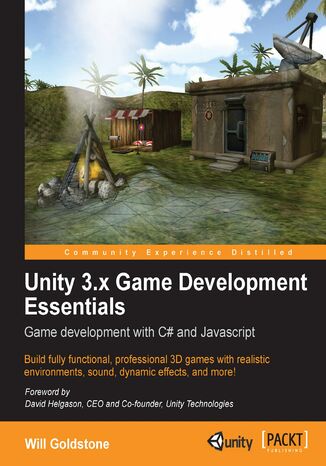
Will Goldstone
Game Engines such as Unity are the power-tools behind the games we know and love. Unity is one of the most widely-used and best loved packages for game development and is used by everyone, from hobbyists to large studios, to create games and interactive experiences for the web, desktop, mobile, and console. With Unity’s intuitive, easy to learn toolset and this book – it’s never been easier to become a game developer. Taking a practical approach, this book will introduce you to the concepts of developing 3D games, before getting to grips with development in Unity itself – prototyping a simple scenario, and then creating a larger game. From creating 3D worlds to scripting and creating game mechanics you will learn everything you’ll need to get started with game development. This book is designed to cover a set of easy-to-follow examples, which culminate in the production of a First Person 3D game, complete with an interactive island environment. All of the concepts taught in this book are applicable to other types of game, however, by introducing common concepts of game and 3D production, you'll explore Unity to make a character interact with the game world, and build puzzles for the player to solve, in order to complete the game. At the end of the book, you will have a fully working 3D game and all the skills required to extend the game further, giving your end-user, the player, the best experience possible. Soon you will be creating your own 3D games with ease!