Node.js
Node.js Blueprints. Develop stunning web and desktop applications with the definitive Node.js
Krasimir Stefanov Tsonev
Node.js By Example. Learn to use Node.js by creating a fully functional social network
Krasimir Tsonev, Krasimir Stefanov Tsonev
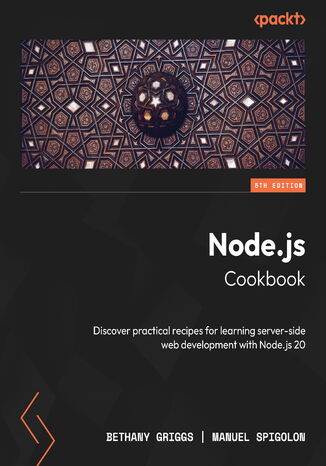
Bethany Griggs, Manuel Spigolon
Node.js is a game-changing technology for building modern web applications and tooling, bringing the power of JavaScript to the server and enabling full-stack development in a unified language. This updated edition of this Node.js cookbook, featuring Node.js 22, equips you with the latest advancements and enhancements in the Node.js framework ecosystem.From Bethany Griggs, who has served on the Node.js Technical Steering Committee and participated in the Node.js Release Working Group, and Manuel Spigolon, a core maintainer of Fastify, comes this fifth edition of the Node.js Cookbook to help you master Node.js 22. This book guides you step by step through crafting reusable code with Node.js modules, streamlining development using the Fastify web framework, and implementing data persistence in databases and rigorous testing practices for robust applications. You’ll address security concerns, optimize performance with worker threads, deploy Node.js microservices using containerization and orchestration, and tackle troubleshooting with effective debugging strategies. Packed with real-world examples, this guide empowers you to harness Node.js 22's full potential for creating secure, performant, and dynamic applications.
Mario Casciaro, Luciano Mammino
In this book, we will show you how to implement a series of best practices and design patterns to help you create efficient and robust Node.js applications with ease.We kick off by exploring the basics of Node.js, analyzing its asynchronous event driven architecture and its fundamental design patterns. We then show you how to build asynchronous control flow patterns with callbacks, promises and async/await. Next, we dive into Node.js streams, unveiling their power and showing you how to use them at their full capacity. Following streams is an analysis of different creational, structural, and behavioral design patterns that take full advantage of JavaScript and Node.js. Lastly, the book dives into more advanced concepts such as Universal JavaScript, scalability and messaging patterns to help you build enterprise-grade distributed applications.Throughout the book, you’ll see Node.js in action with the help of several real-life examples leveraging technologies such as LevelDB, Redis, RabbitMQ, ZeroMQ, and many others. They will be used to demonstrate a pattern or technique, but they will also give you a great introduction to the Node.js ecosystem and its set of solutions.
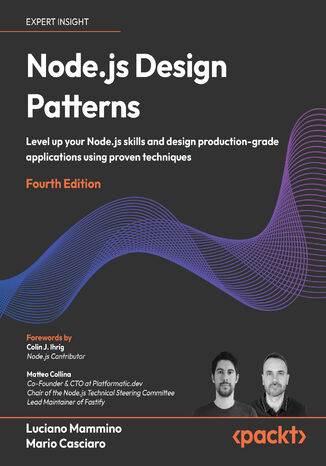
Luciano Mammino, Mario Casciaro, Colin J. Ihrig,...
Node.js underpins much of modern web development, reliably powering APIs and full-stack apps across all industries. Authors Luciano Mammino and Mario Casciaro offer a practical guide that unpacks the JavaScript runtime so you can write reliable, high-performance Node.js apps.Building on the highly rated third edition, this new edition adds fresh case studies and the latest Node.js developments: newer APIs and libraries, ESM improvements, practical security and production tips, and guidance on using Node.js with TypeScript. It also introduces a new chapter on testing that gives you a full introduction to testing philosophy and practical guidance on writing unit, integration, and end-to-end tests, giving you the confidence to write functional, stable, and reliable code.Real-world, end-to-end examples throughout the book show how to build microservices and distributed systems with Node.js, integrating production-proven technologies such as Redis, RabbitMQ, LevelDB, and ZeroMQ, the same components you’ll find in scalable deployments at companies of all sizes. End-of-chapter exercises consolidate your understanding.By the end of this Node.js book, you’ll have the design patterns, mindset, and hands-on skills every serious Node.js professional needs to confidently architect robust, efficient, and maintainable applications.
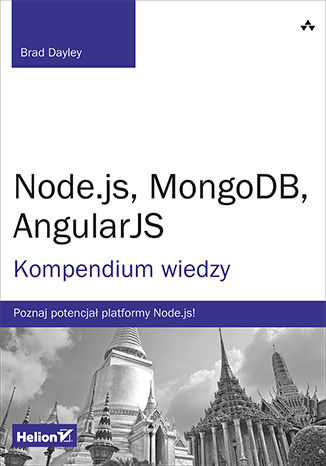
Node.js, MongoDB, AngularJS. Kompendium wiedzy
Brad Dayley
Node.js to wiodące, serwerowe środowisko programistyczne. MongoDB to najpopularniejsza baza danych NoSQL, a AngularJS to szybko zyskujące wiodącą rolę środowisko służące do projektowania interfejsów opartych na technologii MVC. Czego chcieć więcej? W sieci króluje połączenie serwera Apache z bazą danych MySQL i językiem PHP. Do niedawna wydawało się, że pozycja tej trójcy na fotelu lidera jest niezagrożona. Jednak na horyzoncie pojawili się nowi gracze: Node.js, MongoDB oraz AngularJS! Node.js to platforma, która pozwoli Ci stworzyć niezwykle wydajną aplikację internetową przy użyciu języka JavaScript. AngularJS specjalizuje się w interfejsie użytkownika opartym na MVC. Natomiast MongoDB to jedna z najpopularniejszych baz danych NoSQL. Co wynika z połączenia tych trzech narzędzi? Przekonasz się, gdy sięgniesz po tę niezwykłą książkę! W trakcie lektury poznasz składnię i niuanse języka JavaScript, a następnie zgłębisz tajemnice środowiska Node.js. Na kolejnych stronach znajdziesz informacje na temat korzystania ze zdarzeń, procesów nasłuchiwania, wywołań zwrotnych oraz obsługi operacji wejścia-wyjścia. Ponadto przekonasz się, jak w Node.js zaimplementować usługi HTTP oraz skalować tworzoną aplikację. W dalszej części przejdziesz do poznawania tajników bazy MongoDB. Skonfigurujesz połączenie z bazą oraz poznasz dokumenty i ich kolekcje w MongoDB. Na sam koniec zobaczysz, jak przygotować klienta Twoich usług za pomocą AngularJS. Ta książka jest pasjonująca i prezentuje wszystkie warstwy nowoczesnej aplikacji internetowej — to lektura obowiązkowa każdego programisty! Stwórz skalowalną aplikację za pomocą najnowocześniejszych narzędzi! Implementowanie dynamicznego serwera WWW o dużej skalowalności za pomocą komponentów Node.js i Express Implementowanie magazynu danych MongoDB dla aplikacji internetowych Uzyskiwanie dostępu do bazy danych MongoDB z poziomu kodu JavaScript aplikacji Node.js oraz prowadzenie interakcji z bazą Definiowanie niestandardowych dyrektyw AngularJS, które rozszerzają język HTML Budowanie w języku JavaScript usług internetowych po stronie serwera Implementowanie usług po stronie klienta, które mogą prowadzić interakcję z serwerem WWW środowiska Node.js Tworzenie dynamicznych widoków przeglądarki, które zapewniają zaawansowane możliwości interakcji z użytkownikiem Dodawanie do aplikacji i stron internetowych komponentów uwierzytelnianych kont użytkowników i zagnieżdżonych komentarzy Brad Dayley -— programista z wieloletnim doświadczeniem. Twórca licznych stron i aplikacji internetowych o różnym stopniu skomplikowania. Autor popularnych książek poświęconych bazom NoSQL, językowi JavaScript oraz innym narzędziom.