
Bezpieczeństwo systemów
Automating Security Detection Engineering. A hands-on guide to implementing Detection as Code
Dennis Chow, David Bruskin
Today's global enterprise security programs grapple with constantly evolving threats. Even though the industry has released abundant security tools, most of which are equipped with APIs for integrations, they lack a rapid detection development work stream. This book arms you with the skills you need to automate the development, testing, and monitoring of detection-based use cases.You’ll start with the technical architecture, exploring where automation is conducive throughout the detection use case lifecycle. With the help of hands-on labs, you’ll learn how to utilize threat-informed defense artifacts and then progress to creating advanced AI-powered CI/CD pipelines to bolster your Detection as Code practices. Along the way, you'll develop custom code for EDRs, WAFs, SIEMs, CSPMs, RASPs, and NIDS. The book will also guide you in developing KPIs for program monitoring and cover collaboration mechanisms to operate the team with DevSecOps principles. Finally, you'll be able to customize a Detection as Code program that fits your organization's needs.By the end of the book, you'll have gained the expertise to automate nearly the entire use case development lifecycle for any enterprise.
Dr. Ahmad MK Nasser
The Automotive Cybersecurity Engineering Handbook introduces the critical technology of securing automotive systems, with a focus on compliance with industry standards like ISO 21434 and UNECE REG 155-156. This book provides automotive engineers and security professionals with the practical knowledge needed to integrate cybersecurity into their development processes, ensuring vehicles remain resilient against cyber threats. Whether you're a functional safety engineer, a software developer, or a security expert transitioning to the automotive domain, this book serves as your roadmap to implementing effective cybersecurity practices within automotive systems.The purpose of this book is to demystify automotive cybersecurity and bridge the gap between safety-critical systems and cybersecurity requirements. It addresses the needs of professionals who are expected to make their systems secure without sacrificing time, quality, or safety. Unlike other resources, this book offers a practical, real-world approach, focusing on the integration of security into the engineering process, using existing frameworks and tools.By the end of this book, readers will understand the importance of automotive cybersecurity, how to perform threat modeling, and how to deploy robust security controls at various layers of a vehicle's architecture.
Vipul Tankariya, Bhavin Parmar
AWS Certified Developer - Associate Guide starts with a quick introduction to AWS and the prerequisites to get you started. Then, this book gives you a fair understanding of core AWS services and basic architecture. Next, this book will describe about getting familiar with Identity and Access Management (IAM) along with Virtual private cloud (VPC). Moving ahead you will learn about Elastic Compute cloud (EC2) and handling application traffic with Elastic Load Balancing (ELB). Going ahead you we will talk about Monitoring with CloudWatch, Simple storage service (S3) and Glacier and CloudFront along with other AWS storage options. Next we will take you through AWS DynamoDB – A NoSQL Database Service, Amazon Simple Queue Service (SQS) and CloudFormation Overview. Finally, this book covers understanding Elastic Beanstalk and overview of AWS lambda.At the end of this book, we will cover enough topics, tips and tricks along with mock tests for you to be able to pass the AWS Certified Developer - Associate exam and develop as well as manage your applications on the AWS platform.
AWS Lambda Quick Start Guide. Learn how to build and deploy serverless applications on AWS
Markus Klems
AWS Lambda is a part of AWS that lets you run your code without provisioning or managing servers. This enables you to deploy applications and backend services that operate with no upfront cost. This book gets you up to speed on how to build scalable systems and deploy serverless applications with AWS Lambda.The book starts with the fundamental concepts of AWS Lambda, and then teaches you how to combine your applications with other AWS services, such as AmazonAPI Gateway and DynamoDB. This book will also give a quick walk through on how to use the Serverless Framework to build larger applications that can structure code or autogenerate boilerplate code that can be used to get started quickly for increased productivity.Toward the end of the book, you will learn how to write, run, and test Lambda functions using Node.js, Java, Python, and C#.
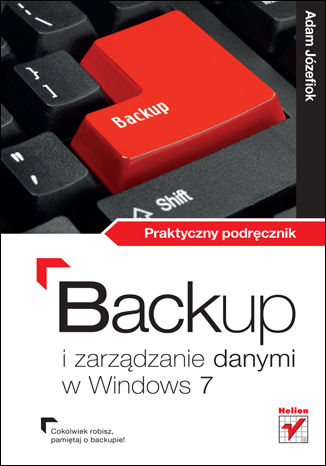
Backup i zarządzanie danymi w Windows 7. Praktyczny podręcznik
Adam Józefiok
Cokolwiek robisz, pamiętaj o backupie! Tworzenie kopii bezpieczeństwa na ogół uważane bywa za stratę czasu albo zło konieczne. Większość ludzi zdaje się wymazywać z pamięci przykre zdarzenia, kiedy awaria komputera pozbawiła ich cennych danych, owoców ciężkiej pracy albo rodzinnych zdjęć. Najwyższa pora uświadomić sobie, że w dzisiejszym świecie utrata danych może kosztować nas wyjątkowo drogo, i stworzyć przejrzyste, eleganckie archiwum, z którego będzie można skorzystać w razie konieczności. Z tą książką przyjdzie Ci to bez trudu. Nauczysz się nie tylko tworzyć proste kopie, ale także właściwie zarządzać danymi, rekonstruować skasowane pliki i szyfrować te, których nie chcesz upubliczniać. Z drugiej strony poznasz sposoby trwałego usuwania plików z dysku, metody ich kompresowania oraz odpowiedniego przechowywania w archiwum. Dowiesz się, co to jest serwer pamięci i jak go używać, a także do czego mogą się przydać partycje na dysku. I natychmiast wykorzystasz tę wiedzę! Podstawowe informacje o plikach Zarządzanie plikami w systemie operacyjnym Tworzenie kopii bezpieczeństwa plików i innych ustawień Odzyskiwanie utraconych plików Szyfrowanie plików Bezpieczne usuwanie plików z dysku Kompresowanie plików oraz zabezpieczanie i naprawa archiwów Podstawy instalacji i konfiguracji serwera pamięci (NAS) Partycjonowanie dysku Nie ryzykuj — już dziś zabezpiecz dane!
Steve Campbell, David Kennedy
Bash shell scripting is essential for penetration testing because it’s versatile and efficient and integrates thoroughly with the Unix-based systems commonly used in cybersecurity assessments. In this book, the author leverages his decades of experience in IT and pentesting to help you automate repetitive tasks, rapidly analyze data, and craft sophisticated exploits, boosting your effectiveness and productivity.You’ll get to grips with Bash basics, set up a hacking environment, and create basic scripts, before exploring file management, text processing, and manipulation. The chapters will guide you through advanced topics such as networking, parallel processing, and regular expressions. From there, the book will move on to practical applications, walking you through reconnaissance, web application and infrastructure pentesting, privilege escalation, persistence, and pivoting, all using Bash scripting. You’ll also get a solid understanding of advanced topics, including evasion and obfuscation tactics, integrating AI into penetration testing workflows, and implementing DevSecOps practices.By the end of this book, you’ll be well-versed with Bash shell scripting techniques tailored to penetration testing scenarios.
Becoming the Hacker. The Playbook for Getting Inside the Mind of the Attacker
Adrian Pruteanu
Becoming the Hacker will teach you how to approach web penetration testing with an attacker's mindset. While testing web applications for performance is common, the ever-changing threat landscape makes security testing much more difficult for the defender.There are many web application tools that claim to provide a complete survey and defense against potential threats, but they must be analyzed in line with the security needs of each web application or service. We must understand how an attacker approaches a web application and the implications of breaching its defenses.Through the first part of the book, Adrian Pruteanu walks you through commonly encountered vulnerabilities and how to take advantage of them to achieve your goal. The latter part of the book shifts gears and puts the newly learned techniques into practice, going over scenarios where the target may be a popular content management system or a containerized application and its network.Becoming the Hacker is a clear guide to web application security from an attacker's point of view, from which both sides can benefit.
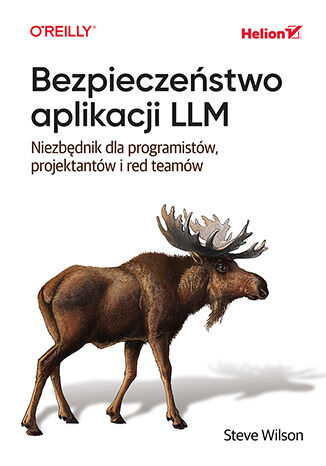
Bezpieczeństwo aplikacji LLM. Niezbędnik dla programistów, projektantów i red teamów
Steve Wilson
Czy nie masz wrażenia, że niemal każdy do swojego stosu oprogramowania pośpiesznie dołącza aplikacje oparte na dużych modelach językowych? Możliwości tej fascynującej technologii wydają się nieograniczone. Ale nie popadaj jeszcze w euforię. Jest haczyk. Bezpieczeństwo. Konsekwencje skutecznego ataku na aplikację LLM mogą się okazać katastrofalne. Ta książka sprawi, że łatwiej sprostasz wyzwaniom i zdobędziesz specjalistyczną wiedzę, aby zabezpieczyć swoje aplikacje LLM! MArten Mickos, CEO, HackerOne Dzięki tej praktycznej książce dogłębnie poznasz zagrożenia specyficzne dla aplikacji opartych na dużych modelach językowych, przeanalizujesz ich charakterystyczne cechy i dowiesz się, jak wyglądają luki w zabezpieczeniach. W ten sposób zdobędziesz praktyczną wiedzę, która podczas tworzenia oprogramowania korzystającego z LLM okazuje się bezcenna. Zapoznasz się również z licznymi wskazówkami i strategiami, które pomogą w zabezpieczaniu aplikacji opartych na sztucznej inteligencji. Niezależnie od tego, czy tworzysz zupełnie nową aplikację, czy zajmujesz się dodawaniem funkcjonalności LLM, znajdziesz tu szeroką gamę przydatnych zagadnień, takich jak architektura dużych modeli językowych, granice zaufania, technika RAG, wstrzykiwanie promptów i wiele innych. Ciekawsze zagadnienia: specyfika zabezpieczania dużych modeli językowych eliminowanie zagrożeń związanych z technologią dużych modeli językowych krytyczne granice zaufania wdrażanie mechanizmów chroniących aplikację LLM usprawnianie budowy bezpiecznego oprogramowania opartego na sztucznej inteligencji Lektura obowiązkowa dla innowatorów! Sherri Douville, CEO, Medigram