
Bezpieczeństwo systemów
Donald A. Tevault
Dive into the world of Linux shell scripting with this hands-on guide. If you’re comfortable using the command line on Unix or Linux but haven’t fully explored Bash, this book is for you. It’s designed for programmers familiar with languages like Python, JavaScript, or PHP who want to make the most of shell scripting.This isn’t just another theory-heavy book—you’ll learn by doing. Each chapter builds on the last, taking you from shell basics to writing practical scripts that solve real-world problems. With nearly a hundred interactive labs, you’ll gain hands-on experience in automation, system administration, and troubleshooting.While Bash is the primary focus, you'll also get a look at Z Shell and PowerShell, expanding your skills and adaptability. From mastering command redirection and pipelines to writing scripts that work across different Unix-like systems, this book equips you for real-world Linux challenges.By the end, you'll be equipped to write efficient shell scripts that streamline your workflow and improve system automation.
Andrew Pease
Threat Hunting with Elastic Stack will show you how to make the best use of Elastic Security to provide optimal protection against cyber threats. With this book, security practitioners working with Kibana will be able to put their knowledge to work and detect malicious adversary activity within their contested network.You'll take a hands-on approach to learning the implementation and methodologies that will have you up and running in no time. Starting with the foundational parts of the Elastic Stack, you'll explore analytical models and how they support security response and finally leverage Elastic technology to perform defensive cyber operations.You’ll then cover threat intelligence analytical models, threat hunting concepts and methodologies, and how to leverage them in cyber operations. After you’ve mastered the basics, you’ll apply the knowledge you've gained to build and configure your own Elastic Stack, upload data, and explore that data directly as well as by using the built-in tools in the Kibana app to hunt for nefarious activities.By the end of this book, you'll be able to build an Elastic Stack for self-training or to monitor your own network and/or assets and use Kibana to monitor and hunt for adversaries within your network.
Threat Modeling Best Practices. Proven frameworks and practical techniques to secure modern systems
Derek Fisher
Threat modeling has become a cornerstone of modern cybersecurity, yet it is often overlooked, leaving security gaps that attackers can exploit. With the rise in system complexity, cloud adoption, AI-driven threats, and stricter compliance requirements, security teams need a structured approach to proactively spot and stop risks before attackers do. This book delivers exactly that, offering actionable insights for applying industry best practices and emerging technologies to secure systems. It breaks down the fundamentals of threat modeling and walks you through key frameworks and tools such as STRIDE, MITRE ATT&CK, PyTM, and Attack Paths, helping you choose the right model and create a roadmap tailored to your business. You'll learn how to use leading threat modeling tools, identify and prioritize potential threats, and integrate these practices into the software development life cycle to detect risks early. The book also examines how AI can enhance analysis and streamline security decision-making for faster, stronger defenses.By the end, you'll have everything you need to build systems that anticipate and withstand evolving threats, keeping your organization secure in an ever-changing digital landscape.*Email sign-up and proof of purchase required
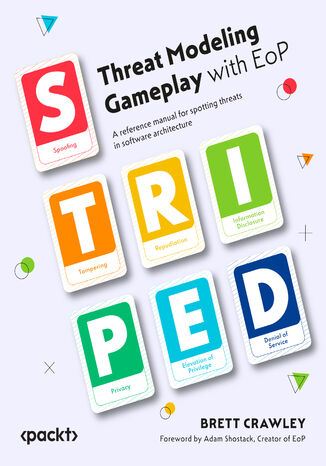
Threat Modeling Gameplay with EoP. A reference manual for spotting threats in software architecture
Brett Crawley, Adam Shostack
Are you looking to navigate security risks, but want to make your learning experience fun? Here's a comprehensive guide that introduces the concept of play to protect, helping you discover the threats that could affect your software design via gameplay.Each chapter in this book covers a suit in the Elevation of Privilege (EoP) card deck (a threat category), providing example threats, references, and suggested mitigations for each card. You’ll explore the methodology for threat modeling—Spoofing, Tampering, Repudiation, Information Disclosure, and Elevation of Privilege (S.T.R.I.D.E.) with Privacy deck and the T.R.I.M. extension pack. T.R.I.M. is a framework for privacy that stands for Transfer, Retention/Removal, Inference, and Minimization. Throughout the book, you’ll learn the meanings of these terms and how they should be applied. From spotting vulnerabilities to implementing practical solutions, the chapters provide actionable strategies for fortifying the security of software systems.By the end of this book, you will be able to recognize threats, understand privacy regulations, access references for further exploration, and get familiarized with techniques to protect against these threats and minimize risks.
Dr. Paul Duplys, Dr. Roland Schmitz
TLS is the most widely used cryptographic protocol today, enabling e-commerce, online banking, and secure online communication. Written by Dr. Paul Duplys, Security, Privacy & Safety Research Lead at Bosch, and Dr. Roland Schmitz, Internet Security Professor at Stuttgart Media University, this book will help you gain a deep understanding of how and why TLS works, how past attacks on TLS were possible, and how vulnerabilities that enabled them were addressed in the latest TLS version 1.3. By exploring the inner workings of TLS, you’ll be able to configure it and use it more securely.Starting with the basic concepts, you’ll be led step by step through the world of modern cryptography, guided by the TLS protocol. As you advance, you’ll be learning about the necessary mathematical concepts from scratch. Topics such as public-key cryptography based on elliptic curves will be explained with a view on real-world applications in TLS. With easy-to-understand concepts, you’ll find out how secret keys are generated and exchanged in TLS, and how they are used to creating a secure channel between a client and a server.By the end of this book, you’ll have the knowledge to configure TLS servers securely. Moreover, you’ll have gained a deep knowledge of the cryptographic primitives that make up TLS.
Eric Richardson, Filipi Pires
Modern organizations rely on complex vendor ecosystems, but third-party risk management (TPRM) and cybersecurity often operate in silos. This book shows how to connect vendor risk management with supply chain cybersecurity using a practical, lifecycle-driven approach.You’ll design a program covering onboarding, vendor risk assessment, continuous monitoring, and offboarding. You’ll begin by examining why TPRM and cybersecurity often operate in separate lanes, and what that gap costs in downtime, breach impact, and compliance exposure. Next, you’ll develop a modern taxonomy of supply chain risk, including fourth-party dependencies and software supply chain concerns, so risk discussions use consistent categories and measurable assumptions.From there, you’ll adopt a lifecycle-based model to structure vendor onboarding, assessment, monitoring, and offboarding—supported by vendor tiering, segmentation, and control mapping. The final chapter focuses on the regulatory blueprint: how to interpret NIST C-SCRM, ISO/IEC 27036, DORA, GDPR, and Executive Order 14028, then convert them into evidence-driven controls and audit-ready documentation.
Zhassulan Zhussupov
Skuteczne wzmacnianie cyberbezpieczeństwa wymaga wiedzy o sposobach działania hakerów. Żaden analityk złośliwego oprogramowania, pentester czy łowca zagrożeń nie obejdzie się bez wiedzy o budowie malware ani bez umiejętności programowania ofensywnego. Innymi słowy, jeśli chcesz poprawić bezpieczeństwo IT w swojej organizacji, musisz dobrze znać narzędzia, taktyki i techniki używane przez cyberprzestępców. Ta książka jest kompleksowym przewodnikiem po ciemnej stronie cyberbezpieczeństwa ― zapewni Ci wiedzę i umiejętności niezbędne do skutecznego zwalczania złośliwego oprogramowania. Nauczysz się poruszać wśród zawiłości związanych z tworzeniem złośliwego oprogramowania, a także dobrze poznasz techniki i strategie stosowane przez cyberprzestępców. Zdobędziesz też praktyczne doświadczenie w projektowaniu i implementowaniu popularnych rozwiązań stosowanych w prawdziwych złośliwych aplikacjach, na przykład Carbanak, Carberp, Stuxnet, Conti, Babuk i BlackCat. Nie zabrakło tu zasad etycznego hakingu i tajników budowy złośliwego oprogramowania, jak techniki unikania wykrycia, mechanizmy persystencji i wiele innych, które poznasz dzięki lekturze. W książce: sposób myślenia twórców złośliwego oprogramowania techniki stosowane w różnych rodzajach malware rekonstrukcja ataków APT metody obchodzenia mechanizmów bezpieczeństwa ponad 80 działających przykładów malware matematyczne podstawy współczesnego złośliwego oprogramowania O książce w mediach: Eksperyment myślowy ― recenzja książki
Parth Ghiya
In the last few years or so, microservices have achieved the rock star status and right now are one of the most tangible solutions in enterprises to make quick, effective, and scalable applications. The apparent rise of Typescript and long evolution from ES5 to ES6 has seen lots of big companies move to ES6 stack. If you want to learn how to leverage the power of microservices to build robust architecture using reactive programming and Typescript in Node.js, then this book is for you.Typescript Microservices is an end-to-end guide that shows you the implementation of microservices from scratch; right from starting the project to hardening and securing your services. We will begin with a brief introduction to microservices before learning to break your monolith applications into microservices. From here, you will learn reactive programming patterns and how to build APIs for microservices. The next set of topics will take you through the microservice architecture with TypeScript and communication between services. Further, you will learn to test and deploy your TypeScript microservices using the latest tools and implement continuous integration. Finally, you will learn to secure and harden your microservice.By the end of the book, you will be able to build production-ready, scalable, and maintainable microservices using Node.js and Typescript.