
Windows 10
Enterprise PowerShell Scripting Bootcamp. The fastest way to learn PowerShell scripting
Brenton J.W. Blawat
Enterprise PowerShell Scripting Bootcamp explains how to create your own repeatable PowerShell scripting framework. This framework contains script logging methodologies, answer file interactions, and string encryption and decryption strategies.This book focuses on evaluating individual components to identify the system’s function, role, and unique characteristics. To do this, you will leverage built-in CMDlets and Windows Management Instrumentation (WMI) to explore Windows services, Windows processes, Windows features, scheduled tasks, and disk statistics. You will also create custom functions to perform a deep search for specific strings in files and evaluate installed software through executable properties.We will then discuss different scripting techniques to improve the efficiency of scripts. By leveraging several small changes to your code, you can increase the execution performance by over 130%.By the end of this book, you will be able to tie all of the concepts together in a PowerShell-based Windows server scanning script. This discovery script will be able to scan a Windows server to identify a multitude of components.
Saurabh Shrivastava, Kamal Arora, Ashutosh Dubey, Sanjeet...
Generative AI for Software Developers is your practical guide to mastering AI-powered development and staying ahead in a fast-changing industry. Through a structured, hands-on approach, this book helps you understand, implement, and optimize Generative AI in modern software engineering. From AI-assisted coding, debugging, and documentation to testing, deployment, and system design, it equips you with the skills to integrate AI seamlessly into your workflows.You’ll work with tools such as GitHub Copilot, Amazon Q Developer, and OpenAI APIs while learning strategies for prompt engineering, fine-tuning, and building scalable AI-powered applications. Featuring real-world use cases, best practices, and expert insights, this book bridges the gap between experimenting with AI and production deployment.Whether you’re an aspiring AI developer, experienced engineer, or solutions architect, this guide gives you the clarity, confidence, and tactical knowledge to thrive in the GenAI-driven future of software development. Armed with these insights, you’ll be ready to build, integrate, and scale intelligent solutions that enhance every stage of the software development lifecycle.
Getting Started with Microsoft System Center Operations Manager. Using SCOM 2016 TP 5
Kevin Greene
Most modern IT environments comprise a heterogeneous mixture of servers, network devices, virtual hypervisors, storage solutions, cross-platform operating systems and applications. All this complexity brings a requirement to deliver a centralized monitoring and reporting solution that can help IT administrators quickly identify where the problems are and how best to resolve them. Using System Center Operations Manager (OpsMgr), administrators get a full monitoring overview of the IT services they have responsibility for across the organization - along with some useful management capabilities to help them remediate any issues they've been alerted to.This book begins with an introduction to OpsMgr and its core concepts and then walks you through designing and deploying the various roles. After a chapter on exploring the consoles, you will learn how to deploy agents, work with management packs, configure network monitoring and model your IT services using distributed applications. There’s a chapter dedicated to alert tuning and another that demonstrates how to visualize your IT using dashboards. The final chapters in the book discuss how to create alert subscriptions, manage reports, backup and recover OpsMgr, perform maintenance and troubleshoot common problems.
Getting Started with Nano Server. Automate multiple VMs and transform your datacenter
Charbel Nemnom
Nano Server allows developers and operations teams to work closely together and use containers that package applications so that the entire platform works as one. The aim of Nano Server is to help applications run the way they are intended to. It can be used to run and deploy infrastructures (acting as a compute host, storage host, container, or VM guest operating system) without consuming significant resources. Although Nano Server isn't intended to replace Server 2016 or 2012 R2, it will be an attractive choice for developers and IT teams.Want to improve your ability to deploy a new VM and install and deploy container apps within minutes? You have come to the right place! The objective of this book is to get you started with Nano Server successfully. The journey is quite exciting, since we are introducing you to a cutting-edge technology that will revolutionize today's datacenters. We'll cover everything from the basic to advanced topics. You'll discover a lot of added value from using Nano Server, such as hundreds of VM types on a single host through a small footprint, which could be a big plus for you and your company. After reading this book, you will have the necessary skills to start your journey effectively using Nano Server.
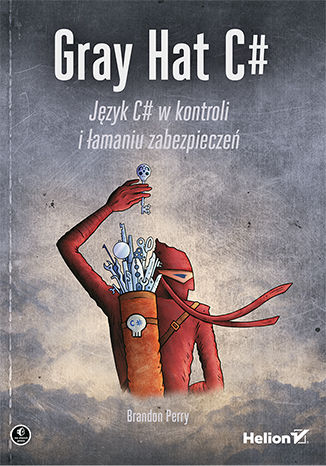
Gray Hat C#. Język C# w kontroli i łamaniu zabezpieczeń
Brandon Perry
C# to nowoczesny język programowania, który został od podstaw zaprojektowany jako obiektowy. Ta dojrzała technologia jest często wybierana przez twórców oprogramowania, również tego służącego do pokonywania zabezpieczeń systemów. Dzięki temu, że platforma .NET jest oprogramowaniem open source, w C# można pisać kod, który bez problemu będzie działał w każdym systemie operacyjnym. Co prawda język ten jest prosty i łatwy do nauczenia się, jednak dopiero gruntowna znajomość C# umożliwia efektywne tworzenie narzędzi związanych z bezpieczeństwem, służących choćby do wyszukiwania luk w infrastrukturze czy prowadzenia testów penetracyjnych. Ta książka jest przeznaczona dla specjalistów ds. bezpieczeństwa, którzy chcą korzystać z języka C# do takich zadań jak fuzzowanie, skanowanie w poszukiwaniu luk zabezpieczeń i analiza złośliwego oprogramowania. Opisano tu zarówno podstawy języka C#, jak i jego dość zaawansowane funkcje. Przedstawiono szereg bibliotek dostępnych dla tego języka. Pokazano, jak pisać kod wyszukujący luki w zabezpieczeniach i jak tworzyć eksploity. Przedstawiono sposoby korzystania z takich narzędzi jak Nessus, sqlmap i Cuckoo Sandbox. Dzięki technikom zaprezentowanym w książce administrator bezpieczeństwa bez problemu zautomatyzuje nawet najbardziej żmudne codzienne zadania! W tej książce między innymi: Podstawowe i zaawansowane funkcjonalności języka C# Generowanie kodu ładunków, również wieloplatformowych Skanery, w tym OpenVAS, Nessus i Nexpose Automatyczna identyfikacja luk umożliwiających wstrzyknięcie kodu SQL Tworzenie w C# narzędzi do inżynierii wstecznej C#. Sprawdź swój system zabezpieczeń! Brandon Perry jest programistą i gorącym zwolennikiem idei open source. Odkąd pojawiło się środowisko Mono, pisze aplikacje w języku C#. Tworzy też moduły dla frameworka Metasploit, analizuje pliki binarne i zarządza ciekawymi projektami (https://volatileminds.net/). Fascynuje się badaniami nad bezpieczeństwem systemów informatycznych. Chętnie dzieli się swoją wiedzą, pisze książki i pomaga innym w tworzeniu solidniejszego oprogramowania.
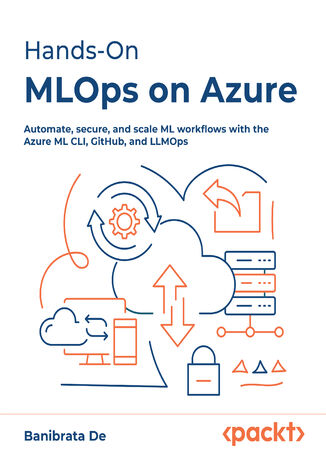
Banibrata De
Effective machine learning (ML) now demands not just building models but deploying and managing them at scale. Written by a seasoned senior software engineer with high-level expertise in both MLOps and LLMOps, Hands-On MLOps on Azure equips ML practitioners, DevOps engineers, and cloud professionals with the skills to automate, monitor, and scale ML systems across environments.The book begins with MLOps fundamentals and their roots in DevOps, exploring training workflows, model versioning, and reproducibility using pipelines. You'll implement CI/CD with GitHub Actions and the Azure ML CLI, automate deployments, and manage governance and alerting for enterprise use. The author draws on their production ML experience to provide you with actionable guidance and real-world examples. A dedicated section on LLMOps covers operationalizing large language models (LLMs) such as GPT-4 using RAG patterns, evaluation techniques, and responsible AI practices. You'll also work with case studies across Azure, AWS, and GCP that offer practical context for multi-cloud operations.Whether you're building pipelines, packaging models, or deploying LLMs, this guide delivers end-to-end strategy to build robust, scalable systems. By the end of this book, you'll be ready to design, deploy, and maintain enterprise-grade ML solutions with confidence.
Phil Bramwell
Windows has always been the go-to platform for users around the globe to perform administration and ad hoc tasks, in settings that range from small offices to global enterprises, and this massive footprint makes securing Windows a unique challenge. This book will enable you to distinguish yourself to your clients.In this book, you'll learn advanced techniques to attack Windows environments from the indispensable toolkit that is Kali Linux. We'll work through core network hacking concepts and advanced Windows exploitation techniques, such as stack and heap overflows, precision heap spraying, and kernel exploitation, using coding principles that allow you to leverage powerful Python scripts and shellcode.We'll wrap up with post-exploitation strategies that enable you to go deeper and keep your access. Finally, we'll introduce kernel hacking fundamentals and fuzzing testing, so you can discover vulnerabilities and write custom exploits. By the end of this book, you'll be well-versed in identifying vulnerabilities within the Windows OS and developing the desired solutions for them.
Anatoly Tykushin, Svetlana Ostrovskaya, Dmitry Volkov
Cybersecurity threats are constantly evolving, posing serious risks to organizations. Incident Response for Windows, by cybersecurity experts Anatoly Tykushin and Svetlana Ostrovskaya, provides a practical hands-on guide to mitigating threats in Windows environments, drawing from their real-world experience in incident response and digital forensics.Designed for cybersecurity professionals, IT administrators, and digital forensics practitioners, the book covers the stages of modern cyberattacks, including reconnaissance, infiltration, network propagation, and data exfiltration. It takes a step-by-step approach to incident response, from preparation and detection to containment, eradication, and recovery. You will also explore Windows endpoint forensic evidence and essential tools for gaining visibility into Windows infrastructure. The final chapters focus on threat hunting and proactive strategies to identify cyber incidents before they escalate.By the end of this book, you will gain expertise in forensic evidence collection, threat hunting, containment, eradication, and recovery, equipping them to detect, analyze, and respond to cyber threats while strengthening your organization's security posture
Bekim Dauti
The Installing and Configuring Windows 10: 70-698 Exam Guide is designed to confirm what you already know, while also updating your knowledge of Windows 10. With its easy-to-follow guidance, you will quickly learn the user interface and discover steps to work efficiently in Windows 10 to rule out delays and obstacles.This book begins by covering various ways of installing Windows 10, followed by instructions on post-installation tasks. You will learn about the deployment of Windows 10 in Enterprise and also see how to configure networking in Windows 10. You’ll understand how to leverage Disk Management and Windows PowerShell to configure disks, volumes, and file system options. As you progress through the chapters, you will be able to set up remote management in Windows 10 and learn more about Windows update usage, behavior, and settings. You will also gain insights that will help you monitor and manage data recovery and explore how to configure authentication, authorization, and advanced management tools in Windows 10.By the end of this book, you will be equipped with enough knowledge to take the 70-698 exam and explore different study methods to improve your chances of passing the exam with ease.
Learn PowerShell Core 6.0. Automate and control administrative tasks using DevOps principles
David das Neves, Jan-Hendrik Peters
Beginning with an overview of the different versions of PowerShell, Learn PowerShell Core 6.0 introduces you to VSCode and then dives into helping you understand the basic techniques in PowerShell scripting. You will cover advanced coding techniques, learn how to write reusable code as well as store and load data with PowerShell.This book will help you understand PowerShell security and Just Enough Administration, enabling you to create your own PowerShell repository. The last set of chapters will guide you in setting up, configuring, and working with Release Pipelines in VSCode and VSTS, and help you understand PowerShell DSC. In addition to this, you will learn how to use PowerShell with Windows, Azure, Microsoft Online Services, SCCM, and SQL Server. The final chapter will provide you with some use cases and pro tips.By the end of this book, you will be able to create professional reusable code using security insight and knowledge of working with PowerShell Core 6.0 and its most important capabilities.
Learning PowerShell DSC. Automate deployment and configuration of your servers - Second Edition
James Pogran
The main goal of this book is to teach you to configure, deploy, and manage your system using the new features of PowerShell v5/v6 DSC.This book begins with the basics of PowerShell Desired State Configuration, covering its architecture and components. It familiarizes you with the set of Windows PowerShell language extensions and new Windows PowerShell commands that make up DSC. Then it helps you create DSC custom resources and work with DSC configurations with the help of practical examples. Finally, it describes how to deploy configuration data using PowerShell DSC. Throughout this book, we will be focusing on concepts such as building configurations with parameters, the local configuration manager, and testing and restoring configurations using PowerShell DSC.By the end of the book, you will be able to deploy a real-world application end-to-end and will be familiar enough with the powerful Desired State Configuration platform to achieve continuous delivery and efficiently and easily manage and deploy data for systems.
Learning Windows Server Containers. Build and deploy high-quality portable apps faster
Srikanth Machiraju
Windows Server Containers are independent, isolated, manageable and portable application environments which are light weight and shippable. Decomposing your application into smaller manageable components or MicroServices helps in building scalable and distributed application environments. Windows Server Containers have a significant impact on application developers, development operations (DevOps) and infrastructure management teams. Applications can be built, shipped and deployed in a fast-paced manner on an easily manageable and updatable environment.Learning Windows Server Containers teaches you to build simple to advanced production grade container based application using Asp.Net Core, Visual Studio, Azure, Docker and PowerShell technologies. The book teaches you to build and deploy simple web applications as Windows and Hyper-V containers on Windows 10 and Windows Server 2016 on Azure. You will learn to build on top of Windows Container Base OS Images, integrate with existing images from Docker Hub, create custom images and publish to Hub. You will also learn to work with storage containers built using Volumes and SQL Server as container, create and configure custom networks, integrate with Redis Cache containers, configure continuous integration and deployment pipelines using VSTS and Git Repository. Further you can also learn to manage resources for a container, setting up monitoring and diagnostics, deploy composite container environments using Docker Compose on Windows and manage container clusters using Docker Swarm. The last chapter of the book focuses on building applications using Microsoft’s new and thinnest server platform – Nano Servers.

Michael D. Smith
Mastering Docker on Windows is your comprehensive guide to deploying, securing, and scaling containers in enterprise-grade Windows environments. Tailored for developers, DevOps engineers, and IT professionals, this book dives deep into Docker’s advanced features, focusing on Windows 11.Starting with installation and setup, you’ll learn how to manage images, networks, and volumes on Windows. The book explores multi-container orchestration with Docker Compose, container security best practices, and performance optimization techniques to ensure your applications run efficiently and securely in production.You’ll also explore advanced topics such as running Docker in hybrid cloud environments and deploying AI/ML models using the Docker GenAI stack. Through practical examples and step-by-step tutorials, you’ll gain the skills to troubleshoot, monitor, and fine-tune Docker environments at scale. Throughout the book, you’ll build and evolve a small but realistic application stack that carries across chapters.Whether you're modernizing enterprise Windows workloads or building scalable, cloud-native applications, this book provides hands-on strategies and expert insights to help you master Docker on Windows. It’s ideal for readers with basic Docker experience who want to elevate their skills for real-world, enterprise success.
Christiaan Brinkhoff, Sandeep Patnaik, Morten Pedholt, Scott...
Windows 365 Cloud PC continues to evolve, integrating AI-driven management, enhanced security, and expanded capabilities to provide a seamless cloud-based Windows experience. This second edition builds on the foundation of the first, incorporating new content on Intune Suite, Copilot+ AI PCs, Windows App, and advanced security with Security Copilot to help IT professionals deploy, manage, and optimize Windows 365 Cloud PCs effectively.This edition expands beyond the basics, covering Intune Suite’s role in optimizing and securing deployments, new methods for application management and delivery, and insights into Windows 365 Link for hybrid cloud environments. You’ll also explore AI-powered administration with Security Copilot, providing intelligent security management and automation.Written by experts from the Windows 365 product team and a Microsoft MVP, this book provides practical guidance, best practices, and real-world insights to help you master modern Windows cloud management. Whether you’re working with Windows 365, Intune Suite, or AI-powered administration, this guide equips you with the latest tools and strategies to stay ahead in cloud computing.
Christiaan Brinkhoff, Sandeep Patnaik, Morten Pedholt
Written by experts from the Windows 365 product group and a seasoned Microsoft MVP, this book offers a unique perspective on the features, functionality, and best practices of Windows 365. Drawing from their extensive professional experience and insight, the authors provide invaluable knowledge for those eager to learn about the next generation of cloud computing. Get ready to gain deep insights into this cutting-edge technology from industry insiders.Mastering Windows 365 starts by covering the fundamentals of Windows 365, helping you gain a deep understanding of deployment, management, access, security, analysis, and extensions with partner solutions. As you progress, you’ll explore the different connectivity layers and options to optimize your network connectivity from the endpoint to your Cloud PC. You’ll also learn how to manage a Cloud PC via the Microsoft Intune admin center successfully and experience how Windows and Windows 365 come together to provide new integrated experiences with Windows 11. In addition, this book will help you prepare for the new MD-102 Endpoint Administrator Exam, enhancing your career prospects.By the end of this book, you will be able to successfully plan, set up, and deploy Windows 365 Cloud PCs.
Jordan Krause
This book begins with a discussion of the core material any administrator needs to know in order to start working with Group Policy. Moving on, we will also walk through the process of building a lab environment to start testing Group Policy today. Next we will explore the Group Policy Management Console (GPMC) and start using the powerful features available for us within that interface. Once you are well versed with using GPMC, you will learn to perform and manage the traditional core tasks inside Group Policy. Included in the book are many examples and walk-throughs of the different filtering options available for the application of Group Policy settings, as this is the real power that Group Policy holds within your network. You will also learn how you can use Group Policy to secure your Active Directory environment, and also understand how Group Policy preferences are different than policies, with the help of real-world examples. Finally we will spend some time on maintenance and troubleshooting common Group Policy-related issues so that you, as a directory administrator, will understand the diagnosing process for policy settings.By the end of the book, you will be able to jump right in and use Group Policy to its full potential.