
Inne - Programowanie
Frank Bruno
Field Programmable Gate Arrays (FPGAs) have now become a core part of most modern electronic and computer systems. However, to implement your ideas in the real world, you need to get your head around the FPGA architecture, its toolset, and critical design considerations. FPGA Programming for Beginners will help you bring your ideas to life by guiding you through the entire process of programming FPGAs and designing hardware circuits using SystemVerilog.The book will introduce you to the FPGA and Xilinx architectures and show you how to work on your first project, which includes toggling an LED. You’ll then cover SystemVerilog RTL designs and their implementations. Next, you’ll get to grips with using the combinational Boolean logic design and work on several projects, such as creating a calculator and updating it using FPGA resources. Later, the book will take you through the advanced concepts of AXI and show you how to create a keyboard using PS/2. Finally, you’ll be able to consolidate all the projects in the book to create a unified output using a Video Graphics Array (VGA) controller that you’ll design.By the end of this SystemVerilog FPGA book, you’ll have learned how to work with FPGA systems and be able to design hardware circuits and boards using SystemVerilog programming.
Functional Kotlin. Extend your OOP skills and implement Functional techniques in Kotlin and Arrow
Mario Arias, Rivu Chakraborty
Functional programming makes your application faster, improves performance, and increases your productivity. Kotlin supports many of the popular and advanced functional features of functional languages. This book will cover the A-Z of functional programming in Kotlin. This book bridges the language gap for Kotlin developers by showing you how to create and consume functional constructs in Kotlin. We also bridge the domain gap by showing how functional constructs can be applied in business scenarios. We’ll take you through lambdas, pattern matching, immutability, and help you develop a deep understanding of the concepts and practices of functional programming. If you want learn to address problems using Recursion, Koltin has support for it as well. You’ll also learn how to use the funKtionale library to perform currying and lazy programming and more. Finally, you’ll learn functional design patterns and techniques that will make you a better programmer.By the end of the book, you will be more confident in your functional programming skills and will be able to apply them while programming in Kotlin.
Game Development Patterns and Best Practices. Better games, less hassle
John P. Doran, Matt Casanova
You’ve learned how to program, and you’ve probably created some simple games at some point, but now you want to build larger projects and find out how to resolve your problems. So instead of a coder, you might now want to think like a game developer or software engineer. To organize your code well, you need certain tools to do so, and that’s what this book is all about.You will learn techniques to code quickly and correctly, while ensuring your code is modular and easily understandable.To begin, we will start with the core game programming patterns, but not the usual way. We will take the use case strategy with this book. We will take an AAA standard game and show you the hurdles at multiple stages of development. Similarly, various use cases are used to showcase other patterns such as the adapter pattern, prototype pattern, flyweight pattern, and observer pattern. Lastly, we’ll go over some tips and tricks on how to refactor your code to remove common code smells and make it easier for others to work with you. By the end of the book you will be proficient in using the most popular and frequently used patterns with the best practices.
Stefano Iacovella
This book is ideal for GIS experts, developers, and system administrators who have had a first glance at GeoServer and who are eager to explore all its features in order to configure professional map servers. Basic knowledge of GIS and GeoServer is required.
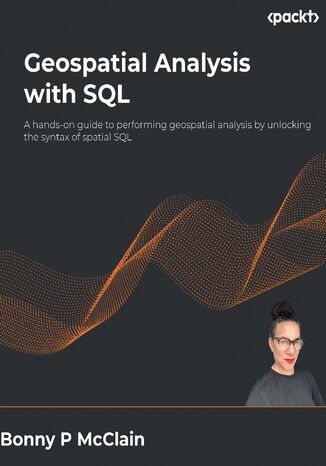
Bonny P McClain
Geospatial analysis is industry agnostic and a powerful tool for answering location questions. Combined with the power of SQL, developers and analysts worldwide rely on database integration to solve real-world spatial problems. This book introduces skills to help you detect and quantify patterns in datasets through data exploration, visualization, data engineering, and the application of analysis and spatial techniques.You will begin by exploring the fundamentals of geospatial analysis where you’ll learn about the importance of geospatial analysis and how location information enhances data exploration. Walter Tobler’s second law of geography states, “the phenomenon external to a geographic area of interest affects what goes on inside.” This quote will be the framework of the geospatial questions we will explore. You’ll then observe the framework of geospatial analysis using SQL while learning to create spatial databases and SQL queries and functions.By the end of this book, you will have an expanded toolbox of analytic skills such as PostGIS and QGIS to explore data questions and analysis of spatial information.
Sudharsan Ravichandiran
BERT (bidirectional encoder representations from transformer) has revolutionized the world of natural language processing (NLP) with promising results. This book is an introductory guide that will help you get to grips with Google's BERT architecture. With a detailed explanation of the transformer architecture, this book will help you understand how the transformer’s encoder and decoder work.You’ll explore the BERT architecture by learning how the BERT model is pre-trained and how to use pre-trained BERT for downstream tasks by fine-tuning it for NLP tasks such as sentiment analysis and text summarization with the Hugging Face transformers library. As you advance, you’ll learn about different variants of BERT such as ALBERT, RoBERTa, and ELECTRA, and look at SpanBERT, which is used for NLP tasks like question answering. You'll also cover simpler and faster BERT variants based on knowledge distillation such as DistilBERT and TinyBERT. The book takes you through MBERT, XLM, and XLM-R in detail and then introduces you to sentence-BERT, which is used for obtaining sentence representation. Finally, you'll discover domain-specific BERT models such as BioBERT and ClinicalBERT, and discover an interesting variant called VideoBERT.By the end of this BERT book, you’ll be well-versed with using BERT and its variants for performing practical NLP tasks.
Fabrizio Romano, Benjamin Baka, Dusty Phillips
This Learning Path helps you get comfortable with the world of Python. It starts with a thorough and practical introduction to Python. You’ll quickly start writing programs, building websites, and working with data by harnessing Python's renowned data science libraries. With the power of linked lists, binary searches, and sorting algorithms, you'll easily create complex data structures, such as graphs, stacks, and queues. After understanding cooperative inheritance, you'll expertly raise, handle, and manipulate exceptions. You will effortlessly integrate the object-oriented and not-so-object-oriented aspects of Python, and create maintainable applications using higher level design patterns. Once you’ve covered core topics, you’ll understand the joy of unit testing and just how easy it is to create unit tests.By the end of this Learning Path, you will have built components that are easy to understand, debug, and can be used across different applications.This Learning Path includes content from the following Packt products:• Learn Python Programming - Second Edition by Fabrizio Romano• Python Data Structures and Algorithms by Benjamin Baka• Python 3 Object-Oriented Programming by Dusty Phillips
Navule Pavan Kumar Rao
A new language on the block, V comes with a promising set of features such as fast compilation and interoperability with other programming languages. This is the first book on the V programming language, packed with concise information and a walkthrough of all the features you need to know to get started with the language.The book begins by covering the fundamentals to help you learn about the basic features of V and the suite of built-in libraries available within the V ecosystem. You'll become familiar with primitive data types, declaring variables, arrays, and maps. In addition to basic programming, you'll develop a solid understanding of the building blocks of programming, including functions, structs, and modules in the V programming language.As you advance through the chapters, you'll learn how to implement concurrency in V Programming, and finally learn how to write test cases for functions. This book takes you through an end-to-end project that will guide you to build fast and maintainable RESTful microservices by leveraging the power of V and its built-in libraries.By the end of this V programming book, you'll be well-versed with the V programming language and be able to start writing your own programs and applications.