
.NET - Programowanie
Can Bilgin
Are you a .NET developer who wishes to develop mobile solutions without delving into the complexities of a mobile development platform? If so, this book is a perfect solution to help you build professional mobile apps without leaving the .NET ecosystem.Mobile Development with .NET will show you how to design, architect, and develop robust mobile applications for multiple platforms, including iOS, Android, and UWP using Xamarin, .NET Core, and Azure.With the help of real-world scenarios, you'll explore different phases of application development using Xamarin, from environment setup, design, and architecture to publishing. Throughout the book, you'll learn how to develop mobile apps using Xamarin and .NET Standard. You'll even be able to implement a web-based backend composed of microservices with .NET Core using various Azure services including, but not limited to, Azure Active Directory, Azure Functions. As you advance, you'll create data stores using popular database technologies such as Cosmos DB and data models such as the relational model and NoSQL.By the end of this mobile application development book, you'll be able to create cross-platform mobile applications that can be deployed as cloud-based PaaS and SaaS.
MrExcel 2025. Navigating Excel
MrExcel's Holy Macro! Books, Bill Jelen
This book serves as the definitive 2025 guide to mastering Excel’s evolving ecosystem. It introduces groundbreaking features like Copilot integration, Python scripting, and AI-driven data analysis while reinforcing timeless tools such as PivotTables, Power Query, and macros. Readers progress through a curated sequence of practical examples and expert insights that show how to blend automation, analytics, and collaboration in real business contexts.With a focus on modern efficiency, the book bridges the gap between foundational Excel operations and cutting-edge tools that redefine productivity in the Microsoft 365 landscape. Readers learn not just how to execute features, but how to use them strategically for intelligent reporting, forecasting, and decision-making.By the end, readers will have an up-to-date command of Excel’s most innovative tools, capable of optimizing performance and extracting deeper insights from data across the Microsoft 365 environment.

Neha Shrivastava, Rishabh Verma
With the rise in the number of tools and technologies available today, developers and architects are always exploring ways to create better and smarter solutions. Before, the differences between target platforms was a major roadblock, but that's not the case now. .NET Core 2.0 By Example will take you on an exciting journey to building better software.This book provides fresh and relevant content to .NET Core 2.0 in a succinct format that’s enjoyable to read. It also delivers concepts, along with the implications, design decisions, and potential pitfalls you might face when targeting Linux and Windows systems, in a logical and simple way.With the .NET framework at its center, the book comprises of five varied projects: a multiplayer Tic-tac-toe game; a real-time chat application, Let'sChat; a chatbot; a microservice-based buying-selling application; and a movie booking application. You will start each chapter with a high-level overview of the content, followed by the above example applications described in detail. By the end of each chapter, you will not only be proficient with the concepts, but you’ll also have created a tangible component in the application.By the end of the book, you will have built five solid projects using all the tools and support provided by the .NET Core 2.0 framework.
Praseed Pai, Shine Xavier
Knowing about design patterns enables developers to improve their code base, promoting code reuse and making their design more robust.This book focuses on the practical aspects of programming in .NET. You will learn about some of the relevant design patterns (and their application) that are most widely used. We start with classic object-oriented programming (OOP) techniques, evaluate parallel programming and concurrency models, enhance implementations by mixing OOP and functional programming, and finally to the reactive programming model where functional programming and OOP are used in synergy to write better code. Throughout this book, we’ll show you how to deal with architecture/design techniques, GoF patterns, relevant patterns from other catalogs, functional programming, and reactive programming techniques. After reading this book, you will be able to convincingly leverage these design patterns (factory pattern, builder pattern, prototype pattern, adapter pattern, facade pattern, decorator pattern, observer pattern and so on) for your programs. You will also be able to write fluid functional code in .NET that would leverage concurrency and parallelism!
Roger Ye
An evolution of Xamarin.Forms, .NET Multi-platform App UI (.NET MAUI) is a cross-platform framework for creating native mobile and desktop apps with C# and XAML. Using .NET MAUI, you can develop apps that’ll run on Android, iOS, macOS, and Windows from a single shared code-base. This step-by-step guide provides a comprehensive introduction to those who are new to .NET MAUI that will have you up to speed with app development using .NET MAUI in no time.The book begins by showing you how to develop a cross-platform application using .NET MAUI and then helps you build an app throughout the chapters. You’ll gain all the knowledge needed to create a cross-platform application for Android, iOS, the mac OS, and Windows from a single shared code-base using .NET MAUI. As you advance, you’ll get to grips with the entire application development lifecycle, from design and implementation through to deployment to the app store through the development of a password manager app using KeePassLib. The concluding chapters will teach you how to integrate the latest frontend technology into your app through .NET MAUI Blazor.By the end of this book, you’ll have learned how to develop your own cross-platform applications using .NET MAUI.
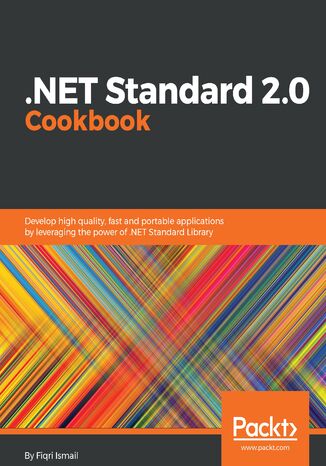
Fiqri Ismail
The .NET Standard is a standard that represents a set of APIs that all .NET platforms have to implement, making it easy for developers to access and use one common library for their development needs. This book begins with a quick refresher, helping you understand the mechanics of the new standard and offering insight into how it works. You’ll explore the core library concepts, such as working with collections, configurations, I/O, security, and multithreading. You’ll explore the iOS and Android libraries of Xamarin and we’ll guide you through creating a .NET Standard 2.0 library, which you’ll use with both Android and iOS applications. In the final chapters, you’ll learn the various debugging and diagnostics tools to deliver quality libraries and create a NuGet package of the .NET Standard 2.0 library. By the end of this book, you’ll be able to expand your current workflow to various .NET flavors and have the essential skills to create a .NET Standard 2.0 library from scratch to package and deliver it to the world.

Jimmy Engström
Do niedawna tworzenie interaktywnych stron internetowych wymagało programowania w JavaScripcie. Obecnie można się posłużyć platformą Blazor, która umożliwia efektywne tworzenie dynamicznych aplikacji internetowych opartych na technologii .NET i kodzie C#. Jeśli chcesz za pomocą Blazora tworzyć złożone aplikacje i wdrażać je w środowisku produkcyjnym, musisz dobrze poznać zasady pracy z tą platformą. Oto praktyczny, przystępnie napisany przewodnik, który stanowi wprowadzenie do pracy z technologią Blazor. Opisuje możliwości modeli Server i WebAssembly, przedstawia także krok po kroku proces powstawania aplikacji internetowej. Dzięki temu płynnie przejdziesz do tworzenia projektów Blazor, nauczysz się składni języka Razor, będziesz też weryfikować zawartość formularzy i budować własne komponenty. W tym wydaniu omówiono również generatory kodu źródłowego i zasady przenoszenia komponentów witryn utworzonych w innych technologiach do platformy Blazor. W trakcie lektury dowiesz się, jak tworzyć uniwersalne aplikacje za pomocą wersji Blazor Hybrid wraz z platformą .NET MAUI. Z tą książką nauczysz się: tworzenia prostych i zaawansowanych komponentów Blazor właściwego stosowania projektów Blazor Server i Blazor WebAssembly pisania interfejsów Minimal API korzystania z interoperacyjnych bibliotek JavaScript zawartych w platformie Blazor diagnozowania aplikacji Blazor testowania komponentów Blazor za pomocą biblioteki bUnit Poznaj przenośność i moc platformy Blazor!
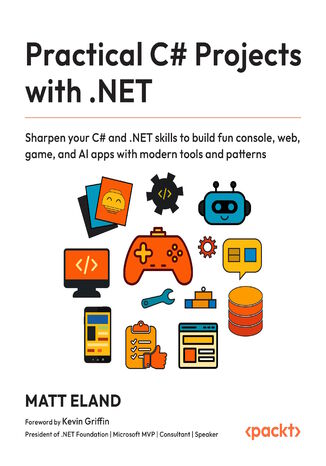
Matt Eland, Kevin Griffin
Too many C# developers feel stuck building the same apps day in and day out, but learning through side projects can reignite your passion and level up your skills. This book offers a practical, hands-on approach to building confidence with .NET 10 and modern C# by building a variety of engaging applications, from interactive games and productivity tools to machine learning apps and browser-based chatbots.These projects are designed to teach practical patterns and modern tooling, with a focus on learning and experimentation over production hardening. You'll work with tools like Spectre.Console, ML.NET, Uno Platform, and more, developing everything from an adventure game and a card tracker to an AI chatbot. You’ll also build modern AI-enabled systems using Ollama, Microsoft Agent Framework, OpenTelemetry, and Aspire.Written by an experienced C# engineer and teacher, this book blends technical depth with a developer-friendly tone, helping you learn faster and retain more. You'll sharpen your understanding of core .NET capabilities and gain confidence to apply them in your own work or hobby projects.By the end of this book, you'll not only have a portfolio of practical .NET apps - you’ll also have grown as a developer and rediscovered the joy of programming.*Email sign-up and proof of purchase required
Davide Bedin
Over the last decade, there has been a huge shift from heavily coded monolithic applications to finer, self-contained microservices. Dapr is a new, open source project by Microsoft that provides proven techniques and best practices for developing modern applications. It offers platform-agnostic features for running your applications on public cloud, on-premises, and even on edge devices.This book will help you get to grips with microservice architectures and how to manage application complexities with Dapr in no time. You'll understand how Dapr offers ease of implementation while allowing you to work with multiple languages and platforms. You'll also understand how Dapr's runtime, services, building blocks, and software development kits (SDKs) help you to simplify the creation of resilient and portable microservices. Dapr provides an event-driven runtime that supports the essential features you need to build microservices, including service invocation, state management, and publish/subscribe messaging. You'll explore all of those in addition to various other advanced features with this practical guide to learning Dapr.By the end of this book, you'll be able to write microservices easily using your choice of language or framework by implementing industry best practices to solve problems related to distributed systems.
Jesse Liberty, Joseph Dluzen
APIs are at the heart of modern software development, enabling seamless communication between applications. In the C# and .NET ecosystem, mastering API development is key to building scalable, reliable systems that meet both client and enterprise needs.Written by C# and .NET experts Jesse Liberty and Joseph Dluzen, this book draws on their extensive experience as hands-on programmers to equip you with the tools, techniques, and best practices for creating powerful APIs.Starting with API fundamentals, it covers everything you need to design, build, and consume APIs using .NET technologies such as ASP.NET Core, and explores both controller and Function API implementations. You'll integrate essential tools such as Postman for testing to streamline your development workflow.Through practical examples and exercises, the book guides you from database creation to deploying APIs on Azure. By the end of this book, you’ll have gained real-world skills to develop secure, high-performance APIs that scale with your applications for both personal projects and enterprise-level systems.
Programming Excel with Office Scripts. Straight to the Point
MrExcel's Holy Macro! Books, Eduardo N. Sanchez
This book guides readers through the fundamentals of automating Excel using Office Scripts, TypeScript, and Power Automate. It starts by introducing scripting basics and gradually explores how to manipulate Excel data, tables, and charts programmatically. The progression from core coding concepts to applied automation ensures clarity for those new to scripting.Readers will gain confidence in building scripts that handle repetitive Excel tasks, automate workflows through Power Automate, and apply programming logic to optimize efficiency. Each chapter introduces practical examples and progressively builds toward creating complete automation pipelines that connect data manipulation, visualization, and workflow execution.By the end, readers will be equipped to design intelligent automation routines that blend Excel’s familiar interface with the flexibility of TypeScript, enabling smarter, faster, and more efficient business operations across the Microsoft 365 environment.
Simaranjit Singh Bhalla, SrinivasMadhav Gorthi
Programming in C# is a certification from Microsoft that measures the ability of developers to use the power of C# in decision making and creating business logic. This book is a certification guide that equips you with the skills that you need to crack this exam and promote your problem-solving acumen with C#.The book has been designed as preparation material for the Microsoft specialization exam in C#. It contains examples spanning the main focus areas of the certification exam, such as debugging and securing applications, and managing an application's code base, among others. This book will be full of scenarios that demand decision-making skills and require a thorough knowledge of C# concepts. You will learn how to develop business logic for your application types in C#. This book is exam-oriented, considering all the patterns for Microsoft certifications and practical solutions to challenges from Microsoft-certified authors.By the time you've finished this book, you will have had sufficient practice solving real-world application development problems with C# and will be able to carry your newly-learned skills to crack the Microsoft certification exam to level up your career.
Programowanie równoległe i asynchroniczne w C# 5.0
Mateusz Warczak, Jacek Matulewski, Rafał Pawłaszek, Piotr...
Programowanie współbieżne - wykorzystaj w pełni moc procesorów! Opanuj wątki, zadania i TPL Poznaj sprytne rozwiązania z użyciem bibliotek DSS i CCR Wejdź na wyższy poziom z Reactive Extensions i CUDAfy.NET Programowanie współbieżne jest w dzisiejszych czasach absolutnym standardem, jedyną drogą pozwalającą w pełni wykorzystać moc wielordzeniowych procesorów, umieszczanych we współczesnych komputerach. Jednak nadal niewielu programistów potrafi poprawnie i efektywnie korzystać z tej technologii. Czas to zmienić! Jeśli chcesz być naprawdę świetnym programistą C#, tworzącym aplikacje na platformę .NET, a do tej pory nie przestudiowałeś jeszcze porządnie kwestii współbieżności, pora to nadrobić. W tej książce znajdziesz informacje o podstawach tej technologii, takich jak wątki, a także o klasycznych pułapkach związanych z programowaniem współbieżnym. Kolejne rozdziały odkryją przed Tobą tajemnice zadań oraz bibliotek TPL. Poznasz również technologie DSS i CCR oraz dowiesz się co nieco na temat asynchroniczności. Potem przyjdzie kolej na omówienie technologii Reactive Extensions oraz biblioteki CUDAfy.NET, pozwalającej efektywnie wykorzystać karty graficzne do obliczeń niezwiązanych z grafiką. Odkryj zalety programowania równoległego! Dla niecierpliwych: asynchroniczność i pętla równoległa Wątki i zadania Zmienne w aplikacjach wielowątkowych Synchronizacja wątków, zadań i kontrolek interfejsu z zadaniami Wątki i zadania a interfejs użytkownika Dane w programach równoległych Analiza aplikacji wielowątkowych. Debugowanie i profilowanie Wstęp do CCR i DSS Skalowalne rozwiązanie dla systemów rozproszonych na bazie technologii CCR i DSS Wprowadzenie do Reactive Extensions. Zarządzanie sekwencjami zdarzeń Współbieżność w Rx Przykłady użycia technologii Rx w aplikacjach WPF CUDA w .NET Biblioteka TPL w WinRT Dobre praktyki programowania aplikacji wielowątkowych Zostań mistrzem programowania współbieżnego!
Programuj z .NET. Praktyka ponad teorią
Paweł Dróżdż
Poznaj platformę .NET od praktycznej strony! Projektuj rozwiązania, które zdobędą serca klientów Implementuj je zgodnie z najlepszymi wzorcami Testuj aplikacje przy użyciu właściwych narzędzi .NET stanowi jedną z najpopularniejszych platform do tworzenia i uruchamiania rozmaitych aplikacji, które można pisać w jednym z wielu wspieranych przez nią języków. Framework ten przez lata dojrzał i wzbogacił o wiele przydatnych możliwości, które z powodzeniem spełniają oczekiwania nawet najbardziej wymagających programistów. .NET znajduje zastosowanie wszędzie tam, gdzie trzeba szybko i sprawnie dostarczyć działające rozwiązanie, niezależnie od tego, czy ma być ono aplikacją desktopową, czy internetową, utrzymywaną we własnej infrastrukturze lub w chmurze obliczeniowej. Jeśli chcesz szybko poznać platformę .NET i dowiedzieć się, jak może Ci pomóc realizować różnego rodzaju projekty, sięgnij po książkę Programuj z .NET. Praktyka ponad teorią. Zgodnie z jej podtytułem autor przechodzi od razu do sedna, nie tracąc czasu na zbędne wstępy. Już od pierwszych stron przedstawia praktyczne sposoby zastosowania platformy .NET do rozwiązywania problemów napotykanych w codziennej pracy programistów. Dzięki tej książce sprawnie zdobędziesz wiedzę pozwalającą wkroczyć w świat profesjonalnego tworzenia aplikacji, które spełnią oczekiwania klientów. Projektowanie aplikacji spełniających zadane wymagania Dobór odpowiednich technologii do zastanych problemów Tworzenie baz danych, back-endów i front-endów Integracja elementów składowych rozwiązania Zastosowanie zwinnych technik prowadzenia projektów Wdrażanie aplikacji w infrastrukturze chmurowej Zastosowanie narzędzi wspierających testy rozwiązań Twórz aplikacje jak prawdziwy profesjonalista!
Roger Ye
Spośród narzędzi do budowy aplikacji wieloplatformowych .NET MAUI wyróżnia się efektywnością i wysoką jakością tworzonego kodu. .NET MAUI powstał na podstawie Xamarin.Forms i służy do pisania natywnych aplikacji mobilnych i desktopowych w językach C# i XAML. Programiści cenią go za współużytkowanie zasobów, proste debugowanie i testowanie, a także za łatwą konfigurację. Ten szczegółowy przewodnik pozwoli Ci na błyskawiczne zapoznanie się z .NET MAUI i sprawne rozpoczęcie pisania aplikacji za pomocą tej technologii. Zaprezentowano w nim filozofię działania .NET MAUI, jak również przebieg prac nad tworzeniem kompletnej aplikacji wieloplatformowej dla systemów: Android, iOS, macOS i Windows, na podstawie jednego wspólnego kodu bazowego. Podczas lektury zrozumiesz też cały cykl rozwoju oprogramowania, w tym zasady publikowania w sklepach z aplikacjami. Ciekawym elementem książki jest opis najnowszej technologii tworzenia frontendów - .NET MAUI Blazor. Dzięki tej książce: odkryjesz najnowsze funkcje frameworka .NET nauczysz się pisać aplikacje wieloplatformowe za pomocą .NET MAUI zaczniesz stosować wzorzec MVVM, wiązać dane i wstrzykiwać zależności utworzysz aplikacje typu .NET MAUI Hybrid Blazor dowiesz się, jak wykonywać testy jednostkowe na kilka sposobów nauczysz się publikować aplikacje w różnych sklepach dla systemów mobilnych i desktopowych Oto .NET MAUI: aplikacja dla wielu systemów - jeden kod bazowy!
Projektowanie frameworków w .NET. Wytyczne, konwencje, idiomy i wzorce. Wydanie III
Krzysztof Cwalina, Jeremy Barton, Brad Abrams
Projektant frameworka tworzy dla innych programistów. To odpowiedzialne zadanie: celem jest zapewnienie większości potrzebnych elementów, które po dostosowaniu i połączeniu mają stać się aplikacją. Dobrze zaprojektowany framework pozwala na wygodną i efektywną pracę. Jest prosty, łatwy do rozwijania i dobrze integruje się z innymi narzędziami programistycznymi, językami czy modelami aplikacji. Projektant musi więc dobrze się orientować w zasadach tworzenia interfejsów API, bibliotek i innych komponentów wielokrotnego użytku. Ta książka jest trzecim, przejrzanym i zaktualizowanym wydaniem znakomitego wprowadzenia do programowania komponentów i ich bibliotek na platformie .NET. Położono w niej nacisk na zagadnienia projektowe bezpośrednio wiążące się z programowalnością frameworka. Przedstawione wytyczne, wypracowane przez lata rozwijania platformy .NET, wynikają z doświadczenia i wiedzy projektantów i ekspertów branżowych. Uwzględniają też innowacje w zakresie projektowania interfejsów API oraz programowania asynchronicznego i uproszczonego dostępu do pamięci. Poszczególne wytyczne zostały uporządkowane, wyjaśnione i bogato skomentowane. Dzięki temu można w pełni wykorzystać najlepsze wzorce języka C# 8, a także platform .NET Framework 4.8 i .NET Core. W książce: Najważniejsze zasady projektowania nowoczesnych frameworków Typowe dla frameworków wzorce projektowe Wytyczne w zakresie nazw, typów, rozszerzalności i wyjątków Projektowanie skalowalnych bibliotek działających w chmurze Nowe techniki programowania asynchronicznego z wykorzystaniem typów Task i ValueTask Dostęp do pamięci za pomocą typów Memory i Span Najlepsze wzorce tworzenia frameworków i bibliotek: poznaj i stosuj!
Mark J. Price
Real-World Web Development with .NET 9 equips you to build professional websites and services using proven technologies like ASP.NET Core MVC, Web API, and OData—trusted by organizations for delivering robust web applications.You’ll learn to design and build efficient web applications with ASP.NET Core MVC, creating well-structured, maintainable code that follows industry best practices. From there, you’ll focus on Web API, building RESTful services that are both secure and scalable. Along the way, you’ll also explore testing, authentication, and containerization for deployment, ensuring that your solutions are fully production ready.In the final part of the book, you will be introduced to Umbraco CMS, a popular content management system for .NET. By mastering this tool, you’ll learn how to empower users to manage website content independently.By the end of this book, you'll not only have a solid grasp of controller-based development but also the practical know-how to build dynamic, content-driven websites using a popular .NET CMS.
Matt Eland
Termin dług techniczny oznacza zbiór skrótów, niedociągnięć i potworków projektowych, które powstają w trakcie ewolucyjnego rozwoju programu. Jeśli się ich nie zlikwiduje, mogą dramatycznie spowolnić pracę nad programem. Rozwiązywanie tego typu problemów jest nazywane refaktoryzacją i każdy programista powinien umieć ją przeprowadzać. Dzięki tej przystępnej, świetnie napisanej książce dowiesz się, czym jest dług techniczny, co prowadzi do jego powstawania i w jaki sposób można go bezpiecznie zrefaktoryzować przy użyciu nowoczesnych narzędzi dostępnych w środowisku Visual Studio, a także najnowszych składników języka C# 12 i platformy .NET 8. Nauczysz się też korzystać z zaawansowanych testów jednostkowych tworzonych przy użyciu xUnit i takich bibliotek jak Moq, Snapper czy Scientist.NET. Dowiesz się, jak stosować zasady SOLID, aby tworzyć łatwy w utrzymaniu kod, poznasz również techniki programowania defensywnego, które można stosować w nowszych wersjach C#. Ponadto nauczysz się przeprowadzać analizy kodu i pisać własne analizatory Roslyn do wykrywania i rozwiązywania problemów typowych dla Twojego projektu. Najciekawsze zagadnienia: najważniejsze informacje o długu technicznym różne sposoby refaktoryzacji klas, metod i wierszy kodu efektywne testy jednostkowe zasady SOLID i tworzenie kodu łatwego w utrzymaniu korzystanie ze sztucznej inteligencji GitHub Copilot standardy kodowania w zwinnych zespołach
Andrzej Jarzyna, Samir Amzani, Mike Amundsen
Designing scalable, user-focused, and robust APIs that last isn’t just a technical challenge but a design imperative. Written by API leaders with over 30 years of combined experience in API strategy, governance, and community, this book is your comprehensive guide to API design, focusing on domain-driven, consumer-centric APIs that meet real user needs while remaining flexible and maintainable over time. It covers modern REST API design, tools like OpenAPI and JSON Schema, and the importance of a product-based approach. The chapters help you explore best practices, potential pitfalls, and anti-patterns, extending beyond the design phase.Starting with the “why” behind building an API, its intended users, and value, this book walks you through the API lifecycle, the role of contracts, and applying domain-driven design. You’ll develop a solid foundation in REST API design as you discover different styles, constraints, and more. Beyond design, the book covers testing techniques, API evolution, maintenance, and deprecation.By the end, you’ll not only know how to design great APIs but understand how to treat them as products, manage their lifecycle, and deliver real value by keeping your APIs relevant and reliable long after release.*Email sign-up and proof of purchase required
Roslyn Cookbook. Compiler as a Service, Code Analysis, Code Quality and more
Manish Vasani, Ovais Mehboob Ahmed Khan
Open-sourcing the C# and Visual Basic compilers is one of the most appreciated things by the .NET community, especially as it exposes rich code analysis APIs to analyze and edit code. If you want to use Roslyn API to write powerful extensions and contribute to the C# developer tool chain, then this book is for you. Additionally, if you are just a .NET developer and want to use this rich Roslyn-based functionality in Visual Studio to improve the code quality and maintenance of your code base, then this book is also for you.This book is divided into the following broad modules:1. Writing and consuming analyzers/fixers (Chapters 1 - 5): You will learn to write different categories of Roslyn analyzers and harness and configure analyzers in your C# projects to catch quality, security and performance issues. Moving ahead, you will learn how to improve code maintenance and readability by using code fixes and refactorings and also learn how to write them. 2. Using Roslyn-based agile development features (Chapters 6 and 7): You will learn how to improve developer productivity in Visual Studio by using features such as live unit testing, C# interactive and scripting.3. Contributing to the C# language and compiler tool chain (Chapters 8 - 10): You will see the power of open-sourcing the Roslyn compiler via the simple steps this book provides; thus, you will contribute a completely new C# language feature and implement it in the Roslyn compiler codebase. Finally, you will write simple command line tools based on the Roslyn service API to analyze and edit C# code.
Serverless computing in Azure with .NET. Build, test, and automate deployment
Sasha Rosenbaum
Serverless architecture allows you to build and run applications and services without having to manage the infrastructure. Many companies have started adopting serverless architecture for their applications to save cost and improve scalability. This book will be your companion in designing Serverless architecture for your applications using the .NET runtime, with Microsoft Azure as the cloud service provider. You will begin by understanding the concepts of Serverless architecture, its advantages and disadvantages. You will then set up the Azure environment and build a basic application using a sample text sentiment evaluation function. From here, you will be shown how to run services in a Serverless environment. We will cover the integration with other Azure and 3rd party services such as Azure Service Bus, as well as configuring dependencies on NuGet libraries, among other topics. After this, you will learn about debugging and testing your Azure functions, and then automating deployment from source control. Securing your application and monitoring its health will follow from there, and then in the final part of the book, you will learn how to Design for High Availability, Disaster Recovery and Scale, as well as how to take advantage of the cloud pay-as-you-go model to design cost-effective services. We will finish off with explaining how azure functions scale up against AWS Lambda, Azure Web Jobs, and Azure Batch compare to other types of compute-on-demand services.Whether you’ve been working with Azure for a while, or you’re just getting started, by the end of the book you will have all the information you need to set up and deploy applications to the Azure Serverless Computing environment.
Einar Ingerbrigsten
With technology trends, demands on software have changed with more and more skilled users. Over the past few years, with services such as Facebook, Twitter and push notifications on smartphones, users are now getting used to being up to date with everything that happens all the time. With SignalR, the applications stay connected and will generate notifications when something happens either from the system or by other users thus giving new opportunities to enter into this new, exciting world of real-time application development.This is a step-by-step guide that follows a practical approach helping you as a developer getting to get started with SignalR by learning its fundamentals. It will help you through building real-time applications using the new methods and functions in the SignalR framework. Starting from getting persistent connections with the server, you will learn the basics of connecting a client to the server and how the messaging works. This will be followed by setting up a hub on the server and consuming it from a JavaScript client. Next you will be taught how you can group connections together to send messages. We will then go on to know how you can have state in the client to handle specific operations like connecting or disconnecting. Then, moving on you will learn how to secure your SignalR connections using OWIN and scaling SignalR across multiple servers. Next you will learn building a client for WPF and building a client using Xamarin that targets Windows Phone, iPhone and Android. Lastly, you will learn how to monitor the traffic in SignalR using Fiddler, Charles and hosting SignalR using OWIN.
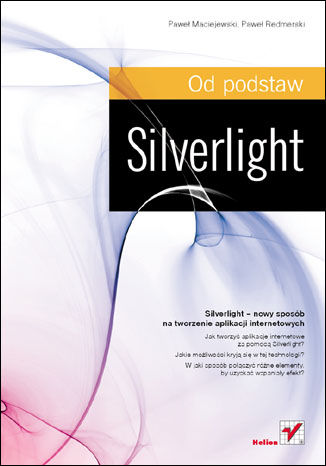
Paweł Maciejewski, Paweł Redmerski
Silverlight -- nowy sposób na tworzenie aplikacji internetowych Jak tworzyć aplikacje internetowe za pomocą Silverlight? Jakie możliwości kryją się w tej technologii? W jaki sposób połączyć różne elementy, by uzyskać wspaniały efekt? Technologia Silverlight, opracowana przez Microsoft, jest propozycją dla tych, którzy przymierzają się do projektowania aplikacji internetowych lub zajmują się tym już od jakiegoś czasu, a chcieliby poszerzyć spektrum swoich umiejętności. Do podstawowych zalet tej technologii należą prostota jej używania oraz ogromna elastyczność -- oprócz języka XAML, służącego do opisania interfejsu użytkownika, twórca aplikacji może posługiwać się dowolnym językiem programowania, dostępnym dla platformy .NET. Gotowe programy przygotowane w Silverlight są kompatybilne z większością przeglądarek, zainstalowanych na różnych platformach. Książka "Silverlight. Od podstaw" zawiera wszelkie informacje na temat najnowszej wersji tej technologii. Znajdziesz tu opis tego środowiska programistycznego, jego funkcjonalności oraz narzędzi, które musisz zainstalować, by móc sprawnie korzystać z Silverlight. Poznasz także zasady tworzenia nowych projektów i całą masę przykładów konkretnych rozwiązań. Wszystko to uzupełnione zostało licznymi zrzutami ekranu, ilustrującymi niemal każdy krok oraz efekty działania podanego kodu. Jeśli chcesz nauczyć się projektować aplikacje internetowe w Silverlight, nie znajdziesz lepszej książki! Zasady działania technologii Silverlight Silverlight a platforma .NET Programowanie w języku XAML Używanie kontrolek interfejsu Pozycjonowanie za pomocą kontenerów Wykorzystywanie grafiki Integracja z multimediami Obsługa zdarzeń Tworzenie animacji Stosowanie stylów i szablonów Otwórz się na nowe możliwości. Wypróbuj Silverlight!
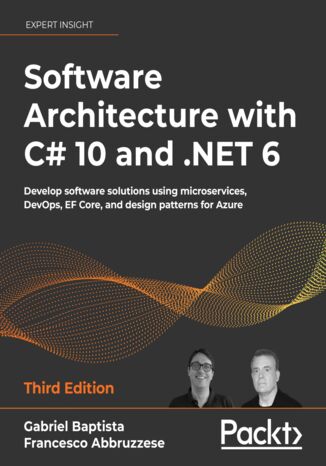
Gabriel Baptista, Francesco Abbruzzese
Software architecture is the practice of implementing structures and systems that streamline the software development process and improve the quality of an app. This fully revised and expanded third edition, featuring the latest features of .NET 6 and C# 10, enables you to acquire the key skills, knowledge, and best practices required to become an effective software architect.Software Architecture with C# 10 and .NET 6, Third Edition features new chapters that describe the importance of the software architect, microservices with ASP.NET Core, and analyzing the architectural aspects of the front-end in the applications, including the new approach of .NET MAUI. It also includes a new chapter focused on providing a short introduction to artificial intelligence and machine learning using ML.NET, and updated chapters on Azure Kubernetes Service, EF Core, and Blazor.You will begin by understanding how to transform user requirements into architectural needs and exploring the differences between functional and non-functional requirements. Next, you will explore how to choose a cloud solution for your infrastructure, taking into account the factors that will help you manage a cloud-based app successfully. Finally, you will analyze and implement software design patterns that will allow you to solve common development problems.By the end of this book, you will be able to build and deliver highly scalable enterprise-ready apps that meet your business requirements.