
Inne
Joseph Steinberg
Virtual Private Networks (VPNs) provide remote workers with secure access to their company network via the internet by encrypting all data sent between the company network and the user?s machine (the client). Before SSL VPN this typically required the client machine to have special software installed, or at least be specially configured for the purpose.Clientless SSL VPNs avoid the need for client machines to be specially configured. Any computer with a Web browser can access SSL VPN systems. This has several benefits:Low admin costs, no remote configurationUsers can safely access the company network from any machine, be that a public workstation, a palmtop or mobile phoneBy pass ISP restrictions on custom VPNs by using standard technologies SSL VPN is usually provided by a hardware appliance that forms part of the company network. These appliances act as gateways, providing internal services such as file shares, email servers, and applications in a web based format encrypted using SSL. Existing players and new entrants, such as Nokia, Netilla, Symantec, Whale Communications, and NetScreen technologies, are rushing our SSL VPN products to meet growing demand.This book provides a detailed technical and business introduction to SSL VPN. It explains how SSL VPN devices work along with their benefits and pitfalls. As well as covering SSL VPN technologies, the book also looks at how to authenticate and educate users ? a vital element in ensuring that the security of remote locations is not compromised. The book also looks at strategies for making legacy applications accessible via the SSL VPN.
Garima Bajpai, Thomas Schuetz
Many organizations are embracing cloud technology to remain competitive, but implementing and adopting development processes while modernizing a cloud-based ecosystem can be challenging.Strategizing Continuous Delivery in Cloud helps you modernize continuous delivery and achieve infrastructure-application convergence in the cloud. You’ll learn the differences between cloud-based and traditional delivery approaches and develop a tailored strategy. You’ll discover how to secure your cloud delivery environment, ensure software security, run different test types, and test in the pre-production and production stages.You’ll also get to grips with the prerequisites for onboarding cloud-based continuous delivery for organizational and technical aspects. Then, you’ll explore key aspects of readiness to overcome core challenges in your cloud journey, including GitOps, progressive delivery controllers, feature flagging, differences between cloud-based and traditional tools, and implementing cloud chaos engineering.By the end of this book, you’ll be well-equipped to select the right cloud environment and technologies for CD and be able to explore techniques for implementing CD in the cloud.
Brittany Joiner
Managing large projects and teams can be an immense challenge, but having an efficient project management system can make all the difference. Trello is one of the leading project management systems, however, it’s crucial to understand its features to leverage its full potential Supercharging Productivity with Trello is the perfect guide for you to enhance efficiency and do more in less time. You’ll start by exploring Trello's structure, including cards, boards, and lists, before diving into Trello card basics. Next, you’ll learn to use Trello views and templates to aggregate tasks and organize projects. You’ll then explore automation, including triggers and actions, to create powerful workflows that will help you prioritize tasks and organize your data effectively. Later, you’ll discover Power-Ups, an add-on that extends Trello's functionality. Throughout the book, you’ll find practical tips and real-world examples to gain practical knowledge. By the end of this book, you’ll be well-equipped to use Trello effectively for task and project management helping you stay on top of your game and deliver quick wins in no time.
Niklas Sundberg
We are at a critical point in human history. Humanity is under threat, but all is not lost. We can take action! But how?Sustainable IT Playbook for Technology Leaders will show you how. It will walk you through the construction and implementation of a sustainable IT strategy and enable you to do your bit for the future of mankind.The book is split into three parts. Part I details the “why” and the clear and present danger that humanity faces today: the climate crisis. How did we get here, what are the immediate threats, what are the planetary boundaries that we need to peel back to safe levels, and what impact does IT have on society at large? Part II will focus on the what.” It examines the nitty-gritty details of what we can do to unlock significant returns on sustainable investments toward a more sustainable future. Part III, the final part of the book, focuses on the “how.” How do you turn your ideas into action? What do you need to do to establish your baseline and your direction of travel towards your objective? This part provides tangible case studies and explains how you can start your journey today to begin delivering global and impactful objectives.By the end of this book, you’ll be able to plan, implement, and communicate a sustainable IT strategy and set yourself apart as a progressive technology leader.
Tim Bowler, Wojciech Bancer
With its flexible architecture, the Symfony framework allows you to build modern web applications and web services easily and rapidly. The MVC components separate the logic from the user interface and therefore make developing, changing, and testing your applications much faster. Using Symfony you can minimize repetitive coding tasks, optimize performance, and easily integrate with other libraries and frameworks.Although this framework contains with many powerful features, most developers do not exploit Symfony to its full potential.This book makes it easy to get started and produce a powerful and professional-looking web site utilizing the many features of Symfony. Taking you through a real-life application, it covers all major Symfony framework features without pushing you into too much theoretical detail, as well as throwing some light on the best practices for rapid application development.This book takes you through detailed examples as well as covering the foundations that you will need to get the most out of the Symfony framework. You will learn to shorten the development time of your complex applications and maintain them with ease. You will create several useful plug-ins and add them to your application and automate common tasks. The book also covers best practices and discussions on security and optimization. You will learn to utilize all major features of this framework by implementing them in your application.By the end, you should have a good understanding of the development features of Symfony (for Propel as well as Doctrine editions), and be able to deploy a high-performance web site quite easily.

Fedor G. Pikus
Jeszcze kilka lat temu, by zwiększyć szybkość działania programu, wystarczyło wymienić procesor. Dzisiejsze procesory nie są znacząco szybsze od poprzedników. Nowsze architektury zapewniają zaledwie niewielkie przyrosty wydajności istniejących już programów. Nie ma innego wyjścia: jeśli programista chce tworzyć efektywne oprogramowanie, musi wiedzieć, jak odpowiednio używać dostępnych zasobów obliczeniowych. Jest to trudna sztuka, wymagająca ciągłej gotowości do nauki. To książka przeznaczona dla doświadczonych programistów, którzy chcą sprawnie tworzyć efektywny kod. Omówiono w niej, jak korzystać z zasobów procesora i pamięci, unikać zbędnych obliczeń, mierzyć wydajność kodu i prawidłowo stosować współbieżność i wielowątkowość. Zaprezentowano również zagadnienia związane z optymalizacjami przeprowadzanymi przez kompilator, a także metody efektywniejszego korzystania z właściwości języka programowania (C++). Dokładnie wyjaśniono zasady projektowania oprogramowania pod kątem wydajności i aby ułatwić przyswajanie wiedzy, zamieszczono wiele przykładów, które będą przydatne w czasie samodzielnej nauki. Dzięki dogłębnemu zrozumieniu wiedzy ujętej w książce łatwiej będzie podejmować właściwe decyzje podczas projektowania nowego systemu lub modyfikowania już istniejącej architektury. Najciekawsze zagadnienia: korzystanie ze sprzętowych zasobów obliczeniowych uporządkowanie pamięci i należyte zorganizowanie danych wydajność operacji a współbieżny dostęp stosowanie technik programowania bez użycia blokady zwiększanie efektywności optymalizacji za pomocą kompilatora interfejsy API dla współbieżnych struktur danych i struktur o dużej wydajności Dobre decyzje projektowe to klucz do wydajności kodu!
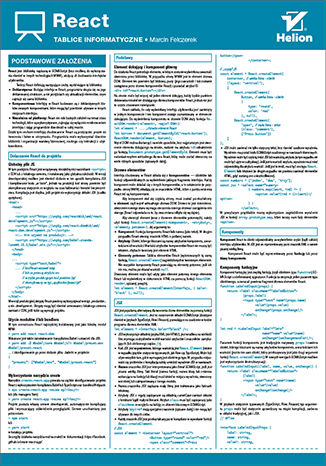
Marcin Felczerek
Zapomniałeś? Sięgnij po ściągę! React to zdobywająca coraz większą popularność biblioteka do budowania graficznych interfejsów użytkownika serwisów internetowych. Dzięki deklaratywności, modułowości i niezależności od jakiejkolwiek platformy stała się jedną z wiodących technologii w branży, a budowane za jej pomocą interfejsy są przejrzyste, elastyczne oraz łatwe do utworzenia i utrzymania. Tablice informatyczne. React to krótkie podsumowanie najważniejszych informacji na temat biblioteki. Niezależnie od tego, czy dopiero się jej uczysz, czy wykorzystujesz tę technologię już od pewnego czasu, pomogą Ci szybko znaleźć niezbędne wiadomości. Przejrzysty układ i skrótowa forma tablic sprawdzi się zarówno w codziennej pracy, jak i podczas nauki czy przygotowywania się do egzaminów. Podstawowe informacje Dołączanie Reacta do projektu Komponenty, stany i cykl życia Klucze, formularze, zdarzenia Wirtualny DOM, referencje, kontekst Architektura i biblioteki komponentów Tworzenie aplikacji mobilnych w React Native React? Z tablicami to nic strasznego!

Krzysztof Boruń
Autor opisuje przypadki konstruowanych w XX wieku sztucznych zwierząt. Pierwszy elektryczny pies Philidog został zaprezentowany na Międzynarodowej Wystawie w Paryżu w 1929 roku. Potrafił on "tropić" światło, czyli podążać za jego źródłem. To dość prosta umiejętność, jednak ostatnie opisane przez autora zwierzęta wykazują znacznie bardziej skomplikowane działania - przy ich budowie zastosowano techniki maszynowego modelowania zjawisk i procesów psychicznych.