
Programowanie w chmurze
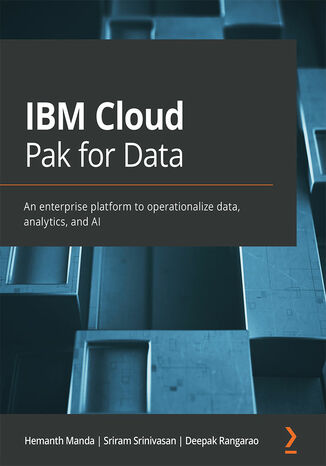
IBM Cloud Pak for Data. An enterprise platform to operationalize data, analytics, and AI
Hemanth Manda, Sriram Srinivasan, Deepak Rangarao
Cloud Pak for Data is IBM's modern data and AI platform that includes strategic offerings from its data and AI portfolio delivered in a cloud-native fashion with the flexibility of deployment on any cloud. The platform offers a unique approach to addressing modern challenges with an integrated mix of proprietary, open-source, and third-party services.You'll begin by getting to grips with key concepts in modern data management and artificial intelligence (AI), reviewing real-life use cases, and developing an appreciation of the AI Ladder principle. Once you've gotten to grips with the basics, you will explore how Cloud Pak for Data helps in the elegant implementation of the AI Ladder practice to collect, organize, analyze, and infuse data and trustworthy AI across your business. As you advance, you'll discover the capabilities of the platform and extension services, including how they are packaged and priced. With the help of examples present throughout the book, you will gain a deep understanding of the platform, from its rich capabilities and technical architecture to its ecosystem and key go-to-market aspects.By the end of this IBM book, you'll be able to apply IBM Cloud Pak for Data's prescriptive practices and leverage its capabilities to build a trusted data foundation and accelerate AI adoption in your enterprise.
Andri Yadi
iCloud is a cloud storage and cloud computing service from Apple Inc. iCloud is a hub in a multi-devices environment, that allows your iPads, iPhones, iPod Touches, and Macs sync with each other and always have the same content. The service allows users to store data, such as music files, on remote computer servers that can be downloaded to multiple devices such as iOS-based devices, and personal computers running OS X or Microsoft Windows.This practical guide provides easy, step-by-step guidance to using the numerous features offered by iCloud, for first time users You will be guided through everything that you need to know about using iCloud on multiple platforms, as well as how to use it on a Windows PC.Learn about what iCloud can offer you with this practical guide, and what makes it better than other cloud services. It will take you through all of the iCloud services available, and help you to manage your contents easily across devices.You will also learn how to use Mail, Contacts, Calendar, and other iCloud services on Mac, PC, iOS devices or in the web browser. This book will also let you explore more on using iPhone and iTunes with iCloud, sync all contents without any hassle, and even back them up with iCloud. If you want to take full advantage of iCloud, then this is the right book for you.
Jeremy Wallace
As enterprises adopt multi-cloud and DevOps at scale, securing identities and access across complex cloud environments is no longer optional, it is mission-critical. Identity and Access Management for Cloud and DevOps Engineers is a hands-on guide for professionals who need to design and manage IAM solutions across Azure, AWS, and Google Cloud, while meeting modern security and compliance demands. Written for cloud architects, DevOps engineers, and IT security professionals, this book delivers practical tools, automation techniques, and forward-looking strategies to master IAM.You’ll start with IAM foundations such as least privilege, zero trust, MFA, RBAC, and ABAC, then move into platform-specific implementations in Azure, AWS, and GCP. With each concept mapped to real-world workflows, you'll also learn how to automate IAM using Terraform and Infrastructure as Code, integrate identity controls into CI/CD pipelines, and secure access across hybrid and multi-cloud environments. Each chapter features hands-on examples, best practices, and case studies.This book goes beyond teaching the basics. It empowers you to lead security-first initiatives. Whether you’re building a greenfield cloud IAM architecture or fixing legacy access risks in your DevOps pipelines, this is your blueprint for scalable, future-ready identity governance.
Yohan Wadia, Rowan Udell, Lucas Chan, Udita...
With this Learning Path, you’ll explore techniques to easily manage applications on the AWS cloud. You’ll begin with an introduction to serverless computing, its advantages, and the fundamentals of AWS. The following chapters will guide you on how to manage multiple accounts by setting up consolidated billing, enhancing your application delivery skills, with the latest AWS services such as CodeCommit, CodeDeploy, and CodePipeline to provide continuous delivery and deployment, while also securing and monitoring your environment's workflow. It’ll also add to your understanding of the services AWS Lambda provides to developers. To refine your skills further, it demonstrates how to design, write, test, monitor, and troubleshoot Lambda functions. By the end of this Learning Path, you’ll be able to create a highly secure, fault-tolerant, and scalable environment for your applications.This Learning Path includes content from the following Packt products:• AWS Administration: The Definitive Guide, Second Edition by Yohan Wadia• AWS Administration Cookbook by Rowan Udell, Lucas Chan• Mastering AWS Lambda by Yohan Wadia, Udita Gupta
Oliver Michalski, Stefano Demiliani
A well designed cloud infrastructure covers factors such as consistency, maintenance, simplified administration and development, and reusability. Hence it is important to choose the right architectural pattern as it has a huge impact on the quality of cloud-hosted services. This book covers all Azure design patterns and functionalities to help you build your cloud infrastructure so it fits your system requirements.This book initially covers design patterns that are focused on factors such as availability and data management/monitoring. Then the focus shifts to complex design patterns such as multitasking, improving scalability, valet keys, and so on, with practical use cases. The book also supplies best practices to improve the security and performance of your cloud. By the end of this book, you will thoroughly be familiar with the different design and architectural patterns available with Windows Azure and capable of choosing the best pattern for your system.
Henry Been, Maik van der Gaag
Implementing Azure DevOps Solutions helps DevOps engineers and administrators to leverage Azure DevOps Services to master practices such as continuous integration and continuous delivery (CI/CD), containerization, and zero downtime deployments.This book starts with the basics of continuous integration, continuous delivery, and automated deployments. You will then learn how to apply configuration management and Infrastructure as Code (IaC) along with managing databases in DevOps scenarios. Next, you will delve into fitting security and compliance with DevOps. As you advance, you will explore how to instrument applications, and gather metrics to understand application usage and user behavior. The latter part of this book will help you implement a container build strategy and manage Azure Kubernetes Services. Lastly, you will understand how to create your own Azure DevOps organization, along with covering quick tips and tricks to confidently apply effective DevOps practices.By the end of this book, you’ll have gained the knowledge you need to ensure seamless application deployments and business continuity.
Rick Farmer, Sean Keery, Clive Harber, Marcus...
Whether you're just getting your feet wet in cloud infrastructure or already creating complex systems, this book will guide you through using the patterns to fit your system needs.Starting with patterns that cover basic processes such as source control and infrastructure-as-code, the book goes on to introduce cloud security practices. You'll then cover patterns of availability and scalability and get acquainted with the ephemeral nature of cloud environments. You'll also explore advanced DevOps patterns in operations and maintenance, before focusing on virtualization patterns such as containerization and serverless computing. In the final leg of your journey, this book will delve into data persistence and visualization patterns. You'll get to grips with architectures for processing static and dynamic data, as well as practices for managing streaming data.By the end of this book, you will be able to design applications that are tolerant of underlying hardware failures, resilient against an unexpected influx of data, and easy to manage and replicate.