Naukowe i akademickie
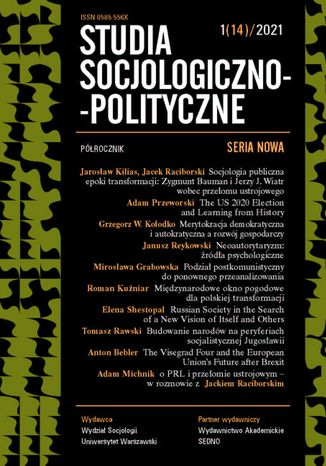
Studia Socjologiczno-Polityczne 1(14)/2021
Praca zbiorowa
Tematem numeru 1(14)/2021 „Studiów Socjologiczno-Politycznych. Seria nowa” jest problematyka transformacji ustrojowej państw oraz współczesnego kryzysu demokracji. Autorzy poszczególnych rozpraw – wybitni politolodzy z kraju oraz z Federacji Rosyjskiej, Słowenii i Stanów Zjednoczonych - dedykują swoje prace profesorowi Jerzemu J. Wiatrowi z okazji Jubileuszu 90-lecia urodzin. Numer zamyka rozmowa Jacka Raciborskiego z Adamem Michnikiem o politycznej roli Jerzego J. Wiatra, Zygmunta Baumana, Janusza Reykowskiego i kilku innych uczonych w przełomie ustrojowym.
Studia Socjologiczno-Polityczne 1(14)/2021
Praca zbiorowa
Tematem numeru 1(14)/2021 „Studiów Socjologiczno-Politycznych. Seria nowa” jest problematyka transformacji ustrojowej państw oraz współczesnego kryzysu demokracji. Autorzy poszczególnych rozpraw – wybitni politolodzy z kraju oraz z Federacji Rosyjskiej, Słowenii i Stanów Zjednoczonych - dedykują swoje prace profesorowi Jerzemu J. Wiatrowi z okazji Jubileuszu 90-lecia urodzin. Numer zamyka rozmowa Jacka Raciborskiego z Adamem Michnikiem o politycznej roli Jerzego J. Wiatra, Zygmunta Baumana, Janusza Reykowskiego i kilku innych uczonych w przełomie ustrojowym.
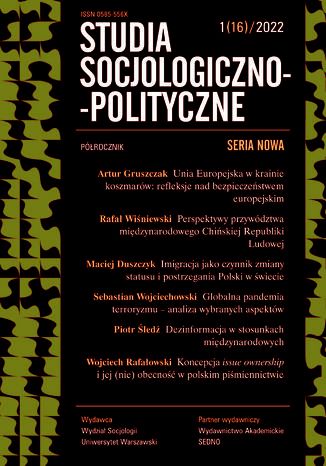
Studia Socjologiczno-Polityczne 1(16) 2022
Praca zbiorowa
W numeru 1(16)/2022 „Studiów Socjologiczno-Politycznych. Seria nowa” znajdziemy blok artykułów na temat „Niektóre problemy nowego porządku międzynarodowego”, redaktorem bieżącego tomu czasopisma jest prof. Roman Kuźniar. Zagadnienia omawiane przez autorów są zróżnicowane, ale łączy je jeden wyróżnik. Odnoszą się do nowych zjawisk międzynarodowych, są wręcz ich ilustracją. Jest tak również w tych przypadkach, gdy ich korzenie są odległe, ale ich obecna postać wnosi nową jakość do życia międzynarodowego. Z jednej strony wzbogaca jego strukturę, a z drugiej jest przyczyną napięć, konfliktów i niestabilności.
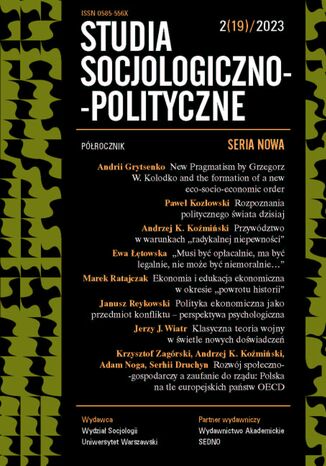
Studia Socjologiczno-Polityczne 2(19)/ 2023
praca zbiorowa
Numer 2(19)/2023 Redakcja ,,Studiów Socjologiczno-Politycznych. Seria Nowa" dedykuje Profesorowi Grzegorzowi W. Kołodko z okazji Jubileuszu 75-lecia urodzin. Publikowane artykuły dotyczą wyzwań społeczno-gospodarczych i politycznych, wobec których znalazł się współczesny świat. Autorzy analizują diagnozy i rekomendacje, jakie przedstawia w swoich pracach naukowych prof. Grzegorz W. Kołodko oraz dostrzegają spójność jego dorobku akademickiego z dokonaniami podczas sprawowania ważnych funkcji państwowych w działalności publicznej.
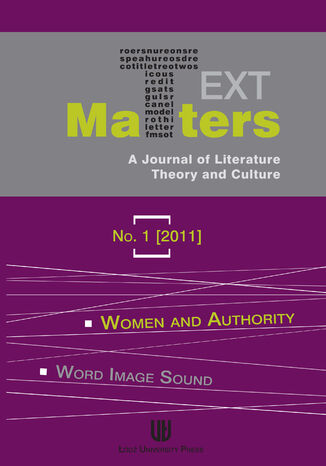
Text Matters: A Journal of Literature, Theory and Culture, No. 1 (2011)
Dorota Filipczak
The first issue of Text Matters, published in 2011 and supervised by its editor-in-chief, Professor Dorota Filipczak, consists of two main sections. The first one, entitled "Women and Authority," contains thirteen texts exploring, in its editor's words, "the relationship between women and authority, vested in literary and philosophical texts." The authors come from different backgrounds: philosophy, theology, literature, while their articles concern the works of authors as varied as Michele Le Doeuff, Jane Urquhart, Laurence Sterne, Michele Roberts, Iris Murdoch, Virginia Woolf, Ian McEwan, Muriel Spark, Denise Levertov, Mary Dorcey, Carol Shields, Sylvia Plath, and Janet Frame. One of the analyses is devoted to the male/female relations in selected late medieval and early modern English texts. In the second section, named "Word/Image/Sound," there are six scholarly articles that cover the following topics: the oeuvre of Rudy Wiebe, close connections between artistry and religion, the postcolonial aspects of Michael Haneke's Hidden, the use of Ulster dialects in the poetry of Tom Paulin and Michael Longley, the role of dance in Brian Friel's Molly Sweeney, and, finally, the depiction of ambiguity and paradox in Ian McEwan's Saturday. Additionally, the volume includes an overview of book tributes to Professor Andrzej Kopcewicz, a look at the current state of American newspapers, a review of The Body (edited by Ilona Dobosiewicz and Jacek Gutorow), as well as two conversations: between Jared Thomas and Teresa Podemska-Abt, and Pamela Sue Anderson and Alison Jasper.
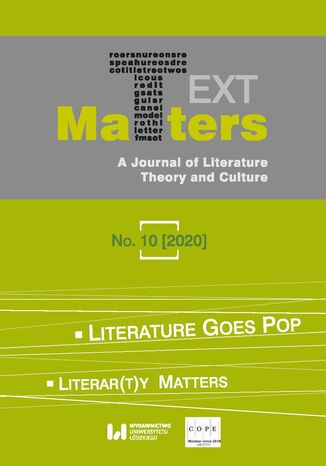
Text Matters: A Journal of Literature, Theory and Culture, No. 10 (2020)
Dorota Filipczak
Issue 10 (2020), entitled "Literature Goes Pop" and edited by the journal's editor-in-chief, Dorota Filipczak, revolves around the encounters between literary intertexts/conventions/genres and the visual/digital modes. Although the volume opens with a critical essay on Pamela Sue Anderson's philosophy, the next sixteen scholarly texts explore a wide range of topics demonstrating close ties between literature and widely understood pop culture: film, music videos, the blogosphere, biographies of iconic poets, the realm of cyberpunk, video games, and even memes, as demonstrated by the article on online humor responding to the global crisis caused by the COVID-19 pandemic. The next section, playfully named "Literar(t)y Matters," deals with the following subjects: sensorial aesthetics in modernist fiction, Hart Crane's and Yvor Winters's interactions with Emily Dickinson's poetic legacy, the cosmic sublime in Tracy K. Smith's Life on Mars, the depiction of racial issues in contemporary US in Claudia Rankine's Citizen. An American Lyric, the portrayal of 19th-century America in Frances Wright's works, Wallace Stevens's ties to philosophy, a morphogenetic perspective on intertextuality, Thomas William Robertson's well-made plays, and wartime propaganda and gender in Ahmad Mahmoud's The Scorched Earth.
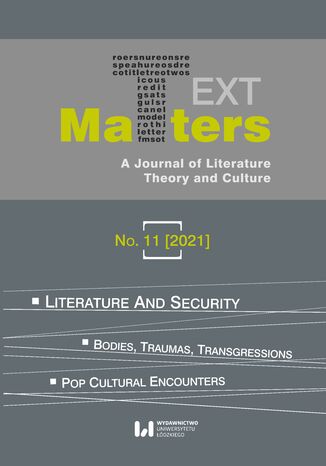
Text Matters: A Journal of Literature, Theory and Culture, No. 11 (2021)
Liam Gearon
The main section of issue 11 (2021), edited by Liam Gearon, deals with the entangled relationship between literature, security, and intelligence. Like other forms of media, books have been used as part of the ideological and intelligence apparatus; authors have been perceived as a physical or ideological threat by dictatorial regimes and targeted alongside intellectuals, to be undermined or even eliminated. While propaganda itself can be considered a weapon of war, books and bombshells often share the same ideological trajectory, particularly during times of war: the cultural always forms a backdrop to conflict. This volume of Text Matters offers a broad treatment of various alignments between the notions of security and cultural production. The subjects addressed include the figure of the spy and themes related to espionage, e.g. in the works of Ciaran Carson; political, cultural and religious destabilizations in (post)Troubles-era Northern Ireland in the poetry of Paul Muldoon and the fiction of Anna Burns; populist and fictional notions of the migrant as "terrorist" in contemporary film and literature; shifting ideas of security in dystopian, post-apocalyptic narratives with a feminist twist (Mad Max: Fury Road); a psychology of security in a reinterpretation of Patricia Highsmith's Ripley novels. The remaining three sections, titled "Bodies, Traumas, Transgressions," "Pop Cultural Encounters," and "Literary Continuities" offer a broad array of subjects, ranging from the fictions of Margaret Atwood and Kurt Vonnegut to the sculptures of Kiki Smith and Shakesperean plays. The concluding part consists of four reviews (of Agnieszka Łowczanin's A Dark Transfusion: The Polish Literary Response to Early English Gothic: Anna Mostowska Reads Ann Radcliffe, Nolen Gertz's Nihilism, Don DeLillo's The Silence, and Natalie Crohn Schmitt's Performing Commedia dell'Arte, 1570-1630). The issue is dedicated to the memory of the journal's Founder, Dorota Filipczak (1963-2021).
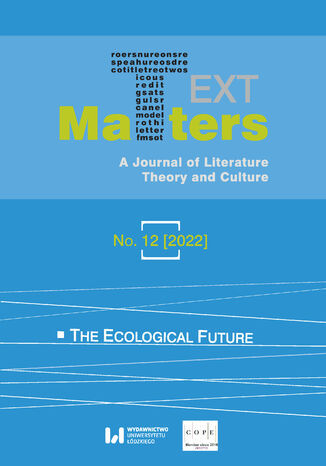
Text Matters: A Journal of Literature, Theory and Culture, No. 12 (2022)
Agnieszka Soltysik Monnet, Christian Arnsperger
Issue 12 (2022) of Text Matters, titled The Ecological Future, edited by Agnieszka Soltysik Monnet and Christian Arnsperger of the University of Lausanne, Switzerland, deals with the temporal aspect of the ecological challenge facing humanity. Time is a central category in thinking about the environment because of our focus on the planet's possible futures as well as our awareness of how quickly the climate is changing and how fast we must react if we want to prevent a catastrophe. These issues are addressed by the volume's main section, containing scholarly papers, excerpts from two books by William deBuys, a fictional narrative by John Michael Greer, a screenplay by Elizabeth Watson, and conversations with the three authors. The scholarly articles discuss the work of writers such as J. G. Ballard, Imbolo Mbue, Cherie Dimaline, Louise Erdrich, Gary Snyder, Kenneth White, Richard Powers, and M. R. Carey, as well as graphic novels, photography, painting, and cultural practices. Their main points of focus are re-flected by the titles of the five sub-sections into which they have been divided: "Tempo-rality and Deep Time," "Eco-Anxiety and Anthropocene Nostalgia," "Indigenous Pasts, Presents and Futures," "Interconnectivity and Animacy," and "Ecotopia and Eco-Futurism." The ecological futures imagined in these interventions require creating new narratives of modernity, often, as it turns out, ones inspired by Indigenous attitudes to-wards the biosphere. As the ecological is often closely linked to different approaches towards the body, the subsequent section, titled "BODY/TEXT/IMAGE," contains pa-pers discussing several works of literature as well as visual and performing arts, sharing the theme of corporeality and embodiment. The volume is concluded by a review of a scholarly volume on Shakespeare and an interview with Philip Terry.