
Elementy komputera
OpenStack: Building a Cloud Environment. Building a Cloud Environment
Rikard Strid, Cody Bunch, Egle Sigler, Sunil...
OpenStack is a collection of software projects that work together to provide a cloud fabric.Learning OpenStack Cloud Computing course is an exquisite guide that you will need to build cloud environments proficiently. This course will help you gain a clearer understanding of OpenStack’s components and their interaction with each other to build a cloud environment. The first module, Learning OpenStack, starts with a brief look into the need for authentication and authorization, the different aspects of dashboards, cloud computing fabric controllers, along with 'Networking as a Service' and 'Software defined Networking'. Then, you will focus on installing, configuring, and troubleshooting different architectures such as Keystone, Horizon, Nova, Neutron, Cinder, Swift, and Glance. After getting familiar with the fundamentals and application of OpenStack, let's move deeper into the realm of OpenStack.In the second module, OpenStack Cloud Computing Cookbook, preview how to build and operate OpenStack cloud computing, storage, networking, and automation. Dive into Neutron, the OpenStack Networking service, and get your hands dirty with configuring ML2, networks, routers, and distributed virtual routers. Further, you'll learn practical examples of Block Storage, LBaaS, and FBaaS.The final module, Troubleshooting OpenStack, will help you quickly diagnose, troubleshoot, and correct problems in your OpenStack. We will diagnose and remediate issues in Keystone, Glance, Neutron networking, Nova, Cinder block storage, Swift object storage, and issues caused by Heat orchestration.This Learning Path combines some of the best that Packt has to offer in one complete, curated package. It includes content from the following Packt products:? Learning OpenStack by Alok Shrivastwa, Sunil Sarat ? OpenStack Cloud Computing Cookbook - Third Edition by Kevin Jackson , Cody Bunch, Egle Sigler ? Troubleshooting OpenStack by Tony Campbell
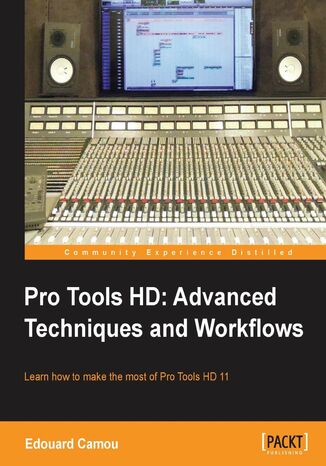
Edouard Camou
Pro Tools HD is a digital audio workstation platform for Microsoft Windows and Mac OS X operating systems. It is the leading audio software when it comes to professional audio work. Working effectively with audio and producing professional music with Pro Tools HD is not an easy task.Beginning with what the software is about, we will take you all the way through to the steps required to efficiently record your audio. You will discover how to improve the workflow of Pro Tools software and receive innovative tips to enable flawless editing in music production, film scoring, film, and television post-production.Packed with concise and clear instructions on using Pro Tools HD: Advanced Techniques and Workflows, this book starts with different possible hardware and software combinations to help you understand the strengths and limitations of each, before taking you through powerful editing and advanced mixing techniques.When it comes to choosing a ProTools HD system there are different technologies available and therefore, many ways to use the system optimally so, you will learn about some digital audio concepts for better software optimisation. You will then learn editing using Beat detective, as well as covering excellent workflow and routing concepts to take full advantage of ProTools mixing capabilities, integrating both hardware analogue units with your favorite plugins. Finally, you will see how you can export your project safer, faster and better.This guide shows you the framework to enable you to take your usage of ProTools to the next level by explaining and discussing new and advanced features to achieve industry standard techniques.
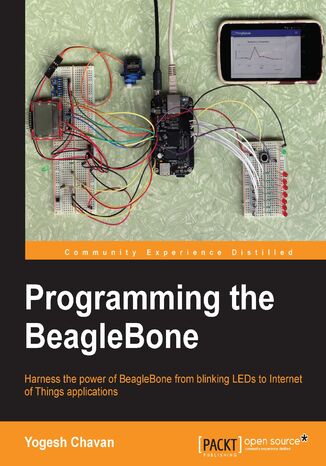
Yogesh Chavan
The whole world is moving from desktop computers to smartphones and embedded systems. We are moving towards utilizing Internet of Things (IoT). An exponential rise in the demand for embedded systems and programming in the last few years is driving programmers to use embedded development boards such as Beaglebone. BeagleBone is an ultra-small, cost-effective computer that comes with a powerful hardware. It runs a full-fledged Debian Linux OS and provides numerous electronics solutions. BeagleBone is open source and comes with an Ethernet port, which allows you to deploy IoT projects without any additions to the board. It provides plenty of GPIO, Anlaog pins, and UART, I2C, SPI pins which makes it the right choice to perform electronics projects. This gives you all the benefits of Linux kernel such as multitasking, multiusers, and extensive device driver support. This allows you to do programming in many languages including high-level languages such as JavaScript and Python.This book aims to exploit the hardware and software capabilities of BeagleBone to create real-life electronics and IoT applications quickly. It is divided into two parts. The first part covers JavaScript programs. The second part provides electronics projects and IoT applications in Python.First, you will learn to use BeagleBone as tool to write useful applications on embedded systems. Starting with the basics needed to set up BeagleBone and the Cloud9 IDE, this book covers interfacing with various electronics components via simple programs. The electronics theory related to these components is then explained in depth before you use them in a program. Finally, the book helps you create some real-life IoT applications.
Robert Loredo, Matt Broomhall
Prepare for a computing shift that will reshape security, optimization, and competitive advantage across every industry. This book helps you build a clear actionable approach to quantum readiness covering strategy, technology, talent, and risk in one framework.Written by Robert Loredo, Founder and CEO of Entangled Solutions Group, this book draws on 25 years of experience across IBM, academia, and enterprise innovation. As a former IBM Quantum Global Strategist, leader of the IBM Quantum Ambassador program, and holds over 275 patents, he translates this complex technology transition into decisions leaders can act on immediately.This book is organized as a complete strategic operating system for the quantum transition. Part One equips executives with investment frameworks, governance structures, and talent roadmaps. Part Two guides technical leaders through infrastructure assessment, workforce development, and quantum-era data strategy. Part Three delivers a security playbook covering post-quantum cryptography and adaptive architecture. Part Four maps the full quantum ecosystem and partnerships that will determine which institutions lead commercially.By the end, you’ll be able to define a quantum strategy, build the right capabilities, and lead your organization through quantum-driven change with clarity and control.
Xuewu Dai, Fei Qin
As an open source embedded single-board computer with many standard interfaces, Beagleboard is ideal for building embedded audio/video systems to realize your practical ideas. The challenge is how to design and implement a good digital processing algorithm on Beagleboard quickly and easily without intensive low-level coding.Rapid BeagleBoard Prototyping with MATLAB and Simulink is a practical, hands-on guide providing you with a number of clear, step-by-step exercises which will help you take advantage of the power of Beagleboard and give you a good grounding in rapid prototyping techniques for your audio/video applications.Rapid BeagleBoard Prototyping with MATLAB and Simulink looks at rapid prototyping and how to apply these techniques to your audio/video applications with Beagleboard quickly and painlessly without intensive manual low-level coding. It will take you through a number of clear, practical recipes that will help you to take advantage of both the Beagleboard hardware platform and Matlab/Simulink signal processing. We will also take a look at building S-function blocks that work as hardware drivers and interfaces for Matlab/Simulink. This gives you more freedom to explore the full range of advantages provided by Beagleboard.By the end of this book, you will have a clear idea about Beagleboard and Matlab/Simulink rapid prototyping as well as how to develop voice recognition systems, motion detection systems with I/O access, and serial communication for your own applications such as a smart home.
Piotr J Kula
There’s no end to what you can do with a Raspberry Pi – it makes a huge range of tech projects possible. This book shows you how to transform it into a multipurpose web server, able to store and manage resources that lets you build some truly innovative and impressive computing creations. You’ll learn how to use your Raspberry Pi 2 to host a website using a range of different languages, host a game server, store files, and run everything from a media center to a cloud network. If you want to take control of your technological world, start building your own server and find out what’s possible with the Raspberry Pi microcomputer.Begin by getting your Pi set up – follow each step as the book shows you how to prepare a network and configure the additional features that you’ll need to build your projects. Once you’ve done this you’ll dig a little deeper and set up your pi as a file server, making sure it’s built for speed using a range of different tools, including Python, Node.js and ASP.NET. Following this the book shows you how to extend your server to allow you to host games, and stream live HD video before customizing it even further to create a fully-fledged media center.It doesn’t stop there however – the book then dives into the exciting world of the Internet of Things (IoT). You’ll learn how to install Windows IoT onto your Raspberry Pi, the operating system that’s driving embedded software projects all around the world. Once you’ve done this you’ll be ready to explore IoT further, as the book shows you how to use your device to host a cloud network that can form the basis of a wider IoT project.
Dhairya Parikh
The future of IoT has the potential to be limitless. Wouldn’t it be great if you could add it to your own technological stacks? But where to start? With the basics, of course.In this book, you will start by learning about the most popular hardware and communication protocol, Raspberry Pi and MQTT. You will see how to use them together by setting up your own MQTT server on Raspberry Pi and understand how it works.This book explores MQTT in detail, including the clients and devices that you can connect to your server. You will discover two very popular IoT development boards among project developers: the ESP8266 and ESP32 development boards. Then, you will learn how to build interactive dashboards on your Pi and monitor your client devices. The book also shows you how to build a dashboard using another popular software – Node-RED. You will be able to put your skills to the test by creating two full-scale projects. That’s not all: you will also learn how to host your own MQTT server on a virtual cloud service. Finally, you will be guided on how to move forward from here, what technologies to learn, and some project recommendations to polish or test your knowledge.By the end of this book, you will be able to build meaningful projects using Raspberry Pi and MQTT and create dashboards for your projects on Node-RED.
Raspberry Pi Computer Architecture Essentials. Click here to enter text
Andrew K. Dennis
With the release of the Raspberry Pi 2, a new series of the popular compact computer is available for you to build cheap, exciting projects and learn about programming.In this book, we explore Raspberry Pi 2’s hardware through a number of projects in a variety of programming languages. We will start by exploring the various hardware components in detail, which will provide a base for the programming projects and guide you through setting up the tools for Assembler, C/C++, and Python. We will then learn how to write multi-threaded applications and Raspberry Pi 2’s multi-core processor. Moving on, you’ll get hands on by expanding the storage options of the Raspberry Pi beyond the SD card and interacting with the graphics hardware. Furthermore, you will be introduced to the basics of sound programming while expanding upon your knowledge of Python to build a web server. Finally, you will learn to interact with the third-party microcontrollers. From writing your first Assembly Language application to programming graphics, this title guides you through the essentials.
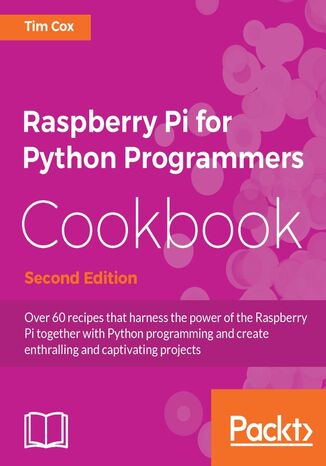
Tim Cox
Raspberry Pi cookbook for Python Programmers is a practical guide for getting the most out of this little computer. This book begins by guiding you through setting up the Raspberry Pi, performing tasks using Python 3 and introduces the first steps to interface with electronics. As you work through each chapter you will build up your skills and knowledge and apply them as you progress throughout the book, delving further and further into the unique abilities and features of the Raspberry Pi.Later, you will learn how to automate tasks by accessing files, build applications using the popular Tkinter library and create games by controlling graphics on screen. You will harness the power of the built-in graphics processor by using Pi3D to generate your own high quality 3D graphics and environments. Connect directly to the Raspberry Pi’s hardware pins to control electronics from switching on LEDs and responding to push buttons right through to driving motors and servos. Learn how to monitor sensors to gather real life data and to use it to control other devices, and view the results over the Internet. Apply what you have learnt by creating your own Pi-Rover or Pi-Hexipod robots. Finally, we will explore using many of the purpose built add-ons available for the Raspberry Pi, as well as interfacing with common household devices in new ways.
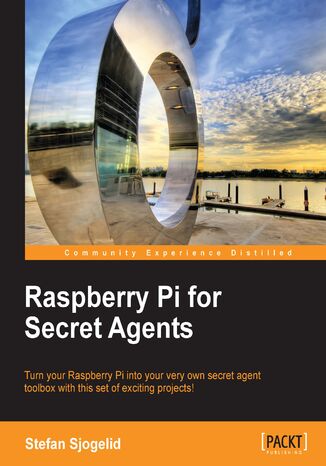
Stefan Sjogelid
Ever wished you could play around with all the neat gadgets your favorite spies use (like James Bond or Michael Westen)? With the introduction of the remarkable Raspberry Pi and a few USB accessories, anybody can now join in on the action.Discover how to turn your Raspberry Pi into a multipurpose secret agent tool! Through a series of fun, easy-to-follow projects you'll learn how to set up audio/video surveillance, explore your Wi-Fi network, play pranks on your friends, and even learn how to free your Raspberry Pi from the constraints of the wall socket.Raspberry Pi for Secret Agents starts out with the initial setup of your Raspberry Pi, guides you through a number of pranks and secret agent techniques, and then shows you how to apply what you've learned out in the real world.Learn how to configure your operating system for maximum mischief and start exploring the audio, video, and Wi-Fi projects. Learn how to record, listen, or talk to people from a distance and how to distort your voice. You can even plug in your webcam and set up a motion detector with an alarm, or find out what the other computers on your Wi-Fi network are up to. Once you've mastered the techniques, combine them with a battery pack and GPS for the ultimate off-road spy kit.
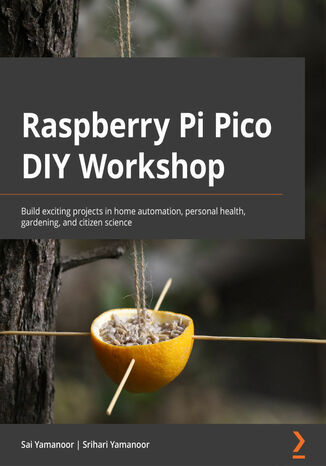
Sai Yamanoor, Srihari Yamanoor
The Raspberry Pi Pico is the latest addition to the Raspberry Pi family of products. Introduced by the Raspberry Pi Foundation, based on their RP2040 chip, it is a tiny, fast microcontroller that packs enough punch to power an extensive range of applications. Raspberry Pi Pico DIY Workshop will help you get started with your own Pico and leverage its features to develop innovative products.This book begins with an introduction to the Raspberry Pi Pico, giving you a thorough understanding of the RP2040's peripherals and different development boards for the Pico designed and manufactured by various organizations. You'll explore add-on hardware and programming language options available for the Pico. Next, you'll focus on practical skills, starting with a simple LED blinking project and building up to a giant seven-segment display, while working with application examples such as citizen science displays, digital health, and robots. You'll also work on exciting projects around gardening, building a weather station, tracking air quality, hacking your personal health, and building a robot, along with discovering tips and tricks to give you the confidence needed to make the best use of RP2040.By the end of this Raspberry Pi book, you'll have built a solid foundation in product development using the RP2040, acquired a skillset crucial for embedded device development, and have a robot that you built yourself.
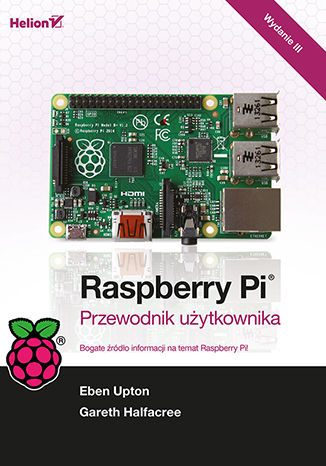
Raspberry Pi. Przewodnik użytkownika. Wydanie III
Eben Upton, Gareth Halfacree
Bogate źródło informacji na temat Raspberry Pi! Raspberry Pi to komputer wielkości karty kredytowej. Wśród jego głównych atutów można wymienić ogrom możliwości oraz niską cenę. Początkowo miał pełnić rolę platformy do nauki programowania, jednak szybko znalazł tysiące innych zastosowań! Raspberry Pi jest używany jako serwer WWW, domowe media center, sterownik urządzeń lub baza do zaawansowanych projektów elektronicznych. Jaki Ty masz pomysł na jego zastosowanie? Ta książka to kolejne wydanie instrukcji użytkownika, dzięki której poznasz tajniki pracy z platformą Raspberry Pi. Została wzbogacona i zaktualizowana o informacje o najnowszej wersji Pi, oznaczonej symbolem B+. Nowa wersja to jeszcze większa moc oraz ciekawe możliwości. Sięgnij po tę książkę i przekonaj się, czym charakteryzuje się architektura ARM oraz jak przygotować Pi do pracy. Naucz się pracować z systemem Linux, a także tworzyć programy i skrypty między innymi za pomocą języka Python. Dowiedz się, jak zbudować centrum multimedialne na podstawie platformy Raspberry Pi oraz jak podłączyć do Pi dodatkowe urządzenia. Książka ta jest obowiązkową lekturą dla wszystkich osób zafascynowanych możliwościami Raspberry Pi. Dzięki tej książce: poznasz historię platformy oraz jej możliwości dowiesz się, jak podłączyć do Pi zewnętrzne urządzenia wykorzystasz złącza GPIO zbudujesz centrum multimedialne z Pi na czele wykorzystasz w pełni możliwości tej niesamowitej platformy Kompletne źródło informacji o Raspberry Pi!
Andrew K. Dennis
A cluster is a type of parallel/distributed processing system which consists of a collection of interconnected stand-alone computers cooperatively working together. Using Raspberry Pi computers, you can build a two-node parallel computing cluster which enhances performance and availability.This practical, example-oriented guide will teach you how to set up the hardware and operating systems of multiple Raspberry Pi computers to create your own cluster. It will then navigate you through how to install the necessary software to write your own programs such as Hadoop and MPICH before moving on to cover topics such as MapReduce. Throughout this book, you will explore the technology with the help of practical examples and tutorials to help you learn quickly and efficiently.Starting from a pile of hardware, with this book, you will be guided through exciting tutorials that will help you turn your hardware into your own super-computing cluster. You'll start out by learning how to set up your Raspberry Pi cluster's hardware. Following this, you will be taken through how to install the operating system, and you will also be given a taste of what parallel computing is about. With your Raspberry Pi cluster successfully set up, you will then install software such as MPI and Hadoop. Having reviewed some examples and written some programs that explore these two technologies, you will then wrap up with some fun ancillary projects. Finally, you will be provided with useful links to help take your projects to the next step.
Danny Staple
The field of robotics is expanding, and this is the perfect time to learn how to create robots at home for different purposes. This book will help you take your first steps in planning, building, and programming a robot with Raspberry Pi Pico, an impressive controller bursting with I/O capabilities. After a quick tour of Pico, you’ll begin designing a robot chassis in 3D CAD. With easy-to-follow instructions, shopping lists, and plans, you’ll start building the robot. Further, you’ll add simple sensors and outputs to extend the robot, reinforce your design skills, and build your knowledge in programming with CircuitPython. You’ll also learn about interactions with electronics, standard robotics algorithms, and the discipline and process for building robots. Moving forward, you’ll learn how to add more complicated sensors and robotic behaviors, with increasing complexity levels, giving you hands-on experience. You’ll learn about Raspberry Pi Pico’s excellent features, such as PIO, adding capabilities such as avoiding walls, detecting movement, and compass headings. You’ll combine these with Bluetooth BLE for seeing sensor data and remotely controlling your robot with a smartphone. Finally, you’ll program the robot to find its location in an arena.By the end of this book, you’ll have built a robot at home, and be well equipped to build more with different levels of complexity.
John Gilbert, Memi Lavi
Organizations undergoing digital transformation rely on IT professionals to design systems to keep up with the rate of change while maintaining stability. With this edition, enriched with more real-world examples, you’ll be perfectly equipped to architect the future for unparalleled innovation.This book guides through the architectural patterns that power enterprise-grade software systems while exploring key architectural elements (such as events-driven microservices, and micro frontends) and learning how to implement anti-fragile systems.First, you'll divide up a system and define boundaries so that your teams can work autonomously and accelerate innovation. You'll cover the low-level event and data patterns that support the entire architecture while getting up and running with the different autonomous service design patterns.This edition is tailored with several new topics on security, observability, and multi-regional deployment. It focuses on best practices for security, reliability, testability, observability, and performance. You'll be exploring the methodologies of continuous experimentation, deployment, and delivery before delving into some final thoughts on how to start making progress.By the end of this book, you'll be able to architect your own event-driven, serverless systems that are ready to adapt and change.
Gineesh Madapparambath, Russ McKendrick, Ed Price
Kubernetes has become the go-to orchestration platform for containerized applications. As a Kubernetes user, you know firsthand how powerful yet complex this tool can be. The Kubernetes Bible cuts through the complexity, offering hands-on examples and expert advice to conquer containerization challengesWith this new edition, you will master cutting edge security practices, deploy seamlessly and scale effortlessly, ensuring unwavering service availability. You will gain the expertise to craft production-grade applications, secure development environments, navigate complex deployments with ease, and become a security maestro. You will be able to optimize network communication and data management across major cloud platforms. Additionally, this book dives deep into these challenges, offering solutions such as multi-container Pods, advanced security techniques, and expert networking guidance. You will also explore persistent storage advancements, cloud-specific cluster management updates, and best practices for traffic routingBy the end of this comprehensive guide, you will possess the skills and knowledge to orchestrate your containerized applications with precision, ensuring their optimal performance and scalability. Stop settling for basic container management. Order your copy today and orchestrate your containers to greatness.