
Hacking
W kategorii Hacking zebrano publikacje dotyczące nie tylko hackerów, crackerów i ich technik działania, ale także opisujące różne aspekty bezpieczeństwa komputerów i danych na nich przechowywanych. Poznacie technikę przeprowadzania audytów bezpieczeństwa oraz sposoby zabezpieczania się przed atakami hackerów, programami szpiegującymi czy zwykłą plagą wirusów.
Nauczycie się chronić nie tylko poszczególne komputery ale całe sieci komputerowe przez opracowanie i wdrożenie odpowiedniej polityki bezpieczeństwa, poprawne użycie firewalli czy odpowiednie skonfigurowanie serwerów pracujących pod Waszym nadzorem, a także opanujecie sposoby bezpiecznego surfowania po internecie.
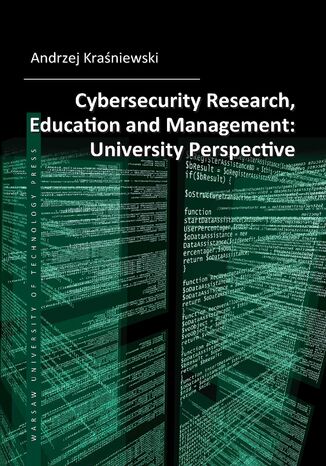
Cybersecurity Research, Education and Management: University Perspective
Andrzej Kraśniewski
In this paper, we focus on those aspects of cybersecurity that are most relevant to universities, intending to provide academic communities with some knowledge that might be useful in their research, education and administration activities related to cybersecurity. The remaining part of the paper is organised as follows. In Section 2, we present basic characteristics of cybersecurity research, its scope and organisation, focusing on initiatives and activities relevant to universities. In Section 3, we show the landscape of cybersecurity education at universities, focusing on competencies acquired by beneficiaries of the educational provision. In Section 4, we discuss challenges faced by universities seen as institutions that have to assure a sufficient level of cybersecurity for their operation. Section 5 presents – as a case study – the developments in cybersecurity research, education and organization taking place at the Warsaw University of Technology. We conclude the paper with a few observations regarding the future developments in cybersecurity, relevant to universities.
Milad Aslaner
If you are a cybersecurity professional looking for practical and actionable guidance to strengthen your organization’s security, then this is the book for you. Cybersecurity Strategies and Best Practices is a comprehensive guide that offers pragmatic insights through real-world case studies. Written by a cybersecurity expert with extensive experience in advising global organizations, this guide will help you align security measures with business objectives while tackling the ever-changing threat landscape. You’ll understand the motives and methods of cyber adversaries and learn how to navigate the complexities of implementing defense measures.As you progress, you’ll delve into carefully selected real-life examples that can be applied in a multitude of security scenarios. You’ll also learn how to cut through the noise and make informed decisions when it comes to cybersecurity solutions by carefully assessing vendor claims and technology offerings. Highlighting the importance of a comprehensive approach, this book bridges the gap between technical solutions and business strategies to help you foster a secure organizational environment.By the end, you’ll have the knowledge and tools necessary to improve your organization's cybersecurity posture and navigate the rapidly changing threat landscape.
Tim Rains, Jeff Jones
Designing a cybersecurity strategy that actually works is difficult when threats evolve faster than budgets, teams, and tools. This book helps security leaders cut through noise by focusing on how organizations are compromised, which strategies succeed, and how to measure outcomes.Written by Tim Rains, a former Global Chief Security Advisor at Microsoft and senior security leader at AWS and Fortune-scale enterprises, this edition expands on the previous editions with major updates and new chapters. You will learn how threat intelligence, attack-centric security, intrusion kill chains, and MITRE ATT&CK can help defenders design stronger strategies.New and expanded content covers ransomware, API security, “living off the land” attacks, resilience as a cybersecurity strategy, and the security of AI systems alongside practical guidance on using AI to improve security outcomes. This book takes a practical, evidence-based approach to cybersecurity strategy, helping you assess trade-offs, avoid costly missteps, and communicate clearly with executives and boards.By the end of this book, you’ll be able to evaluate cybersecurity strategies more effectively, improve enterprise defenses, and communicate security priorities clearly to executives and boards.
Cybersecurity: The Beginner's Guide. A comprehensive guide to getting started in cybersecurity
Dr. Erdal Ozkaya
It's not a secret that there is a huge talent gap in the cybersecurity industry. Everyone is talking about it including the prestigious Forbes Magazine, Tech Republic, CSO Online, DarkReading, and SC Magazine, among many others. Additionally, Fortune CEO's like Satya Nadella, McAfee's CEO Chris Young, Cisco's CIO Colin Seward along with organizations like ISSA, research firms like Gartner too shine light on it from time to time.This book put together all the possible information with regards to cybersecurity, why you should choose it, the need for cyber security and how can you be part of it and fill the cybersecurity talent gap bit by bit. Starting with the essential understanding of security and its needs, we will move to security domain changes and how artificial intelligence and machine learning are helping to secure systems. Later, this book will walk you through all the skills and tools that everyone who wants to work as security personal need to be aware of. Then, this book will teach readers how to think like an attacker and explore some advanced security methodologies. Lastly, this book will deep dive into how to build practice labs, explore real-world use cases and get acquainted with various cybersecurity certifications.By the end of this book, readers will be well-versed with the security domain and will be capable of making the right choices in the cybersecurity field.
Tim Rains, Timothy Youngblood
Tim Rains is Microsoft's former Global Chief Security Advisor and Amazon Web Services’ former Global Security Leader for Worldwide Public Sector. He has spent the last two decades advising private and public sector organizations all over the world on cybersecurity strategies.Cybersecurity Threats, Malware Trends, and Strategies, Second Edition builds upon the success of the first edition that has helped so many aspiring CISOs, and cybersecurity professionals understand and develop effective data-driven cybersecurity strategies for their organizations. In this edition, you’ll examine long-term trends in vulnerability disclosures and exploitation, regional differences in malware infections and the socio-economic factors that underpin them, and how ransomware evolved from an obscure threat to the most feared threat in cybersecurity. You’ll also gain valuable insights into the roles that governments play in cybersecurity, including their role as threat actors, and how to mitigate government access to data. The book concludes with a deep dive into modern approaches to cybersecurity using the cloud.By the end of this book, you will have a better understanding of the threat landscape, how to recognize good Cyber Threat Intelligence, and how to measure the effectiveness of your organization's cybersecurity strategy.
Tim Rains
After scrutinizing numerous cybersecurity strategies, Microsoft’s former Global Chief Security Advisor in this book helps you understand the efficacy of popular cybersecurity strategies and more.Cybersecurity Threats, Malware Trends, and Strategies offers an unprecedented long-term view of the global threat landscape by examining the twenty-year trend in vulnerability disclosures and exploitation, nearly a decade of regional differences in malware infections, the socio-economic factors that underpin them, and how global malware has evolved. This will give you further perspectives into malware protection for your organization. It also examines internet-based threats that CISOs should be aware of.The book will provide you with an evaluation of the various cybersecurity strategies that have ultimately failed over the past twenty years, along with one or two that have actually worked. It will help executives and security and compliance professionals understand how cloud computing is a game changer for them.By the end of this book, you will know how to measure the effectiveness of your organization’s cybersecurity strategy and the efficacy of the vendors you employ to help you protect your organization and yourself.

Cybersecurity w pytaniach i odpowiedziach
Wojciech Ciemski
Co o cyberbezpieczeństwie każdy wiedzieć powinien W świecie, w którym większość naszych mniej lub bardziej wrażliwych danych przechowywana jest w sieci, cyberbezpieczeństwo powinno być tematem numer jeden. Niestety, na ogół nie jest, bo… Po prostu nie chce się nam myśleć o zastosowaniu odpowiednich zabezpieczeń. Stają się one dla nas kluczowe dopiero, kiedy ktoś się cyberwłamie i realnie skradnie coś, co było dla nas istotne: hasło do poczty e-mail, pieniądze z konta w banku, zdjęcia, które wolelibyśmy zachować dla siebie, itd. Tyle że wtedy jest już za późno. Ta książka powstała po to, by jej czytelnik zdążył wyprzedzić zagrożenie. Stanowi wprowadzenie do zagadnienia cyberbezpieczeństwa. Podzielona na kilka kluczowych części (systemy operacyjne, sieci komputerowe, aplikacje webowe, kryptografia, wreszcie cyberbezpieczeństwo jako takie), pozwala zapoznać się z najważniejszymi zagrożeniami i ze sposobami zabezpieczeń. Przybliża terminologię związaną z tematem i stanowi świetny punkt wyjścia do dalszego zgłębiania jego wybranych aspektów. Cyberniebezpieczeństwo czyha. Czy jesteś na nie przygotowany?
Shane Molinari, Jim Packer
In today's world full of online threats, the complexity of harmful software presents a significant challenge for detection and analysis. This insightful guide will teach you how to apply the principles of data science to online security, acting as both an educational resource and a practical manual for everyday use.Data Science for Malware Analysis starts by explaining the nuances of malware, from its lifecycle to its technological aspects before introducing you to the capabilities of data science in malware detection by leveraging machine learning, statistical analytics, and social network analysis. As you progress through the chapters, you’ll explore the analytical methods of reverse engineering, machine language, dynamic scrutiny, and behavioral assessments of malicious software. You’ll also develop an understanding of the evolving cybersecurity compliance landscape with regulations such as GDPR and CCPA, and gain insights into the global efforts in curbing cyber threats.By the end of this book, you’ll have a firm grasp on the modern malware lifecycle and how you can employ data science within cybersecurity to ward off new and evolving threats.
Data science od podstaw. Analiza danych w Pythonie
Joel Grus
Współczesne ogromne zbiory danych zawierają odpowiedzi na prawie każde pytanie. Równocześnie nauka o danych jest dziedziną, która cokolwiek onieśmiela. Znajduje się gdzieś pomiędzy subtelnymi umiejętnościami hakerskimi, twardą wiedzą z matematyki i statystyki a merytoryczną znajomością zagadnień z danej branży. Co więcej, dziedzina ta niezwykle dynamicznie się rozwija. Trud włożony w naukę o danych niewątpliwie się jednak opłaca: biegły analityk danych może liczyć na dobrze płatną, inspirującą i bardzo atrakcyjną pracę. Dzięki tej książce opanujesz najważniejsze zagadnienia związane z matematyką i statystyką, będziesz także rozwijać umiejętności hakerskie. W ten sposób zyskasz podstawy pozwalające na rozpoczęcie przygody z analizą danych. Gruntownie zapoznasz się z potrzebnymi narzędziami i algorytmami. Pozwoli Ci to lepiej zrozumieć ich działanie. Poszczególne przykłady, którymi zilustrowano omawiane zagadnienia, są przejrzyste, dobrze opisane i zrozumiałe. Podczas lektury książki poznasz biblioteki, które umożliwią zaimplementowanie omówionych technik podczas analizy dużych zbiorów danych. Szybko się przekonasz, że aby zostać analitykiem danych, wystarczy odrobina ciekawości, sporo chęci, mnóstwo ciężkiej pracy i... ta książka. Najważniejsze zagadnienia: Praktyczne wprowadzenie do Pythona Podstawy algebry liniowej, statystyki i rachunku prawdopodobieństwa w analizie danych Podstawy uczenia maszynowego Implementacje algorytmów modeli, w tym naiwny klasyfikator bayesowski, regresja liniowa, regresja logistyczna, drzewa decyzyjne, sieci neuronowe i grupowanie, MapReduce Systemy rekomendacji i mechanizmy przetwarzania języka naturalnego Korzystanie z mediów społecznościowych i baz danych. Python. Wyciśniesz z danych każdą kroplę wiedzy!
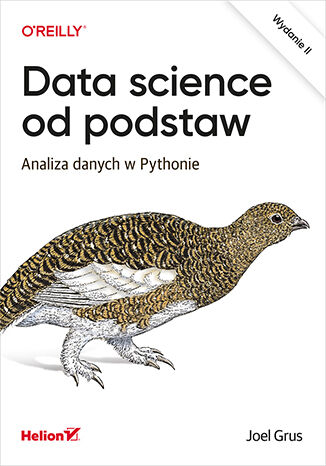
Data science od podstaw. Analiza danych w Pythonie. Wydanie II
Joel Grus
Analityka danych jest uważana za wyjątkowo obiecującą dziedzinę wiedzy. Rozwija się błyskawicznie i znajduje coraz to nowsze zastosowania. Profesjonaliści biegli w eksploracji danych i wydobywaniu z nich pożytecznych informacji mogą liczyć na interesującą pracę i bardzo atrakcyjne warunki zatrudnienia. Jednak aby zostać analitykiem danych, trzeba znać matematykę i statystykę, a także nauczyć się programowania. Umiejętności w zakresie uczenia maszynowego i uczenia głębokiego również są ważne. W przypadku tak specyficznej dziedziny, jaką jest nauka o danych, szczególnie istotne jest zdobycie gruntownych podstaw i dogłębne ich zrozumienie. W tym przewodniku opisano zagadnienia związane z podstawami nauki o danych. Wyjaśniono niezbędne elementy matematyki i statystyki. Przedstawiono także techniki budowy potrzebnych narzędzi i sposoby działania najistotniejszych algorytmów. Książka została skonstruowana tak, aby poszczególne implementacje były jak najbardziej przejrzyste i zrozumiałe. Zamieszczone tu przykłady napisano w Pythonie: jest to język dość łatwy do nauki, a pracę na danych ułatwia szereg przydatnych bibliotek Pythona. W drugim wydaniu znalazły się nowe tematy, takie jak uczenie głębokie, statystyka i przetwarzanie języka naturalnego, a także działania na ogromnych zbiorach danych. Zagadnienia te często pojawiają się w pracy współczesnego analityka danych. W książce między innymi: elementy algebry liniowej, statystyki i rachunku prawdopodobieństwa zbieranie, oczyszczanie i eksploracja danych algorytmy modeli analizy danych podstawy uczenia maszynowego systemy rekomendacji i przetwarzanie języka naturalnego analiza sieci społecznościowych i algorytm MapReduce Nauka o danych: bazuj na solidnych podstawach!
Rohan Pinto
Looking forward to mastering digital identity? This book will help you get to grips with complete frameworks, tools, and strategies for safeguarding personal data, securing online transactions, and ensuring trust in digital interactions in today's cybersecurity landscape.Decentralized Identity Explained delves into the evolution of digital identities, from their historical roots to the present landscape and future trajectories, exploring crucial concepts such as IAM, the significance of trust anchors and sources of truth, and emerging trends such as SSI and DIDs. Additionally, you’ll gain insights into the intricate relationships between trust and risk, the importance of informed consent, and the evolving role of biometrics in enhancing security within distributed identity management systems. Through detailed discussions on protocols, standards, and authentication mechanisms, this book equips you with the knowledge and tools needed to navigate the complexities of digital identity management in both current and future cybersecurity landscapes.By the end of this book, you’ll have a detailed understanding of digital identity management and best practices to implement secure and efficient digital identity frameworks, enhancing both organizational security and user experiences in the digital realm.
Maxim Lapan
Deep Reinforcement Learning Hands-On, Second Edition is an updated and expanded version of the bestselling guide to the very latest reinforcement learning (RL) tools and techniques. It provides you with an introduction to the fundamentals of RL, along with the hands-on ability to code intelligent learning agents to perform a range of practical tasks.With six new chapters devoted to a variety of up-to-the-minute developments in RL, including discrete optimization (solving the Rubik's Cube), multi-agent methods, Microsoft's TextWorld environment, advanced exploration techniques, and more, you will come away from this book with a deep understanding of the latest innovations in this emerging field.In addition, you will gain actionable insights into such topic areas as deep Q-networks, policy gradient methods, continuous control problems, and highly scalable, non-gradient methods. You will also discover how to build a real hardware robot trained with RL for less than $100 and solve the Pong environment in just 30 minutes of training using step-by-step code optimization.In short, Deep Reinforcement Learning Hands-On, Second Edition, is your companion to navigating the exciting complexities of RL as it helps you attain experience and knowledge through real-world examples.
Colin Domoney, Chris Wysopal, Isabelle Mauny
Along with the exponential growth of API adoption comes a rise in security concerns about their implementation and inherent vulnerabilities. For those seeking comprehensive insights into building, deploying, and managing APIs as the first line of cyber defense, this book offers invaluable guidance. Written by a seasoned DevSecOps expert, Defending APIs addresses the imperative task of API security with innovative approaches and techniques designed to combat API-specific safety challenges.The initial chapters are dedicated to API building blocks, hacking APIs by exploiting vulnerabilities, and case studies of recent breaches, while the subsequent sections of the book focus on building the skills necessary for securing APIs in real-world scenarios.Guided by clear step-by-step instructions, you’ll explore offensive techniques for testing vulnerabilities, attacking, and exploiting APIs. Transitioning to defensive techniques, the book equips you with effective methods to guard against common attacks. There are plenty of case studies peppered throughout the book to help you apply the techniques you’re learning in practice, complemented by in-depth insights and a wealth of best practices for building better APIs from the ground up.By the end of this book, you’ll have the expertise to develop secure APIs and test them against various cyber threats targeting APIs.
Defensive Security with Kali Purple. Cybersecurity strategies using ELK Stack and Kali Linux
Karl Lane
Defensive Security with Kali Purple combines red team tools from the Kali Linux OS and blue team tools commonly found within a security operations center (SOC) for an all-in-one approach to cybersecurity. This book takes you from an overview of today's cybersecurity services and their evolution to building a solid understanding of how Kali Purple can enhance training and support proof-of-concept scenarios for your technicians and analysts.After getting to grips with the basics, you’ll learn how to develop a cyber defense system for Small Office Home Office (SOHO ) services. This is demonstrated through the installation and configuration of supporting tools such as virtual machines, the Java SDK, Elastic, and related software. You’ll then explore Kali Purple’s compatibility with the Malcolm suite of tools, including Arkime, CyberChef, Suricata, and Zeek. As you progress, the book introduces advanced features, such as security incident response with StrangeBee’s Cortex and TheHive and threat and intelligence feeds. Finally, you’ll delve into digital forensics and explore tools for social engineering and exploit development.By the end of this book, you’ll have a clear and practical understanding of how this powerful suite of tools can be implemented in real-world scenarios.
Kamalmeet Singh, Ianculescu, Lucian-Paul Torje
Having a knowledge of design patterns enables you, as a developer, to improve your code base, promote code reuse, and make the architecture more robust. As languages evolve, new features take time to fully understand before they are adopted en masse. The mission of this book is to ease the adoption of the latest trends and provide good practices for programmers.We focus on showing you the practical aspects of smarter coding in Java. We'll start off by going over object-oriented (OOP) and functional programming (FP) paradigms, moving on to describe the most frequently used design patterns in their classical format and explain how Java’s functional programming features are changing them.You will learn to enhance implementations by mixing OOP and FP, and finally get to know about the reactive programming model, where FP and OOP are used in conjunction with a view to writing better code. Gradually, the book will show you the latest trends in architecture, moving from MVC to microservices and serverless architecture. We will finish off by highlighting the new Java features and best practices. By the end of the book, you will be able to efficiently address common problems faced while developing applications and be comfortable working on scalable and maintainable projects of any size.
DevOps Bootcamp. The fastest way to learn DevOps
Mitesh Soni
DevOps Bootcamp delivers practical learning modules in manageable chunks. Each chunk is delivered in a day, and each day is a productive one. Each day builds your competency in DevOps. You will be able to take the task you learn every day and apply it to cultivate the DevOps culture.Each chapter presents core concepts and key takeaways about a topic in DevOps and provides a series of hands-on exercises. You will not only learn the importance of basic concepts or practices of DevOps but also how to use different tools to automate application lifecycle management. We will start off by building the foundation of the DevOps concepts. On day two, we will perform Continuous Integration using Jenkins and VSTS both by configuring Maven-based JEE Web Application?. We will also integrate Jenkins and Sonar qube for Static Code Analysis. Further, on day three, we will focus on Docker containers where we will install and configure Docker and also create a Tomcat Container to deploy our Java based web application. On day four, we will create and configure the environment for application deployment in AWS and Microsoft Azure Cloud for which we will use Infrastructure as a Service and Open Source Configuration Management tool Chef. For day five, our focus would be on Continuous Delivery. We will automate application deployment in Docker container using Jenkins Plugin, AWS EC2 using Script, AWS Elastic Beanstalk using Jenkins Plugin, Microsoft Azure VM using script, and Microsoft Azure App Services Using Jenkins. We will also configure Continuous Delivery using VSTS. We will then learn the concept of Automated Testing on day six using Apache JMeter and URL-based tests in VSTS. Further, on day seven, we will explore various ways to automate application lifecycle management using orchestration. We will see how Pipeline can be created in Jenkins and VSTS, so the moment Continuous? Integration is completed successfully, Continuous Delivery will start and application will be deployed. On the final day, our focus would be on Security access to Jenkins and Monitoring of CI resources, and cloud-based resources in AWS and Microsoft Azure Platform as a Service.