
Hacking
The Ransomware Threat Landscape. Prepare for, recognise and survive ransomware attacks
IT Governance Publishing, Alan Calder
The Ransomware Threat Landscape offers an in-depth examination of ransomware, explaining how it works, its modes of access, and the consequences of attacks. The book begins by detailing the mechanisms of ransomware, how cybercriminals exploit vulnerabilities, and the damage it causes to organizations. It further explores the types of ransomware, their infection methods, and how attackers use ransomware for financial gain.The guide provides practical, actionable advice on basic and advanced cybersecurity measures to protect against ransomware. Topics like cybersecurity hygiene, staff awareness, and the importance of creating an anti-ransomware program are covered. The book emphasizes the role of a well-structured risk management framework and its application in preventing attacks and mitigating fallout from infections.For organizations of all sizes, the book offers tailored controls to strengthen defenses. It also explains the steps needed for a comprehensive recovery plan. Advanced prevention strategies for larger enterprises are discussed, making this guide suitable for IT professionals, security experts, and organizational leaders aiming to protect their systems from ransomware threats.
IT Governance Publishing, Richard Bingley
Becoming a successful security consultant requires a unique set of skills that span both the business and security worlds. This handbook serves as a practical guide to help professionals navigate the complex landscape of security consulting. It covers everything from the entrepreneurial aspects of starting a business to the essential security disciplines like private investigations, information security, and protective security. You’ll also explore the growing importance of resilience in both personal and organizational contexts.The book also delves into the crucial elements of security legislation and regulation, offering a thorough understanding of the legal frameworks that affect security professionals. From UK human rights laws to international laws related to corporate management and conflict, readers will gain the knowledge necessary to operate securely and legally in a variety of environments. Whether you are just starting out or looking to refine your security consulting expertise, this handbook provides the insights needed to thrive in the ever-evolving security industry. It’s a must-read for anyone seeking to build a reputation as a trusted expert in the security consulting field.
Blaine Bateman, Ashish Ranjan Jha, Benjamin Johnston,...
Would you like to understand how and why machine learning techniques and data analytics are spearheading enterprises globally? From analyzing bioinformatics to predicting climate change, machine learning plays an increasingly pivotal role in our society.Although the real-world applications may seem complex, this book simplifies supervised learning for beginners with a step-by-step interactive approach. Working with real-time datasets, you’ll learn how supervised learning, when used with Python, can produce efficient predictive models.Starting with the fundamentals of supervised learning, you’ll quickly move to understand how to automate manual tasks and the process of assessing date using Jupyter and Python libraries like pandas. Next, you’ll use data exploration and visualization techniques to develop powerful supervised learning models, before understanding how to distinguish variables and represent their relationships using scatter plots, heatmaps, and box plots. After using regression and classification models on real-time datasets to predict future outcomes, you’ll grasp advanced ensemble techniques such as boosting and random forests. Finally, you’ll learn the importance of model evaluation in supervised learning and study metrics to evaluate regression and classification tasks.By the end of this book, you’ll have the skills you need to work on your real-life supervised learning Python projects.
Glen D. Singh
Build practical ethical hacking skills through realistic attack scenarios that reflect how security assessments are performed in real organizations. This book helps you move beyond theory by showing how vulnerabilities are discovered, exploited responsibly, and reported clearly.Written by Glen D. Singh, a cybersecurity instructor and author with deep experience in offensive security, networking, and security operations, this book emphasizes practical skill development and responsible testing practices. You begin by setting up a safe lab and learning ethical hacking principles, methodologies, and legal considerations. Then you progress through reconnaissance, scanning, and enumeration to understand how attackers gather intelligence and how defenders reduce exposure. You’ll continue with vulnerability assessment, system hacking, malware basics, and network attacks using structured labs.As environments grow more complex, you explore wireless attacks, IoT and OT threats, and gain awareness of SIEM and EDR detection. The final chapters focus on professional reporting and career development, showing how to present findings clearly and ethically.By the end of this book, you will be able to perform ethical hacking engagements from reconnaissance to reporting with confidence.
Glen D. Singh
Journey into the world of Kali Linux – the central hub for advanced penetration testing, with this ultimate guide to exposing security vulnerabilities in websites and both wired and wireless enterprise networks.With real-world scenarios, practical steps and coverage of popular tools, this third edition of the bestselling Ultimate Kali Linux Book is your fast track to learning penetration testing with Kali Linux 2024.x. As you work through the book, from preliminary penetration testing activities through performing network and website penetration testing, to exploring Active Directory and social engineering attacks, you’ll discover the range of vulnerability assessment tools in Kali Linux, building your confidence and proficiency as a penetration tester or ethical hacker.This new edition of the book features a brand new chapter on Open Source Intelligence (OSINT), as well as new labs on web applications and social engineering. Procedures for building virtual labs have also been improved, making these easier to understand and follow.Think of this book as your stepping stone into the modern world of penetration testing and ethical hacking – with the practical guidance and industry best practices the book provides, you’ll be ready to tackle real-world cybersecurity challenges head-on.*Email sign-up and proof of purchase required
Glen D. Singh
Kali Linux is the most popular and advanced penetration testing Linux distribution within the cybersecurity industry. Using Kali Linux, a cybersecurity professional will be able to discover and exploit various vulnerabilities and perform advanced penetration testing on both enterprise wired and wireless networks. This book is a comprehensive guide for those who are new to Kali Linux and penetration testing that will have you up to speed in no time. Using real-world scenarios, you’ll understand how to set up a lab and explore core penetration testing concepts. Throughout this book, you’ll focus on information gathering and even discover different vulnerability assessment tools bundled in Kali Linux. You’ll learn to discover target systems on a network, identify security flaws on devices, exploit security weaknesses and gain access to networks, set up Command and Control (C2) operations, and perform web application penetration testing. In this updated second edition, you’ll be able to compromise Active Directory and exploit enterprise networks. Finally, this book covers best practices for performing complex web penetration testing techniques in a highly secured environment. By the end of this Kali Linux book, you’ll have gained the skills to perform advanced penetration testing on enterprise networks using Kali Linux.
Donald A. Tevault
Dive into the world of Linux shell scripting with this hands-on guide. If you’re comfortable using the command line on Unix or Linux but haven’t fully explored Bash, this book is for you. It’s designed for programmers familiar with languages like Python, JavaScript, or PHP who want to make the most of shell scripting.This isn’t just another theory-heavy book—you’ll learn by doing. Each chapter builds on the last, taking you from shell basics to writing practical scripts that solve real-world problems. With nearly a hundred interactive labs, you’ll gain hands-on experience in automation, system administration, and troubleshooting.While Bash is the primary focus, you'll also get a look at Z Shell and PowerShell, expanding your skills and adaptability. From mastering command redirection and pipelines to writing scripts that work across different Unix-like systems, this book equips you for real-world Linux challenges.By the end, you'll be equipped to write efficient shell scripts that streamline your workflow and improve system automation.
Benjamin Strout
Vulnerability researchers are in increasingly high demand as the number of security incidents related to crime continues to rise with the adoption and use of technology. To begin your journey of becoming a security researcher, you need more than just the technical skills to find vulnerabilities; you’ll need to learn how to adopt research strategies and navigate the complex and frustrating process of sharing your findings. This book provides an easy-to-follow approach that will help you understand the process of discovering, disclosing, and publishing your first zero-day vulnerability through a collection of examples and an in-depth review of the process.You’ll begin by learning the fundamentals of vulnerabilities, exploits, and what makes something a zero-day vulnerability. Then, you'll take a deep dive into the details of planning winning research strategies, navigating the complexities of vulnerability disclosure, and publishing your research with sometimes-less-than-receptive vendors.By the end of the book, you'll be well versed in how researchers discover, disclose, and publish vulnerabilities, navigate complex vendor relationships, receive credit for their work, and ultimately protect users from exploitation. With this knowledge, you’ll be prepared to conduct your own research and publish vulnerabilities.
Andrew Pease
Threat Hunting with Elastic Stack will show you how to make the best use of Elastic Security to provide optimal protection against cyber threats. With this book, security practitioners working with Kibana will be able to put their knowledge to work and detect malicious adversary activity within their contested network.You'll take a hands-on approach to learning the implementation and methodologies that will have you up and running in no time. Starting with the foundational parts of the Elastic Stack, you'll explore analytical models and how they support security response and finally leverage Elastic technology to perform defensive cyber operations.You’ll then cover threat intelligence analytical models, threat hunting concepts and methodologies, and how to leverage them in cyber operations. After you’ve mastered the basics, you’ll apply the knowledge you've gained to build and configure your own Elastic Stack, upload data, and explore that data directly as well as by using the built-in tools in the Kibana app to hunt for nefarious activities.By the end of this book, you'll be able to build an Elastic Stack for self-training or to monitor your own network and/or assets and use Kibana to monitor and hunt for adversaries within your network.
Threat Modeling Best Practices. Proven frameworks and practical techniques to secure modern systems
Derek Fisher
Threat modeling has become a cornerstone of modern cybersecurity, yet it is often overlooked, leaving security gaps that attackers can exploit. With the rise in system complexity, cloud adoption, AI-driven threats, and stricter compliance requirements, security teams need a structured approach to proactively spot and stop risks before attackers do. This book delivers exactly that, offering actionable insights for applying industry best practices and emerging technologies to secure systems. It breaks down the fundamentals of threat modeling and walks you through key frameworks and tools such as STRIDE, MITRE ATT&CK, PyTM, and Attack Paths, helping you choose the right model and create a roadmap tailored to your business. You'll learn how to use leading threat modeling tools, identify and prioritize potential threats, and integrate these practices into the software development life cycle to detect risks early. The book also examines how AI can enhance analysis and streamline security decision-making for faster, stronger defenses.By the end, you'll have everything you need to build systems that anticipate and withstand evolving threats, keeping your organization secure in an ever-changing digital landscape.*Email sign-up and proof of purchase required
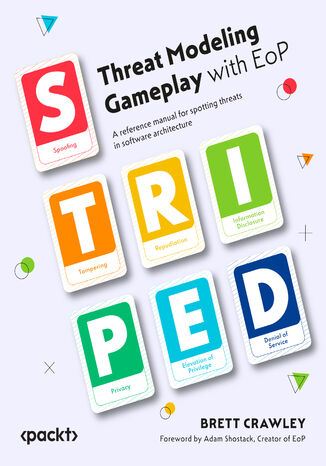
Threat Modeling Gameplay with EoP. A reference manual for spotting threats in software architecture
Brett Crawley, Adam Shostack
Are you looking to navigate security risks, but want to make your learning experience fun? Here's a comprehensive guide that introduces the concept of play to protect, helping you discover the threats that could affect your software design via gameplay.Each chapter in this book covers a suit in the Elevation of Privilege (EoP) card deck (a threat category), providing example threats, references, and suggested mitigations for each card. You’ll explore the methodology for threat modeling—Spoofing, Tampering, Repudiation, Information Disclosure, and Elevation of Privilege (S.T.R.I.D.E.) with Privacy deck and the T.R.I.M. extension pack. T.R.I.M. is a framework for privacy that stands for Transfer, Retention/Removal, Inference, and Minimization. Throughout the book, you’ll learn the meanings of these terms and how they should be applied. From spotting vulnerabilities to implementing practical solutions, the chapters provide actionable strategies for fortifying the security of software systems.By the end of this book, you will be able to recognize threats, understand privacy regulations, access references for further exploration, and get familiarized with techniques to protect against these threats and minimize risks.
Dr. Paul Duplys, Dr. Roland Schmitz
TLS is the most widely used cryptographic protocol today, enabling e-commerce, online banking, and secure online communication. Written by Dr. Paul Duplys, Security, Privacy & Safety Research Lead at Bosch, and Dr. Roland Schmitz, Internet Security Professor at Stuttgart Media University, this book will help you gain a deep understanding of how and why TLS works, how past attacks on TLS were possible, and how vulnerabilities that enabled them were addressed in the latest TLS version 1.3. By exploring the inner workings of TLS, you’ll be able to configure it and use it more securely.Starting with the basic concepts, you’ll be led step by step through the world of modern cryptography, guided by the TLS protocol. As you advance, you’ll be learning about the necessary mathematical concepts from scratch. Topics such as public-key cryptography based on elliptic curves will be explained with a view on real-world applications in TLS. With easy-to-understand concepts, you’ll find out how secret keys are generated and exchanged in TLS, and how they are used to creating a secure channel between a client and a server.By the end of this book, you’ll have the knowledge to configure TLS servers securely. Moreover, you’ll have gained a deep knowledge of the cryptographic primitives that make up TLS.

Tokenomics. The Crypto Shift of Blockchains, ICOs, and Tokens
Sean Au, Thomas Power(GBP)
Tokenomics is the economy of this new world. This is a no-holds-barred, in-depth exploration of the way in which we can participate in the blockchain economy. The reader will learn the basics of bitcoin, blockchains, and tokenomics; what the very first ICO was; and how over a period of 5 years, various projects managed to raise the enormous sums of money they did. The book then provides insights from ICO experts and looks at what the future holds. By comparing the past, current, and future of this technology, the book will inform anyone, whatever motivates their interest.The crypto shift of blockchains, ICOs, and tokens is much more than just buying bitcoins, creating tokens, or raising millions in a minute in an ICO. It is a new paradigm shift from centralized to decentralized, from closed to open, and from opaqueness to transparency. ICOs and the creation of tokens during the craze of 2017 needed a lot of preparation, an understanding of cryptocurrencies and of emerging legal frameworks, but this has spurred a new movement to tokenize the world.The author gives an unbiased, authoritative picture of the current playing field, exploring the token opportunities and provides a unique insight into the developing world of this tokenized economy. This book will nourish hungry minds wanting to grow their knowledge in this fascinating area.
Eric Richardson, Filipi Pires
Modern organizations rely on complex vendor ecosystems, but third-party risk management (TPRM) and cybersecurity often operate in silos. This book shows how to connect vendor risk management with supply chain cybersecurity using a practical, lifecycle-driven approach.You’ll design a program covering onboarding, vendor risk assessment, continuous monitoring, and offboarding. You’ll begin by examining why TPRM and cybersecurity often operate in separate lanes, and what that gap costs in downtime, breach impact, and compliance exposure. Next, you’ll develop a modern taxonomy of supply chain risk, including fourth-party dependencies and software supply chain concerns, so risk discussions use consistent categories and measurable assumptions.From there, you’ll adopt a lifecycle-based model to structure vendor onboarding, assessment, monitoring, and offboarding—supported by vendor tiering, segmentation, and control mapping. The final chapter focuses on the regulatory blueprint: how to interpret NIST C-SCRM, ISO/IEC 27036, DORA, GDPR, and Executive Order 14028, then convert them into evidence-driven controls and audit-ready documentation.
Eric F Crist
OpenVPN, the most widely used open source VPN package, allows you to create a secure network across systems, keeping your private data secure. Connectivity and other issues are a pain to deal with, especially if they are impacting your business. This book will help you resolve the issues faced by OpenVPN users and teach the techniques on how to troubleshoot it like a true expert. This book is a one stop solution for troubleshooting any issue related to OpenVPN. We will start by introducing you to troubleshooting techniques such as Packet Sniffing, Log Parsing, and OpenSSL. You will see how to overcome operating system specific errors. Later on, you will get to know about network and routing errors by exploring the concepts of IPv4 and IPv6 networking issues. You will discover how to overcome these issues to improve the performance of your OpenVPN deployment. By the end of the book, you will know the best practices, tips, and tricks to ensure the smooth running of your OpenVPN.

Twoje bezpieczeństwo w świecie cyber i AI 2026 Część 2 Cyberhigiena
Dariusz Gołębiowski
Teoria to za mało, by powstrzymać cyberprzestępców. Czas na konkretne działania i narzędzia, które zamienią Twoją wiedzę w niezdobytą cyfrową twierdzę. Dowiedz się, jak krok po kroku zabezpieczyć swoje urządzenia, konta i codzienne operacje w sieci na rok 2026. Książka "Twoje bezpieczeństwo w świecie cyber i AI. Część 2: Praktyka i narzędzia 2026" to czysto rzemieślniczy, narzędziowy przewodnik po nowoczesnej ochronie prywatności i danych. Bez owijania w bawełnę i bez skomplikowanego kodu - autor pokazuje sprawdzone programy, aplikacje oraz ustawienia, które skutecznie odetną oszustów od Twojego życia. To pozycja dla każdego, kto chce przejść od świadomości zagrożeń do pełnej kontroli nad swoim cyfrowym ekosystemem. Czego nauczysz się z Części 2 Cyberhigiena - praktyka i narzędzia cyberbezpieczeństwa? Arsenał obronny: Przegląd i wybór najlepszych menedżerów haseł, aplikacji do uwierzytelniania (2FA) oraz bezpiecznych kluczy sprzętowych. Prywatność na co dzień: Jak poprawnie skonfigurować system operacyjny (Windows, macOS, Linux), smartfon (Android, iOS) oraz przeglądarkę internetową, by nie zostawiać cyfrowego śladu. Bezpieczne korzystanie z AI: Jakie narzędzia i wtyczki pomagają weryfikować treści generowane przez sztuczną inteligencję i demaskować próby manipulacji. Ochrona sieci domowej: Prosta instrukcja konfiguracji domowego routera, sieci Wi-Fi dla gości oraz wdrożenia VPN w celu szyfrowania ruchu. Dla kogo jest ta książka Twoje bezpieczeństwo w świecie cyber i AI 2026 Część 2 Cyberhigiena? Dla czytelników Części 1, którzy chcą natychmiast przekuć teorię w praktyczne zabezpieczenia. Dla osób samodzielnych, szukających jasnych instrukcji "kliknięcie po kliknięciu" bez konieczności zatrudniania informatyka. Dla każdego, kto chce świadomie wybrać i skonfigurować narzędzia chroniące prywatność finansową i osobistą. Twoje bezpieczeństwo zależy od narzędzi, z których korzystasz i od tego, jak je ustawisz. Nie zostawiaj domyślnych opcji, które sprzyjają cyberprzestępcom. Uzbrój się w odpowiednie aplikacje i przejmij kontrolę już dziś! cyberbezpieczeństwo, bezpieczny internet, ochrona przed oszustwami, sztuczna inteligencja bezpieczeństwo, jak chronić dane, phishing i vishing, bezpieczeństwo w sieci, poradnik cyberbezpieczeństwa, AI oszustwa, ochrona prywatności, praktyka, narzędzia, cyberbezpieczeństwa #bezpieczeństwo #świat #cyber #AI #cyberbezpieczeństwo #poradnik #cyberhigiena #narzędzia

Twoje bezpieczeństwo w świecie cyber i AI 2026 Część 3 Dziecko i Ty
Dariusz Gołębiowski
Internet, gry, media społecznościowe i sztuczna inteligencja są dziś naturalną częścią życia dzieci i nastolatków. Dziecko uczy się, rozmawia, ogląda, gra, tworzy, korzysta z AI i buduje relacje w świecie, którego wielu dorosłych nie znało w swoim dzieciństwie. Dlatego pytanie nie brzmi już: "czy dziecko korzysta z internetu?", ale: czy robi to bezpiecznie, świadomie i czy wie, że w razie problemu może przyjść do zaufanego dorosłego? "Twoje bezpieczeństwo w świecie cyber i AI 2026. Część 3: Dziecko i Ty" to praktyczny poradnik dla rodziców, opiekunów, nauczycielek, nauczycieli i wszystkich dorosłych, którzy chcą chronić dziecko w cyfrowym świecie bez paniki, moralizowania i kontroli totalnej. To książka o bezpieczeństwie dziecka w internecie, ale również o rozmowie, zaufaniu, granicach, uważności i mądrym towarzyszeniu dziecku w świecie technologii. W środku znajdziesz między innymi: - proste wyjaśnienie najważniejszych zagrożeń online: cyberprzemocy, groomingu, sextingu, oszustw, uzależniających mechanizmów aplikacji i ryzyk związanych z udostępnianiem danych, - praktyczne wskazówki, jak rozpoznać, że dziecko może mieć problem w internecie, grze, komunikatorze lub mediach społecznościowych, - omówienie bezpieczeństwa w social media, grach online, aplikacjach mobilnych i kontaktach z nieznajomymi, - spokojne, ale szczere spojrzenie na sztuczną inteligencję w życiu dziecka, - konkretne zasady cyberhigieny dla dzieci, nastolatków i dorosłych, - wskazówki dotyczące kontroli rodzicielskiej w Windows, Linux i Android, - podpowiedzi, jak rozmawiać z dzieckiem o trudnych tematach bez zawstydzania i straszenia, - to taki Rodzinny Kompas Cyfrowego Bezpieczeństwa, który pomaga ustalić wspólne zasady korzystania z technologii. Ta książka nie jest instrukcją szpiegowania dziecka. Nie obiecuje, że jedna aplikacja rozwiąże wszystkie problemy. Pokazuje natomiast, jak budować bezpieczeństwo oparte na relacji, rozmowie, rozsądnych zasadach i realnym rozumieniu zagrożeń. Najlepszym zabezpieczeniem dziecka w cyfrowym świecie nie jest sama kontrola rodzicielska. Jest nim dorosły, który rozumie, co może się wydarzyć, umie spokojnie zareagować i nie traci zaufania dziecka wtedy, gdy ono najbardziej potrzebuje pomocy. Ten ebook jest dla Ciebie, jeśli chcesz: lepiej rozumieć cyfrowy świat dziecka, wiedzieć, czym są cyberprzemoc, grooming, sexting, phishing, oszustwa i ryzykowne kontakty online, chronić dziecko w internecie bez ciągłego straszenia, ustalić rodzinne zasady korzystania z telefonu, gier, social media i AI, rozmawiać z dzieckiem tak, aby chciało przyjść po pomoc, zbudować bezpieczeństwo cyfrowe oparte na zaufaniu, a nie tylko na zakazach. Nie musisz być ekspertem od technologii. Ta książka została napisana prostym, ludzkim językiem, tak aby można było od razu wykorzystać ją w domu, szkole lub rozmowie z dzieckiem. Bez paniki. Bez kontroli totalnej. Bez technicznego żargonu. Praktycznie, spokojnie i poswojsku. cyberprzemoc, grooming, sexting, phishing, oszustwa, ryzykowne kontakty online, cyberbezpieczeństwo, bezpieczny internet, jak chronić dane, phishing i vishing, bezpieczeństwo w sieci, poradnik cyberbezpieczeństwa, AI oszustwa, ochrona prywatności, praktyka, narzędzia, cyberbezpieczeństwa #bezpieczeństwo #cyberprzemoc # grooming #sexting #phishing #oszustwa #dziecko #AI #cyberbezpieczeństwo #poradnik #cyberhigiena #narzędzia ⭐⭐⭐⭐⭐ Recenzja czytelniczki Kaśka, mama dwójki dzieci w wieku szkolnym Kupiłam tę książkę z myślą: "przeczytam fragmentami, może coś mi się przyda". A skończyło się na tym, że czytałam ją z długopisem w ręku i co chwilę robiłam przerwy, żeby porozmawiać z dziećmi. Największa wartość tej części to to, że nie straszy i nie poucza. Autor nie pisze z pozycji "wszystkowiedzącego eksperta", tylko jak ktoś, kto naprawdę rozumie, jak wygląda codzienność rodziny z dziećmi, szkołą, telefonami i Internetem w tle. Bardzo pomogły mi rozdziały o cyberprzemocy i grach - nagle zobaczyłam rzeczy, które wcześniej bagatelizowałam. A "Rodzinny Kompas Cyfrowego Bezpieczeństwa" to coś, do czego wróciliśmy wspólnie przy kolacji. Bez kłótni. Bez straszenia. Po tej książce czuję, że mam większy spokój, bo wiem: - na co zwracać uwagę - jak rozmawiać, a nie tylko zakazywać - i że moje dzieci wiedzą, że mogą do mnie przyjść, gdy coś je zaniepokoi To nie jest poradnik tylko "o dzieciach w sieci". To książka o byciu rodzicem w cyfrowym świecie. Polecam każdej mamie i każdemu tacie - naprawdę warto.

Twoje bezpieczeństwo w świecie cyber i AI Część 1 Wprowadzenie 2026
Dariusz Gołębiowski
Twoje bezpieczeństwo w świecie cyber i AI Część 1: Wprowadzenie - wydanie 2026 (trzecie, rozszerzone) Autor - lider nowoczesnych technologii - Audytor Wiodący Systemu Zarządzania Bezpieczeństwem Informacji ISO 27001 - szkoli, doradza, wdraża i porządkuje obszar cyberbezpieczeństwa, RODO i ryzyka informacyjnego. Pracuję z kadrą zarządzającą oraz zespołami, pokazując jak chronić: dane, ludzi i reputację Twojej organizacji - w praktyce, a nie tylko na papierze. A do tego - moje doświadczenie zawodowe przelewam do poradników :). To już trzecie wydanie poradnika, który tysiącom czytelniczek i czytelników pomógł zrozumieć cyfrowy świat bez straszenia, ale z pełną świadomością zagrożeń. Wersja 2026 to nie kosmetyczna poprawka - to aktualizacja do realiów, w których cyberzagrożenia i sztuczna inteligencja przenikają codzienne życie szybciej niż kiedykolwiek wcześniej. Ten ebook to solidne fundamenty wiedzy, bez których nie da się dziś mówić ani o bezpieczeństwie rodziny, ani o bezpiecznym korzystaniu z internetu, smartfonów, komputerów czy narzędzi AI. ✅ Dlaczego warto sięgnąć po wydanie 2026? 🔹 Trzecie wydanie = doświadczenie i praktyka To nie jest teoretyczny poradnik pisany "z internetu". To efekt lat pracy szkoleniowej, doradczej i rozmów z realnymi ludźmi: rodzicami, nauczycielami, pracownikami, seniorami. 🔹 Aktualne zagrożenia cyber i AI Nowe oszustwa, nowe mechanizmy manipulacji, nowe wykorzystania sztucznej inteligencji - wszystko wyjaśnione prostym językiem, bez technicznego żargonu. 🔹 Bezpieczeństwo od kuchni, nie od regulaminów Autor pokazuje cyberbezpieczeństwo tak, jak gotowanie: 👉 jeśli znasz podstawy, nie przypalisz się - nawet w bardzo gorącej kuchni internetu. 🔹 Rodzina w centrum uwagi Ten poradnik nie jest tylko "dla informatyków". Jest dla Ciebie, Twojej rodziny, dzieci, bliskich i każdego, kto chce świadomie żyć w świecie cyfrowym. 📘 Co znajdziesz w środku? ✔️ Fundamenty cyberbezpieczeństwa - od poziomu kraju po poziom jednej osoby ✔️ Zagrożenia cyfrowe: kto atakuje, jak atakuje i dlaczego ✔️ Sztuczna inteligencja - zagrożenie czy nadzieja? (bez skrajności i mitów) ✔️ Systemy operacyjne i programy - co naprawdę ma znaczenie dla bezpieczeństwa ✔️ Przeglądarki internetowe - różnice, ryzyka, świadome wybory ✔️ Linux, Windows, Android - bezpieczeństwo w praktyce ✔️ Adresy i źródła, które warto znać (i takie, które lepiej omijać) To wprowadzenie, które przygotowuje Cię do dalszych części serii - ale samo w sobie stanowi kompletną, samodzielną porcję wiedzy. 👤 Dla kogo jest ten ebook? ✔️ dla rodziców i opiekunów ✔️ dla nauczycieli i edukatorów ✔️ dla pracowników i przedsiębiorców ✔️ dla osób, które "nie są techniczne", ale chcą być bezpieczne ✔️ dla każdego, kto czuje, że cyfrowy świat przyspieszył... i chce za nim nadążyć 🧠 To nie jest poradnik strachu. To poradnik świadomości. Jeśli chcesz rozumieć, a nie tylko "klikać dalej" - jeśli chcesz chronić siebie i bliskich, zamiast liczyć na szczęście - jeśli chcesz wejść w świat cyber i AI z głową, a nie na oślep... 👉 To wydanie 2026 jest właśnie dla Ciebie.

Twoje dziecko w sieci. Przewodnik po cyfrowym świecie dla czasami zdezorientowanych rodziców
Agnieszka E. Taper
Internet jest wszędzie zajrzyj, poznaj wirtualny świat młodych i pytaj o wszystko! Obowiązkowa lektura dla rodziców dzieci w każdym wieku! Bo wszyscy jesteśmy online. Codziennie każdy z nas, niezależnie od wieku, spędza wiele czasu w Internecie. Młodzi ludzie dużo szybciej i sprawniej w nim buszują, a my rodzice, nauczyciele i opiekunowie potrzebujemy narzędzi, by mądrze im towarzyszyć, dostrzegać ewentualne zagrożenia i szybko działać. Jak reagować na cyberprzemoc niezależnie od tego, czy jesteśmy jej świadkami, ofiarami czy rodzicami jej twórców? Gdzie szukać dobrych i rzetelnych informacji na temat otaczającego nas świata i w jaki sposób unikać fake newsów? Jak zadbać o to, by maksymalnie ograniczać dostęp do pornografii, pedofilii, ruchów pro-ana i wszelkich oszustw? Dzieci i nastolatki bardziej ufają internetowi niż dorosłym i to w sieci szukają informacji na temat otaczającego ich świata. Ten poradnik pomoże choć trochę zmienić tę tendencję. Znajdziesz w nim dużą dawkę wiedzy, wiele ciekawych profili, linków i rad, dzięki którym pokierujesz aktywnością dziecka online.
Zhassulan Zhussupov
Skuteczne wzmacnianie cyberbezpieczeństwa wymaga wiedzy o sposobach działania hakerów. Żaden analityk złośliwego oprogramowania, pentester czy łowca zagrożeń nie obejdzie się bez wiedzy o budowie malware ani bez umiejętności programowania ofensywnego. Innymi słowy, jeśli chcesz poprawić bezpieczeństwo IT w swojej organizacji, musisz dobrze znać narzędzia, taktyki i techniki używane przez cyberprzestępców. Ta książka jest kompleksowym przewodnikiem po ciemnej stronie cyberbezpieczeństwa ― zapewni Ci wiedzę i umiejętności niezbędne do skutecznego zwalczania złośliwego oprogramowania. Nauczysz się poruszać wśród zawiłości związanych z tworzeniem złośliwego oprogramowania, a także dobrze poznasz techniki i strategie stosowane przez cyberprzestępców. Zdobędziesz też praktyczne doświadczenie w projektowaniu i implementowaniu popularnych rozwiązań stosowanych w prawdziwych złośliwych aplikacjach, na przykład Carbanak, Carberp, Stuxnet, Conti, Babuk i BlackCat. Nie zabrakło tu zasad etycznego hakingu i tajników budowy złośliwego oprogramowania, jak techniki unikania wykrycia, mechanizmy persystencji i wiele innych, które poznasz dzięki lekturze. W książce: sposób myślenia twórców złośliwego oprogramowania techniki stosowane w różnych rodzajach malware rekonstrukcja ataków APT metody obchodzenia mechanizmów bezpieczeństwa ponad 80 działających przykładów malware matematyczne podstawy współczesnego złośliwego oprogramowania O książce w mediach: Eksperyment myślowy ― recenzja książki
Parth Ghiya
In the last few years or so, microservices have achieved the rock star status and right now are one of the most tangible solutions in enterprises to make quick, effective, and scalable applications. The apparent rise of Typescript and long evolution from ES5 to ES6 has seen lots of big companies move to ES6 stack. If you want to learn how to leverage the power of microservices to build robust architecture using reactive programming and Typescript in Node.js, then this book is for you.Typescript Microservices is an end-to-end guide that shows you the implementation of microservices from scratch; right from starting the project to hardening and securing your services. We will begin with a brief introduction to microservices before learning to break your monolith applications into microservices. From here, you will learn reactive programming patterns and how to build APIs for microservices. The next set of topics will take you through the microservice architecture with TypeScript and communication between services. Further, you will learn to test and deploy your TypeScript microservices using the latest tools and implement continuous integration. Finally, you will learn to secure and harden your microservice.By the end of the book, you will be able to build production-ready, scalable, and maintainable microservices using Node.js and Typescript.

Ukryta tożsamość. Jak się obronić przed utratą prywatności
Tomasz Ciborski
Wymknij się podglądaczom! Totalna inwigilacja, czyli witajcie w globalnej wiosce Bezpieczeństwo w sieci i mailu, czyli sprytne sposoby chronienia prywatności Tor i kryptowaluty, czyli zaawansowane sposoby zachowania anonimowości Żyjemy w globalnej wiosce. Sieć WWW dokładnie oplotła świat - kawiarenki internetowe są w peruwiańskiej dżungli i wioskach Pigmejów, a łącza satelitarne mają nawet stacje badawcze na Antarktydzie. Wszechobecność internetu jest oczywiście szalenie wygodna… ale ma to też swoje konsekwencje. Każde Twoje wejście do sieci jest rejestrowane. Analizie poddawane są Twoje preferencje w wyborze stron, na ekranie wyświetlają Ci się dobrane do nich reklamy, a każdy w miarę sprawny haker mógłby bez trudu dotrzeć do Twoich prywatnych e-maili. Niezbyt miła perspektywa, prawda? Na szczęście istnieją sposoby ochrony swojej prywatności w sieci. Jeśli chcesz je poznać i poczuć się bezpiecznie, sięgnij po tę książkę. Znajdziesz w niej mnóstwo metod zacierania własnych śladów. Dowiesz się, jak pozostać anonimowym podczas przeglądania sieci i jak szyfrować swoje wiadomości e-mail (lub korzystać z alternatywnych metod ich przesyłania). Zorientujesz się, jak działa undergroundowy bliźniak Internetu, czyli Tor. Sprawdzisz, co można kupić za bitcoiny. Odkryjesz także, jak zapewnić bezpieczeństwo Twoim urządzeniom i nie dać wykraść sobie żadnych danych. Nie daj się złapać w sieć! Inwigilacja globalna i lokalna Naucz się otwartego oprogramowania Bezpieczne przeglądanie internetu Poczta i szyfrowanie wiadomości Bitmessage — alternatywa dla e-maili W mrokach cebulowej sieci Kryptowaluty i pieniądz wirtualny Bezpieczeństwo dysków i partycji dyskowych Bezpieczeństwo mobilne Jeszcze więcej sposobów na ochronę prywatności — komunikatory internetowe, sieci I2P i VPN Wszystko w jednym — Linux Tails Naucz się dobrze pilnować swoich danych!

Max Kanat-Alexander
In Understanding Software, Max Kanat-Alexander, Technical Lead for Code Health at Google, shows you how to bring simplicity back to computer programming. Max explains to you why programmers suck, and how to suck less as a programmer. There’s just too much complex stuff in the world. Complex stuff can’t be used, and it breaks too easily. Complexity is stupid. Simplicity is smart.Understanding Software covers many areas of programming, from how to write simple code to profound insights into programming, and then how to suck less at what you do! You'll discover the problems with software complexity, the root of its causes, and how to use simplicity to create great software. You'll examine debugging like you've never done before, and how to get a handle on being happy while working in teams.Max brings a selection of carefully crafted essays, thoughts, and advice about working and succeeding in the software industry, from his legendary blog Code Simplicity. Max has crafted forty-three essays which have the power to help you avoid complexity and embrace simplicity, so you can be a happier and more successful developer.Max's technical knowledge, insight, and kindness, has earned him code guru status, and his ideas will inspire you and help refresh your approach to the challenges of being a developer.
Jose Lazaro, Marcus Burnap, Rod Trent
In the evolving cybersecurity landscape, the integration of Microsoft Defender XDR and Security Copilot presents a game-changing approach to modern threat detection and response. With this book, you’ll understand how these tools, in conjunction with Microsoft’s extensive ecosystem, enable organizations to outpace emerging threats.Starting with core XDR concepts, security frameworks, and Microsoft’s competitive advantages in cybersecurity, you’ll master the foundational aspects of deploying Microsoft Sentinel, configuring security infrastructure, and optimizing security operations using AI-driven tools. Advanced topics, including Zero-Trust strategies, DevSecOps integration, and partner programs, prepare you for increasingly sophisticated scenarios in Microsoft cloud security. You’ll also explore practical deployment workflows, covering cost analysis, role-based access configurations, and fast-tracked Sentinel deployment using CI/CD pipelines.By the end of this book, you’ll have gained insights into security automation, threat detection, and AI integration with Security Copilot for optimized operations and have the confidence to implement and manage Microsoft Defender XDR and Sentinel in complex environments, driving scalable and secure solutions.*Email sign-up and proof of purchase required