
Informatyka
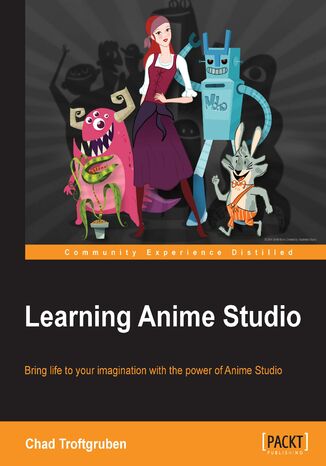
Learning Anime Studio. Bring life to your imagination with the power of Anime Studio
Chad Troftgruben
Written in an easy to follow manner with practical exercises, this book takes you through every aspect of Anime Studio, guiding you to create your own original cartoon. Learning Anime Studio is for newcomers to Anime Studio or animation in general. Hobbyists and newcomers with ambitions of being an animator will get the most out of this book. However, intermediate and long time users will be able to use various chapters as a reference to some of Anime Studio’s tools and features. The book also serves as a guide for the new enhancements introduced in Anime Studio Pro 10.
Learning Ansible 2. Click here to enter text. - Second Edition
Fabio Alessandro Locati
Ansible is an open source automation platform that assists organizations with tasks such as configuration management, application deployment, orchestration, and task automation. With Ansible, even complex tasks can be handled easier than before. In this book, you will learn about the fundamentals and practical aspects of Ansible 2 by diving deeply into topics such as installation (Linux, BSD, and Windows Support), playbooks, modules, various testing strategies, provisioning, deployment, and orchestration. In this book, you will get accustomed with the new features of Ansible 2 such as cleaner architecture, task blocks, playbook parsing, new execution strategy plugins, and modules. You will also learn how to integrate Ansible with cloud platforms such as AWS. The book ends with the enterprise versions of Ansible, Ansible Tower and Ansible Galaxy, where you will learn to interact Ansible with different OSes to speed up your work to previously unseen levelsBy the end of the book, you’ll able to leverage the Ansible parameters to create expeditious tasks for your organization by implementing the Ansible 2 techniques and paradigms.
Learning Ansible 2.7. Automate your organization's infrastructure using Ansible 2.7 - Third Edition
Fabio Alessandro Locati
Ansible is an open source automation platform that assists organizations with tasks such as application deployment, orchestration, and task automation. With the release of Ansible 2.7, even complex tasks can be handled much more easily than before.Learning Ansible 2.7 will help you take your first steps toward understanding the fundamentals and practical aspects of Ansible by introducing you to topics such as playbooks, modules, and the installation of Linux, Berkeley Software Distribution (BSD), and Windows support. In addition to this, you will focus on various testing strategies, deployment, and orchestration to build on your knowledge. The book will then help you get accustomed to features including cleaner architecture, task blocks, and playbook parsing, which can help you to streamline automation processes. Next, you will learn how to integrate Ansible with cloud platforms such as Amazon Web Services (AWS) before gaining insights into the enterprise versions of Ansible, Ansible Tower and Ansible Galaxy. This will help you to use Ansible to interact with different operating systems and improve your working efficiency. By the end of this book, you will be equipped with the Ansible skills you need to automate complex tasks for your organization.
Learning Apache Apex. Real-time streaming applications with Apex
Ananth Gundabattula, Thomas Weise, Munagala V. Ramanath,...
Apache Apex is a next-generation stream processing framework designed to operate on data at large scale, with minimum latency, maximum reliability, and strict correctness guarantees.Half of the book consists of Apex applications, showing you key aspects of data processing pipelines such as connectors for sources and sinks, and common data transformations. The other half of the book is evenly split into explaining the Apex framework, and tuning, testing, and scaling Apex applications.Much of our economic world depends on growing streams of data, such as social media feeds, financial records, data from mobile devices, sensors and machines (the Internet of Things - IoT). The projects in the book show how to process such streams to gain valuable, timely, and actionable insights. Traditional use cases, such as ETL, that currently consume a significant chunk of data engineering resources are also covered.The final chapter shows you future possibilities emerging in the streaming space, and how Apache Apex can contribute to it.
Sandeep Yarabarla, Graham Doman
Cassandra is a distributed database that stands out thanks to its robust feature set and intuitive interface, while providing high availability and scalability of a distributed data store. This book will introduce you to the rich feature set offered by Cassandra, and empower you to create and manage a highly scalable, performant and fault-tolerant database layer.The book starts by explaining the new features implemented in Cassandra 3.x and get you set up with Cassandra. Then you’ll walk through data modeling in Cassandra and the rich feature set available to design a flexible schema. Next you’ll learn to create tables with composite partition keys, collections and user-defined types and get to know different methods to avoid denormalization of data. You will then proceed to create user-defined functions and aggregates in Cassandra. Then, you will set up a multi node cluster and see how the dynamics of Cassandra change with it. Finally, you will implement some application-level optimizations using a Java client.By the end of this book, you'll be fully equipped to build powerful, scalable Cassandra database layers for your applications.
Muhammad Asif Abbasi
Apache Spark has seen an unprecedented growth in terms of its adoption over the last few years, mainly because of its speed, diversity and real-time data processing capabilities. It has quickly become the preferred choice of tool for many Big Data professionals looking to find quick insights from large chunks of data. This book introduces you to the Apache Spark framework, and familiarizes you with all the latest features and capabilities introduced in Spark 2.Starting with a detailed introduction to Spark’s architecture and the installation procedure, this book covers everything you need to know about the Spark framework in the most practical manner. You will learn how to perform the basic ETL activities using Spark, and work with different components of Spark such as Spark SQL, as well as the Dataset and DataFrame APIs for manipulating your data. Then, you will perform machine learning using Spark MLlib, as well as perform streaming analytics and graph processing using the Spark Streaming and GraphX modules respectively. The book also gives special emphasis on deploying your Spark models, and how they can be operated in a clustered mode.During the course of the book, you will come across implementations of different real-world use-cases and examples, giving you the hands-on knowledge you need to use Apache Spark in the best possible manner.
Learning Apache Thrift. Make applications cross-communicate using Apache Thrift!
Krzysztof Rakowski, Diwaker Gupta
With modern software systems being increasingly complex, providing a scalable communication architecture for applications in different languages is tedious. The Apache Thrift framework is the solution to this problem! It helps build efficient and easy-to-maintain services and offers a plethora of options matching your application type by supporting several popular programming languages, including C++, Java, Python, PHP, Ruby, Erlang, Perl, Haskell, C#, Cocoa, JavaScript, Node.js, Smalltalk, OCaml, and Delphi.This book will help you set aside the basics of service-oriented systems through your first Apache Thrift-powered app. Then, progressing to more complex examples, it will provide you with tips for running large-scale applications in production environments.You will learn how to assess when Apache Thrift is the best tool to be used. To start with, you will run a simple example application, learning the framework's structure along the way; you will quickly advance to more complex systems that will help you solve various real-life problems. Moreover, you will be able to add a communication layer to every application written in one of the popular programming languages, with support for various data types and error handling. Further, you will learn how pre-eminent companies use Apache Thrift in their popular applications.This book is a great starting point if you want to use one of the best tools available to develop cross-language applications in service-oriented architectures.
Michael Wicherski, Matthew Kaufman
Learning ArcGIS for Desktop. Create, analyze, and map your spatial data with ArcGIS for Desktop
Daniela C Docan
ArcGIS for Desktop is one of the main components of the ESRI ArcGIS platform used to support decision making and solve real-world mapping problems. Learning ArcGIS for Desktop is a tutorial-based guide that provides a practical experience for those who are interested in start working with ArcGIS. The first five chapters cover the basic concepts of working with the File Geodatabase, as well as editing and symbolizing geospatial data. Then, the book focuses on planning and performing spatial analysis on vector and raster data using the geoprocessing and modeling tools. Finally, the basic principles of cartography design will be used to create a quality map that presents the information that resulted from the spatial analysis previously performed. To keep you learning throughout the chapters, all exercises have partial and final results stored in the dataset that accompanies the book. Finally, the book offers more than it promises by using the ArcGIS Online component in the tutorials as source of background data and for results sharing
Stephanie Harnett
Storyline is an authoring tool packed with out-of-the-box features that don't require any special knowledge to operate. That's right; this is a programming-free zone! E-learning authoring is no longer limited to developers; the doors are now wide open for subject matter experts with their content, writers with their storyboards, and designers with their media to work in conjunction with developers to collectively create some very cool e-learning projects. Learning Articulate Storyline introduces the powerful and easy-to-use features that are changing the landscape of e-learning development. You will learn about the new paradigms and features that set Storyline apart from other development tools. You'll gain insight into how you can best leverage your skills and some best practices when working with Storyline. Storyline rocks! And you're about to discover why. The aim of this book is to help you bring content to life in interesting and engaging ways, customizing the learner experience, allowing for hands-on participation, and optimizing your production processes to streamline your efforts. This book will help you enhance your skills and become an accomplished e-learning author and Storyline user.You'll work on several different projects, all created from scratch by you as you work through this book. Each task focuses on a set of complementary topics to complete the project. You'll be up and running building your first project within 10 minutes of starting this book and will add content, animate it, and control object and slide behavior to complete your first project. You'll then move on to more advanced topics to incorporate media elements, quizzing, and scenarios, then conclude by publishing your projects.When you finish this book you will be able to confidently create shining examples of e-learning done the right way, and it is this skill that will set you apart from the crowd.
Mugilan T. S. Ragupathi, Anuraj Parameswaran
ASP.NET Core MVC helps you build robust web applications using the Model-View-Controller design. This guide will help you in building applications which can be deployed on non-windows platforms such as Linux. In today’s age, it is crucial that you possess the ability to separate the programming and business logic, and this is exactly what ASP.NET Core MVC application will help you achieve. This version comes with a number of improvements that enable fast, TDD-friendly development to create sophisticated applications. You would also learn the fundamentals of Entity framework and on how to use the same in ASP.NET Core web applications.The book presents the fundamentals and philosophies of ASP.NET Core. Starting with an overview of the MVC pattern, we quickly dive into the aspects that you need to know to get started with ASP.NET. You will learn about the core architecture of model, view, and control. Integrating your application with Bootstrap, validating user input, interacting with databases, and deploying your application are some of the things that you will be able to execute with this fast-paced guide. The end of the book will test your knowledge as you build a fully working sample application using the skills you’ve learned throughout the book.
Shiwang Kalkhanda
AWK is one of the most primitive and powerful utilities which exists in all Unix and Unix-like distributions. It is used as a command-line utility when performing a basic text-processing operation, and as programming language when dealing with complex text-processing and mining tasks. With this book, you will have the required expertise to practice advanced AWK programming in real-life examples. The book starts off with an introduction to AWK essentials. You will then be introduced to regular expressions, AWK variables and constants, arrays and AWK functions and more. The book then delves deeper into more complex tasks, such as printing formatted output in AWK, control flow statements, GNU's implementation of AWK covering the advanced features of GNU AWK, such as network communication, debugging, and inter-process communication in the GAWK programming language which is not easily possible with AWK. By the end of this book, the reader will have worked on the practical implementation of text processing and pattern matching using AWK to perform routine tasks.
Aurobindo Sarkar, Amit Shah
Amazon Web Services (AWS) is the most popular and widely-used cloud platform. Administering and deploying application on AWS makes the applications resilient and robust. The main focus of the book is to cover the basic concepts of cloud-based development followed by running solutions in AWS Cloud, which will help the solutions run at scale.This book not only guides you through the trade-offs and ideas behind efficient cloud applications, but is a comprehensive guide to getting the most out of AWS. In the first section, you will begin by looking at the key concepts of AWS, setting up your AWS account, and operating it. This guide also covers cloud service models, which will help you build highly scalable and secure applications on the AWS platform. We will then dive deep into concepts of cloud computing with S3 storage, RDS and EC2. Next, this book will walk you through VPC, building real-time serverless environments, and deploying serverless APIs with microservices. Finally, this book will teach you to monitor your applications, automate your infrastructure, and deploy with CloudFormation.By the end of this book, you will be well-versed with the various services that AWS provides and will be able to leverage AWS infrastructure to accelerate the development process.
Agus Kurniawan
The Internet of Things market increased a lot in the past few years and IoT development and its adoption have showed an upward trend. Analysis and predictions say that Enterprise IoT platforms are the future of IoT. AWS IoT is currently leading the market with its wide range of device support SDKs and versatile management console.This book initially introduces you to the IoT platforms, and how it makes our IoT development easy. It then covers the complete AWS IoT Suite and how it can be used to develop secure communication between internet-connected things such as sensors, actuators, embedded devices, smart applications, and so on. The book also covers the various modules of AWS: AWS Greengrass, AWS device SDKs, AWS IoT Platform, AWS Button, AWS Management consoles, AWS-related CLI, and API references, all with practical use cases.Near the end, the book supplies security-related best practices to make bi-directional communication more secure. When you've finished this book, you'll be up-and-running with the AWS IoT Suite, and building IoT projects.
Riccardo Becker
Learning DocumentDB adopts a practical, step-by-step approach to help you learn the basics of DocumentDB and use your new-found abilities in real-life scenarios and enterprise solutions.We start with the absolute basics, such as setting up a DocumentDB environment, and guide you through managing your databases, and executing simple and complex queries. Next, we explain how to work with DocumentDB using the open REST protocol, and demonstrate how JavaScript works with DocumentDB. We’ll also show you how to authenticate and execute queries. Moving on, you’ll find out how to use DocumentDB from within Node.js to kick-start your Node.js projects. Next, you’ll discover how to increase the performance of your DocumentDB database and fine-tune it. Finally, you’ll get to grips with using DocumentDB in conjunction with other services offered from the Microsoft Azure platform.
Learning Azure Functions. Build scalable cloud systems with serverless architecture
Manisha Yadav, Mitesh Soni
Functions help you easily run small pieces of code in cloud with Azure functions without worrying about a whole application or the infrastructure to run it. With Azure functions, you can use triggers to execute your code and bindings to simplify the input and output of your code. This book will start with the basics of Azure Functions. You will learn the steps to set up the environment and the tools that we will be using in the further chapters. Once you have a better understanding of this, we will be creating our first hello world function app. Later you will be introduced to triggers, how they are used to activate a function, and how binding can be used to output results of a function.You will also explore the steps to create an assembly with complex functionality that can be used by functions. Next, this book will teach you to scale your functions and use them to process data, integrate systems, and build simple APIs and microservices. Finally, this book will cover some diagnostic techniques with Azure App services and best practices of working with Azure Functions. By the end of this book, you will be well-versed with the techniques of scaling your Azure functions and making the most of serverless architecture.