
Informatyka
Zajrzyj do kategorii Informatyka w księgarni internetowej Ebookpoint. Znajdziesz tutaj bestsellerowe książki, ebooki i kursy video z branży IT. Sięgnij po najlepszą literaturę dla specjalistów i rozwijaj doświadczenie, które już posiadasz, lub rozpocznij swoją przygodę z programowaniem, cyberbezpieczeństwem lub grafiką komputerową. Pogłębiaj swoją wiedzę tak, jak Ci wygodnie - z tradycyjną książką, wygodnym ebookiem lub nowoczesnym videokursem. Sprawdź, jakie tytuły znajdziesz w kategorii Informatyka!
Kali Linux - An Ethical Hacker's Cookbook. End-to-end penetration testing solutions
Himanshu Sharma
With the current rate of hacking, it is very important to pentest your environment in order to ensure advanced-level security. This book is packed with practical recipes that will quickly get you started with Kali Linux (version 2016.2) according to your needs, and move on to core functionalities. This book will start with the installation and configuration of Kali Linux so that you can perform your tests. You will learn how to plan attack strategies and perform web application exploitation using tools such as Burp, and Jexboss. You will also learn how to perform network exploitation using Metasploit, Sparta, and Wireshark. Next, you will perform wireless and password attacks using tools such as Patator, John the Ripper, and airoscript-ng. Lastly, you will learn how to create an optimum quality pentest report! By the end of this book, you will know how to conduct advanced penetration testing thanks to the book’s crisp and task-oriented recipes.
Gerard Johansen, Lee Allen, Tedi Heriyanto, Shakeel...
Kali Linux is a comprehensive penetration testing platform with advanced tools to identify, detect, and exploit the vulnerabilities uncovered in the target network environment. With Kali Linux, you can apply appropriate testing methodology with defined business objectives and a scheduled test plan, resulting in a successful penetration testing project engagement.Kali Linux – Assuring Security by Penetration Testing is a fully focused, structured book providing guidance on developing practical penetration testing skills by demonstrating cutting-edge hacker tools and techniques with a coherent, step-by-step approach. This book offers you all of the essential lab preparation and testing procedures that reflect real-world attack scenarios from a business perspective, in today's digital age.
Wolf Halton, Bo Weaver
Microsoft Windows is one of the two most common OS and managing its security has spawned the discipline of IT security. Kali Linux is the premier platform for testing and maintaining Windows security. Kali is built on the Debian distribution of Linux and shares the legendary stability of that OS. This lets you focus on using the network penetration, password cracking, forensics tools and not the OS. This book has the most advanced tools and techniques to reproduce the methods used by sophisticated hackers to make you an expert in Kali Linux penetration testing. First, you are introduced to Kali's top ten tools and other useful reporting tools. Then, you will find your way around your target network and determine known vulnerabilities to be able to exploit a system remotely. Next, you will prove that the vulnerabilities you have found are real and exploitable. You will learn to use tools in seven categories of exploitation tools. Further, you perform web access exploits using tools like websploit and more. Security is only as strong as the weakest link in the chain. Passwords are often that weak link. Thus, you learn about password attacks that can be used in concert with other approaches to break into and own a network. Moreover, you come to terms with network sniffing, which helps you understand which users are using services you can exploit, and IP spoofing, which can be used to poison a system's DNS cache. Once you gain access to a machine or network, maintaining access is important.Thus, you not only learn penetrating in the machine you also learn Windows privilege’s escalations. With easy to follow step-by-step instructions and support images, you will be able to quickly pen test your system and network.
Wolf Halton, Bo Weaver
Microsoft Windows is one of the two most common OSes, and managing its security has spawned the discipline of IT security. Kali Linux is the premier platform for testing and maintaining Windows security. Kali is built on the Debian distribution of Linux and shares the legendary stability of that OS. This lets you focus on using the network penetration, password cracking, and forensics tools, and not the OS.This book has the most advanced tools and techniques to reproduce the methods used by sophisticated hackers to make you an expert in Kali Linux penetration testing. You will start by learning about the various desktop environments that now come with Kali. The book covers network sniffers and analysis tools to uncover the Windows protocols in use on the network. You will see several tools designed to improve your average in password acquisition, from hash cracking, online attacks, offline attacks, and rainbow tables to social engineering. It also demonstrates several use cases for Kali Linux tools like Social Engineering Toolkit, and Metasploit, to exploit Windows vulnerabilities.Finally, you will learn how to gain full system-level access to your compromised system and then maintain that access. By the end of this book, you will be able to quickly pen test your system and network using easy-to-follow instructions and support images.
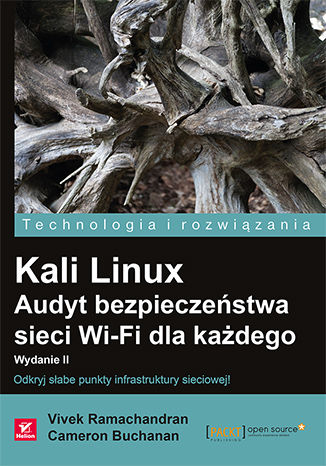
Kali Linux. Audyt bezpieczeństwa sieci Wi-Fi dla każdego. Wydanie II
Vivek Ramachandran, Cameron Buchanan
Odkryj słabe punkty infrastruktury sieciowej! Sieci Wi-Fi obecnie można znaleźć wszędzie — coraz trudniej o miejsce, w którym nie będziemy w zasięgu przynajmniej jednej z nich. Taka sytuacja ma jedną wadę: brak możliwości fizycznej kontroli dostępu do sygnału. Zastanawiasz się, czy Twoja sieć jest bezpieczna i czy żadna postronna osoba nie ma możliwości podłączenia się do wewnętrznych zasobów? To są kluczowe pytania, na które musisz poznać odpowiedź, od tego zależy bezpieczeństwo użytkowników i przetwarzanych danych. Jak przekonać się, czy Twoja sieć jest całkowicie bezpieczna? Spróbuj się do niej włamać! Testy penetracyjne to najskuteczniejsza technika weryfikacji bezpieczeństwa systemów informatycznych. Kali Linux to popularna i zaawansowana dystrybucja systemu Linux, zawierająca zestaw niezbędnych narzędzi każdego pentestera. Jeżeli chcesz wykorzystać jej potencjał, w tej książce znajdziesz szczegółowe omówienie dostępnych narzędzi oraz sposobów prowadzenia ataków. Szyfrowania WEP, WPA/WPA2 mają swoje słabe strony, które może wykorzystać potencjalny intruz, a ataki typu Honeypot, Misassociation, Caffe Latte to tylko niektóre z opisanych tu technik. Dzięki lekturze kolejnych rozdziałów będziesz w stanie sprawdzić podatność na zaawansowane ataki Man-in-the-Middle oraz poznasz metodologię prowadzenia testów penetracyjnych. Sięgnij po tę książkę i zbuduj własne laboratorium do testowania bezpieczeństwa sieci Wi-Fi. Czego możesz dokonać dzięki tej książce... Dowiesz się, jak zbudować własne laboratorium do testowania sieci bezprzewodowych. Naczysz się, jak przechwytywać pakiety przesyłane w sieciach bezprzewodowych. Poznasz sposoby i łamania kluczy szyfrowania WPA-2. Dowiesz się, w jaki sposób wykrywać ukryte sieci, które nie rozgłaszają identyfikatorów SSID. Poznasz zalety i wady różnych technologii sieci bezprzewodowych. Nauczysz się przechwytywać pakiety sondujące i śledzić sieci bezprzewodowe, do których podłączał się użytkownik. Zrozumiesz, jak działa uwierzytelnianie z wykorzystaniem protokołu Radius. Opanujesz różne metody przechwytywania ruchu sieciowego i gromadzenia interesujących Cię informacji. Dowiesz się, jak deszyfrować ruch sieciowy przy użyciu pozyskanych kluczy szyfrowania. Zainwestuj w bezpieczeństwo Twojej sieci bezprzewodowej!
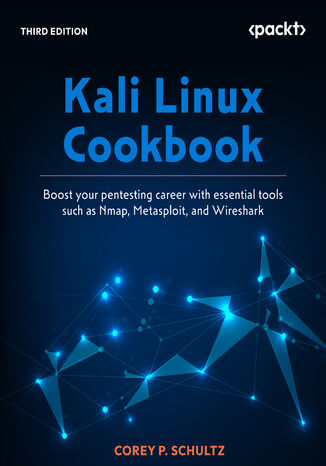
Corey P. Schultz
This hands-on guide will help you become a penetration testing expert by gaining command of the powerful tools of Kali Linux, from versions 2024.3 through 2025.1, aligned with the latest features introduced and applying them in real-world security assessments.This cookbook’s third edition is updated to include the latest advancements in cybersecurity. The author leverages their 20 years of industry experience to guide you through installing Kali on multiple platforms, setting up lab environments, and using modern tools, such as Nmap, Metasploit, Wireshark, OpenVAS, and AI-driven reconnaissance. You’ll also explore automated social engineering, wireless hacking, web and database exploitation, and advanced persistence techniques, delivering a comprehensive and up-to-date penetration testing resource. Recognizing the critical role of human factors in security, this edition expands on social engineering tactics, including psychological principles and AI-driven automation, to craft highly effective attack campaigns.By the end of this book, you’ll have strengthened your grasp of the entire penetration testing process, from environment setup and reconnaissance to vulnerability analysis, exploitation, and maintaining access, and be equipped with industry-standard tools to enhance your effectiveness as a security professional.
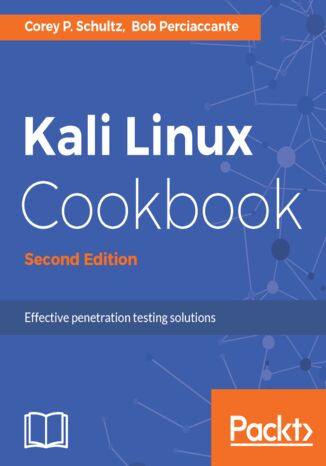
Kali Linux Cookbook. Effective penetration testing solutions - Second Edition
Corey P. Schultz, Bob Perciaccante
Kali Linux is a Linux distribution designed for penetration testing and security auditing. It is the successor to BackTrack, the world’s most popular penetration testing distribution. Kali Linux is the most widely used platform and toolkit for penetration testing. Security is currently the hottest field in technology with a projected need for millions of security professionals.This book focuses on enhancing your knowledge in Kali Linux for security by expanding your skills with toolkits and frameworks that can increase your value as a security professional.Kali Linux Cookbook, Second Edition starts by helping you install Kali Linux on different options available. You will also be able to understand the lab architecture and install a Windows host for use in the lab. Next, you will understand the concept of vulnerability analysis and look at the different types of exploits. The book will introduce you to the concept and psychology of Social Engineering and password cracking. You will then be able to use these skills to expand the scope of any breaches you create. Finally, the book will guide you in exploiting specific technologies and gaining access to other systems in the environment. By the end of this book, you will have gained the core knowledge and concepts of the penetration testing process.
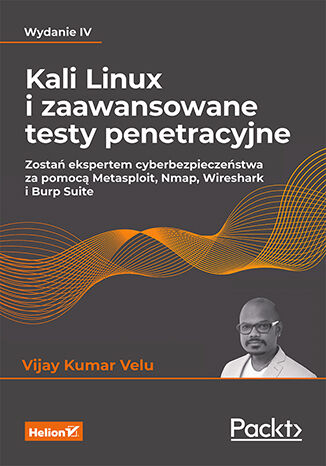
Vijay Kumar Velu
Praca zdalna daje hakerom wiele nowych możliwości i okazji do ataków, obecnie bowiem za pośrednictwem sieci udostępnianych jest znacznie więcej poufnych informacji niż kiedykolwiek wcześniej. Test penetracyjny ma za zadanie symulować taki atak hakera napastnika. Poza skutecznością mechanizmów obronnych testy penetracyjne sprawdzają skutki fazy powłamaniowej eksploracji skompromitowanego systemu. A to pozwala na wykazanie ryzyka naruszenia bezpieczeństwa informacji, jeżeli nie zostaną podjęte odpowiednie działania. Do tych wszystkich celów świetnie nadaje się Kali - potężna dystrybucja systemu Linux, przeznaczona właśnie do przeprowadzania testów penetracyjnych, analiz informatyki śledczej i inżynierii wstecznej. Jeśli masz już pewne umiejętności pentestera, dzięki tej książce poszerzysz swoją wiedzę o zaawansowanych narzędziach dostępnych w Kali Linux, a także nauczysz się wyrafinowanych taktyk stosowanych przez prawdziwych hakerów do atakowania sieci komputerowych. Omówiono tu różne sposoby instalowania i uruchamiania systemu Kali Linux w środowisku maszyn wirtualnych i kontenerów. Opisano też szereg zagadnień związanych z pasywnym i aktywnym rozpoznawaniem środowiska celu, w tym z używaniem skanerów podatności i modelowaniem zagrożeń. Zaprezentowano wiele zaawansowanych metod prowadzenia ataków na sieci komputerowe, urządzenia IoT, systemy wbudowane i urządzenia wykorzystujące połączenia bezprzewodowe. Dzięki książce dowiesz się, jak: eksplorować sieci przewodowe i bezprzewodowe, infrastrukturę chmury i usługi internetowe atakować i łamać zabezpieczenia wbudowanych urządzeń peryferyjnych, Bluetooth, RFID i IoT skutecznie unikać wykrycia używać pakietów: Metasploit, PowerShell Empire i CrackMapExec nasłuchiwać ruch sieciowy za pomocą programów bettercap i Wireshark przeprowadzać ataki przy użyciu narzędzi: Metasploit, Burp Suite i OWASP ZAP Chcesz bezpieczeństwa? Zrozum, jak działa napastnik!
Michael Hixon
With the ever-increasing amount of data flowing in today’s world, information security has become vital to any application. This is where Kali Linux comes in. Kali Linux focuses mainly on security auditing and penetration testing. This step-by-step cookbook on network scanning trains you in important scanning concepts based on version 2016.2. It will enable you to conquer any network environment through a range of network scanning techniques and will also equip you to script your very own tools.Starting with the fundamentals of installing and managing Kali Linux, this book will help you map your target with a wide range of network scanning tasks, including discovery, port scanning, fingerprinting, and more. You will learn how to utilize the arsenal of tools available in Kali Linux to conquer any network environment. The book offers expanded coverage of the popular Burp Suite and has new and updated scripts for automating scanning and target exploitation. You will also be shown how to identify remote services, how to assess security risks, and how various attacks are performed. You will cover the latest features of Kali Linux 2016.2, which includes the enhanced Sparta tool and many other exciting updates.This immersive guide will also encourage the creation of personally scripted tools and the skills required to create them.
Kali Linux. Testy penetracyjne
Joseph Muniz, Aamir Lakhani
Podręcznik pentestera! W dobie internetu możemy cieszyć się globalną dostępnością każdego z systemów informatycznych. Z jednej strony daje to ogromne możliwości wymiany informacji, z drugiej naraża system na ataki z zewnątrz. Zastanawiasz się, jak zapewnić bezpieczeństwo Twojej sieci? Spróbuj się do niej włamać lub zleć to profesjonaliście! Wykonywane w ten sposób testy penetracyjne to jedna z najskuteczniejszych metod weryfikacji bezpieczeństwa w sieci. Jeżeli zainteresował Cię temat testów penetracyjnych, to trafiłeś na doskonałą książkę. Znajdziesz w niej omówienie specjalnej dystrybucji Kali Linux. Zawiera ona zestaw niezbędnych narzędzi oraz pozwoli Ci przeprowadzić testy. W trakcie lektury zrozumiesz, jak przygotować środowisko pracy i jak przeprowadzić atak na popularne serwery aplikacji internetowych oraz ich klientów. W kolejnych rozdziałach dowiesz się, jak zweryfikować zabezpieczenia aplikacji internetowych oraz serwerów WWW. Na sam koniec poznasz najlepsze metody przeciwdziałania i zapobiegania atakom oraz dowiesz się, jak przygotować raport końcowy, w którym zaprezentujesz uzyskane rezultaty. Książka ta jest obowiązkową lekturą dla wszystkich osób, którym bezpieczeństwo sieci nie jest obojętne! Sięgnij po tę książkę i: poznaj możliwości dystrybucji Kali Linux przeprowadź typowe ataki na serwery aplikacji internetowych przekonaj się, jak przeprowadzić atak na metody uwierzytelniania przygotuj kompletny raport ze swoich działań zadbaj o bezpieczeństwo sieci! Bezpieczeństwo sieci jest w Twoich rękach!
Kali Linux. Testy penetracyjne i bezpieczeństwo sieci dla zaawansowanych. Wydanie II
Vijay Kumar Velu
Kali Linux jest dystrybucją BackTrack systemu Linux służącą do zaawansowanego badania zabezpieczeń systemów teleinformatycznych, również poprzez testy penetracyjne. Naturalnie, praca pentestera wiąże się również z przeprowadzaniem rozpoznania, skanowaniem w poszukiwaniu słabych stron zabezpieczeń, wykorzystywaniem exploitów, omijaniem zabezpieczeń i późniejszą eksploracją skompromitowanych systemów. W ten sposób diagnozuje się słabe strony systemu, co z kolei umożliwia usunięcie usterek i osiągnięcie wysokiego stopnia bezpieczeństwa. Realizacja tak ambitnego celu wymaga jednak znakomitego przygotowania i szerokiej wiedzy pentestera. Dzięki tej książce poznasz sprawdzone techniki pokonywania mechanizmów obronnych różnych systemów za pomocą narzędzi dostępnych w Kali Linux. Dowiesz się, jak wybrać najbardziej efektywne rozwiązania, nauczysz się szybkiego skanowania sieci w poszukiwaniu luk w systemie zabezpieczeń, aż w końcu będziesz mógł przeprowadzić atak i powłamaniową eksplorację środowiska, przy czym będziesz wiedzieć, jakie techniki zminimalizują ryzyko wykrycia. Zapoznasz się ze specyfiką ataków na sieci bezprzewodowe, aplikacje internetowe i systemy wykorzystujące zdalny dostęp. W książce przedstawiono również zagadnienia związane z bezpieczeństwem fizycznym infrastruktury i z metodami socjotechnicznymi stosowanymi przez hakerów. Najciekawsze zagadnienia: Zarys metodologii testów penetracyjnych Aktywne i pasywne rozpoznanie celu przed atakiem Rozpoznawanie i przełamywanie zabezpieczeń Powłamaniowa eksploracja celu i pozioma eskalacja ataku Przejmowanie kontroli nad skompromitowanym systemem Kali Linux - subtelne narzędzie pentestera! Vijay Kumar Velu jest zapalonym praktykiem bezpieczeństwa teleinformatycznego. Ma ponad 11-letnie doświadczenie w branży IT. Zdobył wiele certyfikatów bezpieczeństwa, w tym Certified Ethical Hacker, EC-Council Certified Security Analyst i Computer Hacking Forensics Investigator. Velu jest członkiem zarządu Cloud Security Alliance (CSA) w Kuala Lumpur oraz członkiem National Cyber Defense and Research Center (NCDRC) w Indiach. Jest fanatykiem technologii, kocha muzykę i chętnie angażuje się w działalność charytatywną.
Daniel W. Dieterle, Cameron Buchanan, Vivek Ramachandran
As wireless networks become ubiquitous in our lives, wireless penetration testing has become a key skill in the repertoire of the professional penetration tester. This has been highlighted again recently with the discovery of the KRACK attack which enables attackers to potentially break into Wi-Fi networks encrypted with WPA2. The Kali Linux security distribution comes with a myriad of tools used for networking attacks and detecting security loopholes.Kali Linux Wireless Penetration Testing Beginner's Guide, Third Edition has been updated to Kali Linux 2017.3 with the latest methodologies, including full coverage of the KRACK attack and how to defend against it. The book presents wireless pentesting from the ground up, introducing all elements of penetration testing with each new technology. You'll learn various wireless testing methodologies by example, from the basics of wireless routing and encryption through to detailed coverage of hacking methods and attacks such as the Hirte and Caffe Latte.

Marcus Hammarberg, Joakim Sunden
Zwinne metodyki zarządzania projektami biją kolejne rekordy popularności. Scrum jest najbardziej rozpoznawalną spośród nich, jednak nie sprawdza się w każdym przypadku. Dlatego warto poznać inne sposoby radzenia sobie z projektami. Ta książka została poświęcona metodyce kanban - specyficznej metodzie sterowania produkcją, opracowanej w latach pięćdziesiątych XX wieku w Japonii. Zaadaptowana do świata projektów IT, sprawdza się doskonale. Jeżeli chcesz poznać założenia metodyki kanban, trafiłeś na doskonałą książkę. Sięgnij po nią i przekonaj się, dlaczego kanban przydaje się w tak wielu przypadkach. W trakcie lektury poznasz historię tej metodyki, podstawowe założenia oraz sposoby wdrażania. Na kolejnych stronach zobaczysz, jak mapować przepływ zadania, jak ustalać limity WIP (ang. Work In Progress) oraz jak zarządzać przepływem. Ponadto zapoznasz się z zaawansowanymi zagadnieniami szacowania, planowania oraz wskaźników. Na sam koniec zobaczysz, jak uczyć metodyki kanban poprzez granie. Ta metodyka na pewno zyska wielu zwolenników! A książka o niej jest doskonałym podręcznikiem i może zmienić niejeden projekt! Dzięki tej książce: poznasz filozofię kanban, zwizualizujesz swoją pracę, przygotujesz kartę zadania, skutecznie ustalisz limity WIP, poznasz pułapki metodyki kanban, doprowadzisz projekt do szczęśliwego finału. Encyklopedia wiedzy o metodyce kanban!

Kariera na wysokich obcasach. Jak z wdziękiem i klasą osiągnąć sukces zawodowy
Beata Rzepka
Nie taka korporacja straszna, nie taki awans odległy! Strategie, które płci pięknej pomagają zwyciężać w biznesie Atuty, jakie daje kobiecość w męskim świecie Zagrożenia wynikające z samego bycia kobietą pracującą Być kobietą, być kobietą, bo kobiety są świetne w pracy! Ktoś kiedyś powiedział, że różnica między kobietą a mężczyzną jest taka, że mężczyzna w domu myśli o pracy, a kobieta w pracy myśli o domu. Ani to śmieszne, ani prawdziwe - autor tego przewrotnego sloganu z pewnością był mężczyzną! Prawdziwa kobieta w pracy myśli bowiem o tym, jak wykonywać swoje obowiązki jeszcze lepiej, skuteczniej i w idealnej harmonii ze współpracownikami. Niestety, to, że pracownica sumiennie wykonuje powierzone jej zadania, przez męskie otoczenie bywa odbierane jako zgoda na obciążanie jej kolejnymi obowiązkami. Zaś damskie dążenie do pracy zespołowej traktuje się często jak słabość. Bycie kobietą w męskim świecie nie jest łatwe. Bycie kobietą i awansowanie w męskim świecie może wręcz wydawać się niemożliwe! Jednak spokojnie — chcieć to móc. Trzeba tylko wiedzieć JAK. Beata Rzepka podpowie Ci, jak fakt bycia kobietą zamienić w swój atut. Nauczy Cię zasad, których musisz przestrzegać, aby awansować. Gdy zaś Twoje zawodowe wysiłki zostaną nagrodzone awansem na eksponowane środowisko, poradzi, jak być stuprocentową kobietą-szefem. Poznaj swoją wartość. Pracuj tak, jakby firma była Twoja. Dbaj o swoją reputację. Angażuj się. Pozwól się ocenić. Bądź asertywna. Awansuj. Szefuj. Beata Rzepka - coach kariery, pasjonatka rozwoju osobistego. Praktyczną wiedzę o planowaniu ścieżek kariery, ocenie potencjału zawodowego, budowaniu programów rozwojowych zdobyła, pracując w dużych międzynarodowych firmach. Praktykę wsparła teorią: skończyła studia podyplomowe z zakresu zarządzania Personelem na Akademii Ekonomicznej w Krakowie. Właścicielka firmy SELF, zajmującej się coachingiem kariery (www.coachingkariery.pl). Autorka książki Kariera pod kontrolą. Jak zmienić swoje życie zawodowe na lepsze.
Sagar Ganatra
This book is an easy-to-follow guide full of hands-on examples that allows you to learn and build visually compelling web applications using the Kendo UI library.This book will do wonders for web developers having knowledge of HTML and Javascript and want to polish their skills in building applications using the Kendo UI library.
Giuseppe Ciaburro
Keras 2.x Projects explains how to leverage the power of Keras to build and train state-of-the-art deep learning models through a series of practical projects that look at a range of real-world application areas. To begin with, you will quickly set up a deep learning environment by installing the Keras library. Through each of the projects, you will explore and learn the advanced concepts of deep learning and will learn how to compute and run your deep learning models using the advanced offerings of Keras. You will train fully-connected multilayer networks, convolutional neural networks, recurrent neural networks, autoencoders and generative adversarial networks using real-world training datasets. The projects you will undertake are all based on real-world scenarios of all complexity levels, covering topics such as language recognition, stock volatility, energy consumption prediction, faster object classification for self-driving vehicles, and more. By the end of this book, you will be well versed with deep learning and its implementation with Keras. You will have all the knowledge you need to train your own deep learning models to solve different kinds of problems.