
Informatyka
Zajrzyj do kategorii Informatyka w księgarni internetowej Ebookpoint. Znajdziesz tutaj bestsellerowe książki, ebooki i kursy video z branży IT. Sięgnij po najlepszą literaturę dla specjalistów i rozwijaj doświadczenie, które już posiadasz, lub rozpocznij swoją przygodę z programowaniem, cyberbezpieczeństwem lub grafiką komputerową. Pogłębiaj swoją wiedzę tak, jak Ci wygodnie - z tradycyjną książką, wygodnym ebookiem lub nowoczesnym videokursem. Sprawdź, jakie tytuły znajdziesz w kategorii Informatyka!
Edwood Ng, Vineeth Mohan
This book is for software developers who are new to Lucene and who want to explore the more advanced topics to build a search engine. Knowledge of Java is necessary to follow the code samples. You will learn core concepts, best practices, and also advanced features, in order to build an effective search application.
Ciro Cardoso
This book offers uses practical applications using recipes with step-by-step instructions and useful information to help you master how to produce professional architectural visualizations in Lumion. The cookbook approach means you need to think and explore how a particular feature can be applied in your project and perform the intended task. This book is written to be accessible to all Lumion users and is a useful guide to follow when becoming familiar with this cutting-edge real-time technology.This practical guide is designed for all levels of Lumion users who know how to model buildings in 3D and a basic understanding of Lumion, who want to enhance their skills to the next level.
Ciro Cardoso
This book is designed for advanced Lumion users who wish to apply these techniques to their own projects. The reader should be familiar with modeling knowledge and have at least a basic knowledge of a graphics editing program, such as Photoshop or Gimp.
Witold Wrotek
Naucz się lutować jak profesjonalista Poznaj technikę lutowania od podstaw Wyposaż warsztat w odpowiednie narzędzia Naucz się łączyć różne elementy elektroniczne Nawet najbardziej zaawansowane układy elektryczne i elektroniczne nie mogłyby działać, gdyby ich elementy nie były ze sobą odpowiednio połączone. Najtańszą, najpopularniejszą i najskuteczniejszą metodą łączenia obwodów jest lutowanie. Zapewnia nie tylko właściwe połączenie elektryczne, lecz również odpowiednio wytrzymałe spojenie mechaniczne, a tym samym umożliwia stabilne mocowanie elementów na płytce drukowanej. I choć zalety lutowania jako techniki łączenia elementów metalowych znane są ludzkości od starożytności, to prawdziwą popularność zawdzięcza ono dopiero pojawieniu się współczesnej elektroniki, a wzrost znaczenia - jej gwałtownemu rozwojowi. Jeśli chcesz poznać technikę lutowania i nauczyć się prawidłowo stosować ją w praktyce, sięgnij po odpowiednie źródło wiedzy! Książka Lutowanie od podstaw krok po kroku wprowadzi Cię w tajniki sztuki łączenia elementów, przedstawi niezbędne narzędzia i dobre praktyki, nauczy unikać typowych błędów popełnianych przez początkujących oraz pokaże najlepsze sposoby lutowania różnych elementów elektrycznych i elektronicznych. Nauczysz się też dzięki niej, jak wykonać proste prace elektryczne w swoim domu, a nawet jak naprawić typowe usterki występujące w urządzeniach AGD. Przygotowanie do lutowania Niezbędne narzędzia i materiały Dobre praktyki i typowe błędy Praktyczne porady dotyczące lutowania Typowe prace i naprawy elektryczne Ćwiczenia poprawiające umiejętności Lutowanie elementów elektronicznych Usuwanie usterek elektronicznych Zostań prawdziwym mistrzem lutownicy!
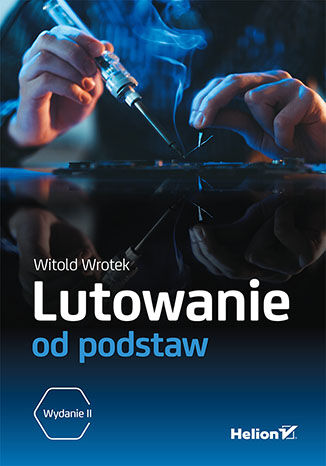
Lutowanie od podstaw. Wydanie II
Witold Wrotek
Lutowanie - prosto, praktycznie, profesjonalnie! Opanuj podstawy techniki lutowania Poznaj przydatne narzędzia pracy Naucz się lutowania w praktyce Lutowanie to najtańsza, najpopularniejsza i najskuteczniejsza metoda łączenia elementów obwodów elektrycznych i elektronicznych. Nawet najbardziej zaawansowane układy nie mogłyby działać bez zastosowania tej techniki, która zapewnia nie tylko właściwe połączenie elektryczne, lecz również odpowiednio wytrzymałe spojenie mechaniczne, umożliwiając tym samym stabilne mocowanie elementów na płytce drukowanej. Do łączenia metalowych części lutowania używano już w starożytności, jednak prawdziwy rozkwit tej metody nastąpił wraz z gwałtownym rozwojem elektroniki. Sięgnij po odpowiednie źródło wiedzy, jeśli chcesz poznać technikę lutowania i nauczyć się prawidłowo stosować ją w praktyce! Drugie wydanie książki Lutowanie od podstaw wprowadzi Cię w tajniki sztuki łączenia elementów, przedstawi niezbędne narzędzia i dobre praktyki, nauczy unikać typowych błędów popełnianych przez początkujących, a także pokaże najlepsze sposoby lutowania różnych elementów elektrycznych i elektronicznych. Dzięki lekturze dowiesz się też, jak wykonać proste prace elektryczne w swoim domu, a nawet jak naprawić typowe usterki urządzeń AGD. Przygotowanie do lutowania Niezbędne narzędzia i materiały Dobre praktyki i najczęstsze błędy Praktyczne porady dotyczące lutowania Typowe prace i naprawy elektryczne Ćwiczenia poprawiające umiejętności Lutowanie elementów elektronicznych Usuwanie usterek elektronicznych Lutuj jak prawdziwy zawodowiec!

Lutowanie od podstaw. Wydanie III
Witold Wrotek
Wszystko, co musisz wiedzieć o lutowaniu Lutowanie jest procesem, w którym elementy metalowe łączy się trwale w wysokiej temperaturze za pomocą metalowego spoiwa zwanego lutem. To najtańsza, najpopularniejsza i najskuteczniejsza metoda łączenia elementów obwodów elektrycznych i elektronicznych. Nawet najbardziej zaawansowane układy nie mogłyby działać bez zastosowania tej techniki. Metodę tę ludzkość zna od starożytności, jednak lutowanie stało się szczególnie ważne, kiedy zaczęliśmy na szeroką skalę korzystać z elektroniki. Umiejętność lutowania drobnych elementów przydaje się zarówno zawodowcom, jak i majsterkowiczom hobbystom. Pozwala ona na samodzielny montaż i konserwowanie podzespołów, płytek drukowanych albo większych układów, na przykład tych, które wprawiają w ruch roboty. Jeśli planujesz zająć się elektroniką amatorsko lub zawodowo, ten poradnik jest skierowany właśnie do Ciebie. Dowiesz się z niego między innymi: Jak się przygotować do lutowania W jakie narzędzia i materiały trzeba się zaopatrzyć Na czym polegają dobre praktyki i najczęstsze błędy podczas lutowania Co warto wiedzieć przed przystąpieniem do procesu Jakie prace lutownicze wykonuje się najczęściej Co możesz zrobić, by poprawić precyzję swojej pracy W jaki sposób lutuje się elementy elektroniczne Jak usunąć najczęściej występujące usterki Trzecie wydanie książki zostało wzbogacone o dodatek poświęcony wyborowi odpowiedniej stacji lutowniczej.
Fabrizio Volpe, Alessio Giombini, Lasse N Wedo,...
If you work with Lync on a daily basis or if you have to use a specific feature of Lync for a project, this is the book for you. For solutions architects, technical consultants, and administrators, if you have a Lync deployment and you want to upgrade, integrate, secure, or extend it to the cloud, you can get valuable information from the recipes in this book.
Łamanie i zabezpieczanie aplikacji w systemie iOS
Jonathan Zdziarski
Twoja lektura obowiązkowa! iOS to obecnie jeden z najpopularniejszych systemów operacyjnych, wykorzystywany w urządzeniach firmy Apple. Jednak dzięki tej popularności jest on też łakomym kąskiem dla hakerów. Uzyskanie dostępu do danych przechowywanych w telefonie może mieć katastrofalne skutki. Dlatego jeżeli tworzysz aplikacje na platformę iOS, ta książka jest dla Ciebie pozycją obowiązkową. Jak obronić się przed atakiem? Wszystkie niezbędne informacje znajdziesz w tym wyjątkowym podręczniku. W trakcie lektury dowiesz się, jak działają hakerzy, jak wyszukują słabe punkty aplikacji oraz jak modyfikują jej kod. Ponadto nauczysz się utrudniać śledzenie kodu Twojej aplikacji oraz bezpiecznie usuwać pliki (tak, aby nie było możliwe ich odtworzenie). Wśród poruszanych tematów znajdziesz również te związane z transmisją danych: wykorzystanie protokołu SSL to nie wszystko, musisz zadbać także o to, żeby nie było możliwe przejęcie sesji SSL. Weź książkę do ręki i obroń się przed atakiem! Dzięki tej książce: zrozumiesz, jak działają hakerzy zabezpieczysz swoją aplikację przez nieuprawnionymi zmianami ochronisz swoje bezpieczne połączenia bezpowrotnie usuniesz niepotrzebne pliki zagwarantujesz bezpieczeństwo danych użytkownikom Twojej aplikacji Zadbaj o bezpieczeństwo danych użytkowników Twojej aplikacji!
Oliver Theobald
Starting with Python syntax and data types, this guide builds toward implementing key machine learning models. Learn about loops, functions, OOP, and data cleaning, then transition into algorithms like regression, KNN, and neural networks. A final section walks you through model optimization and building projects in Python.The book is split into two major sections—foundational Python programming and introductory machine learning. Readers are guided through essential concepts such as data types, variables, control flow, object-oriented programming, and using libraries like pandas for data manipulation.In the machine learning section, topics like model selection, supervised vs unsupervised learning, bias-variance, and common algorithms are demystified with practical coding examples. It’s a structured, clear roadmap to mastering both programming and applied ML from zero knowledge.
Giuseppe Bonaccorso
Machine learning has gained tremendous popularity for its powerful and fast predictions with large datasets. However, the true forces behind its powerful output are the complex algorithms involving substantial statistical analysis that churn large datasets and generate substantial insight.This second edition of Machine Learning Algorithms walks you through prominent development outcomes that have taken place relating to machine learning algorithms, which constitute major contributions to the machine learning process and help you to strengthen and master statistical interpretation across the areas of supervised, semi-supervised, and reinforcement learning. Once the core concepts of an algorithm have been covered, you’ll explore real-world examples based on the most diffused libraries, such as scikit-learn, NLTK, TensorFlow, and Keras. You will discover new topics such as principal component analysis (PCA), independent component analysis (ICA), Bayesian regression, discriminant analysis, advanced clustering, and gaussian mixture.By the end of this book, you will have studied machine learning algorithms and be able to put them into production to make your machine learning applications more innovative.
Oliver Theobald
This book is an ideal starting point for anyone interested in Artificial Intelligence and Machine Learning. It begins with the foundational principles of AI, offering a deep dive into its history, building blocks, and the stages of development. Readers will explore key AI concepts and gradually transition to practical applications, starting with machine learning algorithms such as linear regression and k-nearest neighbors. Through step-by-step Python tutorials, the book helps readers build and implement models with hands-on experience.As the book progresses, readers will dive into advanced AI topics like deep learning, natural language processing (NLP), and generative AI. Topics such as recommender systems and computer vision demonstrate the real-world applications of AI technologies. Ethical considerations and privacy concerns are also addressed, providing insight into the societal impact of these technologies.By the end of the book, readers will have a solid understanding of both the theory and practice of AI and Machine Learning. The final chapters provide resources for continued learning, ensuring that readers can continue to grow their AI expertise beyond the book.
Uday Kamath, Krishna Choppella
Machine Learning is one of the core area of Artificial Intelligence where computers are trained to self-learn, grow, change, and develop on their own without being explicitly programmed. In this course, we cover how Java is employed to build powerful machine learning models to address the problems being faced in the world of Data Science. The course demonstrates complex data extraction and statistical analysis techniques supported by Java, applying various machine learning methods, exploring machine learning sub-domains, and exploring real-world use cases such as recommendation systems, fraud detection, natural language processing, and more, using Java programming. The course begins with an introduction to data science and basic data science tasks such as data collection, data cleaning, data analysis, and data visualization. The next section has a detailed overview of statistical techniques, covering machine learning, neural networks, and deep learning. The next couple of sections cover applying machine learning methods using Java to a variety of chores including classifying, predicting, forecasting, market basket analysis, clustering stream learning, active learning, semi-supervised learning, probabilistic graph modeling, text mining, and deep learning.The last section highlights real-world test cases such as performing activity recognition, developing image recognition, text classification, and anomaly detection. The course includes premium content from three of our most popular books:[*]Java for Data Science[*]Machine Learning in Java [*]Mastering Java Machine LearningOn completion of this course, you will understand various machine learning techniques, different machine learning java algorithms you can use to gain data insights, building data models to analyze larger complex data sets, and incubating applications using Java and machine learning algorithms in the field of artificial intelligence.
Andrew P. McMahon
The Second Edition of Machine Learning Engineering with Python is the practical guide that MLOps and ML engineers need to build solutions to real-world problems. It will provide you with the skills you need to stay ahead in this rapidly evolving field.The book takes an examples-based approach to help you develop your skills and covers the technical concepts, implementation patterns, and development methodologies you need. You'll explore the key steps of the ML development lifecycle and create your own standardized model factory for training and retraining of models. You'll learn to employ concepts like CI/CD and how to detect different types of drift.Get hands-on with the latest in deployment architectures and discover methods for scaling up your solutions. This edition goes deeper in all aspects of ML engineering and MLOps, with emphasis on the latest open-source and cloud-based technologies. This includes a completely revamped approach to advanced pipelining and orchestration techniques.With a new chapter on deep learning, generative AI, and LLMOps, you will learn to use tools like LangChain, PyTorch, and Hugging Face to leverage LLMs for supercharged analysis. You will explore AI assistants like GitHub Copilot to become more productive, then dive deep into the engineering considerations of working with deep learning.
Joshua Arvin Lat
Modern AI systems increasingly leverage large language models, retrieval-augmented generation, and AI agents to power generative AI applications in the cloud. As organizations operationalize these systems at scale, there is a growing need for engineers with strong machine learning engineering expertise. To stay ahead in this rapidly evolving field, you need a deep understanding of AI and ML concepts as well as, practical, hands-on experience with the platforms and tools used to build and operate production-grade AI systems.Machine Learning Engineering on AWS is a practical guide that shows you how to use AWS services such as Amazon Bedrock and Amazon SageMaker AI to fine-tune, evaluate, and deploy LLMs and generative AI systems. You'll learn how to develop RAG-powered systems, build and deploy AI agents using Bedrock AgentCore and Strands Agents, evaluate models using LLM-as-a-judge techniques, and automate LLMOps pipelines using SageMaker Pipelines. The book also covers best practices for building scalable, secure, and production-ready GenAI systems.AWS AI hero Joshua Arvin Lat equips you with the skills and practical knowledge to handle a wide variety of ML engineering requirements, helping you design, operationalize, and secure generative AI systems and AI agents on AWS with confidence.*Email sign-up and proof of purchase required
Joshua Arvin Lat
There is a growing need for professionals with experience in working on machine learning (ML) engineering requirements as well as those with knowledge of automating complex MLOps pipelines in the cloud. This book explores a variety of AWS services, such as Amazon Elastic Kubernetes Service, AWS Glue, AWS Lambda, Amazon Redshift, and AWS Lake Formation, which ML practitioners can leverage to meet various data engineering and ML engineering requirements in production.This machine learning book covers the essential concepts as well as step-by-step instructions that are designed to help you get a solid understanding of how to manage and secure ML workloads in the cloud. As you progress through the chapters, you’ll discover how to use several container and serverless solutions when training and deploying TensorFlow and PyTorch deep learning models on AWS. You’ll also delve into proven cost optimization techniques as well as data privacy and model privacy preservation strategies in detail as you explore best practices when using each AWS.By the end of this AWS book, you'll be able to build, scale, and secure your own ML systems and pipelines, which will give you the experience and confidence needed to architect custom solutions using a variety of AWS services for ML engineering requirements.
Rodolfo Bonnin
Most of us have heard about the term Machine Learning, but surprisingly the question frequently asked by developers across the globe is, “How do I get started in Machine Learning?”. One reason could be attributed to the vastness of the subject area because people often get overwhelmed by the abstractness of ML and terms such as regression, supervised learning, probability density function, and so on. This book is a systematic guide teaching you how to implement various Machine Learning techniques and their day-to-day application and development. You will start with the very basics of data and mathematical models in easy-to-follow language that you are familiar with; you will feel at home while implementing the examples. The book will introduce you to various libraries and frameworks used in the world of Machine Learning, and then, without wasting any time, you will get to the point and implement Regression, Clustering, classification, Neural networks, and more with fun examples. As you get to grips with the techniques, you’ll learn to implement those concepts to solve real-world scenarios for ML applications such as image analysis, Natural Language processing, and anomaly detections of time series data. By the end of the book, you will have learned various ML techniques to develop more efficient and intelligent applications.