
Informatyka
Trevoir Williams
Are you a developer seeking practical, up-to-date insights into designing scalable and resilient microservices? Microservices Design Patterns in .NET, Second Edition provides a comprehensive exploration of modern microservices using C# 14 and .NET 10.This edition expands on core patterns such as CQRS, event sourcing, and Saga, while introducing advanced concepts such as observability with OpenTelemetry, zero-trust security, and container-based workflows.You’ll explore both synchronous and asynchronous communication, apply domain-driven design to define service boundaries, and manage data consistency using proven persistence strategies. The book also guides you through container hosting, serverless functions, and production-ready deployment pipelines.By the end of this book, you’ll know how to design and deploy secure, maintainable, and resilient microservices that fit perfectly in modern cloud ecosystems.Free with your book: DRM-free PDF version + access to Packt's next-gen Reader*
Microservices Development Cookbook. Design and build independently deployable modular services
Paul Osman
Microservices have become a popular choice for building distributed systems that power modern web and mobile apps. They enable you to deploy apps as a suite of independently deployable, modular, and scalable services. With over 70 practical, self-contained tutorials, the book examines common pain points during development and best practices for creating distributed microservices. Each recipe addresses a specific problem and offers a proven, best-practice solution with insights into how it works, so you can copy the code and configuration files and modify them for your own needs.You’ll start by understanding microservice architecture. Next, you'll learn to transition from a traditional monolithic app to a suite of small services that interact to ensure your client apps are running seamlessly. The book will then guide you through the patterns you can use to organize services, so you can optimize request handling and processing. In addition this, you’ll understand how to handle service-to-service interactions. As you progress, you’ll get up to speed with securing microservices and adding monitoring to debug problems. Finally, you’ll cover fault-tolerance and reliability patterns that help you use microservices to isolate failures in your apps.By the end of this book, you’ll have the skills you need to work with a team to break a large, monolithic codebase into independently deployable and scalable microservices.
Microservices with Azure. Build highly maintainable and scalable enterprise-grade apps
Namit Tanasseri, Rahul Rai
Microsoft Azure is rapidly evolving and is widely used as a platform on which you can build Microservices that can be deployed on-premise and on-cloud heterogeneous environments through Microsoft Azure Service Fabric. This book will help you understand the concepts of Microservice application architecture and build highly maintainable and scalable enterprise-grade applications using the various services in Microsoft Azure Service Fabric. We will begin by understanding the intricacies of the Microservices architecture and its advantages over the monolithic architecture and Service Oriented Architecture (SOA) principles. We will present various scenarios where Microservices should be used and walk you through the architectures of Microservice-based applications. Next, you will take an in-depth look at Microsoft Azure Service Fabric, which is the best–in-class platform for building Microservices. You will explore how to develop and deploy sample applications on Microsoft Azure Service Fabric to gain a thorough understanding of it. Building Microservice-based application is complicated. Therefore, we will take you through several design patterns that solve the various challenges associated with realizing the Microservices architecture in enterprise applications. Each pattern will be clearly illustrated with examples that you can keep referring to when designing applications.Finally, you will be introduced to advanced topics such as Serverless computing and DevOps using Service Fabric, to help you undertake your next venture with confidence.
Anuj Kumar
The microservice architecture is sweeping the world as the de facto pattern with which to design and build scalable, easy-tomaintain web applications. This book will teach you common patterns and practices, and will show you how to apply these using the Clojure programming language.This book will teach you the fundamental concepts of architectural design and RESTful communication, and show you patterns that provide manageable code that is supportable in development and at scale in production. We will provide you with examples of how to put these concepts and patterns into practice with Clojure. This book will explain and illustrate, with practical examples, how teams of all sizes can start solving problems with microservices.You will learn the importance of writing code that is asynchronous and non-blocking and how Pedestal helps us do this. Later, the book explains how to build Reactive microservices in Clojure that adhere to the principles underlying the Reactive Manifesto. We finish off by showing you various ways to monitor, test, and secure your microservices. By the end, you will be fully capable of setting up, modifying, and deploying a microservice with Clojure and Pedestal.
Alexander Shuiskov
Microservices with Go, Second Edition explains the key benefits and common issues faced by developers when working with microservices, helping you understand the problems microservice architecture solves, the issues it introduces, and how to tackle them.The author distils his 18+ years of experience in building scalable and reliable infrastructure to help you grasp the importance of using the right principles and standards to achieve all that microservice architecture has to offer. You'll see why Go is a popular choice for microservice development, as well as navigate its foundational aspects, including service scaffolding, discovery, data serialization, communication, deployment, and testing. After covering development, you'll move to maintenance and reliability. This second edition is fully updated with newly added topics, including security and compliance, distributed system challenges, and performance monitoring. The final section focuses on advanced concepts, such as system reliability, observability, maintainability, and scalability. Through best practices and practical examples, you'll learn how to apply key ideas to existing applications using previously scaffolded services.By the end of this book, you'll have gained hands-on experience in developing scalable, reliable, and high-performance microservices with Go.
Magnus Larsson
Do you want to build and deploy microservices but are unsure where to begin? Check out the fully updated 2025 edition of Microservices with Spring Boot and Spring Cloud. Drawing from Magnus’ decades of experience, you’ll start with simple microservices and progress to complex distributed applications, learning essential functionality and deploying microservices using Kubernetes and Istio along the way. This book covers Java 24, Spring Boot 3.5, and Spring Cloud 2025, featuring updated code examples and replacing deprecated APIs. You’ll get a clear understanding of Spring’s Ahead of Time (AOT) module, observability, distributed tracing, and Helm for Kubernetes packaging. The chapters show you how to use Docker Compose to run microservices with databases and messaging services and deploy microservices on Kubernetes with Istio. You’ll also explore persistence, resilience, reactive microservices, and API documentation with OpenAPI, as well as learn service discovery with Netflix Eureka, edge servers with Spring Cloud Gateway, and monitoring with Prometheus, Grafana, and the EFK stack. By the end of this book, you’ll be able to confidently build scalable microservices using Spring Boot and Spring Cloud.
Magnus Larsson
Want to build and deploy microservices, but don’t know where to start? Welcome to Microservices with Spring Boot and Spring Cloud.This edition features the most recent versions of Spring, Java, Kubernetes, and Istio, demonstrating faster and simpler handling of Spring Boot, local Kubernetes clusters, and Istio installation. The expanded scope includes native compilation of Spring-based microservices, support for Mac and Windows with WSL2, and an introduction to Helm 3 for packaging and deployment. A revamped security chapter now follows the OAuth 2.1 specification and makes use of the newly launched Spring Authorization Server from the Spring team.You’ll start with a set of simple cooperating microservices, then add persistence and resilience, make your microservices reactive, and document their APIs using OpenAPI.Next, you’ll learn how fundamental design patterns are applied to add important functionality, such as service discovery with Netflix Eureka and edge servers with Spring Cloud Gateway. You’ll deploy your microservices using Kubernetes and adopt Istio, then explore centralized log management using the Elasticsearch, Fluentd, and Kibana (EFK) stack, and then monitor microservices using Prometheus and Grafana.By the end of this book, you'll be building scalable and robust microservices using Spring Boot and Spring Cloud.
Aaron Guilmette
The MS-102: Microsoft 365 Administrator Exam Guide is meticulously crafted to empower readers with practical insights, starting with the essentials of provisioning a Microsoft 365 tenant, configuring identity synchronization and secure access, and deploying key Microsoft 365 Defender components.The book's purpose is clear—to guide professionals through the complexities of the MS-102 exam, ensuring not just exam success but mastery of the subject matter. This comprehensive exam guide comes with lifetime access to supplementary resources on an online platform, including flashcards, mock exams, and exam tips from experts. With unlimited access to the website, you'll have the flexibility to practice as many times as you desire, maximizing your exam readiness.As you progress through each chapter, the book unveils the layers of Microsoft 365 workloads, equipping you with the skills to manage role-based administration, deploy identity synchronization using Entra ID Connect, implement modern authentication methods, manage secure access through Conditional Access policies, and analyze security threats using Microsoft 365 Defender.By the end of this book, you'll have the proficiency to implement data loss prevention, configure information and data protection features, and approach the MS-102 exam with confidence.
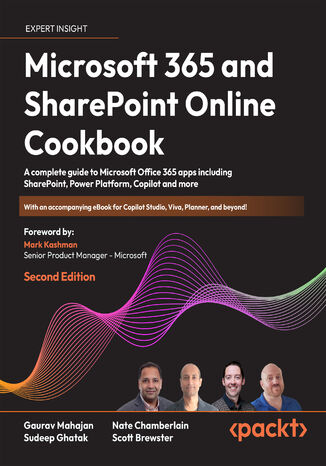
Gaurav Mahajan, Sudeep Ghatak, Nate Chamberlain, Scott...
Microsoft 365 offers tools for content management, communication, process automation, and report creation. Microsoft 365 and SharePoint Online Cookbook maximizes workplace collaboration and productivity using SharePoint Online, Teams, OneDrive, Delve, M365 Search, Copilot, Power Platform, Viva, Planner, and Microsoft Forms.You will find thoroughly updated recipes for SharePoint Online, covering sites, lists, libraries, pages, web parts, and learn SharePoint Framework (SPFx) basics for building solutions. You will explore many Microsoft Teams recipes to prepare it to be your organization’s central collaboration hub. You will be able to unlock Power Platform potential with recipes for Power Apps to enable low-code/no-code app development and learn to automate tasks with Power Automate and Power Automate Desktop. The book teaches you data visualization with Power BI, and chatbot creation with Power Virtual Agents (Copilot Studio). Finally, you will also learn about the cutting-edge Copilot and Gen AI functionality in Microsoft 365 and Power Platform. By the end, you will be equipped with skills to effectively use Microsoft 365, SharePoint Online, and the Power Platform.Whether it's enhancing career prospects or improving business operations, this book is a perfect companion on your journey through the Microsoft Office 365 suite.*Email sign-up and proof of purchase required
Steve Miles
Microsoft 365 Copilot and AI agents are transforming how organizations collaborate, automate workflows, and manage productivity. This practical certification guide prepares you for the Microsoft AB-900 exam while building real-world administration skills for modern AI-powered workplaces. Aligned with the latest Microsoft Learn objectives, the book covers Microsoft 365 services, security principles, governance controls, and Copilot administration fundamentals.You’ll begin with Microsoft 365 essentials, including licensing, Exchange Online, SharePoint, Teams, identity management, authentication, Conditional Access, and Zero Trust. You’ll then explore Microsoft Purview capabilities, including data classification, sensitivity labels, retention, DLP, Insider Risk Management, Communication Compliance, and DSPM for AI.The book also explains how Copilot accesses organizational data through Microsoft Graph, how to identify oversharing risks in SharePoint, and how to use Purview tools to investigate compliance and governance issues. Finally, you’ll learn how to manage Copilot licensing, billing, prompts, usage analytics, and AI agent lifecycles using Microsoft 365 and Power Platform admin centers.By the end of this book, you’ll be ready to confidently take the AB-900 exam and support secure, compliant Microsoft 365 Copilot deployments.
Microsoft Access 2010 PL. Praktyczne podejście
Curtis D. Frye
Poznaj proste i skuteczne metody pracy w programie Access 2010! Jak szybko stworzyć użyteczną bazę danych? Jak zapisywać w bazach grafikę i różnego rodzaju dokumenty? Jak tworzyć poprawne i atrakcyjne wizualnie raporty? Najnowsza wersja programu Microsoft Access umożliwia budowanie i przetwarzanie baz danych bez potrzeby znajomości języka SQL czy też skomplikowanych środowisk serwerowych. Nowego Accessa można wykorzystywać zarówno w przypadku prostych projektów, takich jak baza adresowa, jak i bardziej złożonych, na przykład z zewnętrznym źródłem danych. Ponadto program w wielu wypadkach umożliwia uzyskanie tego samego efektu różnymi metodami. Każdy użytkownik może więc znaleźć najlepsze dla siebie sposoby. W tym podręczniku znajdziesz nie tylko proste i skuteczne metody pracy z Accessem, ale także mnóstwo inspiracji do samodzielnego eksplorowania programu. Książka "Microsoft Access 2010 PL. Praktyczne podejście", Microsoft Access 2010 Plain & Simple" zawiera przejrzysty i klarowny opis wszystkich niezbędnych procedur i narzędzi programu, ilustrowany zrzutami ekranowymi. Korzystając z tego podręcznika, nauczysz się używać formularzy Accessa do sprawnego zbierania informacji, a także projektować i budować bazy danych oraz wymieniać dane pomiędzy nimi i programami zewnętrznymi. Dowiesz się, jak stosować grafikę i inne elementy, aby tworzyć wyszukane barwne raporty. Poznasz również inne zaawansowane zagadnienia, takie jak administrowanie bazą w sposób umożliwiający oddzielanie danych dostępnych dla każdego użytkownika od danych poufnych. Narzędzia programu Access 2010 Tworzenie bazy danych Praca z polami i tabelami Formularze i kwerendy Tworzenie raportów Formatowanie elementów wykresu Interakcje z innymi programami Administrowanie bazą danych Personalizacja programu i konfigurowanie interfejsu Dynamiczna prezentacja danych i kwerend Najprostszy barwny przewodnik po świecie Accessa do stosowania na bieżąco!
Microsoft Access 2021 Programming Pocket Primer. A Comprehensive Guide to Mastering Access VBA
Mercury Learning and Information, Julitta Korol
This book, part of the successful Pocket Primer series, is designed for those who need to master Access programming fundamentals quickly. You only need this concise guide to get started and feel comfortable with VBA. The concepts learned here also apply to Excel programming. The book is divided into nine chapters, each progressively introducing you to programming in Microsoft Access 2021.Beginning with an introduction to Access VBA, the book covers the Visual Basic Editor, fundamental VBA programming concepts, and how to create both built-in and custom functions. You will learn to add decision-making capabilities and repeating actions to your programs, manage multiple values using arrays and collections, and utilize built-in tools for testing and debugging your code.This structured approach ensures that by the end of the course, you will have a solid foundation in Access programming. The companion files provide all the hands-on resources needed to complete chapter projects, making this an essential resource for mastering Access VBA efficiently and effectively.
Microsoft Access. Przewodnik dla użytkowników Excela
Michael Alexander
Rozszerz swój wachlarz narzędzi do analizy o Accessa! Kiedy wybrać Excela, a kiedy Accessa? Jak wykonać raport i wizualizować dane w Accessie? Jak zintegrować Excel z Accessem? Excel to obok Worda najpopularniejsze narzędzie znajdujące się w pakiecie Microsoft Office. Narzędzie, bez którego nie wyobrażają sobie pracy analitycy, księgowi i prezesi firm. Dzięki ogromnym możliwościom oraz łatwości użycia znajduje on zastosowanie wszędzie tam, gdzie trzeba dokonać obliczeń na dużych ilościach danych. Czy Excel jest jednak lekarstwem na wszystko? Otóż nie! Pakiet Microsoft Office posiada w swych szeregach jeszcze jednego asa - program Access. Jeżeli zależy Ci na bezproblemowej współpracy kilku osób nad jednym zbiorem danych, jeżeli chcesz oddzielić wygląd raportu od danych, a w dodatku wymagasz skalowalności, Access może okazać się lepszym wyborem. Nie obawiaj się nowego! Dzięki tej książce błyskawicznie zapoznasz się ze środowiskiem, filozofią pracy oraz możliwościami Accessa. Książka odpowiada na wiele pytań, w tym na jedno kluczowe - kiedy lepszy jest Excel, a kiedy Access. Ponadto znajdziesz tu odpowiedzi na pytania dotyczące danych, ich struktur oraz metod analizy. Dowiesz się, jak korzystać z kwerend agregujących, funkcjonalnych oraz krzyżowych. Z pewnością zainteresują Cię również rozdziały poświęcone analizom warunkowym oraz tworzeniu raportów i wizualizacji danych w programie Access. Ostatni rozdział pozwoli Ci połączyć świat, który znasz - świat Excela, z tym, który poznałeś w trakcie lektury - światem Accessa. Integracja tych dwóch narzędzi zdejmie z Ciebie wszelkie ograniczenia w codziennej pracy z danymi o dowolnej wielkości i złożoności. Przekonaj się o tym sam! Trudny wybór - Access czy Excel Podstawy Accessa - tabele, teoria relacyjnych baz danych, kwerendy Kwerendy wybierające, funkcjonalne, usuwające, aktualizujące Wykorzystanie kwerend krzyżowych Transformacja danych za pomocą programu Access Wykonywanie obliczeń oraz przetwarzanie dat Analizy warunkowe Zastosowanie podkwerend i domenowych funkcji agregacji Statystyki opisowe w Accessie Planowanie zadań Wykorzystanie VBA do usprawnienia procesu analizy Tworzenie raportów w Accessie Wykorzystanie tabel i wykresów przestawnych Przenoszenie danych z Accessa do Excela Integracja Accessa z Excelem Tworzenie zapytań SQL Znasz Excel? Poznaj też Access - szybko i przyjemnie!
Bogdan Brinzarea, Cristian Darie
Microsoft AJAX Library Essentials is a practical reference for the client-side library of the ASP.NET AJAX Framework 1.0, and a tutorial for the underlying technologies and techniques required to use the library at its full potential. The main goal of this book is to get you comfortable with the Microsoft AJAX Library, a huge set of functions that can be used for developing powerful client-side functionality.Beginning with a hands-on tour of the basic technologies associated with AJAX, JavaScript, XMLHttpRequest, JSON, and the DOM, you'll move on to a crash course in the Microsoft AJAX tools. You will learn, through numerous step-by-step exercises, how to create basic AJAX applications, how the object-based programming model of JavaScript works, and how Microsoft AJAX Library extends this model. You'll understand the architecture of the Microsoft AJAX components, how they all fit together, and exactly what they can do for you. Then you will learn how to use the Microsoft AJAX Library in your web projects, and a detailed case study will walk you through creating your own customized client components. At every stage of your journey, you'll be able to try out examples to illuminate the theory, and consolidate your understanding. In addition to learning about the client and server controls, you'll also see how to handle errors and debug your AJAX applications.To complement your new found skills, the book ends with a visual reference of the Microsoft AJAX Library namespaces and classes, including diagrams and quick explanations for all the classes mentioned in the book, providing an invaluable reference you will turn to again and again.
Aaron Guilmette, Steve Miles, Peter De Tender
The AI-900 exam helps you take your first step into an AI-shaped future. Regardless of your technical background, this book will help you test your understanding of the key AI-related topics and tools used to develop AI solutions in Azure cloud.This exam guide focuses on AI workloads, including natural language processing (NLP) and large language models (LLMs). You’ll explore Microsoft’s responsible AI principles like safety and accountability. Then, you’ll cover the basics of machine learning (ML), including classification and deep learning, and learn how to use training and validation datasets with Azure ML. Using Azure AI Vision, face detection, and Video Indexer services, you’ll get up to speed with computer vision-related topics like image classification, object detection, and facial detection. Later chapters cover NLP features such as key phrase extraction, sentiment analysis, and speech processing using Azure AI Language, speech, and translator services. The book also guides you through identifying GenAI models and leveraging Azure OpenAI Service for content generation. At the end of each chapter, you’ll find chapter review questions with answers, provided as an online resource.By the end of this exam guide, you’ll be able to work with AI solutions in Azure and pass the AI-900 exam using the online exam prep resources.
Richard J. Dudley, Nathan A. Duchene, Richard...
Microsoft's Azure platform has proved itself to be a highly scalable and highly available platform for enterprise applications. Despite a familiar development model, there is a difference between developing for Azure and moving applications and data into the cloud. You need to be aware of how to technically implement large-scale elastic applications. In this book, the authors develop an Azure application and discuss architectural considerations and important decision points for hosting an application on Azure.This book is a fast-paced introduction to all the major features of Azure, with considerations for enterprise developers. It starts with an overview of cloud computing in general, followed by an overview of Microsoft's Azure platform, and covers Windows Azure, SQL Azure, and AppFabric, discussing them with the help of a case-study.The book guides you through setting up the tools needed for Azure development, and outlines the sample application that will be built in the later chapters. Each subsequent chapter focuses on one aspect of the Azure platform—web roles, queue storage, SQL Azure, and so on—discussing the feature in greater detail and then providing a programming example by building parts of the sample application. Important architectural and security considerations are discussed with each Azure feature.The authors cover topics that are important to enterprise development, such as transferring data from an on-premises database to SQL Azure using SSIS, securing an application using AppFabric access control, blob and table storage, and asynchronous messaging using Queue Storage. Readers will learn to leverage the use of queues and worker roles for the separation of responsibilities between web and worker roles, enabling linear scale out of an Azure application through the use of additional instances. A truly elastic application is one that can be scaled up or down quickly to match resources to demand as well as control costs; with the practices in this book you will achieve application elasticity.