
Informatyka
Mastering Spring Boot 2.0. Build modern, cloud-native, and distributed systems using Spring Boot
Dinesh Rajput
Spring is one of the best frameworks on the market for developing web, enterprise, and cloud ready software. Spring Boot simplifies the building of complex software dramatically by reducing the amount of boilerplate code, and by providing production-ready features and a simple deployment model.This book will address the challenges related to power that come with Spring Boot's great configurability and flexibility. You will understand how Spring Boot configuration works under the hood, how to overwrite default configurations, and how to use advanced techniques to prepare Spring Boot applications to work in production. This book will also introduce readers to a relatively new topic in the Spring ecosystem – cloud native patterns, reactive programming, and applications. Get up to speed with microservices with Spring Boot and Spring Cloud. Each chapter aims to solve a specific problem or teach you a useful skillset. By the end of this book, you will be proficient in building and deploying your Spring Boot application.
Ahmet Meric
Mastering Spring Boot 3.0 is your gateway to building scalable and robust backend systems using the latest techniques. Penned by a seasoned software developer with 20+ years of experience in the tech industry, this book follows a hands-on, step-by-step approach to helping you understand Spring Boot concepts and apply them to real-world projects.You’ll start by exploring key architectural patterns such as DDD, CQRS, and event sourcing. Next, you’ll focus on the nuances of reactive REST development, delve into advanced testing strategies, and fortify your applications' security. You’ll also discover the power of containerization and orchestration with Spring Boot 3.0 and unlock its potential for smooth deployments. Additionally, by integrating Kafka, you’ll be able to build robust event-driven systems.By the end of this book, you’ll have become proficient in architectural patterns, testing strategies, and application security. Whether you’re an architect, backend developer, or DevOps engineer, this book will help you leverage the advanced features of Spring Boot 3.0 for secure and efficient backend development.
Piotr Mińkowski
Developing, deploying, and operating cloud applications should be as easy as local applications. This should be the governing principle behind any cloud platform, library, or tool. Spring Cloud–an open-source library–makes it easy to develop JVM applications for the cloud. In this book, you will be introduced to Spring Cloud and will master its features from the application developer's point of view. This book begins by introducing you to microservices for Spring and the available feature set in Spring Cloud. You will learn to configure the Spring Cloud server and run the Eureka server to enable service registration and discovery. Then you will learn about techniques related to load balancing and circuit breaking and utilize all features of the Feign client. The book now delves into advanced topics where you will learn to implement distributed tracing solutions for Spring Cloud and build message-driven microservice architectures. Before running an application on Docker container s, you will master testing and securing techniques with Spring Cloud.
Dan Peleg
Sublime is the leading platform for developing websites, applications, and software. Sublime Text is a sophisticated, cross-platform text and source code editor. It supports a number of different programming languages and is extremely efficient and feature rich. With Sublime Text, programmers can develop their web applications faster and with more efficiency.This book will put you at the frontier of modern software development. It will teach you how to leverage Sublime for anything from mobile games to missile protection. Above all, this book will help you harness the power of other Sublime users and always stay on top.This book will show you how to get started, from basic installation through lightning fast code navigation and up to the development of your own plugins. It takes you from the early stages of navigating through the platform and moves on by teaching you how to fully customize your platform, test, debug, and eventually create and share your own plugins to help and lead this community forward.The book will then teach you how to efficiently edit text, primarily by using the keyboard. You will learn how to interact with the Sublime Text community using the mailing lists and IRC.
Jon Hoffman
If you are a developer that learns best by looking at, and working with, code, then this book is for you. A basic understanding of Apple's tools is beneficial but not mandatory.
Jon Hoffman
Swift is a modern, fast, and safe programming language created by Apple. Writing Swift is interactive and fun, the syntax is concise yet expressive, and the code runs lightning-fast. Swift’s move to open source has been embraced with open arms and has seen increased adoption in the Linux platform.Our book will introduce you to the Swift language, further delving into all the key concepts you need to create applications for desktop, server, and embedded Linux platforms. We will teach you the best practices to design an application with Swift 3 via design patterns and Protocol-Oriented Programming. Further on, you will learn how to catch and respond to errors within your application. When you have gained a strong knowledge of using Swift in Linux, we’ll show you how to build IoT and robotic projects using Swift on single board computers. By the end of the book, you will have a solid understanding of the Swift Language with Linux and will be able to create your own applications with ease.
Jon Hoffman
Over the years, the Mastering Swift book has established itself amongst developers as a popular choice as an in-depth and practical guide to the Swift programming language. The latest edition is fully updated and revised to cover the new version: Swift 5.Inside this book, you'll find the key features of Swift 5 easily explained with complete sets of examples. From the basics of the language to popular features such as concurrency, generics, and memory management, this definitive guide will help you develop your expertise and mastery of the Swift language.Mastering Swift 5, Fifth Edition will give you an in-depth knowledge of some of the most sophisticated elements in Swift development, including protocol extensions, error handling, and closures. It will guide you on how to use and apply them in your own projects.Later, you'll see how to leverage the power of protocol-oriented programming to write flexible and easier-to-manage code. You will also see how to add the copy-on-write feature to your custom value types and how to avoid memory management issues caused by strong reference cycles.
Jon Hoffman
Over the years, Mastering Swift has proven itself among developers as a popular choice for an in-depth and practical guide to the Swift programming language. This sixth edition comes with the latest features, an overall revision to align with Swift 5.3, and two new chapters on building swift from source and advanced operators.From the basics of the language to popular features such as concurrency, generics, and memory management, this in-depth guide will help you develop your expertise and mastery of the language.As you progress, you will gain practical insights into some of the most sophisticated elements in Swift development, including protocol extensions, error handling, and closures. The book will also show you how to use and apply them in your own projects. In later chapters, you will understand how to use the power of protocol-oriented programming to write flexible and easier-to-manage code in Swift. Finally, you will learn how to add the copy-on-write feature to your custom value types, along with understanding how to avoid memory management issues caused by strong reference cycles.By the end of this Swift book, you will have mastered the Swift 5.3 language and developed the skills you need to effectively use its features to build robust applications.
Jon Hoffman
This seventh edition of Mastering Swift 6 is your ultimate guide to harnessing the full power of Swift. Whether you're aiming to optimize the performance of your applications or looking to explore the exciting new features in Swift 6.2, this book has you covered. The author distills his 28 years of experience in the Engineering and IT fields to help you dive deep into advanced concepts and techniques, such as concurrency, memory management, and Generics, all essential for creating high-performance applications.The chapters take you on a flexible journey, covering Swift 6.2’s newest features alongside advanced programming topics such as reflection, concurrency, and Generics. Packed with best practices, testing strategies, and modern programming techniques, this book equips you with the skills to develop scalable, high-performance applications with confidence.Whether you're looking to stay competitive or simply want to excel in Swift 6, this book provides the tools and knowledge you need to succeed.
Sohail Salehi
In this book, you will learn some lesser known aspects of development with Symfony, and you will see how to use Symfony as a framework to create reliable and effective applications. You might have developed some impressive PHP libraries in other projects, but what is the point when your library is tied to one particular project? With Symfony, you can turn your code into a service and reuse it in other projects.This book starts with Symfony concepts such as bundles, routing, twig, doctrine, and more, taking you through the request/response life cycle. You will then proceed to set up development, test, and deployment environments in AWS. Then you will create reliable projects using Behat and Mink, and design business logic, cover authentication, and authorization steps in a security checking process. You will be walked through concepts such as DependencyInjection, service containers, and services, and go through steps to create customized commands for Symfony's console. Finally, the book covers performance optimization and the use of Varnish and Memcached in our project, and you are treated with the creation of database agnostic bundles and best practices.
Marleen Meier, David Baldwin
Tableau is one of the leading business intelligence (BI) tools used to solve BI and analytics challenges. With this book, you will master Tableau's features and offerings in various paradigms of the BI domain. This book is also the second edition of the popular Mastering Tableau series, with new features, examples, and updated code. The book covers essential Tableau concepts and its advanced functionalities. Using Tableau Hyper and Tableau Prep, you’ll be able to handle and prepare data easily. You’ll gear up to perform complex joins, spatial joins, union, and data blending tasks using practical examples. Following this, you’ll learn how to perform data densification to make displaying granular data easier. Next, you’ll explore expert-level examples to help you with advanced calculations, mapping, and visual design using various Tableau extensions. With the help of examples, you’ll also learn about improving dashboard performance, connecting Tableau Server, and understanding data visualizations. In the final chapters, you’ll cover advanced use cases such as Self-Service Analytics, Time Series Analytics, and Geo-Spatial Analytics, and learn to connect Tableau to R, Python, and MATLAB. By the end of this book, you’ll have mastered the advanced offerings of Tableau and be able to tackle common and not-so-common challenges faced in the BI domain.
Marleen Meier
This edition of the bestselling Tableau guide will teach you how to leverage Tableau's newest features and offerings in various paradigms of the BI domain. Updated with fresh topics, including the newest features in Tableau Server, Prep, and Desktop, as well as up-to-date examples, this book will take you from mastering essential Tableau concepts to advance functionalities. A chapter on data governance has also been added.Throughout this book, you'll learn how to use Tableau Hyper files and Prep Builder to easily perform data preparation and handling, as well as complex joins, spatial joins, unions, and data blending tasks using practical examples. You'll also get to grips with executing data densification and explore other expert-level examples to help you with calculations, mapping, and visual design using Tableau extensions.Later chapters will teach you all about improving dashboard performance, connecting to Tableau Server, and understanding data visualization with examples. Finally, you'll cover advanced use cases, such as self-service analysis, time series analysis, geo-spatial analysis, and how to connect Tableau to Python and R to implement programming functionalities within Tableau.By the end of this book, you'll have mastered Tableau 2023 and be able to tackle common and advanced challenges in the BI domain.
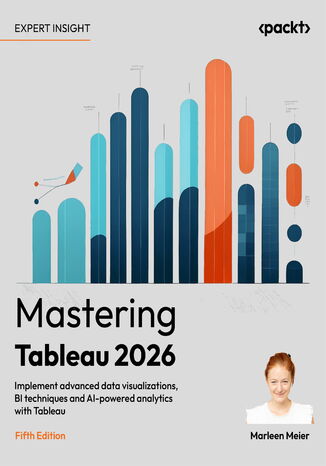
Marleen Meier, Tim Ngwena
Master the full capabilities of Tableau to design, build, and scale modern data visualization and business intelligence solutions.This book takes you beyond the basics to help you create advanced Tableau dashboards, perform efficient data preparation with Tableau Prep Builder, and deliver impactful analytics across your organization. Through practical examples, you’ll learn how to turn raw data into meaningful insights using proven Tableau data visualization techniques.As you progress, you’ll work with calculated fields and LOD expressions to build more flexible and powerful analyses. You’ll also explore performance optimization, deployment, and collaboration using Tableau Server, along with best practices for data governance and security in enterprise environments.In addition, the book covers AI-powered Tableau features that enhance analysis and accelerate insight discovery. You’ll apply advanced techniques such as time series analysis, geospatial analytics, and data modeling, and extend Tableau’s capabilities through Python and R integration for more sophisticated analytics workflows.By the end of this book, you’ll be equipped to build scalable, high-performance Tableau analytics solutions, enabling you to solve complex business problems with confidence.
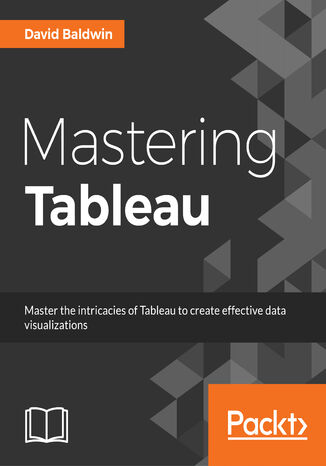
Mastering Tableau. Smart Business Intelligence techniques to get maximum insights from your data
Jen Stirrup, David Baldwin
Tableau has emerged as one of the most popular Business Intelligence solutions in recent times, thanks to its powerful and interactive data visualization capabilities. This book will empower you to become a master in Tableau by exploiting the many new features introduced in Tableau 10.0.You will embark on this exciting journey by getting to know the valuable methods of utilizing advanced calculations to solve complex problems. These techniques include creative use of different types of calculations such as row-level, aggregate-level, and more. You will discover how almost any data visualization challenge can be met in Tableau by getting a proper understanding of the tool’s inner workings and creatively exploring possibilities. You’ll be armed with an arsenal of advanced chart types and techniques to enable you to efficiently and engagingly present information to a variety of audiences through the use of clear, efficient, and engaging dashboards. Explanations and examples of efficient and inefficient visualization techniques, well-designed and poorly designed dashboards, and compromise options when Tableau consumers will not embrace data visualization will build on your understanding of Tableau and how to use it efficiently.By the end of the book, you will be equipped with all the information you need to create effective dashboards and data visualization solutions using Tableau.
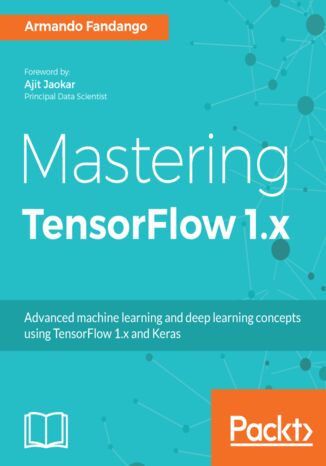
Armando Fandango, Ajit Jaokar
TensorFlow is the most popular numerical computation library built from the ground up for distributed, cloud, and mobile environments. TensorFlow represents the data as tensors and the computation as graphs.This book is a comprehensive guide that lets you explore the advanced features of TensorFlow 1.x. Gain insight into TensorFlow Core, Keras, TF Estimators, TFLearn, TF Slim, Pretty Tensor, and Sonnet. Leverage the power of TensorFlow and Keras to build deep learning models, using concepts such as transfer learning, generative adversarial networks, and deep reinforcement learning. Throughout the book, you will obtain hands-on experience with varied datasets, such as MNIST, CIFAR-10, PTB, text8, and COCO-Images.You will learn the advanced features of TensorFlow1.x, such as distributed TensorFlow with TF Clusters, deploy production models with TensorFlow Serving, and build and deploy TensorFlow models for mobile and embedded devices on Android and iOS platforms. You will see how to call TensorFlow and Keras API within the R statistical software, and learn the required techniques for debugging when the TensorFlow API-based code does not work as expected.The book helps you obtain in-depth knowledge of TensorFlow, making you the go-to person for solving artificial intelligence problems. By the end of this guide, you will have mastered the offerings of TensorFlow and Keras, and gained the skills you need to build smarter, faster, and efficient machine learning and deep learning systems.
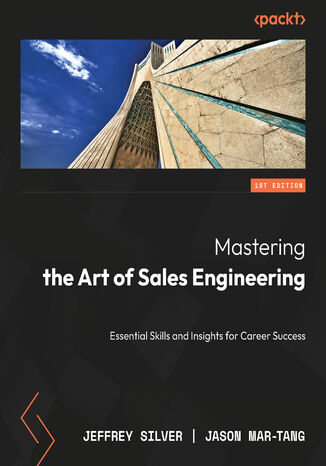
Jeffrey Silver, Jason Mar-Tang, Michael Huckaby
Sales engineers often need to balance their technical expertise with the soft skills needed to close deals and build lasting client relationships. This book provides a framework for both senior engineers seeking professional growth and individuals just starting their sales engineering careers. This book draws from the authors’ extensive experience in this industry and as leaders in top high-tech companies, offering real-world insights and life lessons applicable to this specialized and in-demand industry. You’ll pick up the core disciplines a successful sales engineer should exemplify, along with mastering practical, day-to-day operational aspects. Within these chapters, you will learn the roles and responsibilities of a sales engineer, as well as adjacent roles within a sales team. You’ll also develop the skills needed to navigate complex sales cycles and exceed traditional expectations. This book covers various key aspects of sales engineering, including mastering communication techniques, navigating complex meetings, managing customer expectations, understanding legal matters, and handling administrative tasks. By the end of this book, you’ll have acquired advanced knowledge to excel as a world-class sales engineer and become a valuable member of your organization’s broader team.