
Informatyka
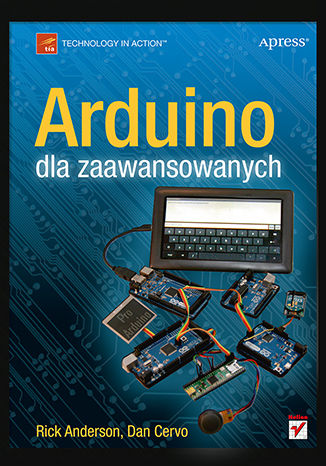
Rick Anderson, Dan Cervo
Platforma Arduino to cudowne dziecko inżynierów, dzięki któremu świat elektroniki zyskał tysiące nowych entuzjastów. Skąd oni się wzięli? Dzięki Arduino nawet kompletny laik może zbudować atrakcyjny układ elektroniczny, który ułatwi mu życie. Jeżeli do tego dołożymy świetną dokumentację oraz środowisko przeznaczone specjalnie do tworzenia oprogramowania, to staje się jasne, dlaczego Arduino jest tak popularne. Na rynku wydawniczym obecnych jest już kilka pozycji poświęconych Arduino, jednak zazwyczaj zawierają one zbiory projektów, które czytelnik może wykonać we własnym zakresie. Tymczasem jeżeli masz ambicję tworzyć nowatorskie rozwiązania, których nie spotkasz w sieci ani w książkach, musisz zdobyć zdecydowanie szerszą wiedzę. Ta książka Ci jej dostarczy. W trakcie lektury dowiesz się, jak wykorzystać sieci radiowe XBee, komunikować się z systemem Android oraz integrować Arduino z niestandardowymi układami, takimi jak Atmel. Ponadto dowiesz się, jak wykorzystać wiele platform Arduino do pracy nad jednym problemem. A potem nauczysz się tworzyć biblioteki dla Arduino i udostępniać je społeczności. W tym tkwi największa siła platformy! Dowiedz się: jak zwiększyć wydajność Arduino jak zbudować sieć sensorową do czego wykorzystać moduły radiowe XBee jak stworzyć grę na Arduino Obowiązkowa lektura dla każdego pasjonata elektroniki!
Arduino for Kids. A cool guide to help kids develop robots and electronics
Priya Kuber, Rishi Gaurav Bhatnagar, Vijay Varada,...
The mission of this book is to integrate technology with the tools that children already use for crafts so that they feel that the technology is an extension of their playtime. We use coding, sensors, and micro-controllers integrated with art and craft supplies, origami, and Playdough. There are 10 fun-filled chapters that talk to children directly, and give clear instructions for non-technical parents too.We use Arduino as the controller of choice due to its easy availability and large community. By the end of the book, children will comfortably be able to set up their Arduino, read and understand code, manipulate code, and ultimately write their own code for projects. They will also be able to use basic sensors and know how components connect to each other. All the learning takes place with lots of colorful pictures and the circuits are neatly presented using wiring.
Arduino Home Automation Projects. Automate your home using the powerful Arduino platform
Marco Schwartz
This book is divided into projects that are explained in a step-by-step format, with practical instructions that are easy to follow. If you want to build your own home automation systems wirelessly using the Arduino platform, this is the book for you. You will need to have some basic experience in Arduino and general programming languages, such as C and C++ to understand the projects in this book.
Muhammad Afzal
The Arduino IoT Cloud offers a variety of features for building modern IoT solutions while reducing time and costs for prototyping and deployment. This book is a step-by-step guide, helping you master the powerful Arduino IoT Cloud ecosystem. This book begins by introducing you to the IoT landscape including its architecture, communication technologies, and protocols and then to the capabilities of the Arduino IoT Cloud platform and the Cloud Editor. With practical projects, such as monitoring air quality, building a portable asset tracker, and creating a remote alarm system using the LoRaWAN specification, you'll learn how to implement real-world IoT applications. Next, you'll explore communication between IoT devices and cloud platforms as well as the implementation of the Arduino IoT Cloud SDK and JavaScript for advanced customization. You'll also find out how to program IoT nodes, analyze the surrounding environment data, and visualize it on dashboards. Additionally, you’ll get to grips with advanced features such as task scheduling, synchronization, remote over-the-air updates for IoT nodes, and scripting with CCLI, through hands-on examples.By the end of this book, you’ll have learned how to work with the Arduino IoT Cloud platform and related hardware devices and will be able to develop industry-specific and cost-effective IoT solutions, such as smart homes and smart agriculture.
Arduino Networking. Connect your projects to the Web using the Arduino Ethernet library
Marco Schwartz
This book is intended for those who want to build their own network-connected projects using the Arduino platform. You will be able to build exciting projects that connect to your local network and the Web. You will need to have some basic experience in electronics and web programming languages. You will also need to know the basics of the Arduino platform as the projects mainly deal with the networking aspects of the Arduino Ethernet shield.
Martin Evans, Joshua Noble, Jordan Hochenbaum
Poznaj możliwości platformy Arduino! Arduino to niesamowita platforma, która otworzyła świat elektroniki przed wszystkimi. Dzięki niej możesz zbudować zaawansowany układ elektroniczny bez konieczności wykonywania czasochłonnych projektów i żmudnych obliczeń. Arduino błyskawicznie zyskało ogromną popularność, a w ślad za nią pojawiły się w sprzedaży liczne dodatkowe moduły. Pozwalają one zbudować dowolne urządzenie — ogranicza Cię tylko Twoja wyobraźnia! Ta wyjątkowa książka została w całości poświęcona platformie Arduino. Znajdziesz tu szczegółowe omówienie możliwości platformy, liczne przykłady oraz opisy. W trakcie lektury dowiesz się, jak przygotować środowisko pracy, oraz rozpoczniesz tworzenie prostych projektów, korzystających z cyfrowych portów wejścia-wyjścia. W kolejnych rozdziałach poznasz coraz bardziej zaawansowane możliwości Arduino. Wykorzystasz silniki prądu stałego i serwomechanizmy, zastosujesz czujniki ultradźwiękowe oraz wyświetlisz informacje na wyświetlaczu LCD. Ponadto przekonasz się, że można zintegrować Arduino z systemem iOS oraz innym oprogramowaniem. Książka ta jest doskonałą lekturą dla wszystkich pasjonatów elektroniki. Dzięki tej książce: poznasz tajniki platformy Arduino wykorzystasz czujniki oraz silniki skomunikujesz się z układem za pomocą sieci odkryjesz dla siebie potencjał drzemiący w tej platformie! Twoja przepustka do świata elektroniki!
Arduino Wearable Projects. Design, code, and build exciting wearable projects using Arduino tools
Tony Effe A Olsson
The demand for smart wearable technologies is becoming more popular day by day. The Arduino platform was developed keeping wearables, such as watches that track your location or shoes that count the miles you've run, in mind. It is basically an open-source physical computing platform based on a simple microcontroller board and a development environment in which you create the software for the board. If you're interested in designing and creating your own wearables, this is an excellent platform for you.This book provides you with the skills and understanding to create your own wearable projects. The book covers different prototyping boards which are compatible with the Arduino platform and are suitable for creating wearable projects. Each chapter of the book covers a project in which knowledge and skills are introduced gradually, making the book suitable for all kinds of readers.You begin your journey with understanding electronic components, including LEDs and sensors, to get yourself up to scratch and comfortable with different components. You will then gain hands-on experience by creating your very first wearable project, a pair of interactive bike gloves that help you cycle at night. This is followed by a project making your own funky LED glasses and a cool GPS watch. You'll also delve into other projects including creating your own keyless doorlock, wearable NFC tags, a fitness-tracking device, and a WiFi-enabled spark board. The final project is a compilation of the previous concepts used where you make your own smart watch with fitness tracking, internet-based notifications, GPS, and of course time telling.
Argo CD in Practice. The GitOps way of managing cloud-native applications
Liviu Costea, Spiros Economakis
GitOps follows the practices of infrastructure as code (IaC), allowing developers to use their day-to-day tools and practices such as source control and pull requests to manage apps. With this book, you’ll understand how to apply GitOps bootstrap clusters in a repeatable manner, build CD pipelines for cloud-native apps running on Kubernetes, and minimize the failure of deployments.You’ll start by installing Argo CD in a cluster, setting up user access using single sign-on, performing declarative configuration changes, and enabling observability and disaster recovery. Once you have a production-ready setup of Argo CD, you’ll explore how CD pipelines can be built using the pull method, how that increases security, and how the reconciliation process occurs when multi-cluster scenarios are involved. Next, you’ll go through the common troubleshooting scenarios, from installation to day-to-day operations, and learn how performance can be improved. Later, you’ll explore the tools that can be used to parse the YAML you write for deploying apps. You can then check if it is valid for new versions of Kubernetes, verify if it has any security or compliance misconfigurations, and that it follows the best practices for cloud-native apps running on Kubernetes.By the end of this book, you’ll be able to build a real-world CD pipeline using Argo CD.
Articulate Studio Cookbook. Go from Studio newbie to Studio guru
Robert Kennedy
More and more companies find they need to build their training courses internally. They are turning to tools like Articulate Studio because it is easy to use and doesn't have a steep learning curve. If you are familiar with Microsoft PowerPoint in any way, you should feel right at home with Articulate Studio.Articulate Studio Cookbook will get you ready to add Articulate Studio to your enterprise toolkit. This book gives you detailed yet simple steps to complete your training course. By following the clear steps in each chapter, you will gain an understanding of the software but also be able to complete specific tasks and common activities.The good thing about this book is that you can start anywhere and get the information that you need for a specific activity. Cross-references are provided if there is a skill located elsewhere that you need to complete a task.It can be frustrating to pick up a new piece of software and not know where to begin. With Articulate Studio, there is a whole suite of software to work with. You need to know how to work with Presenter, Engage, Quizmaker and Encoder to make great Articulate courses. Then, you'll need to know how to put them all together in a way that makes a professional looking, cohesive and smooth-flowing course. We'll make it easy to follow step by step until you have a professional course.Articulate Studio Cookbook will help you go from Studio newbie to Studio guru. Dive in and choose your recipe.
Artificial Intelligence and Expert Systems. Techniques and Applications for Problem Solving
Mercury Learning and Information, I. Gupta, G....
This book covers current AI applications and techniques for solving problems and accomplishing tasks. It introduces branches of AI such as formal logic, reasoning, knowledge engineering, expert systems, neural networks, and fuzzy logic. It emphasizes expert systems, with sections on state space search, knowledge engineering, neural networks, fuzzy logic, and Prolog.It begins with an introduction to AI and its applications, setting the stage for foundational concepts. Readers are guided through state space search and heuristic search strategies, crucial for problem-solving in AI. The focus shifts to expert systems, covering their development life cycle, knowledge acquisition, and representation, providing a deep dive into emulating human decision-making.Later chapters cover neural networks and the learning process, essential for creating adaptive systems. Sections on fuzzy logic and fuzzy systems introduce methods for handling uncertainty in AI. Final chapters on programming in logic and advanced Prolog offer practical techniques for AI solutions. This approach equips readers with the skills to apply AI in various domains, enhancing their problem-solving abilities and understanding of intelligent systems.
Zsolt Nagy
Machine learning and neural networks are pillars on which you can build intelligent applications. Artificial Intelligence and Machine Learning Fundamentals begins by introducing you to Python and discussing AI search algorithms. You will cover in-depth mathematical topics, such as regression and classification, illustrated by Python examples.As you make your way through the book, you will progress to advanced AI techniques and concepts, and work on real-life datasets to form decision trees and clusters. You will be introduced to neural networks, a powerful tool based on Moore's law.By the end of this book, you will be confident when it comes to building your own AI applications with your newly acquired skills!
Artificial Intelligence Basics. A Self-Teaching Introduction
Mercury Learning and Information, N. Gupta, R....
This book is designed as a self-teaching introduction to the fundamental concepts of artificial intelligence (AI). It begins with the history of AI, the Turing test, and early applications, providing a strong foundation. Later chapters cover the basics of searching, game playing, and knowledge representation. The journey continues with detailed explorations of expert systems and machine learning, equipping readers with essential AI techniques.As the course progresses, you will delve into separate programming chapters on Prolog and Python, learning how to implement AI concepts in these languages. These chapters offer practical coding experience, enhancing your understanding of AI programming. The book culminates with a comprehensive chapter on AI machines and robotics, showcasing numerous modern applications and providing a glimpse into the future of AI technology.Understanding these AI concepts is crucial as they form the basis of many modern technologies and applications. This book ensures a smooth transition from a beginner to a proficient AI practitioner, equipped with both theoretical knowledge and practical skills. By the end of the book, you will have a thorough understanding of AI's history, core principles, and practical implementations, ready to apply this knowledge to real-world problems and projects.
Denis Rothman, Nicolas GUET, Jérémie ROTHMAN
Artificial intelligence has the potential to replicate humans in every field. Artificial Intelligence By Example serves as a starting point for you to understand how AI is built, with the help of intriguing examples and case studies.Artificial Intelligence By Example will make you an adaptive thinker and help you apply concepts to real-life scenarios. Using some of the most interesting AI examples, right from a simple chess engine to a cognitive chatbot, you will learn how to tackle the machine you are competing with. You will study some of the most advanced machine learning models, understand how to apply AI to blockchain and IoT, and develop emotional quotient in chatbots using neural networks.You will move on to designing AI solutions in a simple manner rather than get confused by complex architectures and techniques. This comprehensive guide will be a starter kit for you to develop AI applications on your own.By the end of this book, you will have understood the fundamentals of AI and worked through a number of case studies that will help you develop your business vision.
Artificial Intelligence Engines. A Tutorial Introduction to the Mathematics of Deep Learning
James V Stone
This book is a comprehensive guide to the mathematics behind artificial intelligence engines, taking readers from foundational concepts to advanced applications. It begins with an introduction to artificial neural networks, exploring topics like perceptrons, linear associative networks, and gradient descent. Practical examples accompany each chapter, making complex mathematical principles accessible, even for those with limited prior knowledge.The book's detailed structure covers key algorithms like backpropagation, Hopfield networks, and Boltzmann machines, advancing to deep restricted Boltzmann machines, variational autoencoders, and convolutional neural networks. Modern topics such as generative adversarial networks, reinforcement learning, and capsule networks are explored in depth. Each section connects theory to real-world AI applications, helping readers understand how these techniques are used in practice.Ideal for students, researchers, and AI enthusiasts, the book balances theoretical depth with practical insights. Basic mathematical knowledge or foundation is recommended, allowing readers to fully engage with the content. This book serves as an accessible yet thorough resource for anyone eager to dive deeper into artificial intelligence and machine learning.
Artificial Intelligence. Ethical, social, and security impacts for the present and the future
IT Governance Publishing, Dr. Julie E. Mehan
This book offers an in-depth exploration of Artificial Intelligence (AI), from its origins to the ethical and societal challenges it presents today. It provides a comprehensive understanding of AI’s impact on human interaction, collaboration, privacy, and security. Through analyzing both opportunities and risks, the book emphasizes the ethical concerns surrounding AI, such as bias, privacy violations, and security threats.Chapters explore AI’s transformative role in cybersecurity, misinformation, and human-machine collaboration, highlighting its implications for job markets and human relationships. Real-world examples illustrate how AI can drive progress or cause harm. The ethical dilemmas around AI, including its use in surveillance and decision-making, are thoroughly examined, presenting challenges central to modern technology.Looking ahead, the book offers a forward-thinking perspective on AI’s future, discussing emerging trends and the need for responsible policy-making. It concludes by addressing how society can prepare for AI’s continued growth, offering strategies for navigating the evolving landscape. With practical insights and deep analysis, this book helps readers grasp AI’s profound implications for our future.
Anand Deshpande, Manish Kumar, Albenzo Coletta, Giancarlo...
In this age of big data, companies have larger amount of consumer data than ever before, far more than what the current technologies can ever hope to keep up with. However, Artificial Intelligence closes the gap by moving past human limitations in order to analyze data.With the help of Artificial Intelligence for big data, you will learn to use Machine Learning algorithms such as k-means, SVM, RBF, and regression to perform advanced data analysis. You will understand the current status of Machine and Deep Learning techniques to work on Genetic and Neuro-Fuzzy algorithms. In addition, you will explore how to develop Artificial Intelligence algorithms to learn from data, why they are necessary, and how they can help solve real-world problems.By the end of this book, you'll have learned how to implement various Artificial Intelligence algorithms for your big data systems and integrate them into your product offerings such as reinforcement learning, natural language processing, image recognition, genetic algorithms, and fuzzy logic systems.