
Informatyka
R Deep Learning Cookbook. Solve complex neural net problems with TensorFlow, H2O and MXNet
PKS Prakash, Achyutuni Sri Krishna Rao
Deep Learning is the next big thing. It is a part of machine learning. It's favorable results in applications with huge and complex data is remarkable. Simultaneously, R programming language is very popular amongst the data miners and statisticians. This book will help you to get through the problems that you face during the execution of different tasks and Understand hacks in deep learning, neural networks, and advanced machine learning techniques. It will also take you through complex deep learning algorithms and various deep learning packages and libraries in R. It will be starting with different packages in Deep Learning to neural networks and structures. You will also encounter the applications in text mining and processing along with a comparison between CPU and GPU performance.By the end of the book, you will have a logical understanding of Deep learning and different deep learning packages to have the most appropriate solutions for your problems.
Aloysius Shao Qin Lim, Tjhi W Chandra
This book is for programmers and developers who want to improve the performance of their R programs by making them run faster with large data sets or who are trying to solve a pesky performance problem.
Dr. Sunil Kumar Chinnamgari
R is one of the most popular languages when it comes to performing computational statistics (statistical computing) easily and exploring the mathematical side of machine learning. With this book, you will leverage the R ecosystem to build efficient machine learning applications that carry out intelligent tasks within your organization.This book will help you test your knowledge and skills, guiding you on how to build easily through to complex machine learning projects. You will first learn how to build powerful machine learning models with ensembles to predict employee attrition. Next, you’ll implement a joke recommendation engine and learn how to perform sentiment analysis on Amazon reviews. You’ll also explore different clustering techniques to segment customers using wholesale data. In addition to this, the book will get you acquainted with credit card fraud detection using autoencoders, and reinforcement learning to make predictions and win on a casino slot machine.By the end of the book, you will be equipped to confidently perform complex tasks to build research and commercial projects for automated operations.
Kelly Black
This book is designed for people with some experience in basic programming practices. It is also assumed that they have some basic experience using R and are familiar using the command line in an R environment. Our primary goal is to raise a beginner to a more advanced level to make him/her more comfortable creating programs and extending R to solve common problems.
R: Predictive Analysis. Master the art of predictive modeling
Tony Fischetti, Eric Mayor
Predictive analytics is a field that uses data to build models that predict a future outcome of interest. It can be applied to a range of business strategies and has been a key player in search advertising and recommendation engines.The power and domain-specificity of R allows the user to express complex analytics easily, quickly, and succinctly. R offers a free and open source environment that is perfect for both learning and deploying predictive modeling solutions in the real world. This Learning Path will provide you with all the steps you need to master the art of predictive modeling with R. We start with an introduction to data analysis with R, and then gradually you’ll get your feet wet with predictive modeling. You will get to grips with the fundamentals of applied statistics and build on this knowledge to perform sophisticated and powerful analytics. You will be able to solve the difficulties relating to performing data analysis in practice and find solutions to working with “messy data”, large data, communicating results, and facilitating reproducibility. You will then perform key predictive analytics tasks using R, such as train and test predictive models for classification and regression tasks, score new data sets and so on. By the end of this Learning Path, you will have explored and tested the most popular modeling techniques in use on real-world data sets and mastered a diverse range of techniques in predictive analytics.This Learning Path combines some of the best that Packt has to offer in one complete, curated package. It includes content from the following Packt products:• Data Analysis with R, Tony Fischetti• Learning Predictive Analytics with R, Eric Mayor• Mastering Predictive Analytics with R, Rui Miguel Forte
R Programming By Example. Practical, hands-on projects to help you get started with R
Omar Trejo Navarro
R is a high-level statistical language and is widely used among statisticians and data miners to develop analytical applications. Often, data analysis people with great analytical skills lack solid programming knowledge and are unfamiliar with the correct ways to use R. Based on the version 3.4, this book will help you develop strong fundamentals when working with R by taking you through a series of full representative examples, giving you a holistic view of R.We begin with the basic installation and configuration of the R environment. As you progress through the exercises, you'll become thoroughly acquainted with R's features and its packages. With this book, you will learn about the basic concepts of R programming, work efficiently with graphs, create publication-ready and interactive 3D graphs, and gain a better understanding of the data at hand. The detailed step-by-step instructions will enable you to get a clean set of data, produce good visualizations, and create reports for the results. It also teaches you various methods to perform code profiling and performance enhancement with good programming practices, delegation, and parallelization.By the end of this book, you will know how to efficiently work with data, create quality visualizations and reports, and develop code that is modular, expressive, and maintainable.
Yu-Wei, Chiu (David Chiu), Atmajitsinh Gohil, Shanthi...
The R language is a powerful, open source, functional programming language. At its core, R is a statistical programming language that provides impressive tools to analyze data and create high-level graphics. This Learning Path is chock-full of recipes. Literally! It aims to excite you with awesome projects focused on analysis, visualization, and machine learning. We’ll start off with data analysis – this will show you ways to use R to generate professional analysis reports. We’ll then move on to visualizing our data – this provides you with all the guidance needed to get comfortable with data visualization with R. Finally, we’ll move into the world of machine learning – this introduces you to data classification, regression, clustering, association rule mining, and dimension reduction.This Learning Path combines some of the best that Packt has to offer in one complete, curated package. It includes content from the following Packt products:• R Data Analysis Cookbook by Viswa Viswanathan and Shanthi Viswanathan• R Data Visualization Cookbook by Atmajitsinh Gohil• Machine Learning with R Cookbook by Yu-Wei, Chiu (David Chiu)
R Web Scraping Quick Start Guide. Techniques and tools to crawl and scrape data from websites
Olgun Aydin
Web scraping is a technique to extract data from websites. It simulates the behavior of a website user to turn the website itself into a web service to retrieve or introduce new data. This book gives you all you need to get started with scraping web pages using R programming.You will learn about the rules of RegEx and Xpath, key components for scraping website data. We will show you web scraping techniques, methodologies, and frameworks. With this book's guidance, you will become comfortable with the tools to write and test RegEx and XPath rules. We will focus on examples of dynamic websites for scraping data and how to implement the techniques learned. You will learn how to collect URLs and then create XPath rules for your first web scraping script using rvest library. From the data you collect, you will be able to calculate the statistics and create R plots to visualize them. Finally, you will discover how to use Selenium drivers with R for more sophisticated scraping. You will create AWS instances and use R to connect a PostgreSQL database hosted on AWS. By the end of the book, you will be sufficiently confident to create end-to-end web scraping systems using R.
David Dossot
This book is a quick and concise introduction to RabbitMQ. Follow the unique case study of Clever Coney Media as they progressively discover how to fully utilize RabbitMQ, containing clever examples and detailed explanations. Whether you are someone who develops enterprise messaging products professionally or a hobbyist who is already familiar with open source Message Queuing software and you are looking for a new challenge, then this is the book for you. Although you should be familiar with Java, Ruby, and Python to get the most out of the examples, RabbitMQ Essentials will give you the push you need to get started that no other RabbitMQ tutorial can provide you with.
Rachunek macierzowy. Podręcznik dla studentów studiów licencjackich i inżynierskich
Marta Jarocka, Justyna Kozłowska, Beata Madras-Kobus, Anna...
Niniejszy podręcznik powstał z myślą o studentach Wydziału Inżynierii Zarządzania Politechniki Białostockiej kształcących się na kierunkach: logistyka, zarządzanie, zarządzanie i inżynieria produkcji, zarządzanie i inżynieria usług oraz inżynieria meblarstwa. Może on również służyć innym młodym adeptom matematyki – studentom studiów licencjackich i inżynierskich, którzy poznają tajniki rachunku macierzowego. Książka zawiera bowiem podstawowe treści, które są zgodne z obowiązującym programem przedmiotu matematyka na wielu kierunkach studiów.
Beata Madras-Kobus, Marta Jarocka, Anna Małgorzata Olszewska
Pojęcie funkcji znane jest z nauki matematyki w szkole. Ale czy potrafimy obliczyć pochodne funkcji jednej zmiennej? Czy wiemy jak wykorzystać pochodne do badania przebiegu zmienności i narysowania wykresu funkcji? Jakie zastosowania mają pochodne w naukach ekonomicznych czy w fizyce? Odpowiedzi na te i wiele innych pytań dotyczących rachunku różniczkowego funkcji jednej zmiennej można znaleźć w podręczniku napisanym przez wykładowców z Międzynarodowej Katedry Logistyki i Inżynierii Usług Wydziału Inżynierii Zarządzania - dr Beatę Madras-Kobus, dr Martę Jarocką, prof. PB oraz dr inż. Annę M. Olszewską, prof. PB zatytułowanym Rachunek różniczkowy funkcji jednej zmiennej. Podręcznik dla studentów studiów licencjackich i inżynierskich. Podręcznik powstał z myślą o studentach Wydziału Inżynierii Zarządzania Politechniki Białostockiej kształcących się na kierunkach: logistyka, zarządzanie, zarządzanie i inżynieria produkcji, zarządzanie i inżynieria usług oraz zarządzanie finansami i rachunkowość.
Jia Huang
Most developers can spin up a RAG pipeline in an afternoon using LangChain or LlamaIndex. Far fewer understand why retrieval fails or how to fix it. This book is for those who want to go deeper.'RAG From First Principles' dismantles the retrieval-augmented generation stack layer by layer, how documents are ingested and parsed, why chunking strategy directly impacts answer quality, how embedding models encode meaning, what happens inside a vector database, and how sparse and dense retrieval interact in a hybrid system. Written by Jia Huang, a research engineer and bestselling AI author, it brings research depth and production experience to one of AI's most critical engineering disciplines.Structured as a progressive dialogue between a seasoned engineer and two students, the book surfaces the questions practitioners actually ask. Each chapter builds on the last, from data import and chunking through embedding selection, index design, hybrid search, and post-retrieval processing, into response generation, evaluation, and advanced paradigms including GraphRAG, Agentic RAG, and Modular RAG.By the end, you'll have the architectural understanding to optimize, debug, and extend your RAG systems with confidence.
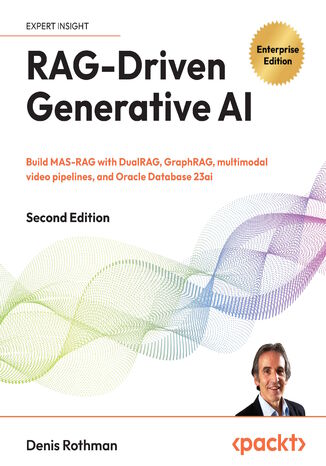
Denis Rothman
Stop moving your data to the AI. This second edition defines a revolutionary architectural shift: bringing the AI to the data. By using Oracle Database 23ai as a converged engine in this book, you will architect Sovereign AI systems that eliminate the fragmentation, latency, and massive security risks inherent in traditional data extraction.You’ll work with DualRAG, synchronizing unstructured vector semantics with the deterministic truth of structured SQL, Graph, and Spatial retrieval. This allows your systems to reason over verified corporate data rather than probabilistic guesses, reducing hallucinations at the source. Moving beyond simple pipelines, you’ll also build MAS-RAG (multi-agent systems for RAG), where autonomous agents coordinate across hybrid retrieval workflows, multimodal video pipelines, and graph-based knowledge structures.Designed for developers and architects, these blueprints transform disconnected data silos into a unified engine to architect autonomous enterprise intelligence that scales with RLHF and model fine-tuning. By the end of the book, you’ll be able to design and deploy enterprise AI systems that combine retrieval, reasoning, and structured data to build reliable generative AI applications.*Email sign-up and proof of purchase required
Eric Berry
Cała wiedza o Rails, której potrzebujesz! Jak zainstalować i skonfigurować Rails? Jak wykorzystać możliwości technologii ActiveRecord? Jak stworzyć dynamiczną aplikację, korzystając z technologii AJAX? Ruby on Rails przebojem wdarł się na rynek szkieletów aplikacji internetowych. Stworzony w architekturze MVC, został niezmiernie dobrze przyjęty przez programistów z całego świata. Niewątpliwie wpływ na ten fakt miały założenia poczynione przez autora projektu - łatwość i przyjemność tworzenia kodu. Powszechnie wiadomo, że te atuty mają niebagatelny wpływ na szybkość tworzenia aplikacji internetowych. Dzięki popularności Ruby on Rails również znajomość języka Ruby, pochodzącego przecież z Dalekiego Wschodu, staje się powszechniejsza. W tej niezwykłej książce znajdziesz odpowiedzi na wszystkie pytania, które mogą pojawić się w trakcie kodowania nowej aplikacji. Dowiesz się, jak skonfigurować Rails, testować napisany kod, wykorzystać technologię ActiveRecord oraz przygotować widoki. Ponadto zdobędziesz wiedzę na temat używania technologii AJAX i REST, nauczysz się wykorzystywać usługi sieciowe oraz logować ważne informacje w trakcie pracy Twojej aplikacji. Z wiedzy tu zawartej możesz skorzystać szybko i w każdej chwili, a co najważniejsze, nie będziesz musiał przedzierać się przez setki niepotrzebnych stron. Tu znajdziesz tylko wiedzę niezbędną w Twojej pracy! Instalacja Rails Struktura plików Konfiguracja Rails Wykorzystanie skryptów Konfiguracja środowiska Sposoby przeprowadzania testów w Rails Używanie technologii ActiveRecord Zarządzanie danymi w bazie Zastosowanie ActionController Tworzenie widoków Sposoby użycia technologii AJAX i REST w Rails Wykorzystanie usług sieciowych Logowanie informacji w trakcie pracy aplikacji Stosowanie metod pomocniczych Wykorzystaj Rails w Twoim projekcie szybko i przyjemnie!
Rails. Projektowanie systemów klasy enterprise
Dan Chak
Poznaj najbardziej zaawansowane tajniki Rails! Jak zorganizować kod, wykorzystując system wtyczek lub moduły? Jakie zalety posiada architektura SOA? Jak zwiększyć wydajność Rails? Rynek szkieletów aplikacji internetowych jest niezwykle urozmaicony. Wśród wielu dostępnych opcji można znaleźć tu rozwiązania przeznaczone dla projektów o różnej skali złożoności, zarówno te mniej, jak i bardziej popularne. Warto jednak sięgnąć po rozwiązanie absolutnie unikatowe i wyjątkowe — Rails. Szkielet ten świetnie sprawdza się zarówno w projektach małych, jak i tych klasy enterprise, a ponadto znany jest ze swoich możliwości, wydajności oraz elastyczności. Warto także podkreślić, że w pakiecie razem z nim dostaniemy liczną, chętną do pomocy społeczność użytkowników! Autor książki porusza interesujące kwestie związane z budową zaawansowanych systemów informatycznych opartych o Rails. W trakcie lektury dowiesz się, jak wykorzystać system wtyczek jako środek organizujący Twój kod oraz jak w tej roli sprawdzą się moduły. Kolejne rozdziały przyniosą solidny zastrzyk wiedzy na temat tworzenia rozbudowanego i bezpiecznego modelu danych, dziedziczenia wielotabelarycznego oraz wykorzystania wyzwalaczy jako narzędzia kontroli skomplikowanych zależności w danych. Dan Chak duży nacisk kładzie na zagadnienia związane z SOA (skrót od ang. Service Oriented Architecture) oraz wydajnością. Jest to genialna pozycja dla wszystkich programistów i projektantów uczestniczących w projekcie wytwarzanym z wykorzystaniem Rails. Komponenty aplikacji Organizacja kodu z wykorzystaniem wtyczek Rola modułów w porządkowaniu kodu Budowa solidnego modelu danych Normalizacja modelu Obsługa danych dziedzinowych Wykorzystanie wyzwalaczy w celu kontroli zależności w danych Dziedziczenie jedno- i wielotabelaryczne Zastosowanie modeli widokowych Architektura SOA Dostarczanie usług typu XML-RPC Usługi typu REST Zwiększenie wydajności Rails Obowiązkowa pozycja dla wszystkich programistów i projektantów korzystających z Rails!
Rob Orsini
Zbiór gotowych rozwiązań dla twórców aplikacji internetowych Instalacja i uruchomienie środowiska Rails Przetwarzanie grafiki Korzystanie z technologii AJAX Dynamiczny rozwój sieci sprawia, że tradycyjne programy są stopniowo wypierane przez aplikacje sieciowe dostępne z poziomu przeglądarki internetowej -- wygodne, niezależne od systemu operacyjnego i łatwe w aktualizowaniu. Nadal jednak kluczowe znaczenie ma szybkość ich przygotowywania i modyfikowania. Dzięki zbiorom bibliotek zwanym "frameworks" proces tworzenia takich produktów znacznie się skrócił -- umożliwia to programistom skoncentrowanie się na faktycznej funkcjonalności tworzonego narzędzia, ponieważ biblioteki te przejmują wiele typowych i wspólnych dla wszystkich aplikacji zadań. Wśród dostępnych w sieci narzędzi tego typu coraz większą popularność zyskuje Ruby on Rails, powoli stający się "ikoną" nurtu Web 2.0. Tworzone za jego pomocą systemy są zwarte i łatwe do skalowania, a ich kod źródłowy jest przejrzysty i czytelny. "Rails. Receptury" to zestaw porad i rozwiązań problemów, przed którymi stają programiści stosujący ten zbiór bibliotek w swojej pracy. Omówione tu zagadnienia przydadzą się zarówno początkującym, jak i doświadczonym twórcom aplikacji sieciowych. Przeczytasz tu o instalowaniu, konfigurowaniu i uruchamianiu środowiska Rails, połączeniach z bazami danych za pomocą ActiveRecord, generowaniu kodu HTML, zabezpieczaniu programów i tworzeniu kontrolerów odpowiadających za funkcjonalność systemu. Dowiesz się, jak wdrażać aplikacje Rails i korzystać w nich z możliwości oferowanych przez mechanizmy AJAX. Instalacja i uruchomienie środowiska Komunikacja z bazami danych Wyświetlanie danych w przeglądarce Wykorzystywanie szablonów RHTML Generowanie kodu XML i RSS Przetwarzanie danych z formularzy Personalizacja narzędzi Korzystanie z JavaScript i AJAX Zabezpieczanie aplikacji Rails Optymalizacja aplikacji Wdrażanie i utrzymywanie systemów na serwerach Przetwarzanie obrazów Skorzystaj ze sprawdzonych receptur i dołącz do twórców Web 2.0!